
A Quick Guide to Understanding the Relationship and Differences Between Liquidity and Market Depth
In the cryptocurrency asset market, liquidity and market depth are two key but distinct concepts. Understanding their relationship and differences helps investors and traders formulate more effective trading strategies.
1. Definition of Liquidity
Liquidity refers to the ability of an asset to be quickly bought and sold in the market at a stable price. A highly liquid market typically has active trading, a sufficient number of buyers and sellers, fast transaction execution, and minimal price fluctuations.
2. Definition of Market Depth
Market depth measures the number and size of buy and sell orders accumulated at different price levels. It reflects the market's ability to absorb large transactions within a certain price range without causing significant price fluctuations.
3. Relationship
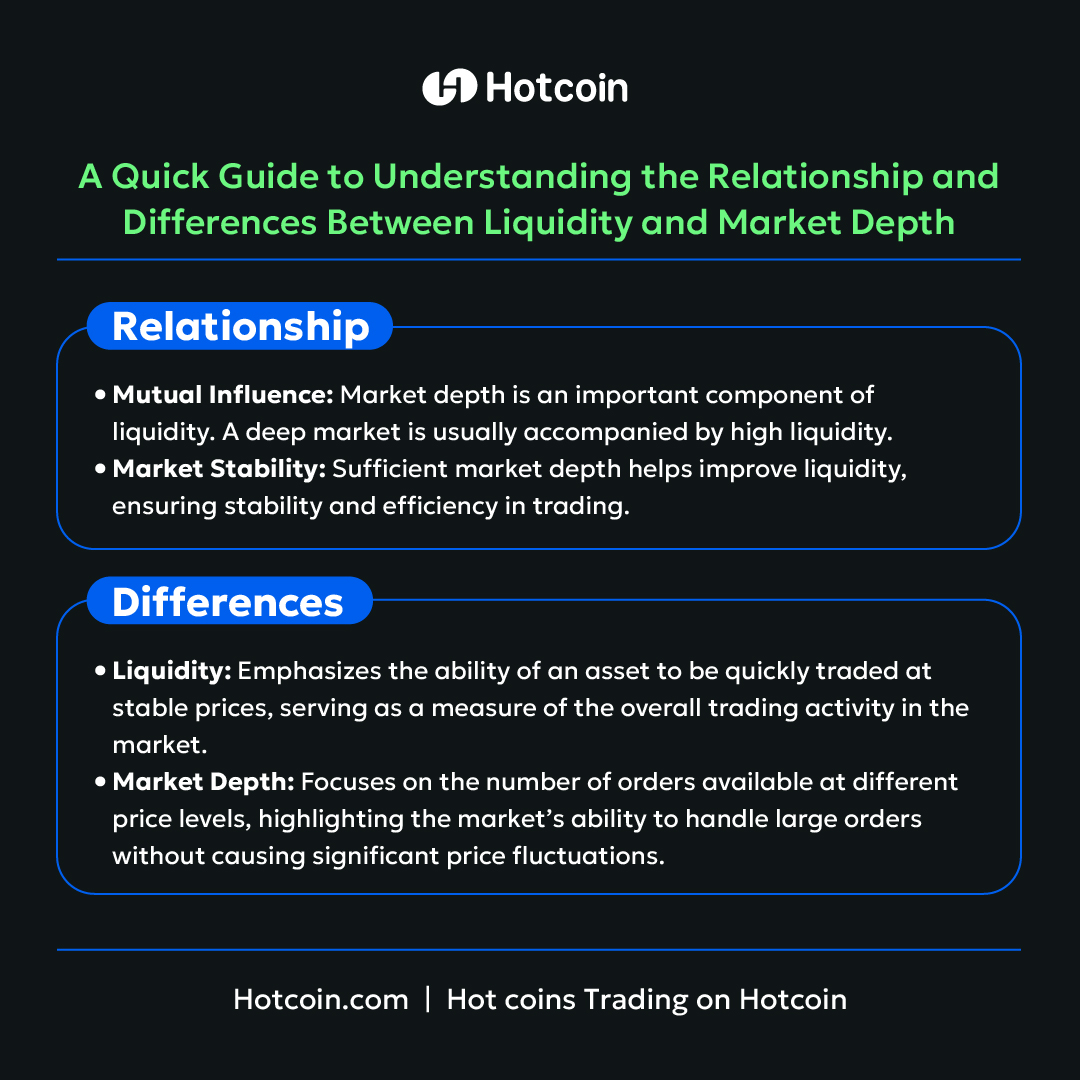
Mutual Influence: Market depth is an important component of liquidity. A deep market is usually accompanied by high liquidity, allowing traders to execute large orders close to the expected price, reducing slippage risk.
Market Stability: Sufficient market depth helps improve liquidity, ensuring stability and efficiency in trading.
4. Differences
Liquidity: Emphasizes the ability of an asset to be quickly traded at stable prices, serving as a measure of the overall trading activity in the market.
Market Depth: Focuses on the number of orders available at different price levels, highlighting the market’s ability to handle large orders without causing significant price fluctuations.
5. Possible Combinations
High Liquidity, Low Depth: The market has active trading, but the number of orders at specific price points is limited, meaning large trades may cause significant price fluctuations.
Low Liquidity, High Depth: The overall market activity is low, but there are large order volumes at certain price levels, allowing the market to absorb sizable trades without causing drastic price movements.
In conclusion, liquidity and market depth are key indicators for assessing the state of the cryptocurrency market. Understanding their relationship and differences helps traders develop more effective strategies, optimize trade execution, reduce risk, and achieve investment goals.
読書をお勧めします
もっと見る



Service@hotcoin.com
Product@hotcoin.com
Business@hotcoin.com
Casecn@hotcoin.com