What is Avalanche (AVAX) and How to Buy It?
Avalanche is a high-performance Layer 1 blockchain that focuses on a "Subnet" architecture: projects can launch their own chains while sharing Avalanche's security and interoperability.
AVAX is the network's native token, used for paying gas, staking, and governance. Its narrative has shifted from an "Ethereum killer" to an "institutional and gaming subnet platform."
Key Takeaways
• Avalanche is a Layer 1 public chain that uses subnets to let projects customize their own execution environments.
• The C-Chain is EVM-compatible and serves as the main gateway for DeFi and NFTs.
• AVAX is used for gas, staking, and governance, with a maximum supply of 720 million tokens.
• Risks include public chain competition, subnet adoption, token unlocks, and ecosystem concentration.
What is Avalanche?
Avalanche's consensus mechanism groups validators, allowing multiple chains to process transactions in parallel. Developers can create subnets, customizing virtual machines, fees, and permissions, while communicating with other subnets through Avalanche Warp Messaging.
The C-Chain is the most commonly used EVM-compatible chain, hosting most DeFi and NFT applications. Subnets, on the other hand, attract gaming, institutional, and enterprise scenarios, such as dedicated chains and compliant environments.
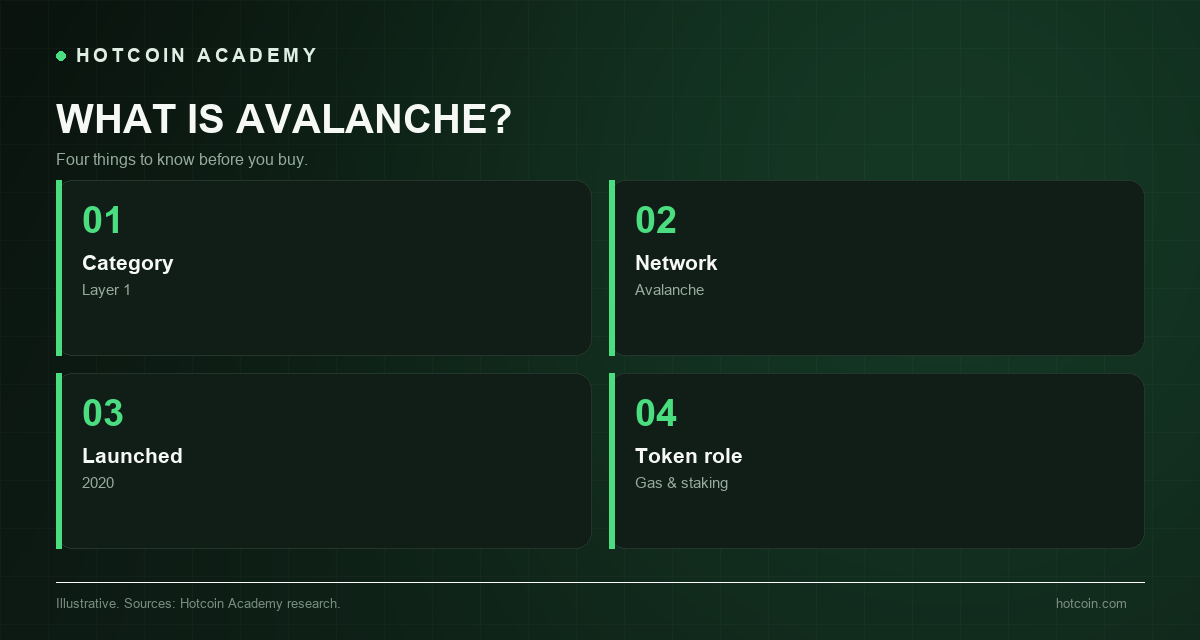
AVAX is used to pay gas on the C-Chain, staked to maintain security, and used for governance. The token has a maximum supply of 720 million, with approximately 446 million currently in circulation.
How Does Avalanche Work?
Avalanche's operation can be broken down into three parts:
• Usage: Use EVM applications on the C-Chain and pay gas with AVAX.
• Subnets: Projects can launch their own chains with custom rules and fees.
• Staking: Stake AVAX to participate in validation and governance.
AVAX Tokenomics
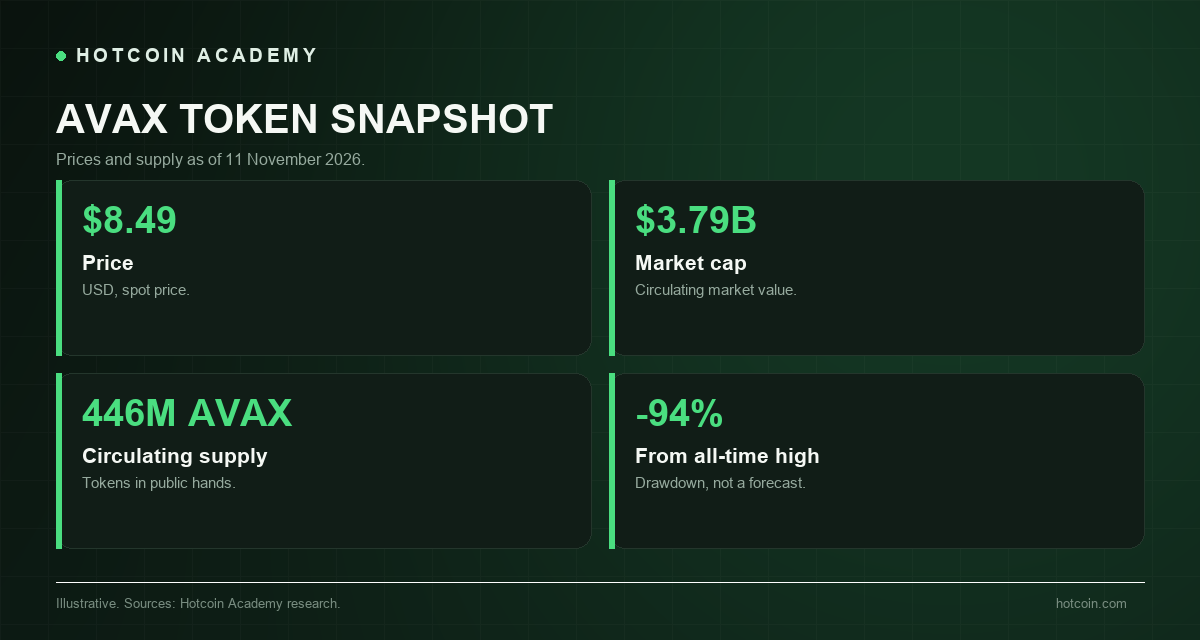
AVAX is Avalanche's native token, used for gas, staking, and governance. The maximum supply is 720 million, with about 446 million in circulation; future releases will affect supply and demand.
| Item | Data |
|---|---|
| Token Name | Avalanche (AVAX) |
| Max Supply | 720 million |
| Circulating Supply | ~446 million |
| Market Cap | ~$3.79 billion |
| Current Price | ~$8.49 |
| Drawdown from ATH | ~-94% |
Data from CoinGecko as of November 11, 2026; supply data is subject to official sources.
Avalanche in 2026: Status and Risks
In 2026, Avalanche is focusing on subnets, institutional partnerships, and RWA. The subnet model suits scenarios requiring customization and compliance, but it also brings liquidity fragmentation: each subnet can potentially weaken the depth of the main chain.
AVAX is down about 94% from its peak, with a market cap of around $3.79 billion. Competition among public chains is fierce, and Avalanche needs to prove that subnets are not just "tech demos" but can bring real users and fees.
• Public chain competition: Ethereum L2s, Solana, and Sui are competing for developers.
• Subnet liquidity fragmentation: Crossing subnets adds friction for assets.
• Token releases: Uncirculated AVAX creates selling pressure.
• Ecosystem concentration: DeFi activity is concentrated in a few protocols.
How to Buy AVAX?
If you already understand Avalanche's mechanics and risks and decide to participate with a small amount, you can follow these steps to buy AVAX on Hotcoin.
• Registration & KYC: Complete Hotcoin account registration and identity verification.
• Deposit: Deposit USDT or use a supported fiat on-ramp.
• Search for the trading pair: Search for AVAX/USDT in the spot market.
• Place an order: Choose a market or limit order, confirm fees and slippage, and buy.
• Withdraw: For long-term holding, it is recommended to withdraw to a self-custody wallet and verify the contract address.
Common Misconceptions
• Treating the number of subnets as a metric of ecosystem success.
• Ignoring AVAX unlocks and changes in staking yields.
• Treating "high performance" as a guarantee of adoption.
FAQ
What is Avalanche? Avalanche is a Layer 1 public chain that supports an EVM-compatible C-Chain and customizable subnets.
What is AVAX used for? It is used to pay gas, stake to maintain network security, and participate in governance.
What is a subnet? A subnet is an independent chain built by a project based on Avalanche technology, allowing custom virtual machines, fees, and permissions while sharing Avalanche's interoperability.
Why has AVAX fallen so much? Public chain competition, token releases, and a broader market pullback have combined to push AVAX down about 94% from its all-time high.
Conclusion
Avalanche's technical roadmap is clear: using subnets to turn a "public chain" into a "chain factory." But whether the chain factory can make money depends on whether projects are willing to stay on it long-term.
For AVAX holders, the real activity and fees on subnets are more important than partnership announcements.
Risk warning: This article is for educational and informational purposes only and does not constitute investment advice. Crypto assets are highly volatile, and liquidity risks for new coins and small-cap tokens are higher; investors may lose their entire principal. Please do your own research and manage your position size.
Lettura consigliata
Visualizza altro