What Is Arbitrum (ARB) and How to Buy It?
Arbitrum is one of the largest Optimistic Rollups on Ethereum. It executes transactions off-chain and submits them to Ethereum in batches, reducing fees and increasing throughput while inheriting Ethereum's security.
ARB is Arbitrum's governance token, distributed via airdrop in 2023. It is not used to pay gas—gas is still paid in Ethereum's ETH; ARB's value mainly comes from governance and ecosystem incentives.
Key Takeaways
- Arbitrum is an Ethereum L2 that scales with Optimistic Rollup, focusing on low fees and EVM compatibility.
- Its ecosystem includes Arbitrum One, Nova, and Orbit chains, covering DeFi, gaming, and infrastructure.
- ARB is used for governance and ecosystem incentives, with a total supply of 10 billion and about 6.89 billion in circulation.
- Risks include L2 competition, token unlocks, reliance on ecosystem incentives, and governance fragmentation.
What Is Arbitrum?
Optimistic Rollup follows a "trust first, verify later" approach: transactions are executed off-chain, results are submitted to Ethereum, and if someone finds an error, they can submit a fraud proof during the challenge period. This makes it cheap without sacrificing too much security.
Arbitrum's ecosystem covers DeFi, perpetual contracts, gaming, and RWA, and it is one of the Ethereum L2 networks with the highest TVL. Orbit allows projects to launch their own chains based on the Arbitrum tech stack.
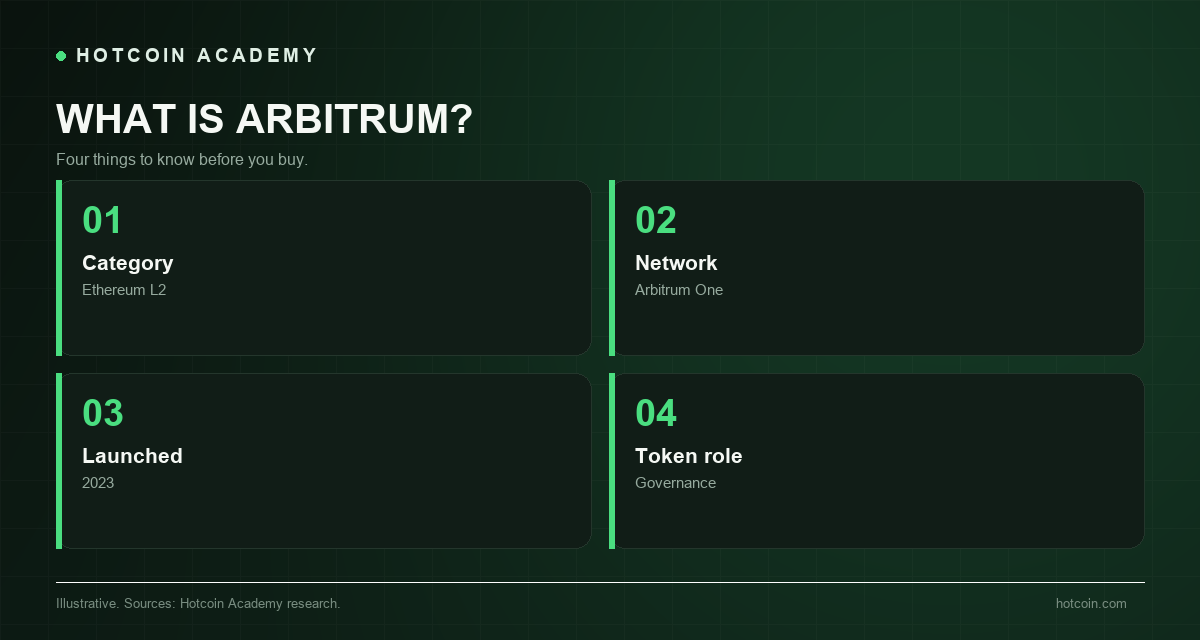
Figure: Four basic facts about Arbitrum.
ARB holders can participate in governance, deciding on ecosystem funds, protocol upgrades, and incentive directions. The token itself does not generate cash flow; its value depends on ecosystem scale and governance influence.
How Does Arbitrum Work?
Arbitrum's operation can be broken down into three parts:
- Transactions: Bridge assets to Arbitrum One and use DeFi applications on L2.
- Governance: Stake or delegate ARB to participate in proposal voting.
- Ecosystem: Projects can build their own chains through Orbit and share Arbitrum technology.
ARB Tokenomics
ARB has a total supply of 10 billion, with about 6.89 billion in circulation. The token is mainly used for governance and ecosystem incentives, and future unlocks will still affect supply and demand.
| Item | Data |
|---|---|
| Token name | Arbitrum (ARB) |
| Total supply | 10 billion tokens |
| Circulating supply | About 6.89 billion tokens |
| Market cap | About US$1.15 billion |
| Current price | About US$0.167 |
| Drawdown from all-time high | About -93% |
Data from CoinGecko, November 11, 2026; unlock schedules are subject to official announcements.
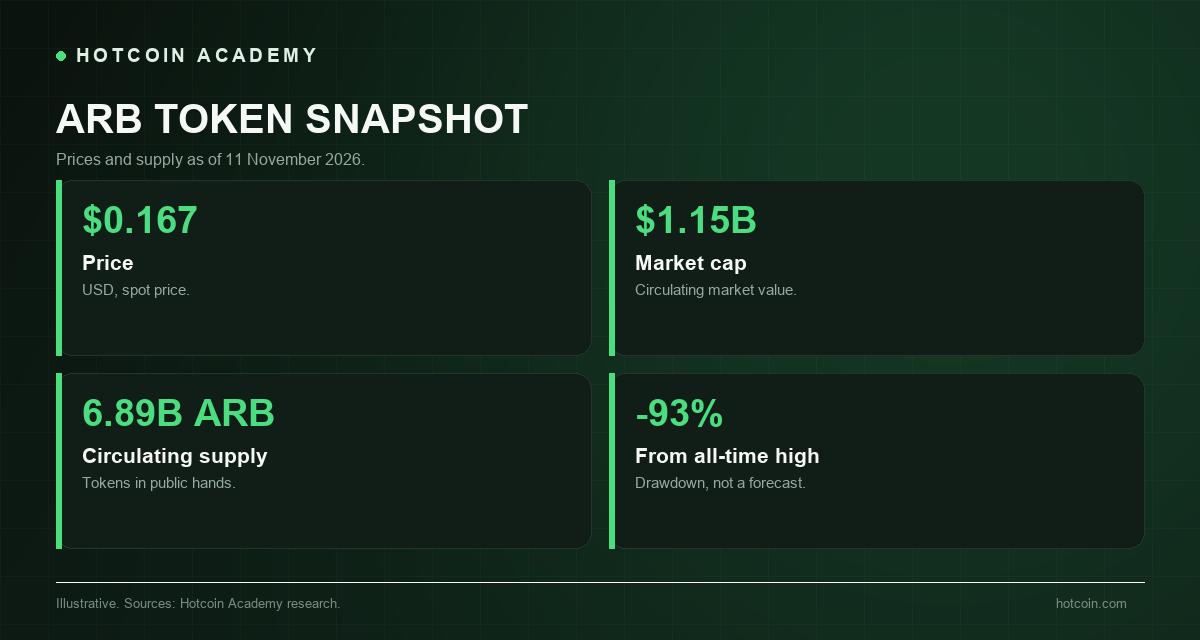
Figure: ARB market data snapshot (November 11, 2026).
Arbitrum in 2026: Current State and Risks
In 2026, L2 competition has entered a "stock game": Base, Optimism, zkSync, and emerging L2s are all competing for users and liquidity. Arbitrum's advantage is its mature ecosystem and large developer base; its challenge is token price and incentive efficiency.
ARB is down about 93% from its high, with a market cap of about US$1.15 billion. Value capture for governance tokens has always been a challenge for L2s: the more successful the network, the cheaper the gas, but the token does not necessarily benefit.
- L2 competition: Users and liquidity are diverted to other Rollups.
- Token unlocks: Uncirculated tokens will create selling pressure.
- Weak value capture: ARB does not directly share sequencer revenue.
- Governance complexity: The allocation of ecosystem funds and incentives can easily spark controversy.
How to Buy ARB?
If you already understand Arbitrum's mechanics and risks and decide to participate with a small amount, you can follow these steps to buy ARB on Hotcoin.
- Registration and KYC: Complete Hotcoin account registration and identity verification.
- Deposit: Deposit USDT, or use a supported fiat on-ramp.
- Search for the trading pair: Search for ARB/USDT in the spot section.
- Place an order: Choose a market or limit order, confirm fees and slippage, and buy.
- Withdraw: For long-term holding, it is recommended to withdraw to a self-custody wallet and verify the contract address.
Common Misconceptions
- Equating L2 usage growth with ARB price increases.
- Ignoring selling pressure from unlocks and ecosystem funds.
- Treating ARB as "Ethereum beta" and ignoring competition among L2s.
FAQ
What is Arbitrum? Arbitrum is an Optimistic Rollup L2 on Ethereum that reduces fees and increases throughput through off-chain execution and on-chain settlement.
What is ARB used for? ARB is used for governance and ecosystem incentives, not for paying gas; gas is still priced in ETH.
What is the relationship between Arbitrum and Ethereum? Arbitrum submits transaction results to Ethereum, inheriting its security while offering lower fees.
Why has ARB fallen so much? L2 competition, token unlocks, insufficient value capture, and the broader market pullback have combined to push ARB about 93% below its all-time high.
Conclusion
Arbitrum is one of the most successful cases of Ethereum scaling, but "network success" does not equal "token success." ARB's value depends on whether governance can convert ecosystem growth into token demand.
If you use Arbitrum, you enjoy low fees and a mature ecosystem; if you hold ARB, you should focus on governance, unlocks, and L2 competition, not just TVL.
Risk warning: This article is for educational and informational purposes only and does not constitute investment advice. Crypto assets are highly volatile, and liquidity risks are higher for new and small-cap tokens; investors may lose all their principal. Please do your own research and manage your position size.
Lettura consigliata
Visualizza altro