DEX Aggregators: How 1inch Finds You the Best Price
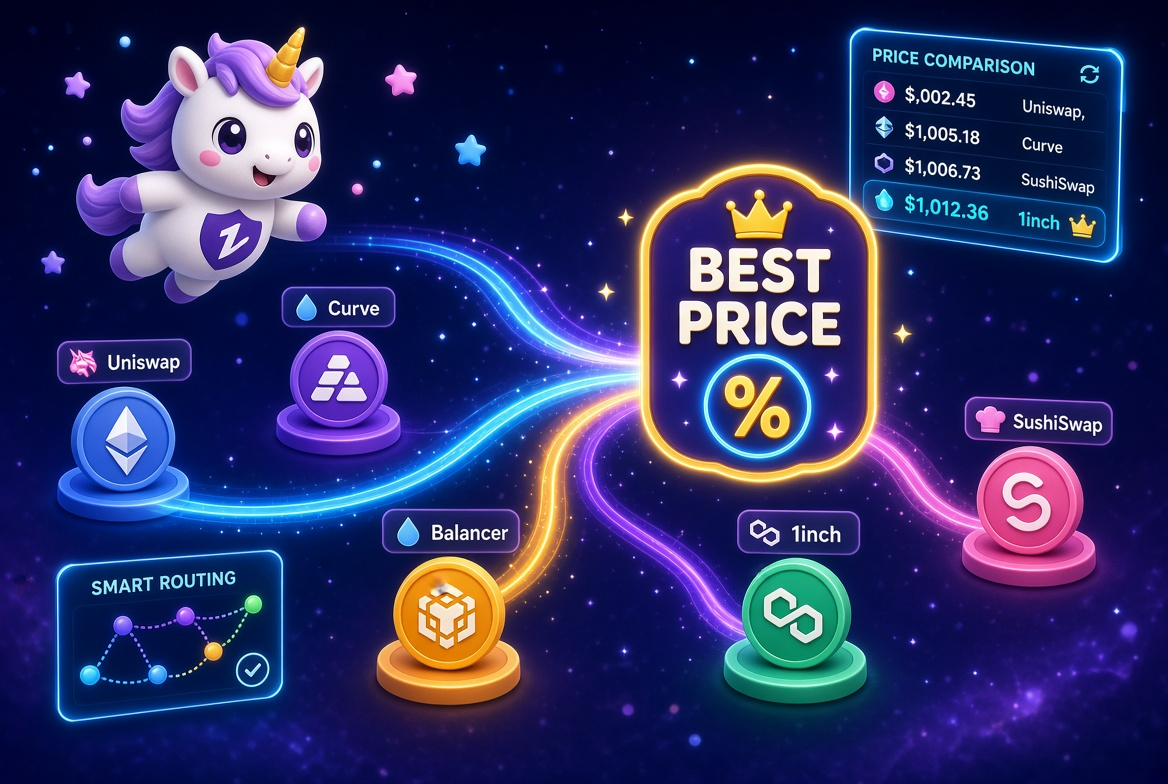
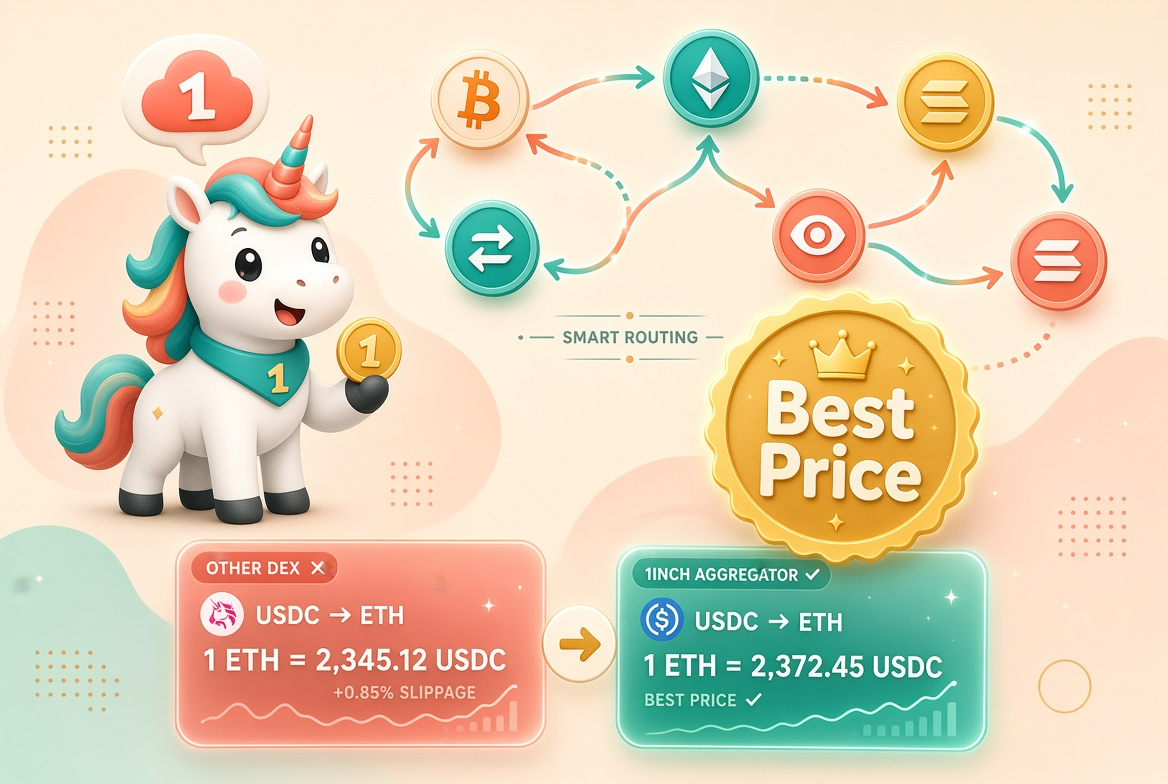
A DEX aggregator is a trading tool that connects to multiple decentralized exchanges and liquidity sources. Its goal is not to make you compare DEXs one by one, but to find a better swap route automatically. 1inch is one of the best-known examples: routing engines such as Pathfinder compare different DEXs, different liquidity depths, and different trade paths, and split an order when that helps, so the final execution price comes out better.
What is a DEX aggregator?
You can think of a DEX aggregator as a "price comparison plus routing" tool for DeFi.
If you swap ETH for USDC directly on a single DEX, you are only trading against the liquidity that DEX happens to have available at that moment. But DeFi liquidity is scattered across protocols, pools, and market depths, so the same pair can show different quotes in different places at the same time.
That is the problem a DEX aggregator solves: you only enter the token you want to sell, the amount, and the token you want to receive, and the aggregator compares available liquidity and works out a better route.
So the biggest difference between a DEX aggregator and an ordinary DEX is not whether you can swap tokens, but who is responsible for finding the trade path:

"Best price" therefore does not just mean comparing the exchange rates shown on two DEX pages. It means comparing how much of the target asset the whole trade actually delivers, and what it cost you to get there.
How does 1inch find a better price?
One of 1inch's core capabilities is the Pathfinder routing algorithm.
It does not simply pick "the one DEX with the highest current price". It searches across trade paths. Today Pathfinder can split a single trade across multiple DEXs, use different market depths inside the same DEX, and continue optimizing the route from there.
Say you want to buy ETH with 10,000 USDC.
An illustrative example only:
Swapping directly on Uniswap: about 3.00 ETH;
DEX A: about 3.01 ETH;
DEX B: about 3.02 ETH;
A multi-hop path such as USDC → USDT → ETH: about 3.03 ETH;
Splitting the order across several liquidity sources: about 3.04 ETH in total.
These numbers only illustrate the routing logic. They are not current market quotes.
For an ordinary user it is hard to open several DEXs in real time, compare pool depths, and then manually work out the gas and price impact of every path. The value of 1inch is that it hands that job to a routing algorithm.
Why split one trade across several DEXs?
Because the DEX with the highest quote does not necessarily give the best result for the whole trade.
Imagine a DEX where the first 1,000 USDC of liquidity is plentiful, but the price deteriorates quickly as the trade size grows. If you push the entire 10,000 USDC through it at once, the later part of the order may carry a much larger price impact.
Another DEX may not offer the single best rate, but it has deeper liquidity.
In that case a more sensible approach might be:
part of the trade through DEX A + part of the trade through DEX B.
By splitting the trade, the aggregator can make the most of what each market offers and reduce the price impact of pushing all the volume through one pool. 1inch itself describes trade splitting and the use of different market depths as core Pathfinder capabilities.
This is also why the larger the trade, the more routing value a DEX aggregator usually adds.
How exactly does 1inch calculate the "best price"?
The comparison that actually matters is not the headline quote for Token A, but:
final amount received − trade-related costs
The factors affecting the outcome include at least:
the DEX's current quote;
liquidity depth;
trade size;
price impact;
slippage;
gas cost;
intermediate tokens on the path;
the extra steps created by multi-hop trades;
current network conditions.
So if:
path A shows a higher exchange rate;
path B shows a slightly lower exchange rate;
that alone does not prove A is the better deal.
If path A needs more on-chain operations and costs more gas, the amount you actually receive may end up lower than with path B.
1inch's route optimization tries to put all of these factors into one calculation instead of comparing a single surface-level rate. Its own material on Pathfinder likewise highlights route splitting, use of market depth, and gas efficiency.
Why do large trades need a DEX aggregator more?
With a small trade, the price difference between DEXs may not even cover the extra trading costs, so simply using a DEX with enough liquidity can be fine.
As the trade size grows, however, the picture changes.
Suppose the best quote on some ETH/USDC pool only holds for smaller amounts. When you buy a large amount of ETH in one go, the order eats through the pool's available liquidity and the execution price gets steadily worse.
That is price impact.
An aggregator can look for more efficient routes through order splitting, multi-hop paths, and combinations of liquidity sources, easing the pressure of putting all the volume through a single pool.
So the scenario where a DEX aggregator really proves its worth is usually not "I'm swapping 10 dollars, where is it a bit cheaper", but rather:
when the trade is large, liquidity is fragmented, and quotes across DEXs differ noticeably, automatic routing is worth more.
What is the difference between 1inch Classic Swap and Fusion?
Understanding 1inch today means going beyond the traditional aggregation model and distinguishing between Classic Swap and Fusion.
Classic Swap is the traditional aggregation route. You submit a transaction, 1inch's Aggregation Protocol routes it according to available liquidity, and you normally bear the corresponding on-chain gas cost.
Fusion uses a different execution mechanism.
You submit a trade intent, and Resolvers then compete to fill the order. Fusion uses mechanisms such as a Dutch Auction for price discovery, and the Resolver executes the trade and bears the associated gas cost.
The two can be summarized simply as:
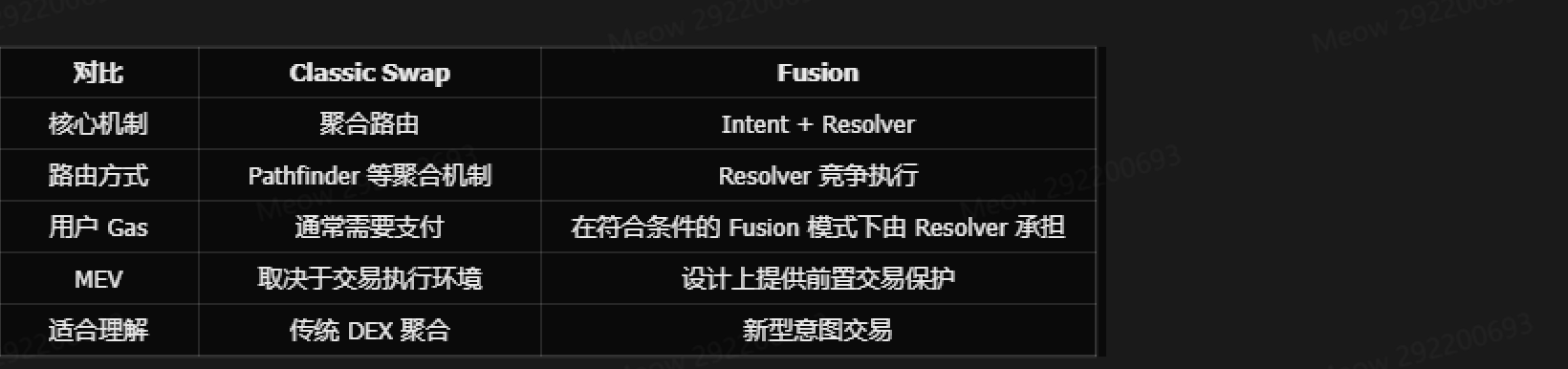
Note that Fusion does not mean "zero cost" in every case. Operations such as token approval may still create on-chain fees, and the exact rules differ between modes and trade states.
How does 1inch reduce slippage?
Slippage is one of the most easily overlooked costs in DEX trading.
Suppose the quote you see says 1 ETH can be swapped for 3,000 USDC, but once the trade settles you only receive 2,970 USDC. The gap can come from price movement, liquidity changes, and the execution process itself.
1inch can improve execution in several ways:
First, find more liquidity sources. It is not limited to a single DEX but compares several available markets.
Second, split the order. Volume is distributed across liquidity sources, lowering the price impact on any one pool.
Third, look for multi-hop paths. If direct liquidity for ETH → Token B is too thin, the swap can go through another intermediate asset.
Fourth, optimize the path's steps. Newer versions of Pathfinder try to merge some steps, improving the quote while cutting unnecessary gas use.
But remember: an aggregator cannot eliminate slippage.
If the market itself lacks liquidity, or the trade is large relative to the market, you can still see significant price impact even after aggregation.
Can 1inch guarantee the lowest price on the whole market?
"Finding the best price" should not be read as "guaranteeing the absolute lowest price market-wide".
That is the most common misunderstanding about DEX aggregators.
First, market prices keep changing. There can be a time gap between the quote you see, the transaction you sign, and the moment it finally executes.
Second, what an aggregator can compare is the set of liquidity sources it currently connects to and can execute against, not every theoretically possible trade across crypto.
Third, gas, slippage, liquidity, and execution conditions all affect the final result.
So a more accurate way to put it is:
1inch aims to find a more efficient execution path given currently available liquidity and trade conditions; it does not promise the absolute lowest price at any time and any trade size.
Why does 1inch Fusion reduce some MEV risk?
An ordinary on-chain swap may go through:
user submits transaction → transaction enters pending state → block is built → on-chain execution
In some public trading environments, an attacker can observe the pending transaction and arbitrage the price change around it, the classic example being a sandwich attack.
Fusion executes differently. You submit a trade intent, Resolvers compete to fill the order, and the order is organized and executed through the corresponding mechanism, which by design reduces the risk of a publicly pending transaction being exploited directly. 1inch's own material lists MEV protection as one of Fusion's main features.
But "having an MEV protection mechanism" does not mean every on-chain trading risk disappears. You still need to watch token contract risk, approval risk, liquidity risk, price volatility, and simple mistakes.
The basic flow of swapping tokens with 1inch
For an ordinary user, a single swap on 1inch is not complicated.
Step 1: Connect your wallet
Open the 1inch trading interface and connect your own self-custody wallet.
1inch supports multiple networks, and the networks and assets actually available change as the product evolves. Before anything else, confirm you are on the right network.
Step 2: Choose the tokens you sell and buy
Choose:
Pay: the token you are selling
Receive: the token you want to receive
Then enter the amount to swap.
Step 3: Review the quote and the route
Do not look only at "how many tokens I get". You should also check:
the expected amount received;
price impact;
slippage;
gas or related trading costs;
execution mode;
the trade route.
For larger amounts, pay even more attention to price impact and the final amount received.
Step 4: Check the token contract
With obscure tokens, never assume a token is safe just because an aggregator can find a quote for it.
Before swapping, at least confirm:
that the token contract address is correct;
that it is an official project;
that liquidity is sufficient;
that there are no abnormal buying or selling restrictions;
whether it requires a special token approval.
The aggregator finds the trade path; it does not judge for you whether a token is worth buying.
Step 5: Confirm the transaction
Once the parameters look right, complete the approval or signature in your wallet.
The current 1inch flow asks users to complete operations such as Approval or Permit depending on the specific token and trading mode, and then executes the swap.
The 5 most common mistakes when using a DEX aggregator
1. Looking only at the quote, not the final amount received
The exchange rate on the page is not the only metric.
What really matters is how much of the target token you end up with and how much the trade cost you.
2. Assuming an aggregator is always cheaper than a single DEX
An aggregator's advantage comes from a wider set of liquidity sources and routing options, but a complex route can also add steps and cost.
On very small trades, the extra gas can even wipe out part of the price advantage.
3. Confusing price impact with slippage
Price impact mainly describes the price effect caused by your trade size relative to the pool's liquidity.
Slippage is more about the range of price movement you accept and the deviation between the actual and expected execution price.
They are not the same concept.
4. Setting slippage too high just to get filled
A high slippage setting means you are willing to accept a larger price move.
When liquidity is thin or the market is volatile, that can push the final execution price well away from what you originally expected.
5. Seeing a "best quote" and ignoring token risk
A DEX aggregator can find you a trade path, but it cannot guarantee the token itself is sound.
With unfamiliar small-cap tokens in particular, check the contract address, liquidity, holder structure, trading restrictions, and approval risk.
When should you use 1inch instead of a single DEX?
A simple framework helps:
Small trade + a single DEX with deep liquidity: going straight to an established DEX may already be enough.
Large trade + liquidity on several DEXs: the aggregator's price comparison and order splitting are worth more.
Quotes differ noticeably across DEXs: an aggregator cuts the cost of comparing them by hand.
Market liquidity is poor: even with an aggregator, watch price impact and the actual execution conditions closely.
You want to reduce some MEV risk: look further into intent-based modes such as Fusion.
So a DEX aggregator is not "better than a DEX in every case". What it really solves is choosing a trade path once DeFi liquidity has become fragmented.
FAQ
What is the difference between a DEX aggregator and a DEX?
A DEX itself provides trading liquidity and execution, while a DEX aggregator connects to multiple DEXs or other liquidity sources and uses routing algorithms to find a better trade path. The core value of 1inch is automating a comparison users used to do by hand.
Why can 1inch get a better price?
1inch can use Pathfinder to compare multiple liquidity sources and split or combine trades according to trade size, market depth, and route, so in some market conditions it can achieve a better final result than a single DEX.
Is 1inch always cheaper than Uniswap?
No. 1inch aims to find a more efficient route, but the final cost still depends on gas, liquidity, trade size, price impact, and changing market conditions. Small trades especially need to account for the extra cost of aggregated routing.
Do I have to pay gas to use 1inch?
It depends on the trading mode. Traditional Classic Swap usually means the user bears the relevant on-chain gas; in Fusion mode, eligible orders have the Resolver bear the execution gas, though operations such as approvals may still cost fees.
Can 1inch prevent slippage?
Not completely. An aggregator can reduce part of the price impact through routing, order splitting, and liquidity optimization, but thin liquidity or a fast-moving price in the market itself can still produce slippage.
Is a DEX aggregator safe?
A DEX aggregator does not remove DeFi risk by itself. Users still face smart contract, token contract, approval, liquidity, price volatility, MEV, network, and execution risks. So before trading, verify the asset and contract address, and check the trade parameters carefully.
Summary
What a DEX aggregator solves is not "where can I buy coins", but how to complete a trade more efficiently within fragmented DeFi liquidity.
The core capabilities of 1inch can be summed up as:
aggregate liquidity → search routes → split orders → optimize execution → compare final cost.
Pathfinder finds and optimizes the trade path, Classic Swap represents the traditional aggregation model, and Fusion goes further by changing how orders execute through Resolvers and intent-based trading, adding designs such as MEV protection.
But remember: "best quote" does not equal "guaranteed lowest cost". To judge whether a trade is actually worthwhile, look at the final amount received, price impact, slippage, gas, liquidity, and execution risk together.
For users who need to swap larger amounts on-chain, the value of a DEX aggregator is especially clear. For small, simple trades with ample liquidity, decide whether it is worth using based on the actual quote and trading costs.
Crypto assets and DeFi trading carry significant risk. Price volatility, thin liquidity, smart contract bugs, token contract risk, approval risk, MEV, and execution slippage can all lead to loss of funds. This article is for educational purposes only and is not investment or trading advice.
1inch aims to find a more efficient execution path given currently available liquidity and trade conditions; it does not promise the absolute lowest price at any time and any trade size.
Lettura consigliata
Visualizza altro