APY vs APR: How to Read DeFi Yields Correctly
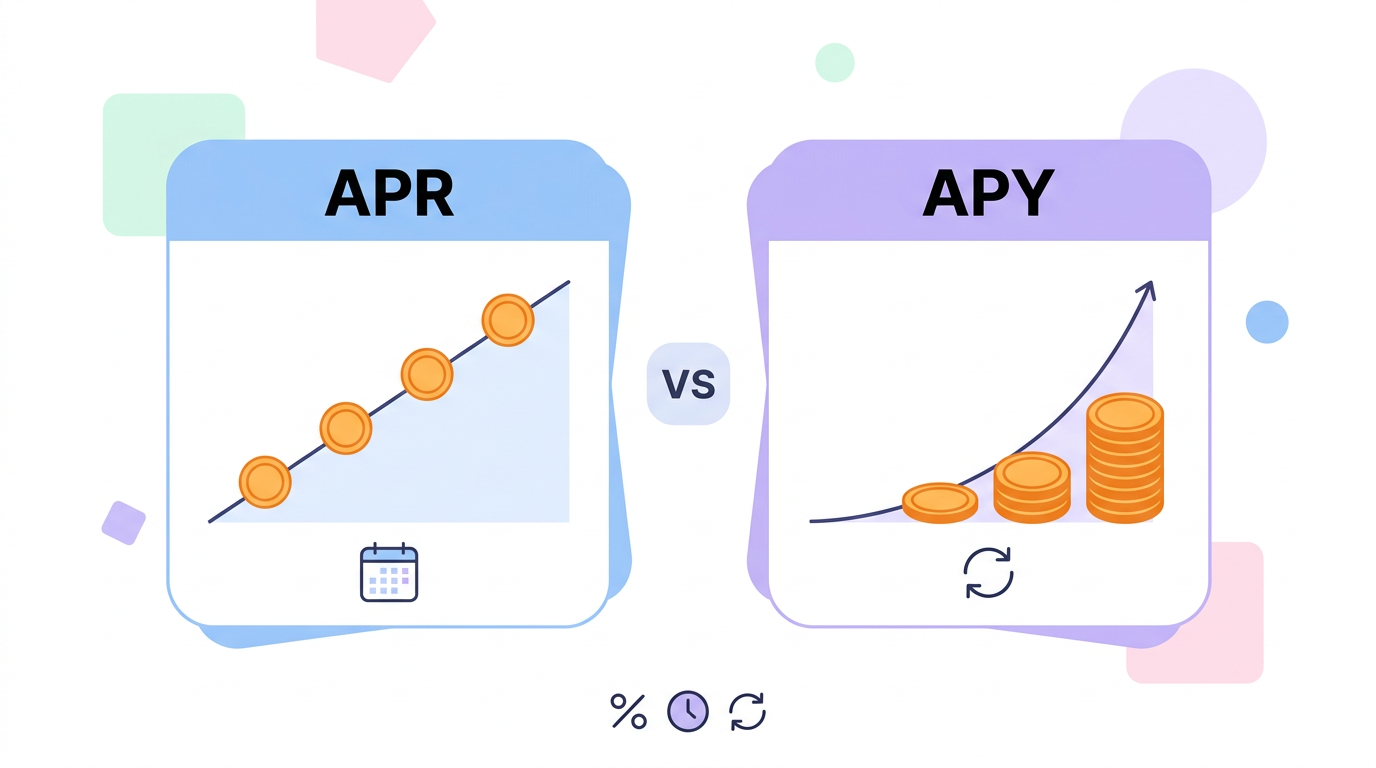
APR and APY are both common yield metrics in DeFi, but they are not the same concept. APR is usually the annual rate that ignores compounding, while APY factors the effect of compounding in. So when a platform shows "10%", 10% APR and 10% APY do not translate into the same actual return.
What do APR and APY mean?
APR stands for Annual Percentage Rate, often used to describe a one-year base yield or the cost of borrowing. Without compounding, if you hold 1,000 USDT at 10% APR, the theoretical return for one year is 100 USDT.
APY stands for Annual Percentage Yield. It goes a step further and accounts for compounding when earnings are reinvested. If the yield keeps being added to the principal, the base for the next calculation becomes larger, so the effective annual yield is usually higher than the same APR.
Put simply:
APR = the annual rate without compounding
APY = the effective annual yield after compounding
That is why, when comparing DeFi products, you cannot judge by the size of the number alone. You first have to confirm whether the platform is showing APR or APY.
Why are APR and APY different?
The gap comes from compounding frequency.
Take a DeFi product with 10% APR. If the yield is not reinvested, the theoretical return for the year is 10% of the principal.
If the yield is reinvested every month, the earnings from the first month join the principal, and the second month calculates returns on a larger base. After repeated compounding, the actual growth over a year is higher than 10%.
Under the standard compounding assumption, APR can be converted into APY with:
APY = (1 + APR / n)ⁿ − 1
Here APR is the nominal annual rate, and n is the number of compounding periods in a year.
For example, with APR at 10%:

As you can see, the more frequent the compounding, the wider the gap between APY and APR usually becomes.
There is a precondition here: the yield really is reinvested at that frequency, and the rate stays unchanged over the calculation period.
In DeFi, those two conditions do not always hold.
Why can't DeFi APY be read as "how much I earn per year"?
Annual yields on traditional fixed-rate products are usually easy to understand, but APY in DeFi tends to shift with market conditions.
If a liquidity pool shows 30% APY today, that does not mean you will keep earning 30% for the next 12 months after you deposit.
DeFi yields can be affected by:
changes in supply and demand for capital;
liquidity size;
borrowing demand;
trading volume;
protocol rewards;
the price of reward tokens;
protocol parameter adjustments;
reinvestment mechanisms;
and other factors.
So the APY on a page is closer to a reference annual yield under current conditions than a promise about future returns.
This is also a point to keep in mind when learning how DeFi earning works. If you want to go deeper into different yield sources such as Staking and Farming, you can read Crypto Earning Strategies: From Staking to Farming, then come back and judge what the APR or APY shown for different strategies actually means.

Where do APR and APY appear in DeFi?
APR and APY are not metrics exclusive to any single DeFi product. They can appear across different yield strategies.
For example, users may see APR or APY when staking, providing liquidity, taking part in lending, or using other yield strategies.
But the sources of return differ from product to product.
Staking returns may come from network validation rewards; lending returns are usually tied to borrowing demand and capital utilization; liquidity mining may combine trading fees with token incentives.
So even if two products both show "20% APY", their yield quality is not necessarily the same.
What really needs comparing is:
How high is the yield → where does it come from → is it auto-compounded → what asset pays it → will the rate change.
Which is higher, APR or APY?
When other conditions are equal and compounding happens more than once a year, APY is usually higher than APR.
For example:
Product A: 10% APR, compounded monthly;
Product B: 10% APY.
If Product A's 10% APR truly compounds monthly, the theoretical APY is about 10.47%, so the two cannot simply be read as "both 10%".
But if one product only quotes APR and another only quotes APY, you still cannot tell which pays more just from the size of the numbers.
The right approach is to convert both to the same basis first, then compare.
Does a higher APY always mean you earn more?
Not necessarily.
This is where misunderstandings about DeFi yields happen most often.
Assume:
Product A: 50% APY
Product B: 10% APY
On the surface A looks clearly better. But if A's 50% comes mainly from a highly volatile token reward and that token then falls sharply, the actual return measured in USDT or dollars may end up far below the figure you first saw.
"Yield" in DeFi is not always paid in stablecoins or major assets. It may be distributed as a protocol token or something similar.
So two ideas need to be kept apart:
A larger token count ≠ a larger asset value.
Say you deposit 1,000 USDT and receive token rewards worth 500 USDT, which looks like a 50% return. But if the reward token's price drops sharply, the market value of those rewards falls along with it.
So when judging an APY, what asset pays the yield matters as much as how high the number is.
Why does the APY of some DeFi products suddenly drop?
Because DeFi yields are usually dynamic.
Take lending markets. When capital supply and borrowing demand change, interest rates can move with them. When a large amount of capital enters the same pool and new demand does not rise in step, the return per unit of capital can fall.
Liquidity mining works the same way. If participants increase while the reward pool does not grow proportionally, each participant's share can shrink.
So a product going from 40% APY to 15% APY does not necessarily mean something is wrong with the protocol. It may simply reflect changes in market supply, demand and reward distribution.
A high APY usually means you need to dig into why it is that high.
How to tell whether a high APY deserves attention
When you see an unusually high yield, do not start by asking "how much can I earn". Work through the questions below, layer by layer.
First, look at the source of the yield
Confirm where the return comes from.
Yields generated mainly by fees or interest from real business activity follow a different sustainability logic than yields that rely entirely on token incentives.
Second, check whether it is APR or APY
Confirm whether the page shows APR or APY, and whether the APY already includes compounding.
If the compounding period is not stated, do not judge future returns from a single APY figure.
Third, look at the asset that pays the yield
Is the yield paid in assets such as USDT or ETH, or in the protocol's own token?
If the payout asset is volatile, your final return will be affected by its price moves.
Fourth, check whether the rate floats
If APR/APY moves with market supply and demand, the current rate cannot be used directly to predict the next twelve months.
Fifth, look at other costs and risks
The final return can also be affected by:
Gas;
trading fees;
slippage;
withdrawal costs;
asset price changes;
liquidity risk;
smart contract risk;
and other factors.
So a high APY is only one signal when screening yield strategies, not the final basis for a decision.
How should APR, APY and actual returns be calculated?
A simple example makes it clear.
Assume you deposit:
Principal: 1,000 USDT
APR: 12%
Holding period: 90 days
If we assume the rate stays unchanged and ignore compounding and all fees, the theoretical return can be estimated simply as:
1000 × 12% × 90 ÷ 365 ≈ 29.59 USDT
But this is only a static estimate.
If the product compounds, you need to recalculate using the actual compounding frequency; and if the APR itself changes daily, the final result will differ from this estimate too.
So in real DeFi investing, this calculation is better understood as:
"a theoretical estimate based on the current yield"
rather than:
"exactly how much I will have after 90 days".
Why is "yield" not the same as "return on investment"?
APR and APY describe annual yields, while return on investment is also affected by changes in asset prices.
Say you deposit ETH worth 1,000 USDT and earn the equivalent of 100 USDT through some DeFi strategy.
If ETH's own price rises, your total asset value may increase noticeably; but if ETH falls sharply, your final asset value may still be lower than what you put in, even though you earned a yield.
Therefore:
Yield answers "how much return did the asset generate", while return on investment also has to account for "what happened to the price of the asset itself".
For strategies such as liquidity mining, you also need to factor in things like impermanent loss.
That is why you cannot simply see a high APY and conclude that the final return must be higher.
A judgment order for newcomers reading DeFi yields
Whenever you see a DeFi product advertising a "high yield", run through this order:
① APR or APY?
Establish the basis of the yield first.
② Is it compounded?
Confirm whether earnings are automatically reinvested and how often.
③ Where does the yield come from?
Separate interest, fees, staking rewards and token incentives.
④ What asset pays the yield?
Pay attention to the price volatility of the reward asset itself.
⑤ Will the rate change?
Check whether the current APR/APY is dynamic data.
⑥ Are there extra costs and risks?
Consider Gas, fees, slippage, liquidity and smart contracts together.
Only then comes:
⑦ What is the expected actual return?
This order is a more useful reference than simply comparing whose APY is higher.
APR vs APY: the comparison in one table

FAQ
Which pays more, APR or APY?
With the same base rate and multiple compounding periods, APY is usually higher than APR. But they are different measures, so the displayed numbers cannot be compared directly.
Is 10% APR the same as 10% APY?
No. 10% APR usually excludes compounding, while 10% APY already accounts for it. When compounding occurs, the effective annual yields behind the two are different.
Is APY in DeFi fixed?
You generally cannot assume it stays fixed. Many DeFi yields are affected by capital supply and demand, borrowing demand, trading volume, reward mechanisms and protocol parameters.
Does a higher APY mean it is safer?
No. APY only describes a yield; it says nothing about protocol safety. A high APY may come with greater asset price, liquidity, smart contract or reward mechanism risk.
Why is the yield high but the money I actually make small?
The rate may have changed, the reward token's price may have fallen, or fees, Gas and slippage may have eaten into the return. Some liquidity strategies also involve impermanent loss.
Can APR be converted into APY?
Yes, but you must know the compounding frequency. Under the standard compounding assumption, you can use APY = (1 + APR/n)ⁿ − 1. With real DeFi products, you also need to confirm whether the rate is fixed and whether compounding truly happens at that frequency.
Risk disclaimer
APR and APY in DeFi are yield metrics only. They do not represent future actual returns and do not constitute any guarantee of profit. Actual results may be affected by price volatility of digital assets, changes in yield rates, reward token prices, Gas, trading fees, slippage, liquidity, smart contracts and other protocol risks. For strategies such as liquidity mining, specific risks including impermanent loss also require attention. Before participating in any related product, you should fully understand the sources of yield and the product mechanics, and make a prudent judgment based on your own risk tolerance.
Lettura consigliata
Visualizza altro