
What Are Cryptocurrency Token Buybacks and Burns?
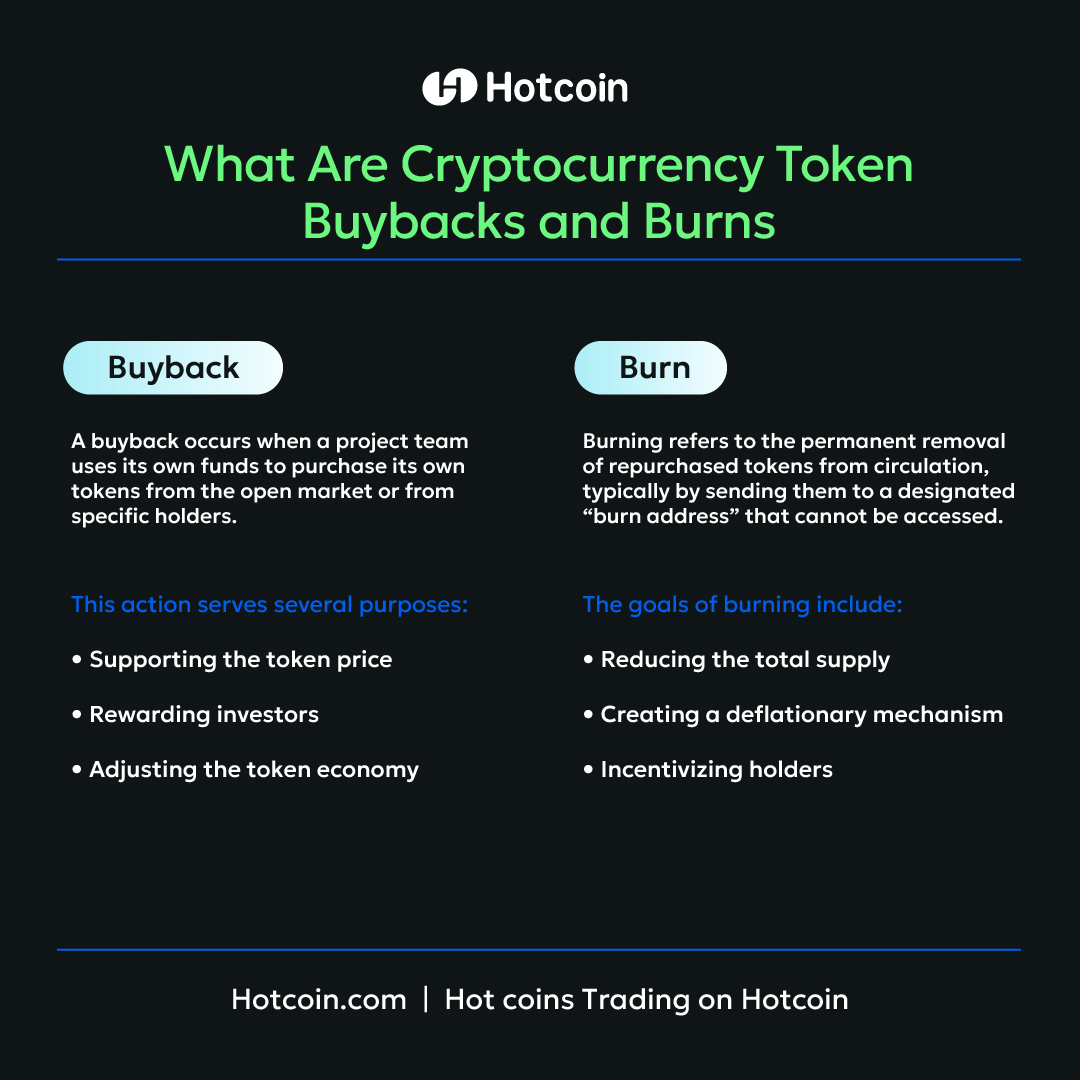
Cryptocurrency token buybacks and burns are common mechanisms in token economics, typically implemented by token issuers or project teams. Their goal is to influence the market price and perceived value of a token by reducing its circulating supply. Widely used in the crypto space, these mechanisms serve as both a way to reward token holders and a tool for adjusting the project’s tokenomics. Below is a detailed explanation of how they work.
1. Buyback
A buyback refers to when a project team uses its own funds—such as project revenue, reserves, or other sources—to purchase its own tokens from the open market or from specific holders. This serves several purposes:
Supporting the token price: By increasing demand and decreasing market supply, buybacks can raise or stabilize the token price in the short term.
Rewarding investors: Similar to stock buybacks in traditional finance, token buybacks are seen as a way to return value to holders.
Adjusting the token economy: By controlling the circulating supply, the project team can flexibly manage token distribution based on market conditions or internal needs.
Buybacks are typically conducted in two ways: purchasing tokens from the open market, or directly acquiring them from specific holders (e.g., early investors).
2. Burn
Burning refers to permanently removing repurchased tokens from circulation, usually by sending them to a "burn address"—a public, irretrievable address that ensures the tokens can never be used again. The goals of burning include:
Reducing the total supply: Assuming constant demand, reducing supply theoretically drives up the token price.
Creating a deflationary mechanism: Some projects implement regular token burns to gradually make the tokens scarcer, thereby enhancing long-term value.
Incentivizing holders: Burning tokens signals the project team’s confidence in the token’s value, which can encourage long-term holding.
3. Implementation and Actual Impact
The funds used for buybacks and burns typically come from the project’s profits or dedicated reserves. Project teams may publicly announce buyback or burn plans to strengthen market confidence. In the short term, these mechanisms often lead to price increases, but long-term effects depend on the project’s fundamentals and market demand. Moreover, regular buybacks and burns can showcase a team’s commitment to the token’s value, enhancing investor trust.
In summary, cryptocurrency token buybacks and burns are effective tools for managing token supply, value, and long-term economic design. While they can boost short-term prices and incentivize holding, their overall effectiveness depends on the project’s real-world performance and the broader market environment. For investors, understanding these mechanisms provides insight into a token’s potential value and the project team’s strategic direction.
Lettura consigliata
Visualizza altro

Service@hotcoin.com
Product@hotcoin.com
Business@hotcoin.com
Casecn@hotcoin.com