
What Is a Validator? The Role of a Staking Node
A validator is a protocol role that participates in block proposals and consensus voting on PoS and similar networks. It generally requires staking assets and running a node. Misconduct may lead to slashing, but a validator is not the same as every full node.
Validators check blocks according to protocol rules, sign votes, and propose new blocks when selected. Each network has its own requirements for minimum stake, the active validator set, delegation, rewards, and withdrawal procedures.
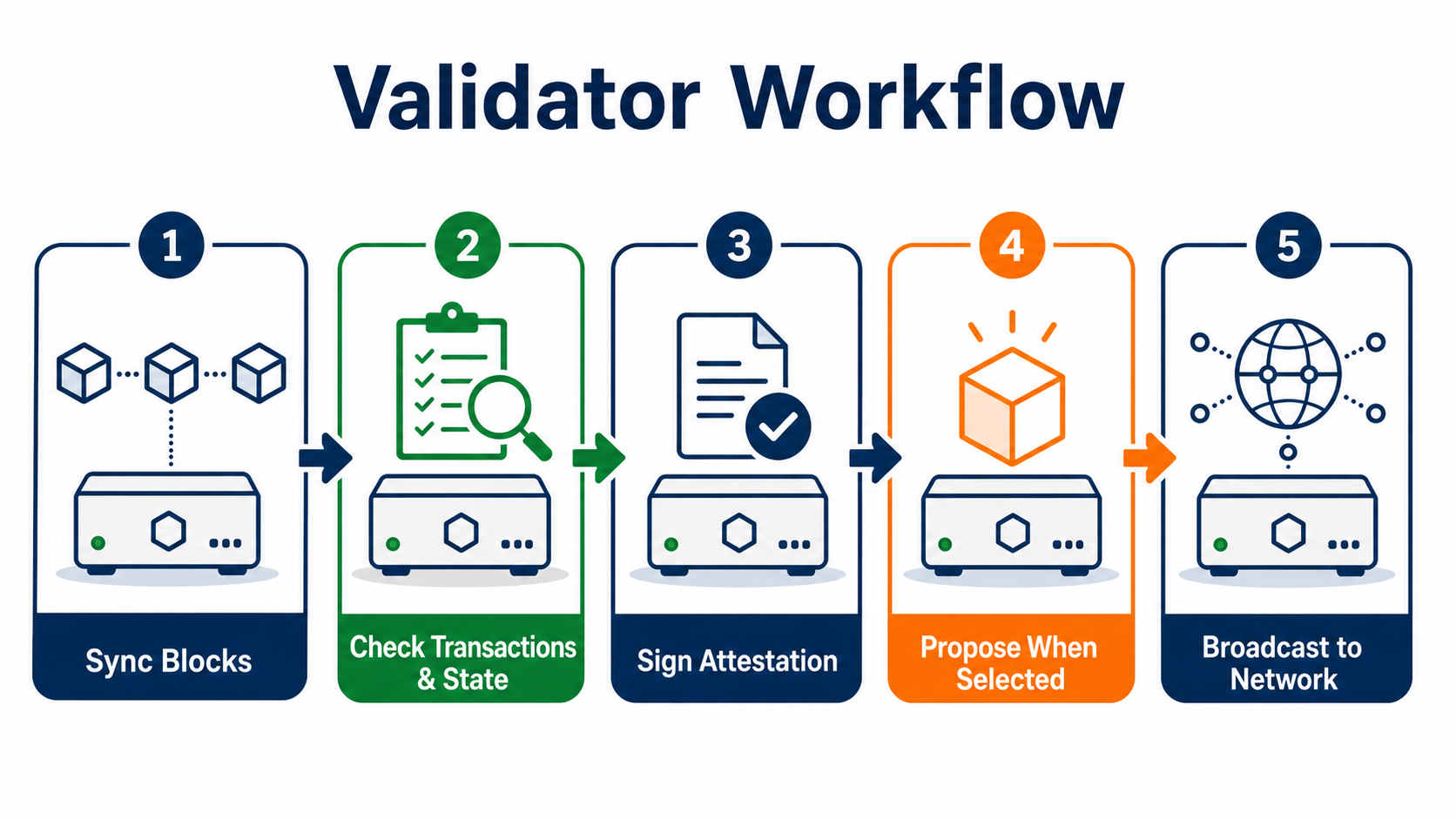
What Does a Validator Do Each Day?
A validator client receives blocks from the network and passes them to an execution client or full node, which checks transactions, signatures, and state changes. If a block is valid, the validator signs and broadcasts a vote based on its view of the chain head.
The protocol selects proposers randomly, by rotation, or according to stake weight. A selected validator builds a block from pending transactions, adds consensus data, and broadcasts it. Other validators independently verify the block again; they do not accept it merely because the proposer has a large stake.
Some networks also require validators to participate in checkpoint finality, signature aggregation, sync committees, or on-chain governance. More duties increase the requirements for uptime, clock accuracy, and client compatibility.
To learn how validators participate in PoS voting, read this together with Proof of Stake.
What Is the Difference Between Validators, Nodes, and Delegators?
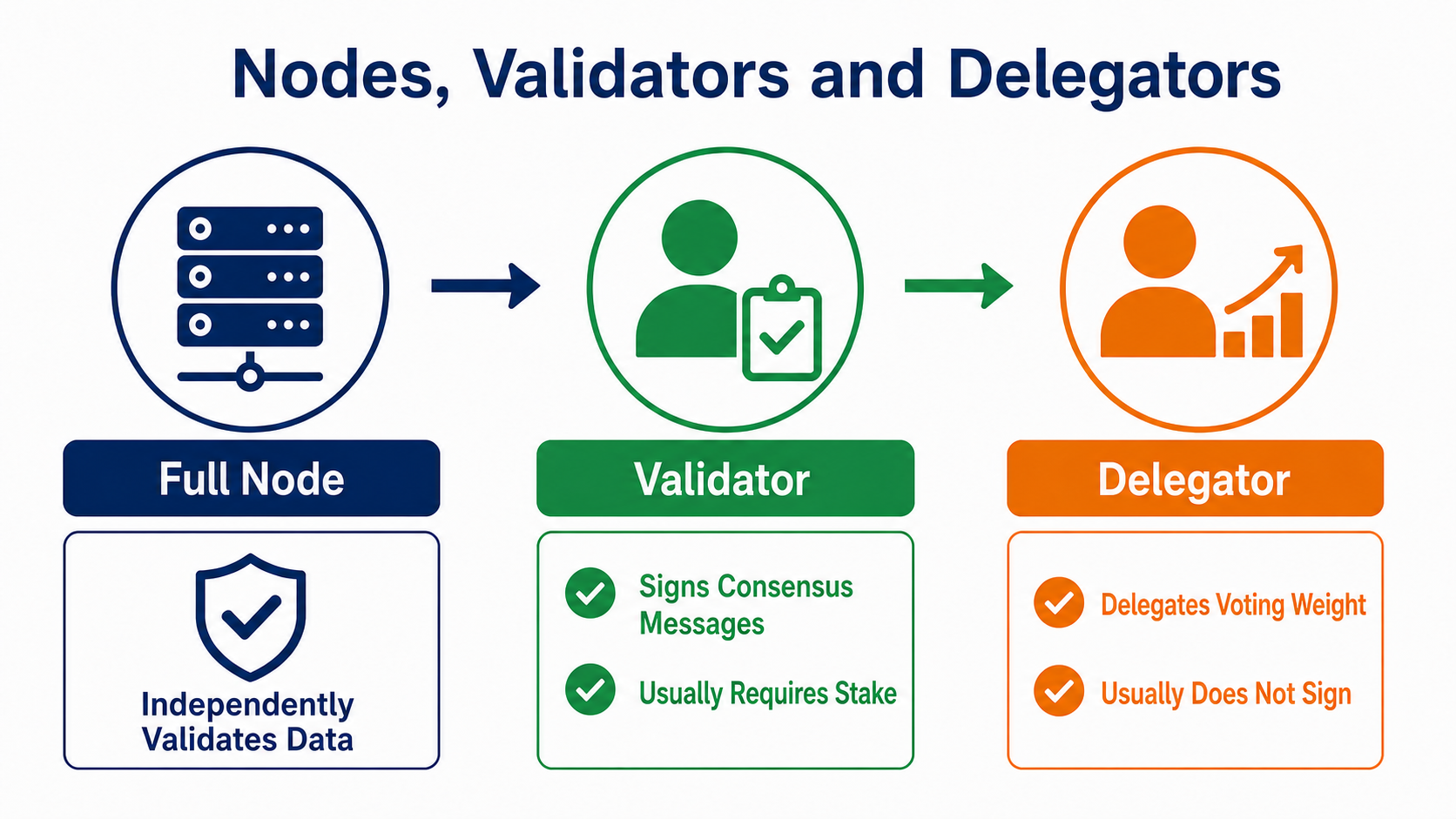
| Role | Main responsibility | Must stake? | Signs consensus messages? |
|---|---|---|---|
| Full node | Synchronizes and independently verifies transactions and blocks | Usually no | Usually does not sign validator votes |
| Validator | Runs a node and participates in proposals, attestations, or finality votes | Usually yes | Yes |
| Delegator | Delegates staking weight to a validator | Must hold and delegate assets | Usually does not sign directly |
| RPC service | Provides query and broadcast interfaces for wallets and applications | Not necessarily | Not necessarily |
Running a full node does not automatically earn staking rewards. A validator also cannot replace ordinary nodes in deciding whether transactions follow the rules; other nodes still independently verify its blocks.
Delegation generally transfers consensus weight rather than asset ownership, but delegators may share slashing risk with validators. Whether assets are held in custody, when they can be unstaked, and how rewards are settled depend on the protocol or service terms.
How Are Staking Rewards Generated?
When validators propose blocks on time, submit valid votes, or complete assigned duties, the protocol may distribute newly issued assets, transaction fees, or a combination of both. Delegator rewards are generally distributed according to protocol rules after the validator deducts its commission.
The reward rate is not fixed interest. Total stake, network issuance, validator uptime, commission, block proposal opportunities, and protocol parameters all affect actual results. Unclaimed rewards, unbonding periods, and token price movements also affect the final value.
A validator cannot guarantee the same return in every period, and historical annualized rates should not be treated as fixed future returns.
What Actions Can Lead to Penalties or Slashing?
Ordinary downtime usually results in missed rewards or a small penalty. Provable violations such as double-signing or voting for conflicting checkpoints can trigger slashing, causing a validator to lose part of its stake and be removed from the active set.
Running the same validator key on multiple machines is a common high-risk mistake. If two machines sign conflicting messages at the same time, the protocol cannot distinguish a backup configuration error from an intentional attack and may still treat it as double-signing.
Validator keys should be managed separately from everyday wallet keys. When migrating clients, operators should preserve signing history and slashing-protection data. High availability does not mean allowing multiple instances to sign simultaneously.
What Should You Check Before Running a Validator?
- Are the staking threshold, activation queue, unbonding period, and exit rules acceptable?
- What hardware and bandwidth do the execution, consensus, and validator clients require?
- Are validator keys, withdrawal keys, and server permissions stored separately?
- Are monitoring, alerts, maintenance windows, and slashing protection in place?
- Are cloud providers, regions, or clients overly concentrated, and can the system recover safely after a failure?
- Will delegators share losses if the validator goes offline or violates protocol rules?
A validator is one role within a consensus mechanism; not every network assigns validators the same duties. To learn more about staking and other earning methods, see Ways to Earn Cryptocurrency.
FAQ
Can a Validator Transfer a Delegator's Tokens?
Protocol-native delegation usually grants only consensus weight, so a validator cannot directly control assets in the delegator's address. Custodial staking and some smart-contract models may transfer actual control of assets, so users must distinguish between product structures.
Are Validator Rewards Fixed?
No. Rewards vary with total stake, network issuance, proposal opportunities, uptime, fees, and validator commission. Protocol upgrades may also change the calculation method.
Can One Operator Run Multiple Validators?
Yes. Many protocols allow one entity to manage multiple validator instances. When measuring decentralization, identify common operators instead of looking only at validator identifiers.
Are a Validator and an RPC Node the Same Server?
They can run together or separately. A public RPC endpoint handles many external requests, while a validator signing service requires stricter isolation. In production, operators often place them within different security boundaries.
Inirerekumendang pagbabasa
Tingnan ang higit pa


service hotcoin.com
producthotcoin.com
businesshotcoin.com
casecnhotcoin.com