
Proof of Work (PoW): Bitcoin's Hashrate Race
Proof of work requires miners to spend computing resources searching for a block hash that meets the difficulty target. Bitcoin nodes verify the result and treat the valid chain with the greatest cumulative work as the preferred main-chain candidate.
Miners are not decrypting transactions or calculating a unique answer. They repeatedly change the nonce and other fields in the block header and compute hashes until a result falls below the network target. Finding such a result is difficult, while other nodes can verify it quickly.
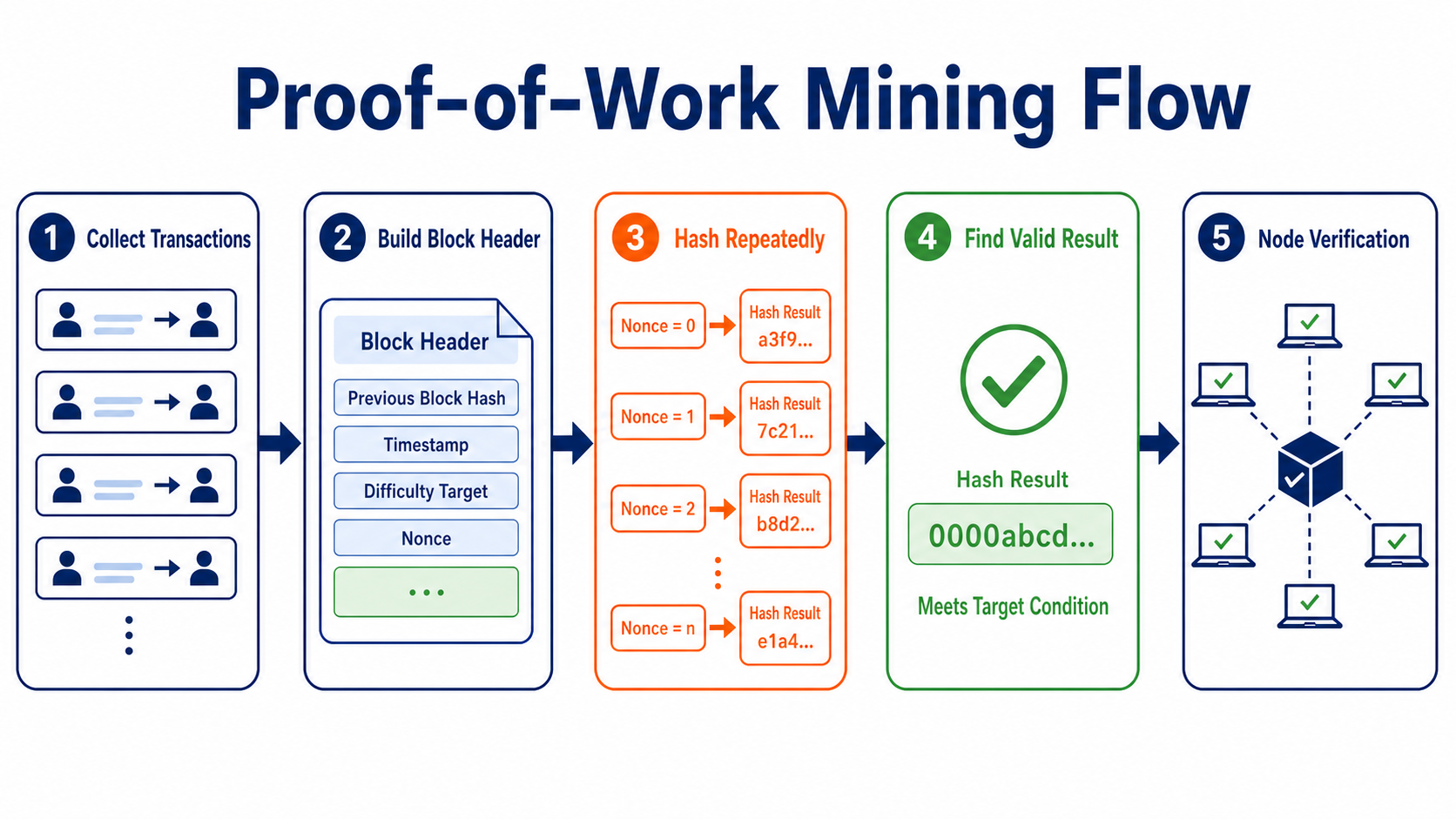
How Does Proof of Work Produce New Blocks?
Miners first assemble pending transactions into a candidate block. They then construct a block header containing the previous block hash, Merkle root, timestamp, difficulty information, and other fields. Mining machines keep trying different inputs and calculating hashes until they find a result that meets the target.
The successful miner broadcasts the block to the network. Full nodes check its proof of work, parent block, transaction validity, block size, and other consensus rules. If any check fails, nodes reject the block even if the miner spent substantial computing power on it.
Miners therefore propose blocks, while nodes enforce the rules. A mining pool cannot unilaterally create Bitcoin from nothing or make a transaction valid without the required signature.
To understand the relationship between hashes and block-header fields, see Hash Algorithms Explained and Blockchain Block Structure Explained.
Why Does the Difficulty Target Adjust?
Total network hashrate can rise or fall. If the target never changed, more hashrate would cause blocks to arrive too quickly, while less hashrate would slow block production. PoW networks typically adjust difficulty at protocol-defined intervals to bring the average block rate back toward its intended pace.
A higher difficulty narrows the range of hashes that satisfy the target, so miners must make more attempts on average. An individual miner's probability of finding a block depends on its share of the network's total hashrate, although short-term outcomes remain random.
Mining pools combine the hashrate of many participants and reduce income volatility. However, they can also concentrate block-template construction and block-production authority among a small number of operators. Assessing PoW decentralization therefore requires more than counting mining machines.
Why Does the Main Chain Use Cumulative Work?
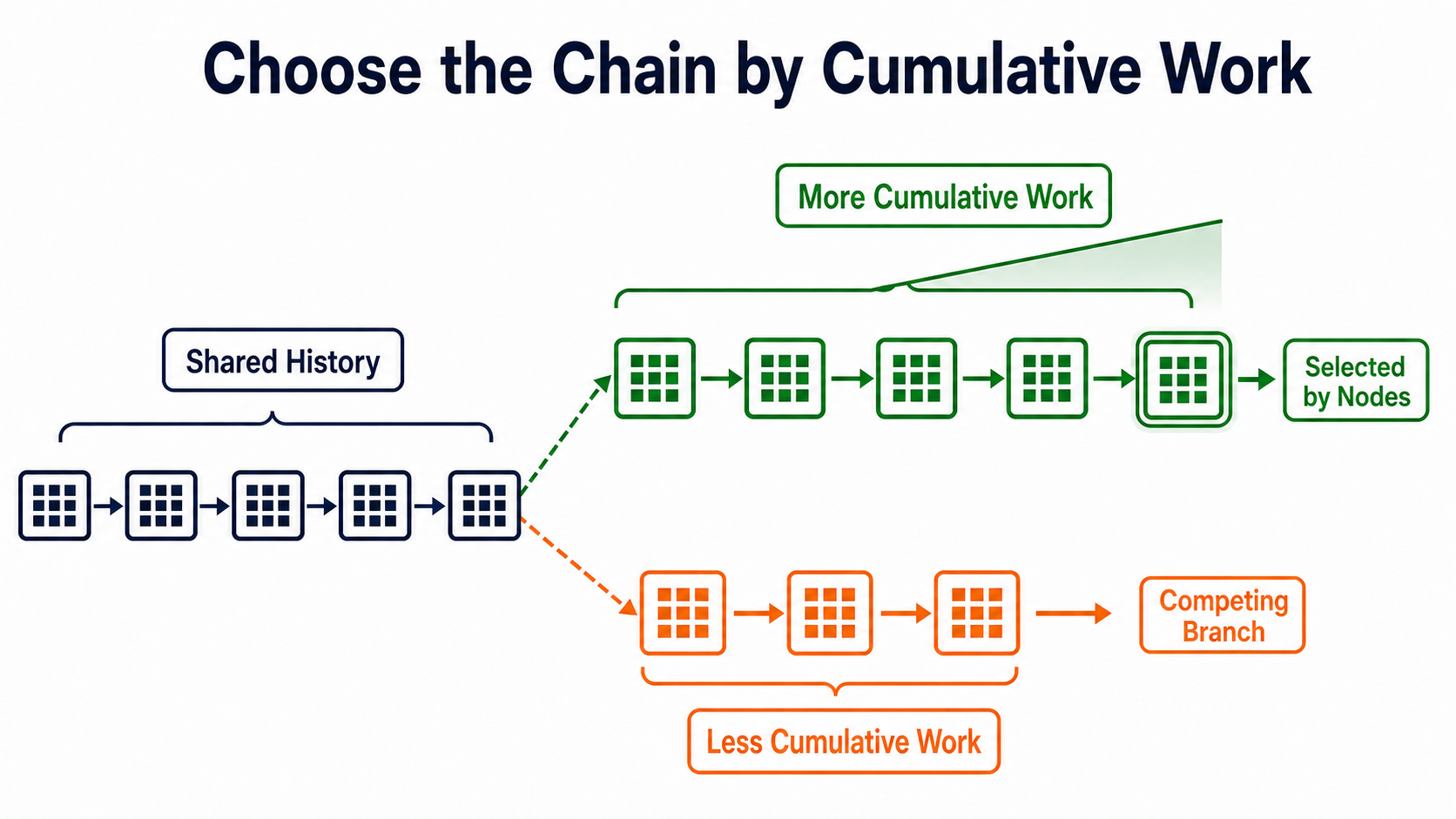
Two miners may find valid blocks at nearly the same time, temporarily creating two chain tips. Each node initially accepts the valid branch it sees first and then continues comparing the cumulative work of the competing branches.
The commonly used term “longest chain” means the valid chain with the most cumulative work and the greatest cost to reconstruct, not simply the chain with more blocks. To rewrite an old transaction, an attacker would have to redo the work from the target block onward while continuing to catch up with the chain extended by honest miners.
As more blocks accumulate after a transaction, replacing that history generally becomes more difficult. This is why PoW networks use confirmation counts to gauge transaction stability, although confirmations are not an absolute guarantee of immutability.
Where Do PoW Rewards Come From?
After a miner successfully proposes a valid block, it usually receives a protocol-issued block subsidy and the transaction fees included in that block. The subsidy rules depend on the network and may decrease according to a predetermined schedule.
Rewards must cover mining hardware, electricity, cooling, facilities, and operating costs. Changes in asset price, difficulty, and fees affect miner profitability and may influence how much hashrate remains on the network. Network security cannot be judged from the block reward alone; the actual distribution of hashrate and the availability of rentable attack resources also matter.
What Are the Advantages and Limitations of Proof of Work?
PoW ties the right to propose blocks to a measurable external cost. Anyone can participate by following the protocol and contributing computing power. Bitcoin's long operating history has also produced extensive public research and real-world observations of this security model.
Its costs are equally clear. Competitive hashing continuously consumes energy, while specialized mining hardware and large-scale operations raise the barrier to participation. Mining pools and hardware supply may also become concentrated. PoW generally relies on subsequent blocks to increase confidence in confirmations and may not provide the explicit checkpoint finality found in some BFT protocols.
To compare a security model based on a different resource, read Proof of Stake (PoS). To learn how elected representatives can replace hashrate competition, see Delegated Proof of Stake (DPoS). Both mechanisms fit into the broader framework described in Consensus Mechanisms Explained.
Frequently Asked Questions
Can Miners Keep Trying After They Exhaust the Nonce Range?
Yes. Miners can change extra fields in the coinbase transaction, adjust the timestamp, or alter the transaction set. These changes produce a different Merkle root and block header, opening a new hash search space.
Why Do Some Miners Produce Blocks with Very Few Transactions?
A miner may first build a simpler candidate template immediately after receiving a parent block, or only a small number of transactions may be available at the time. As long as the block follows the protocol rules, a low transaction count does not invalidate its proof of work.
Can Hashes Already Computed Be Reused for the Next Block?
Not directly. When the parent block hash, transaction set, or another block-header field changes, the input changes as well. Miners must search again using the new block header.
Does More Hashrate Make Every Block Permanently Arrive Faster?
Usually not. Short-term hashrate changes can affect block-production speed, but subsequent difficulty adjustments bring the average pace back toward the protocol target. Each network defines its own adjustment interval and calculation method.
Inirerekumendang pagbabasa
Tingnan ang higit pa
service hotcoin.com
producthotcoin.com
businesshotcoin.com
casecnhotcoin.com