
PoW vs PoS: A Comprehensive Comparison of Security, Efficiency, and Decentralization
PoW uses computing power and energy to compete for block production, while PoS uses staked assets and validator votes to confirm blocks. Both can secure open networks, but they differ in attack costs, energy consumption, finality, and the ways in which control may become concentrated.
There is no absolute winner independent of a specific protocol. A meaningful comparison must examine the actual distribution of hash power or stake, fork-choice rules, finality, client diversity, and barriers to participation—not merely the consensus mechanism's name.
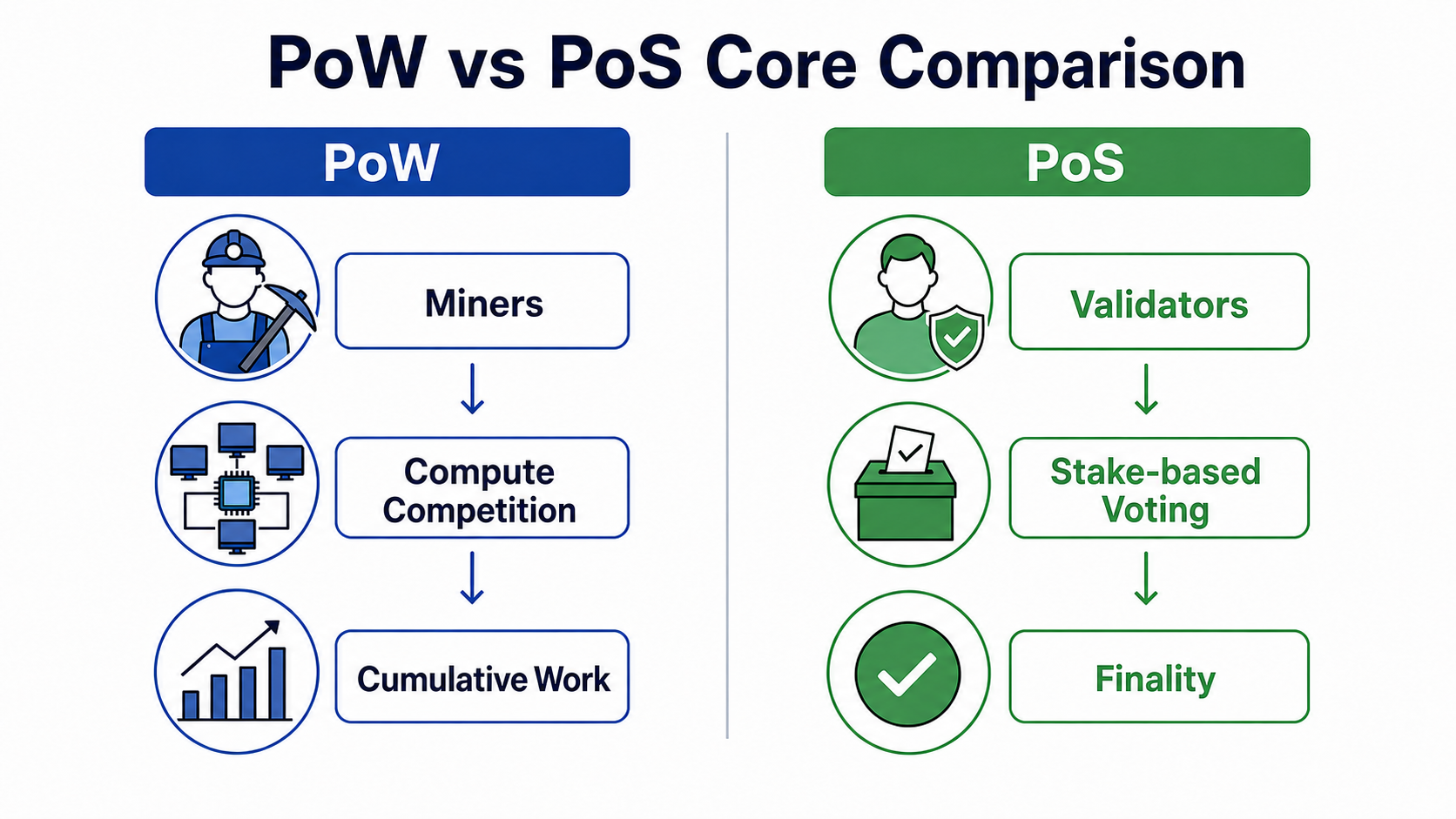
What Are the Core Differences Between PoW and PoS?
| Category | PoW | PoS |
|---|---|---|
| Security resource | Computing hardware, electricity, and ongoing operating costs | Locked native assets that may be slashed |
| Main participants | Miners and mining pools | Validators, delegators, and staking services |
| Block production | Competing to find a hash that satisfies the target | Selecting proposers according to stake and randomized rules |
| Head selection | Usually selecting the valid chain with the most accumulated work | Usually selecting the chain head by validator vote weight |
| Finality | Often relying on later blocks to increase probabilistic confidence | Can combine checkpoint voting with protocol-level finality |
| Energy demand | Continuous competitive computation with relatively high energy use | Running nodes and signing messages without a hash-power race |
| Resources after misconduct | Hardware may remain usable or move to another network | Staked assets may be slashed and validators forcibly exited |
| Main concentration points | Mining pools, mining hardware supply, electricity, and facilities | Large staking pools, custodians, cloud providers, and clients |
For a closer look at each mechanism, see Proof of Work and Proof of Stake.
How Do the Two Mechanisms Create Security Costs?
A PoW attacker must obtain enough hash power and keep paying for hardware and energy long enough for an alternative chain to catch up with the honest chain. After the attack, the hardware may retain value or be redirected to other networks that use a similar algorithm.
A PoS attacker must control enough stake weight to influence the chain head, delay finality, or cast conflicting votes. Provable violations may trigger slashing, directly destroying attack capital, although the exact thresholds and penalties depend on the protocol.
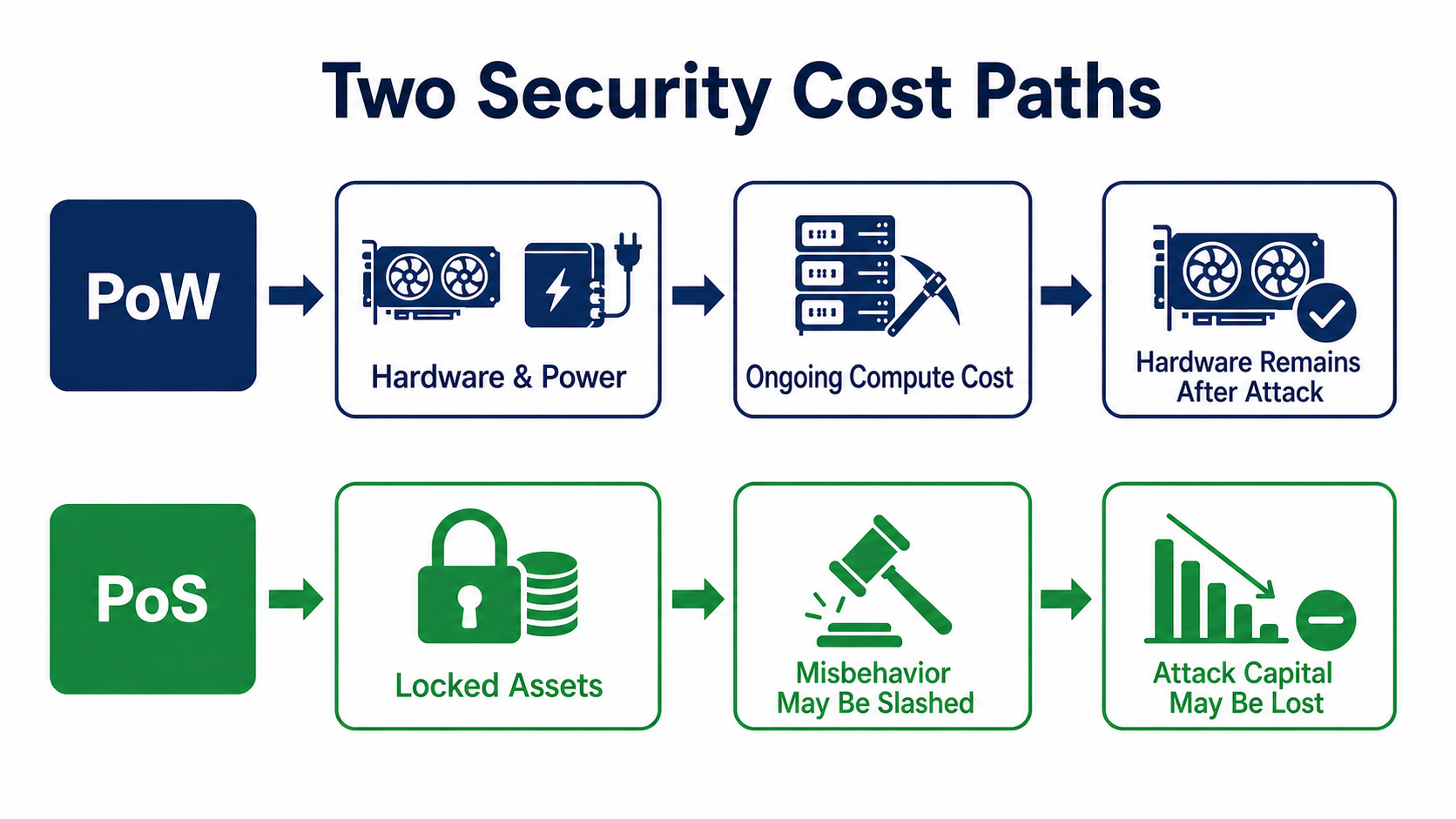
Attack costs cannot be reduced to a dollar amount at a single point in time. The availability of rented hash power, token market depth, stake withdrawal times, derivatives hedging, and social coordination can all change the real level of risk.
Is PoS Always More Efficient Than PoW?
In terms of consensus energy use, PoS is generally far less demanding than PoW because validators do not simultaneously perform a large-scale hashing race. After Ethereum switched from PoW to PoS, its official estimate put the network's energy reduction at approximately 99.95%. That figure reflects one specific network upgrade, not a universal ratio for every blockchain.
Lower energy consumption does not automatically increase throughput. Transaction capacity also depends on block capacity, the execution environment, data propagation, and state storage. PoS still requires servers, network connectivity, and maintenance across multiple client implementations.
PoW has comparatively straightforward rules and validation paths, whereas PoS introduces additional state for validator selection, voting, slashing, exit queues, and finality. Efficiency should therefore account for resource use, protocol complexity, and operational costs together.
Which Mechanism Is More Decentralized?
Decentralization is not a single number. For PoW, relevant factors include mining-pool control, actual ownership of mining hardware, geographic distribution of electricity, and hardware supply. For PoS, they include stake distribution, the share held by custodians, validator operators, client diversity, and reliance on cloud providers.
PoW allows anyone with suitable hardware to participate, but access to wholesale electricity and large-volume hardware purchases creates economies of scale. PoS has a lower hardware barrier, yet capital can become concentrated as larger holders earn more rewards. Staking pools enable participation by smaller holders while potentially concentrating voting power among a few protocols or service providers.
At minimum, comparisons should consider proposal power, validation power, software implementations, and governance power. Counting only miner addresses or validator identifiers can misrepresent multiple instances controlled by the same entity as independent participants.
How Do Confirmations Differ From Finality?
PoW networks often use confirmation depth to represent the cumulative work required to rewrite a transaction. Deeper confirmations generally increase the cost and uncertainty of catching up for an attacker, but the resulting security remains probabilistic.
PoS can add checkpoint voting on top of fork choice. Once the required threshold is reached, a block enters a protocol-defined finalized state. Reversing finalized history generally requires many validators to violate the rules and face slashing or the consequences of social coordination.
“Six confirmations” and “finalized” cannot be converted using a fixed ratio. Wallets and exchanges should set crediting requirements according to the network's characteristics, transaction value, and their own risk policies.
What Should You Consider When Choosing PoW or PoS?
PoW can suit networks that want to establish security through open competition for hash power, accept higher energy costs, and value straightforward validation logic and a long operating history. PoS can suit networks that want to reduce energy demand, use staking incentives and penalties, and provide explicit finality while accepting more complex protocols and staking governance.
The decision still comes down to implementation. Client vulnerabilities, resource distribution, and upgrade governance may matter more than the label itself. To understand where both mechanisms fit within the full consensus stack, return to the Consensus Mechanism Guide. For their implications for scalability, continue with the Blockchain Trilemma.
Frequently Asked Questions
Can a Blockchain Switch From PoW to PoS?
Yes. Ethereum has completed such a transition. However, it requires rewriting the consensus layer, deploying new clients, transferring security responsibilities, and coordinating ecosystem participants. It cannot be accomplished through an ordinary parameter adjustment.
Which Mechanism Makes a Majority Attack More Expensive?
There is no fixed answer. The comparison must account for the target network's cost of acquiring hash power, hardware reusability, token liquidity, staking ratio, slashing rules, and the duration of the attack.
Does PoS Completely Eliminate the Need for Specialized Hardware?
PoS does not require the competitive computation performed by PoW mining machines, but validators still need reliable servers, storage, networking, and secure key management. High-availability operations may also use multiple nodes and independent monitoring.
Can PoW Confirmations Be Directly Converted Into PoS Epochs?
No. The two mechanisms rely on different fork-choice and finality models. Applications should use the target network's officially defined states and their own requirements rather than mechanically converting time or block counts.
Inirerekumendang pagbabasa
Tingnan ang higit pa


service hotcoin.com
producthotcoin.com
businesshotcoin.com
casecnhotcoin.com