
Delegated Proof of Stake (DPoS): Balancing Efficiency and Democracy
Delegated Proof of Stake allows token holders to vote under a network's rules and elect a small group of delegates who take turns producing and confirming blocks. It gains speed by keeping the active set small, but the quality of its governance depends on how voting power is distributed.
DPoS delegates are also commonly called witnesses, block producers, or super representatives. The terminology and number of seats vary by network, so the parameters of one blockchain should not be treated as universal DPoS rules.
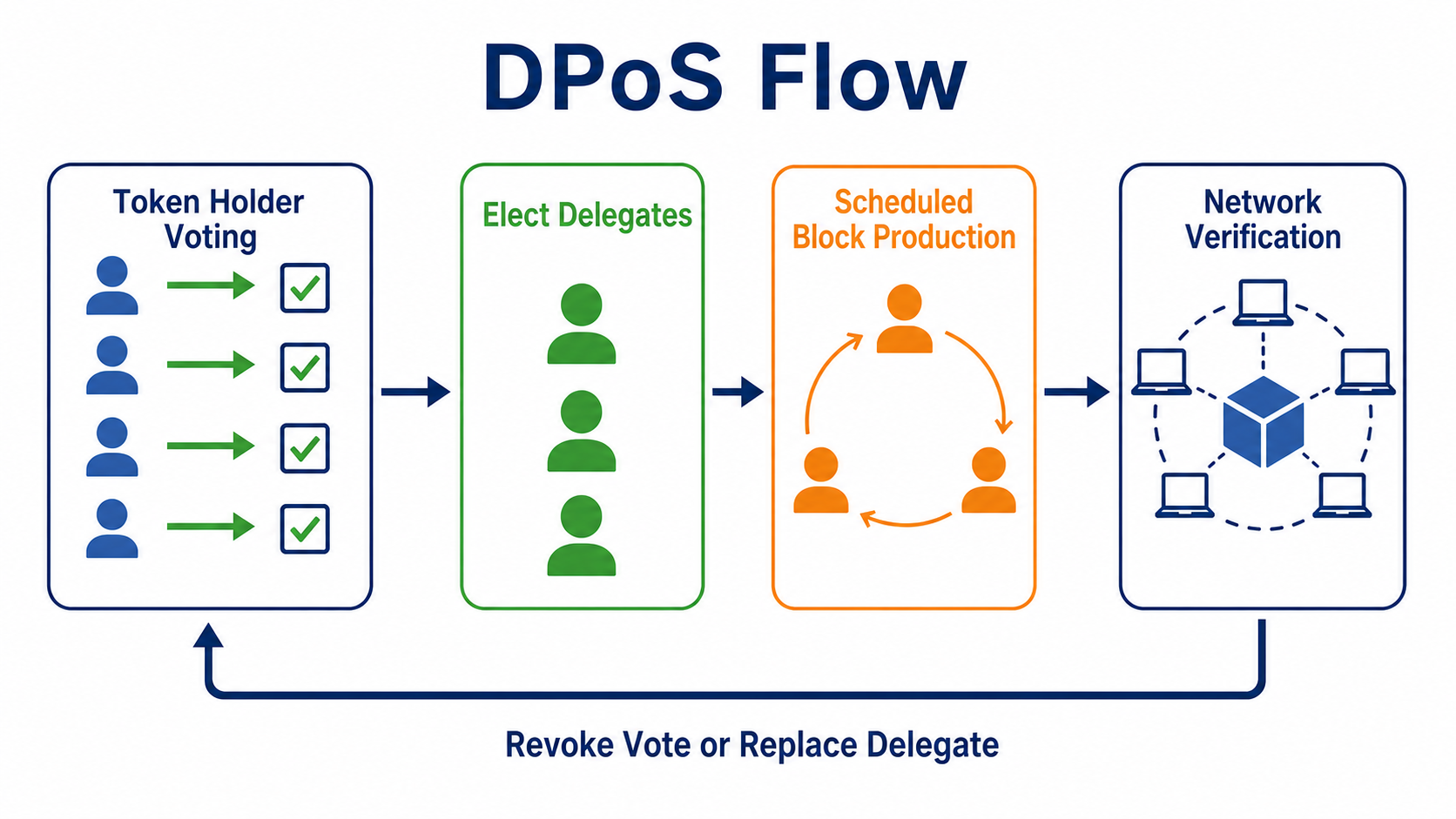
How Does DPoS Select Block Producers?
Token holders use their voting power to support delegate candidates, and some networks also let them assign that voting power to a proxy. The protocol determines the active producer set from the vote and schedules the elected delegates to create blocks during designated time slots.
Delegates maintain nodes, collect transactions, sign blocks, and participate in finality votes. If a delegate goes offline, the schedule will usually skip that slot. A delegate that remains unreliable or loses support may be replaced after the next vote tally.
Voting does not mean a delegate can directly control a user's wallet. Voting rights, asset custody, and staking lockups are separate concepts, so users must still review the specific blockchain's contracts and governance rules.
How Is DPoS Different from Regular PoS?
PoS usually selects proposers from a larger validator set using stake and randomized rules, after which more validators submit votes. DPoS first holds a token-holder election and concentrates active block production rights in a smaller group of delegates.
| Comparison | PoS | DPoS |
|---|---|---|
| Participation | Stake directly as a validator or delegate stake to one | Token holders elect delegates that actively produce blocks |
| Active set | May include many validators | Usually maintains a small set of elected delegates |
| Block production | Selected randomly or by weight | Commonly follows a rotation or predetermined order |
| Governance feedback | Expressed through stake migration, protocol governance, or exit | Voters can directly withdraw votes and replace delegates |
| Main centralization risks | Large staking pools and custodial services | Low turnout, vote buying, proxy concentration, and delegate collusion |
DPoS is not a standard upgrade to PoS. It changes the tradeoff between representation and performance, and whether that tradeoff is suitable depends on the network's goals and its actual voting structure.
Why Does DPoS Usually Confirm Transactions Faster?
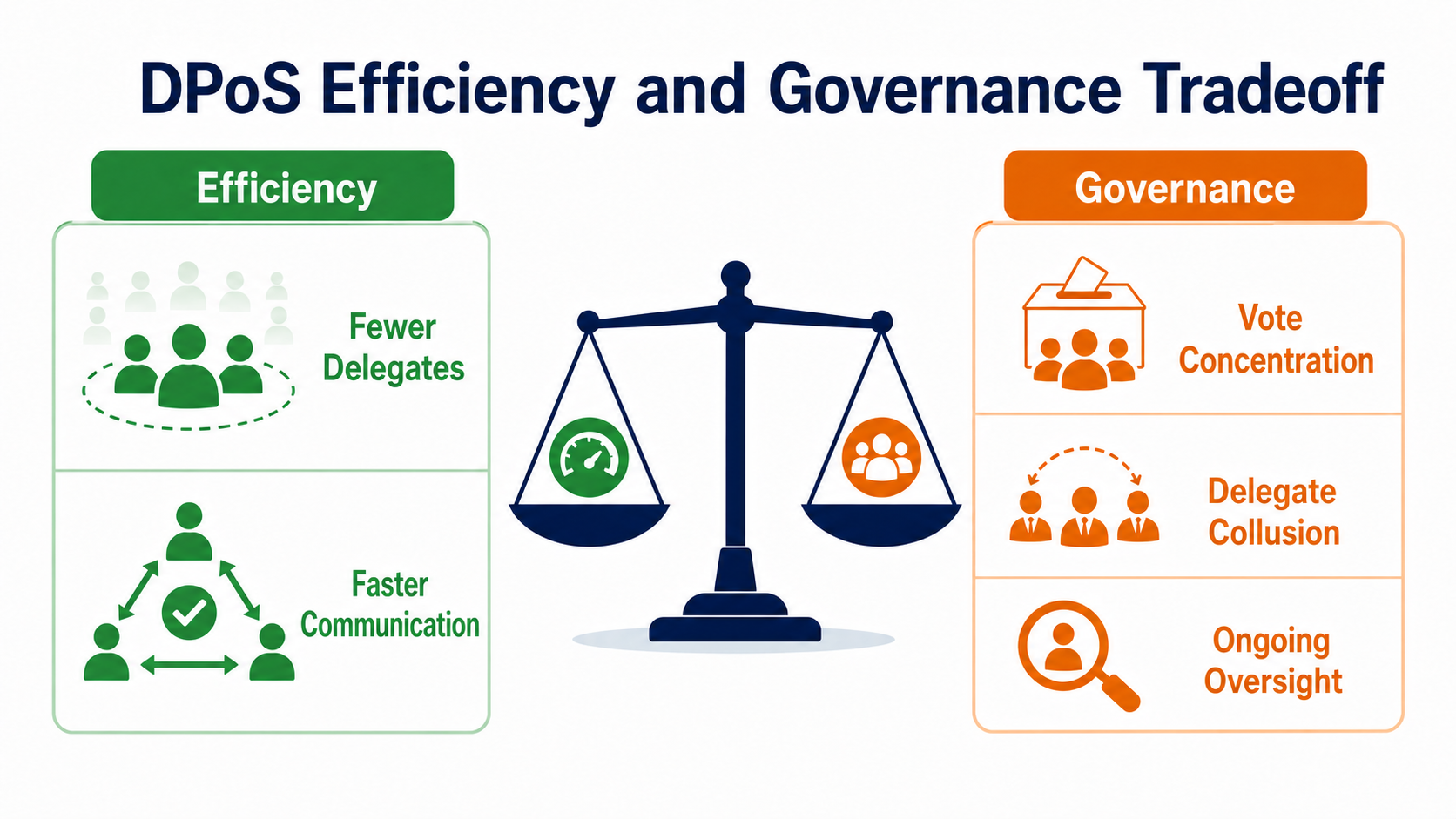
With fewer active delegates, the amount of consensus communication between nodes is easier to manage. A predetermined rotation reduces the wait caused by competitive block production, while BFT-style voting can provide fast finality once the required threshold is reached.
Speed is not determined by the DPoS label alone. Network bandwidth, block capacity, execution performance, delegate count, and finality rules all affect real throughput and confirmation times. Peak results in a test environment also do not represent stable performance during network congestion.
As the delegate set becomes smaller, part of the attack surface shifts from competing for network-wide computing power or stake to controlling elections and a limited number of critical nodes. The system must make block production records, vote changes, and delegate operations transparent for the replacement mechanism to work effectively.
What Does “Democracy” Mean in DPoS?
DPoS voting is generally weighted by token holdings rather than based on one person, one vote. Large holders, exchanges, and proxy voting services may have greater influence, while low participation among smaller holders further amplifies the weight of active voters.
Some networks allow proxy voting, which reduces the burden on ordinary users to continually research candidates but also concentrates decision-making in a small number of proxies. If delegates support one another, share rewards, or form stable alliances, the technical ability to replace them does not guarantee meaningful competition in practice.
To determine whether governance is decentralized, examine voter participation, the weight controlled by the largest accounts, delegate turnover, reward distribution, and emergency powers instead of looking only at the total number of candidates.
What Should You Check When Evaluating a DPoS Network?
- How many active block producers are there, and how easily can a candidate enter the elected set?
- Is voting power persistently concentrated among exchanges, large holders, or a small number of proxies?
- What penalties and replacement procedures apply when a delegate goes offline, double-signs, or censors transactions?
- How many delegate signatures are required for finality, and does the network prioritize safety or continued block production during a partition?
- Who approves governance parameters, contract upgrades, and emergency powers, and can their actions be independently verified?
To compare DPoS with competition based on computing power, read Proof of Work. To compare it with a larger validator set, read Proof of Stake. You can find a unified comparison of other approaches in the Consensus Mechanism Guide.
Frequently Asked Questions
Can DPoS Users Vote for Multiple Delegates at the Same Time?
It depends on the network. Some use approval voting, allowing one account to support multiple candidates, while others limit the number of votes or use proxy voting. Similar voting interfaces do not mean the underlying tally rules are identical.
Are Tokens Transferred to a Delegate's Address After Voting?
Usually, users delegate voting rights or staking weight rather than transferring ownership of their tokens to the delegate. However, whether assets are locked, how they are unlocked, and whether users share slashing penalties depend on the specific protocol.
What Happens When an Elected Delegate Misses a Block?
A common response is to skip that time slot and record the absence. Persistent downtime may reduce rewards or affect future votes. Whether assets are slashed and when the delegate is removed from the active set depend on the blockchain's rules.
Can DPoS Voting Prevent Delegates from Colluding?
No. Voting creates a way to replace delegates, but collusion can persist through concentrated voting power, reciprocal voting, or limited transparency. Assess it using on-chain votes, relationships between delegates, and actual block production data.
Inirerekumendang pagbabasa
Tingnan ang higit pa

service hotcoin.com
producthotcoin.com
businesshotcoin.com
casecnhotcoin.com