
What is the MEV-Share Mechanism?
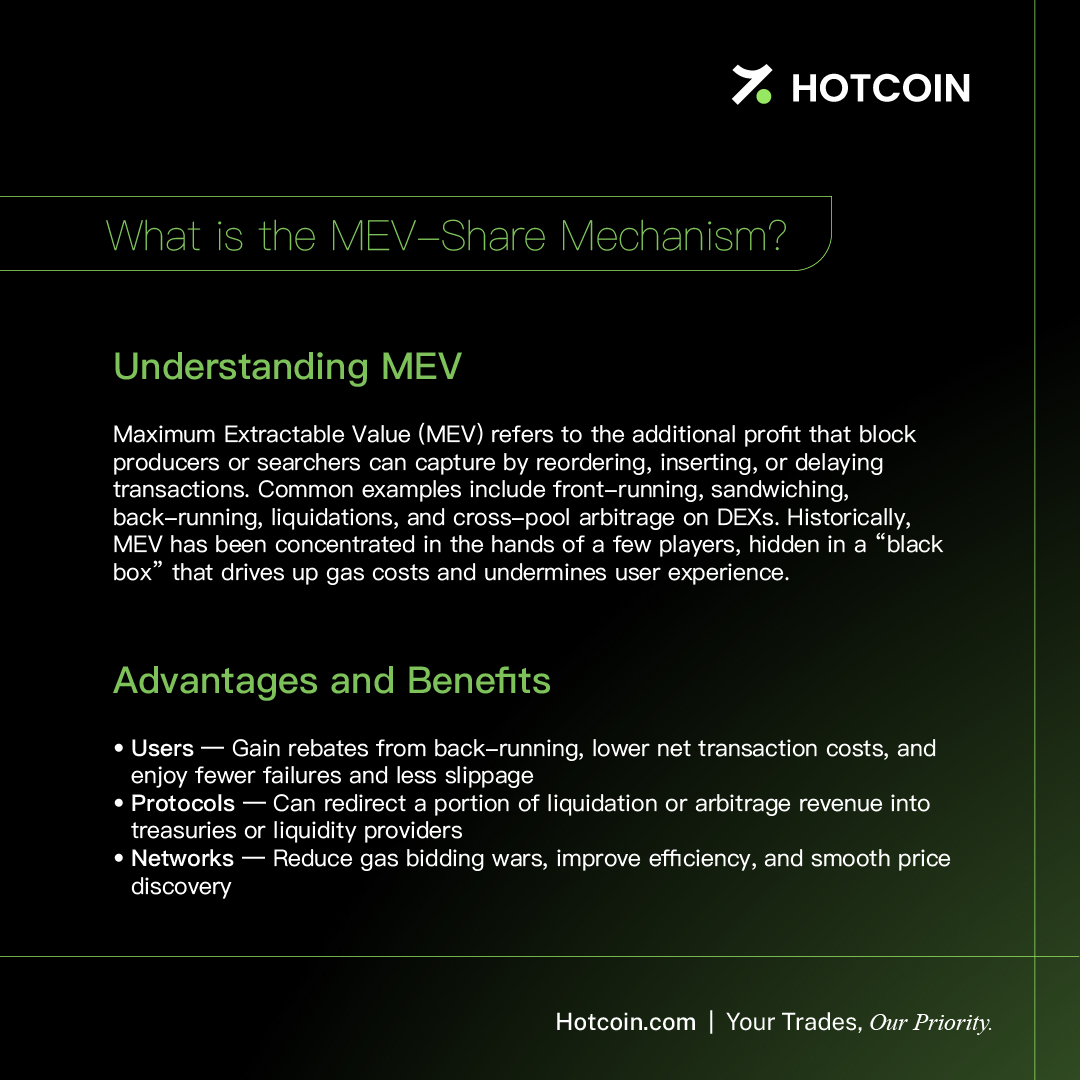
MEV-Share is a technical and market mechanism that redistributes part of the Maximum Extractable Value (MEV) from miners/validators and searchers back to the users or applications that initiate the transactions, while reducing harmful practices such as front-running and sandwich attacks.
Understanding MEV
MEV refers to the additional profit captured by block producers or searchers through reordering, inserting, or delaying transactions. Examples include front-running, sandwiching, back-running, liquidations, and cross-pool arbitrage on DEXs. Historically, MEV has been concentrated in the hands of a few participants, hidden in a “black box” that inflates gas fees and erodes user experience.
Key Issues MEV-Share Solves
Redistributes a portion of back-running/arbitrage profits to the true value creators (users and dApps)
Suppresses front-running and sandwich attacks through private order flow and data masking
Shifts MEV allocation from wasteful gas-fee bidding wars into structured auctions
How MEV-Share Works
A user submits a transaction through a private RPC or relay, setting conditions such as “only if the rebate meets a minimum amount and the transaction is not exposed to sandwiching.”
The matcher exposes only minimal transaction “hints” to avoid copying
Searchers create bundles with the user’s transaction plus the rebate
Builders/validators package the bundle on-chain
Rebates are paid directly to the user or contract address, or used to offset gas costs
Advantages and Benefits
Users — Gain rebates from back-running, lower net costs, fewer failures, and reduced slippage
Protocols — Can redirect part of liquidation/arbitrage revenue back into treasuries or LPs
Networks — Reduce gas bidding wars, improving efficiency and price discovery
Conclusion
MEV-Share doesn’t eliminate MEV—it restructures it. By converting opaque rent-seeking into transparent, competitive rebates, MEV-Share enables users and protocols to reclaim part of the value that rightfully belongs to them.
Inirerekumendang pagbabasa
Tingnan ang higit pa


Service@hotcoin.com
Product@hotcoin.com
Business@hotcoin.com
Casecn@hotcoin.com