
A Quick Guide to Crypto Minting vs. Mining
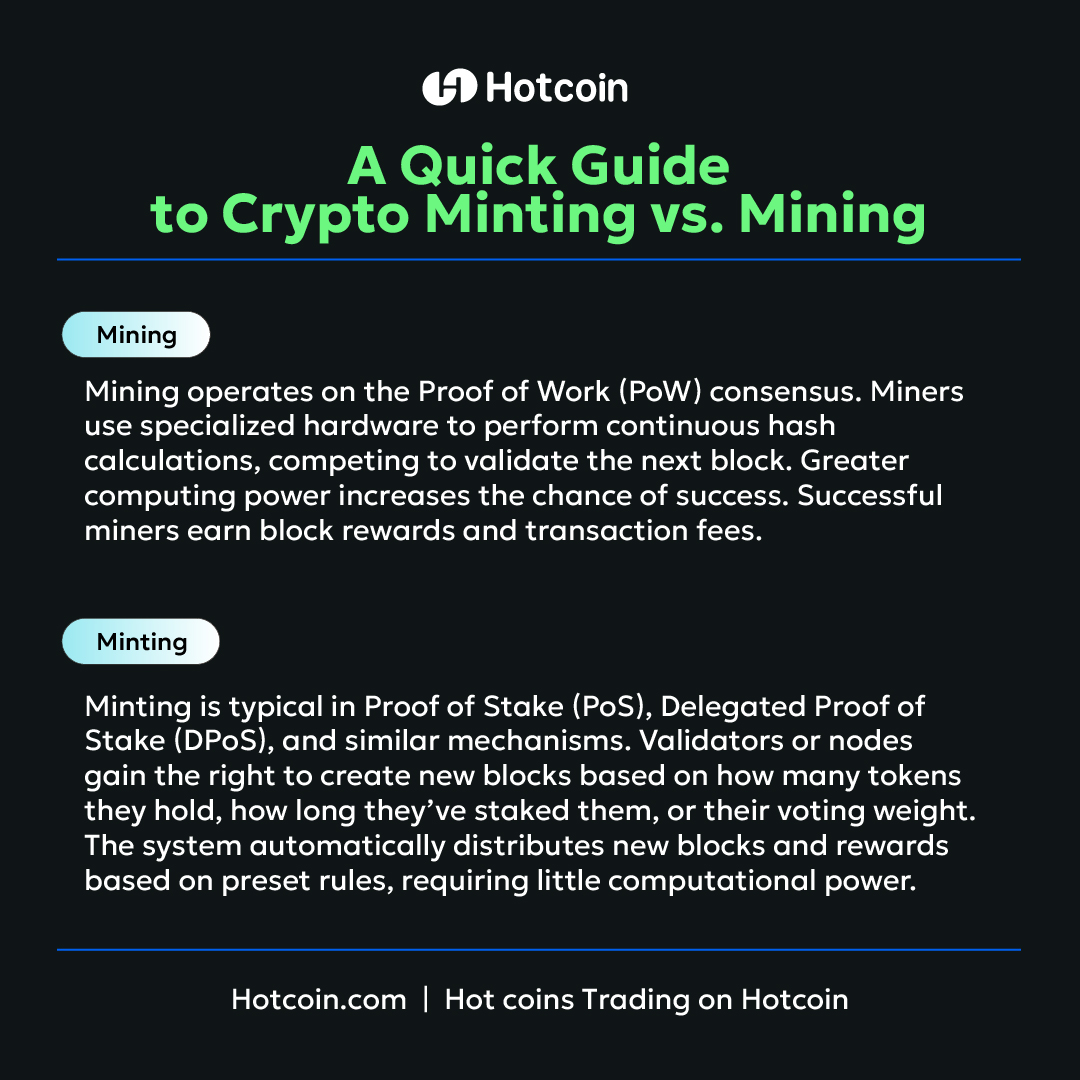
Crypto minting and mining are two fundamental methods of generating new digital assets. While both serve to issue and circulate tokens, they operate through different mechanisms that reflect the design philosophies of various blockchain networks.
1. Definitions
Mining: Mining uses the Proof of Work (PoW) consensus mechanism. Miners deploy specialized hardware to perform continuous cryptographic hash calculations, competing to validate and package the next block. Greater computing power increases the chance of success. Successful miners earn block rewards and transaction fees.
Minting: Minting is typical of Proof of Stake (PoS), Delegated Proof of Stake (DPoS), and similar mechanisms. Validators or nodes produce new blocks based on the amount of tokens they hold or stake, the duration of staking, or their voting weight. The process is automatic, energy-efficient, and follows preset rules to distribute rewards without heavy computation.
2. Similarities
Token Issuance: Both are primary means of introducing new tokens into circulation, supporting network inflation rates and economic models.
Security: Mining secures networks via computational power, while minting secures them through staked assets and penalties for malicious behavior (slashing). Both ensure data integrity through economic incentives.
Incentives: Block rewards and transaction fees motivate miners or validators to maintain network health and operations
3. Differences
Resource Consumption: Mining demands significant electricity and specialized hardware, raising environmental concerns. Minting requires locking tokens, making it far more energy-efficient.
Participation Threshold: Mining difficulty tends to exclude small participants, favoring large pools. Minting depends on staked token amounts, allowing broader participation with lower hardware demands.
Decentralization Risks: PoW risks centralization of computational power among large mining farms; PoS risks concentration of stake among wealthy holders (“the rich get richer”). Decentralization varies with network design and governance.
In summary, mining is rooted in computational competition and is characteristic of early blockchain security models. Minting emphasizes stake-based participation and aligns with today’s priorities for sustainable, energy-efficient blockchain technology. As the industry evolves, minting is increasingly becoming the dominant issuance and incentive mechanism for mainstream blockchain projects.
Inirerekumendang pagbabasa
Tingnan ang higit pa



Service@hotcoin.com
Product@hotcoin.com
Business@hotcoin.com
Casecn@hotcoin.com