Altcoin Season Explained: Rotation Patterns and Signals
An altcoin season is a market phase in which at least 75% of the top 50 cryptocurrencies outperform Bitcoin over 90 days. It marks the process of capital spilling out of Bitcoin into higher-risk assets, and historically it lasts two to six months. Yet the 2025–2026 market is going through structural change: the "institutional wall" of spot ETFs and the rise of AI and tech stocks are breaking the classic rotation path.
The Classic Definition of Altseason and Its Cycle
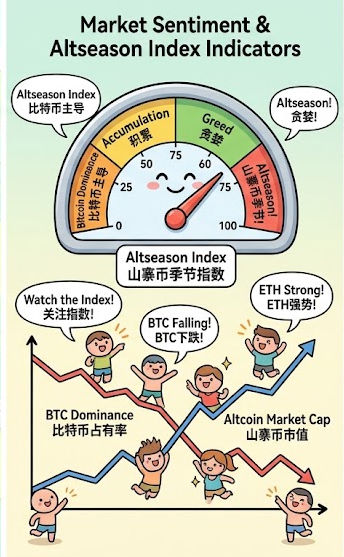
The quantitative standard for an altcoin season was introduced by BlockchainCenter and has since been widely adopted: within a rolling 90-day window, at least 75% of the top 50 cryptocurrencies (excluding stablecoins) must outperform Bitcoin, and an Altseason Index above 75 means the market is in an altcoin season; below 25 it is a "Bitcoin season."
Historically, altseasons have started along a typical capital rotation path: outside money enters and buys Bitcoin first, profit-taking money spills from a rising BTC into Ethereum, and once ETH steadies the flow spreads to major public chains such as Solana, before small- and mid-cap altcoins finally become broadly active. A full altseason usually lasts 27 to 117 days (roughly six weeks to four months); its nature is a brief window of capital rotation, not a permanent state.

Core Metrics to Watch: How to Spot an Altseason Early
The Altseason Index is a lagging confirmation indicator — by the time it breaks above 75, most of the move is already over. Real traders watch the following leading signals:
Bitcoin dominance (BTC Dominance) keeps falling: when dominance drops from above 50% to 40% or lower, it usually means capital is leaving Bitcoin for altcoins. If BTC's share is flat or rising, rotation has not started.
The ETH/BTC ratio strengthens: a rising ETH/BTC ratio usually points to broader rotation. If Ethereum has already outperformed Bitcoin, the market is preparing for higher risk appetite, and smaller assets will follow.
Altcoin breadth expands: more than half of the top 50 altcoins beating BTC over 30 days is a key signal that rotation is under way.
Altcoin spot volume expands without a matching spike in funding rates: an early-stage signal — real money is buying rather than leveraged speculation dominating.
The Structural Shift in 2026: the "ETF Wall" and Capital Diversion
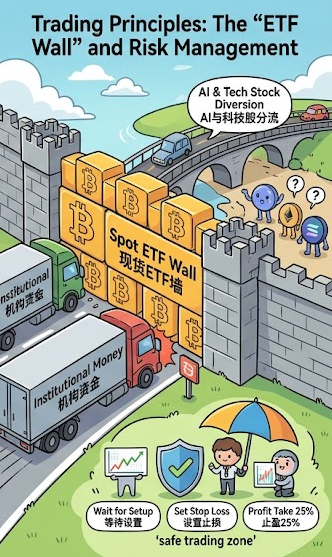
The launch of spot Bitcoin ETFs changed how money flows in. Clients of institutions such as BlackRock and Fidelity (pension funds, family offices) gain Bitcoin exposure through ETFs; that money needs no exchange account and no on-chain activity, and it stays "locked" inside the BTC ecosystem, almost never spilling into altcoins. In 2017 retail money could pour freely into thousands of altcoins; in 2026, ETF flows form a "wall" that blocks that spillover.
Altcoins also face competition from traditional finance. Global venture capital now has more attractive alternatives — AI infrastructure, semiconductors, and mega-cap tech stocks (the "Magnificent Seven"). Spending and investment around AI keep expanding, drawing in incremental risk capital that might otherwise have chased crypto beta. Altcoins no longer compete for attention only with other tokens; they are competing for the same risk budget against "AI as an asset class."
Market traits under institutionalization: institutional traders prefer highly liquid assets and often run non-directional strategies such as basis trades, which weakens the traditional transmission from retail FOMO to an altcoin rally. In June 2026, the altcoin share of Binance futures volume plunged from 63% to 47% within a week as money rushed to BTC and ETH for safety; by August, however, that share had rebounded sharply to 65%, the highest in two years, with BTC down to 21% and ETH to 13.6%. Such violent rotation shows that altseason has not disappeared — it has become more extreme and more driven by macro sentiment.
Entry and Exit Framework: a Data-Driven Trading Plan
Entry timing:
Early entry: when BTC dominance keeps sliding from a local high + ETH/BTC breaks above its 50-day moving average, act before the index clears 75. More upside, but also more risk of a false start.
Confirmed entry: wait for the Altseason Index to break above 75. Less upside, but a more reliable signal.
Exit signals (key to protecting profits):
BTC dominance bottoms and turns back up
ETH/BTC falls below its 50-day moving average
Funding rates on several altcoin contracts spike at the same time — a sign the market is over-leveraged and a reversal usually follows
The Fear & Greed Index reaches extreme greed while altcoin breadth starts to narrow
Example timeline:
Week 1: BTC dominance slips from 58% to 55%, ETH/BTC breaks its 50-day moving average → open a small position in ETH and large-cap altcoins
Week 3: the Altseason Index clears 60 and breadth expands → add to positions
Week 6: the index hits 78 and funding rates rise → cut 30–40%
Week 8: dominance bottoms and turns up, ETH/BTC rolls over → exit entirely
Practical principles: build positions in batches (two or three tranches), set your stop below the most recent swing low on the ETH/BTC chart, and take profit on 20–30% of the position when the index first breaks above 75.
FAQ
Q1: Where can I check the Altseason Index?
Mainstream platforms include BlockchainCenter (free, updated daily, the most widely cited), CoinGlass (near real-time, showing funding rates and open interest alongside), CoinMarketCap (free, refreshed daily), and TradingView (charts ETH/BTC and BTC.D, with price alerts).
Q2: How long does an altseason usually last?
Historically 27 to 117 days, with most traders treating six weeks to four months as the practical window. Altseasons are the brief result of capital rotation and end as soon as Bitcoin reasserts dominance or the macro environment shifts.
Q3: Why does BTC rise while altcoins do not?
Because ETF flows lock most new money inside Bitcoin, and it never spills into altcoins. At the same time, AI and big tech are absorbing risk capital that might otherwise have gone into crypto. An altseason only truly begins once BTC dominance actually starts falling and ETH/BTC confirms strength.
Q4: What is the most common beginner mistake during an altseason?
Chasing the top — buying after the index has been above 75 for weeks and funding rates are already elevated — is the most common cause of losses. The second is mistaking a single narrative (meme coins, for example) for a broad altseason: when breadth is narrow, the rotation is thematic rather than structural.
Related tutorials:
Crypto Market Cycle Analysis: From Bull and Bear Turns to Sector Rotation
Bitcoin Halving Cycle Explained: The Four-Year Rhythm of Wealth
Fear & Greed Index: A Quantitative Guide to Market Sentiment
Recommended reading:
Inirerekumendang pagbabasa
Tingnan ang higit pa