What Is Jito (JTO) and How to Buy It?
Jito is a liquid staking and MEV infrastructure on Solana. Users stake SOL with Jito to receive transferable JitoSOL while sharing MEV revenue.
JTO is Jito's governance token, used to decide network parameters, fees, and ecosystem incentives. It does not directly pay staking yield; its value comes from governance and the ecosystem.
Key Takeaways
- Jito provides Solana liquid staking (JitoSOL) and MEV infrastructure.
- JitoSOL keeps staked SOL liquid and allows it to stack DeFi yield.
- JTO is used for governance, with a total supply of 1 billion tokens and about 543 million in circulation.
- Risks include the Solana network, MEV policy, staking competition, and token unlocks.
What Is Jito?
Liquid staking turns staked SOL into tradable JitoSOL: users earn staking rewards while still being able to use JitoSOL in DeFi. Through validators and MEV auctions, Jito distributes part of the block space revenue to stakers.
MEV (maximal extractable value) refers to the extra revenue validators earn by ordering transactions. Jito's MEV auctions make this revenue transparent and share it with stakers, but they also raise discussions about centralization and fairness.
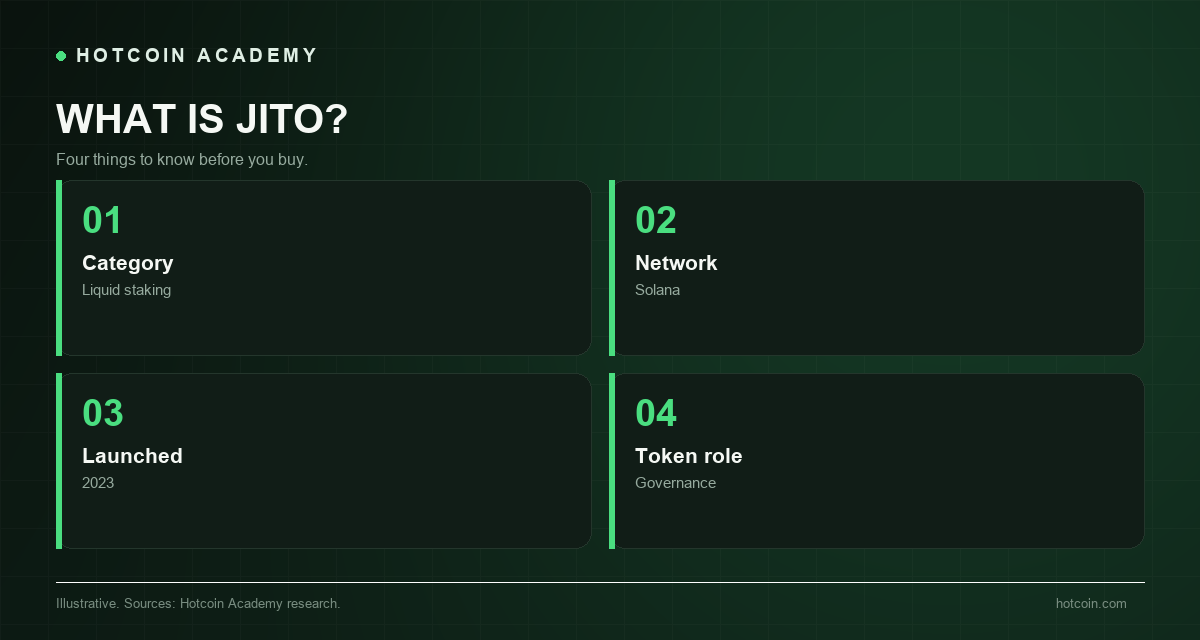
Figure: Four key facts about Jito.
JTO holders can participate in governance to decide fees, validator strategy, and the ecosystem fund. The token itself does not accrue fees; its value depends on Jito's share of the Solana staking market.
How Does Jito Work?
Jito's operation can be broken down into three parts:
- Staking: Deposit SOL into Jito to receive JitoSOL.
- Liquidity: JitoSOL can be traded, lent, or used to provide liquidity in DeFi.
- Governance: JTO holders vote on protocol parameters and incentives.
JTO Tokenomics
JTO has a total supply of 1 billion tokens and about 543 million in circulation. The token is used for governance and ecosystem incentives and does not directly distribute staking yield.
| Item | Data |
|---|---|
| Token name | Jito (JTO) |
| Total supply | 1 billion tokens |
| Circulating supply | About 543 million tokens |
| Market cap | About $182 million |
| Current price | About $0.335 |
| Drawdown from all-time high | About -94% |
Data from CoinGecko as of November 11, 2026; unlock and governance rules are subject to official sources.
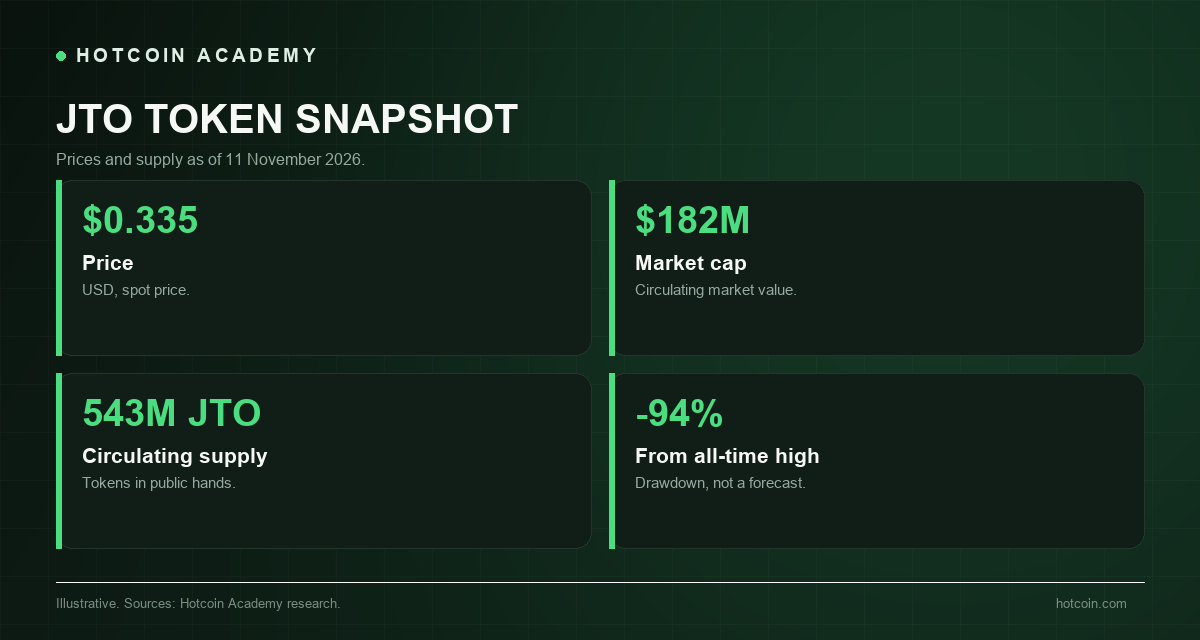
Figure: JTO market data snapshot (November 11, 2026).
Jito in 2026: Status and Risks
In 2026, liquid staking competition in the Solana ecosystem has intensified. Jito remains one of the largest players, but its share and fees face challenges. Regulatory and ethical discussions around MEV may also affect its business model.
JTO is about 94% below its high, with a market cap of about $182 million. The value of a governance token ultimately depends on whether the protocol can continue to attract SOL staking and trading volume.
- Solana network risk: Network outages or validator issues can affect staking.
- MEV policy: Regulatory or community restrictions on MEV may change revenue.
- Staking competition: Other LSTs and native staking divert users.
- Token unlocks: Uncirculated JTO creates selling pressure.
How to Buy JTO?
If you already understand Jito's mechanics and risks and decide to participate with a small amount, you can follow these steps to buy JTO on Hotcoin.
- Registration and KYC: Complete Hotcoin account registration and identity verification.
- Deposit: Deposit USDT or use a supported fiat on-ramp.
- Search for the trading pair: Search for JTO/USDT in the spot market.
- Place an order: Choose a market or limit order, confirm fees and slippage, and buy.
- Withdraw: For long-term holding, it is recommended to withdraw to a self-custody wallet and verify the contract address.
Common Misconceptions
- Treating JitoSOL as risk-free SOL.
- Treating JTO as a staking yield receipt.
- Ignoring the controversy over MEV and validator centralization.
FAQ
What is Jito? Jito is a liquid staking and MEV infrastructure on Solana. Users stake SOL to receive JitoSOL, and JTO is the governance token.
How is JitoSOL different from SOL? JitoSOL is a liquid receipt after staking, and its value increases with staking rewards. It can be used in DeFi; SOL is the native asset.
What is JTO used for? It is used for governance and ecosystem incentives and does not directly pay staking yield.
Why has JTO fallen so much? Solana ecosystem competition, token unlocks, and a broader market correction have combined to push JTO about 94% below its high.
Conclusion
Jito combines staking and MEV, allowing Solana users to stay liquid while sharing block space revenue. It is an important part of Solana infrastructure, but it also exposes the centralization controversy around MEV.
If you use Jito, watch JitoSOL's depeg risk and validator performance; if you hold JTO, watch governance and market share rather than short-term yield.
Risk warning: This article is for educational and informational purposes only and does not constitute investment advice. Crypto assets are highly volatile, and new coins and small-cap tokens carry higher liquidity risk. Investors may lose their entire principal. Please do your own research and manage your position size.
Lectura recomendada
Ver más