What Is a Stablecoin? USDT, USDC and Key Stablecoin Regulations
In the crypto market, stablecoins are the only "cash." They tokenize the US dollar so you can send, receive, trade, lend and hedge on the blockchain without wiring funds back to a bank every time. USDT and USDC are the two best-known names, but the reserves, regulation and risks behind them are what really determine whether they stay "stable."
From 2025 to 2026, stablecoins went from a crypto-native tool to a core financial-regulation topic: the EU's MiCA ended its transition period, Hong Kong's Stablecoins Ordinance issued its first licenses, and the US GENIUS Act entered its implementation phase. This article breaks down how stablecoins work, how USDT and USDC differ, and the regulatory changes you should watch in 2026, in plain language anyone can follow.
Key Takeaways
• A stablecoin is a cryptocurrency pegged to a fiat currency (usually the US dollar); issuers hold cash, short-term US Treasuries and similar assets as reserves, aiming for 1 token to equal 1 US dollar.
• In October 2026, total stablecoin market cap surpassed US$300 billion, with USDT at about US$178 billion and USDC at about US$70.6 billion, together more than 80% of the market.
• Stablecoins are not risk-free: reserve quality, issuer credit, depegging, address freezing and regulatory changes can all affect the dollar in your hands.
• Three major regulatory frameworks took shape in 2026: EU MiCA, Hong Kong's Stablecoins Ordinance and the US GENIUS Act; whether an issuer is compliant directly affects where and which products can trade.
What Is a Stablecoin and Why Does Crypto Need It?
A stablecoin is a cryptocurrency designed to maintain a fixed price, most commonly pegged 1:1 to the US dollar. How it works is simple: the issuer receives 1 US dollar and issues 1 token on-chain; when a user redeems the token, the issuer burns it and pays out US dollars. Reserve assets are typically cash, bank deposits, short-term US Treasuries or repurchase agreements.
For crypto, stablecoins solve three problems. First, they are a medium of exchange: most exchange trading pairs are quoted in USDT, so you can enter and exit without going through a bank. Second, they are a hedging tool: when markets turn bad, funds can park in stablecoins without leaving the chain. Third, they are a settlement layer: cross-border payments, DeFi lending, RWA (real-world assets) and on-chain funds all need a price-stable unit of account.
But "pegged" is a promise, not a law of physics. A stablecoin's value comes from the issuer's ability to redeem tokens for dollars at any time and in full. When reserves fall short, a custodian bank fails, or regulators require assets to be frozen, 1 dollar can become 0.87 dollars, or even less.
The Four Types of Stablecoins: Reserves Determine Risk
There are hundreds of stablecoins on the market, and their underlying designs fall roughly into four categories. Different types have completely different sources of risk.
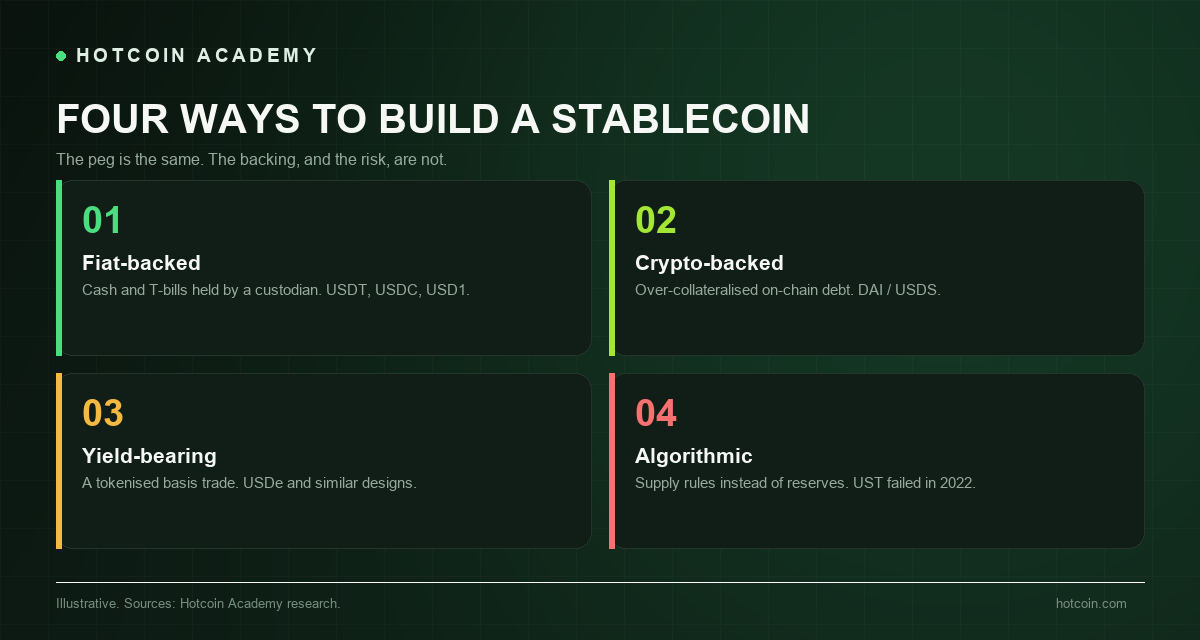
Figure: Four stablecoin designs, from fiat reserves to algorithmic adjustment.
| Type | Representative tokens | Reserve method | Main risks |
|---|---|---|---|
| Fiat-backed | USDT, USDC, USD1, PYUSD | Cash, bank deposits, short-term US Treasuries | Custody and reserve transparency, issuer credit |
| Crypto over-collateralized | DAI/USDS | Over-collateralized by ETH, stETH, WBTC, USDC, etc. | Liquidation risk, collateral volatility, oracles |
| Yield-bearing / synthetic dollar | USDe and others | Basis trades between spot and perpetual futures, custodied assets | Funding-rate reversal, custody and counterparty risk |
| Algorithmic | UST (collapsed) | Algorithmically adjusts supply with no full reserves | Death spiral; UST fell to nearly zero in 2022 |
The categories are simplified; a single token may use multiple mechanisms at once.
Fiat-backed stablecoins are the market mainstream and the design regulators understand most easily. Crypto over-collateralized stablecoins (such as DAI/USDS) put risk into on-chain liquidation; they are transparent but volatile. Yield-bearing stablecoins bundle "dollars" and "yield" together, with yield usually coming from basis trades or lending, so a market reversal can bring depegging and disappearing yield at the same time. Algorithmic stablecoins have already been proven by the 2022 UST event: "stability" without full reserves is very fragile in a run.
USDT vs. USDC: Market Share, Reserves and Transparency
USDT is issued by Tether and launched in 2014, registered in the British Virgin Islands; it is the earliest and largest stablecoin by circulation. Its advantage is liquidity and exchange support: almost every centralized exchange has USDT pairs, especially in emerging markets and cross-border payment scenarios. USDC is issued by Circle, launched in 2018 and headquartered in the US; its reserves are mainly cash and money market funds managed by BlackRock, with stronger transparency and links to US regulation.
| Item | USDT (Tether) | USDC (Circle) |
|---|---|---|
| Launch date | 2014 | 2018 |
| Issuer | Tether Limited (British Virgin Islands) | Circle (US) |
| Reserve composition | Cash, short-term US Treasuries, repos, a small amount of other assets | Cash and short-term US Treasuries, mainly held in BlackRock money market funds |
| Disclosure | Quarterly reserve attestation | Monthly reserve reports, public fund holdings |
| Market cap (November 2026) | About US$178 billion | About US$70.6 billion |
| Main advantages | Deepest liquidity, most trading pairs | Higher compliance and transparency, broad DeFi adoption |
| Main risks | Reserve transparency and issuer credit | US regulatory and banking-system risk |
Market cap from CoinGecko as of November 4, 2026; reserve information is subject to the issuer's latest announcements.
Both have depegged before. When UST collapsed in 2022, USDT briefly fell to about US$0.95; in March 2023, when Silicon Valley Bank failed, about US$3.3 billion of Circle's reserves were stuck there and USDC briefly fell to about US$0.87. Both recovered within days, but this shows that "stability" depends on the accessibility of reserves, not on the brand.
In practice, USDT is more like "the dollar for trading" and USDC more like "the dollar for compliance and DeFi." Which to choose depends on where you need to trade, whether you need regulatory compliance, and how much you trust the issuer's disclosure.
Stablecoin Regulations: Three Major Frameworks in 2026
2026 is a watershed for stablecoin regulation. The era of "issue first, fix later" is over, and major markets have created licensing, reserve, redemption and disclosure requirements.
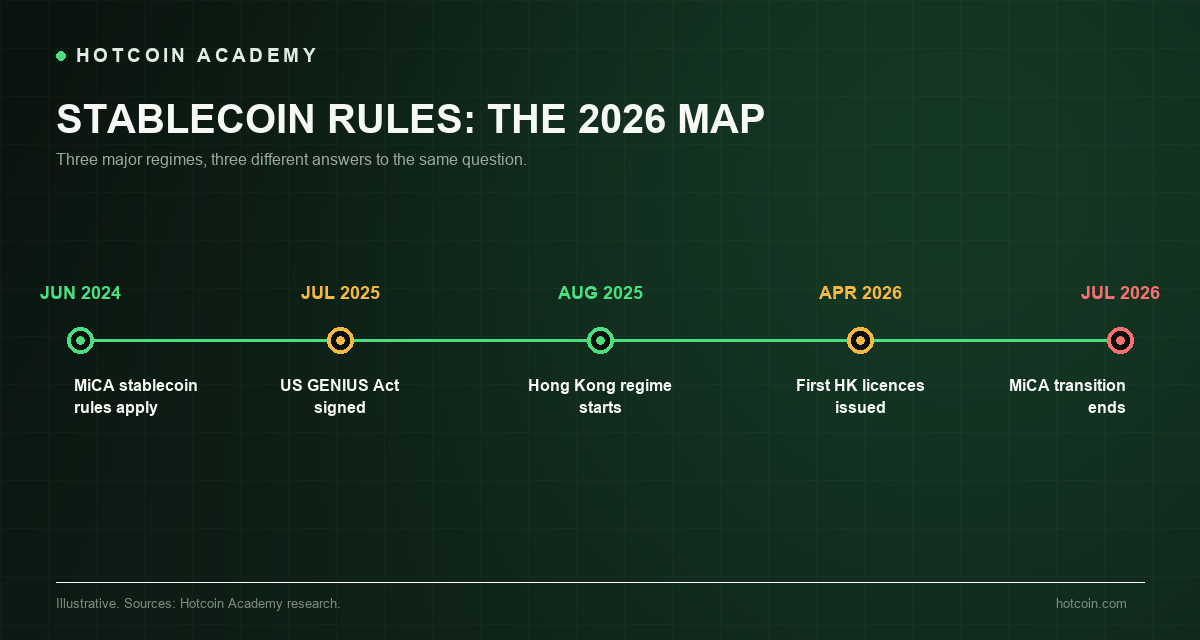
Figure: The stablecoin regulatory timeline across three major markets, 2024 to 2026.
EU: MiCA's E-Money Tokens (EMTs)
MiCA has applied stablecoin rules since June 30, 2024, classifying tokens pegged to a single fiat currency as e-money tokens (EMTs), requiring 1:1 reserves, redemption at par, no interest payments, and stricter capital and liquidity requirements for "significant EMTs." After the transition period ends on July 1, 2026, unauthorized crypto-asset service providers may no longer offer services in the EU; several European exchanges have also restricted or delisted non-compliant USDT pairs.
Hong Kong: The Stablecoins Ordinance and the First Licenses
Hong Kong's Stablecoins Ordinance took effect on August 1, 2025. Any institution issuing fiat-referenced stablecoins in Hong Kong, or promoting related products to the Hong Kong public, must obtain a license from the HKMA. On April 10, 2026, the HKMA issued its first licenses to HSBC and to Anchorpoint Financial, a joint venture of Standard Chartered, HKT and Animoca Brands. Anchorpoint's Hong Kong dollar stablecoin HKDAP rolled out in phases from August; HSBC launched RedCoin (RCHKD) on PayMe in October, targeting payment scenarios for 3.3 million users and more than 100,000 merchants.
The key points of Hong Kong's regime: reserves must be backed by high-quality liquid assets, maintained at 1:1, redeemable at par, no interest paid, and subject to ongoing HKMA supervision. This turns stablecoins from a "crypto tool" into regulated payment infrastructure, and means unlicensed issuers will find it hard to operate compliantly in Hong Kong.
US: The GENIUS Act and OCC Implementing Rules
The US GENIUS Act was signed on July 18, 2025, creating a federal framework for "payment stablecoins": issuers must be permitted payment stablecoin issuers, reserves must be cash, short-term US Treasuries and other high-quality assets maintained at 1:1, paying interest or yield to holders is prohibited, and reserves must be disclosed regularly and audited. The OCC completed implementing rules in October 2026, and existing issuers must complete relevant filings by January 18, 2027.
| Market | Regulation | Core requirements | Impact on users |
|---|---|---|---|
| EU | MiCA (EMT/ART) | 1:1 reserves, redemption at par, no interest, stricter rules for significant tokens | More compliant pairs; non-compliant tokens delisted |
| Hong Kong | Stablecoins Ordinance | HKMA licensing, high-quality reserves, 1:1 redemption, no interest | Limited compliant issuers; payment use cases lead |
| US | GENIUS Act | Federal/state chartering, 1:1 reserves, no interest, audit and disclosure | Compliant stablecoins further integrated with the banking system |
National rules are still evolving; actual application is subject to local regulator announcements.
Stablecoin Risks: Depegging, Freezing and Regulation
Stablecoin risk can be divided into two layers: "the coin itself" and "the use case." The coin's own risk comes from reserves and the issuer; use-case risk comes from exchanges, wallets, DeFi contracts and regulation.
• Depegging risk: insufficient reserves, custodian bank failures and market runs can push the price briefly or permanently below 1 dollar. UST is the most extreme case.
• Issuer credit: whether reserves are real, whether they have been misappropriated, and whether there is enough liquidity to meet redemptions determine the stablecoin's "last line of defense."
• Freezing and blacklists: compliant stablecoins can freeze addresses on law-enforcement or sanctions grounds. This means your assets are not fully permissionless.
• Regulatory risk: delisting in a market, a token being deemed a security, or an issuer losing its license can all affect tradability and price.
• Smart contract risk: using stablecoins in DeFi also exposes you to the contract risk of lending protocols, bridges and liquidity pools.
There is another often-overlooked risk: yield. Both the GENIUS Act and MiCA prohibit issuers from paying interest directly to holders, yet "stablecoin yield" products still exist. This yield usually comes from lending, basis trades or rehypothecation, not from the stablecoin itself. When chasing yield, you take on additional counterparty and strategy risk.
How to Choose and Use Stablecoins
When choosing a stablecoin, ask three questions first: Where will I use it? Is the issuer regulated? Are reserves transparent? If you are only trading on exchanges, liquidity and trading pairs come first; if you are parking funds long-term or making cross-border payments, compliance and redemption capacity matter more.
• Check reserve disclosure: are there regular reports, are they verified by independent parties, and are reserves in cash and short-term US Treasuries?
• Check regulatory status: does the issuer hold local licenses, and does it comply with 1:1 redemption and the no-interest requirements?
• Check on-chain liquidity: the same stablecoin has different depth on different chains, and cross-chain bridging adds risk.
• Diversify issuers: don't put all your funds in a single stablecoin, especially large amounts parked long-term.
• Keep a redemption path: confirm you can convert stablecoins back to fiat through a compliant exchange or the issuer, not just transfer them on-chain.
When using stablecoins, prefer regulated exchanges and wallets, and avoid leaving stablecoins in unknown DeFi contracts long-term. If you need yield, look clearly at the source of the yield and the worst case, and don't equate "stablecoin" with "principal-protected."
The 2026 Landscape: Beyond US$300 Billion
In October 2026, total stablecoin market cap surpassed US$300 billion. Two trends sit behind this number: first, stablecoins are moving from trading tools to payments and settlement; second, regulation is pushing issuers toward banks and large financial institutions. HSBC's RedCoin, Standard Chartered-backed HKDAP, and World Liberty obtaining a conditional OCC trust bank charter all show that stablecoins are becoming "traditional-finance-ized."
For ordinary users, this means clearer rules and better consumer protection, but also less anonymity and higher compliance thresholds. The future stablecoin market may not be about "who has the largest market cap" but about "who can circulate compliantly in the most markets."
Common Misconceptions
• "Stablecoins equal cash": stablecoins are liabilities of the issuer, not cash protected by deposit insurance.
• "The 1-dollar peg can't break": USDC once fell to 0.87 and USDT to 0.95; in extreme cases they may not recover.
• "Big market cap means safe": market cap only reflects circulation, not reserve quality or redemption capacity.
• "Stablecoin yield is the risk-free rate": yield comes from lending, basis trades or rehypothecation, with strategy and counterparty risk behind it.
FAQ
Are stablecoins really stable? Under normal market conditions, compliant stablecoins usually stay close to 1 dollar; but during runs, custodian bank failures or reserve doubts, they can still depeg briefly. A stablecoin's "stability" is the issuer's promise and reserve backing, not a guarantee.
Is USDT or USDC safer? Both have large reserves and market validation, but their risks differ in focus. USDC's US regulation and disclosure are more transparent; USDT's liquidity and trading pairs are broader. Rather than picking a side, diversify by use case and check the issuer's latest reserve reports.
Do stablecoins earn interest? Compliance frameworks (MiCA, the GENIUS Act, Hong Kong's Ordinance) generally prohibit issuers from paying interest directly to holders. The yield seen in the market mostly comes from lending, basis trades or third-party wealth-management products; it is additional risk, not a built-in feature of stablecoins.
What does Hong Kong's Stablecoins Ordinance regulate? The Stablecoins Ordinance took effect on August 1, 2025, requiring anyone issuing fiat-referenced stablecoins in Hong Kong or promoting them to the Hong Kong public to be licensed by the HKMA and meet reserve, redemption, disclosure and AML requirements. The first licenses were issued in April 2026.
What should I do when a stablecoin depegs? First determine whether it is a temporary liquidity problem or a reserve problem. If it is market panic, it usually stabilizes within days; if it is insufficient reserves or an issuer credit event, prioritize reducing exposure and avoid being forced to sell when liquidity is worst.
Conclusion
Stablecoins are the dollar layer of the crypto market and the intersection of traditional finance and the on-chain economy. They make trading and payments more efficient, but tokenizing the "dollar" does not make risk disappear; it shifts risk from price volatility to reserves, custody and regulation.
The 2026 regulatory frameworks have made the rules clear: 1:1 reserves, redemption at par, no interest, regular disclosure. For users, choosing compliant, transparent and redeemable stablecoins matters more than chasing short-term yield. To track the latest market caps and prices of USDT and USDC, see Hotcoin's stablecoin market page.
Risk warning: This article is for educational and informational purposes only and does not constitute investment advice. Stablecoins may depeg due to reserve, custody, regulatory or market-liquidity issues, and investors may lose part or all of their principal. Please assess risks yourself.
Lectura recomendada
Ver más