Palantir (PLTR) Stock Price | Live Chart, Market Cap & FAQ
PLTR is the ticker for Palantir Technologies Inc.'s Class A common stock listed on Nasdaq.
When reading this stock, first distinguish how much revenue government and commercial customers each contribute, compare the official descriptions of platforms such as Gotham, Foundry, Apollo, and AIP, and then return to the quote page to understand price and market cap.
Key Takeaways
- PLTR is the ticker for Palantir Technologies Inc.'s Class A common stock listed on Nasdaq. The company also has Class B and Class F common stock with different voting rights. Market cap calculations usually depend on whether the page includes all classes of common stock.
- The company reports results in two operating segments: government and commercial. In Q3 2026, commercial customer revenue was slightly higher than government customer revenue on a global basis; within the U.S. region, U.S. commercial revenue also exceeded U.S. government revenue for the first time. These two "exceeded" comparisons are not the same set of figures.
- Live charts reflect exchange trading. Regular trading hours are 9:30–16:00 New York time; pre-market and after-hours prices are not the official closing price.
- Market cap is generally estimated as "stock price × shares outstanding." It is not the cash on the company's balance sheet, nor does it mean all shares could be sold at the displayed price.
What is Palantir? Where is PLTR listed?
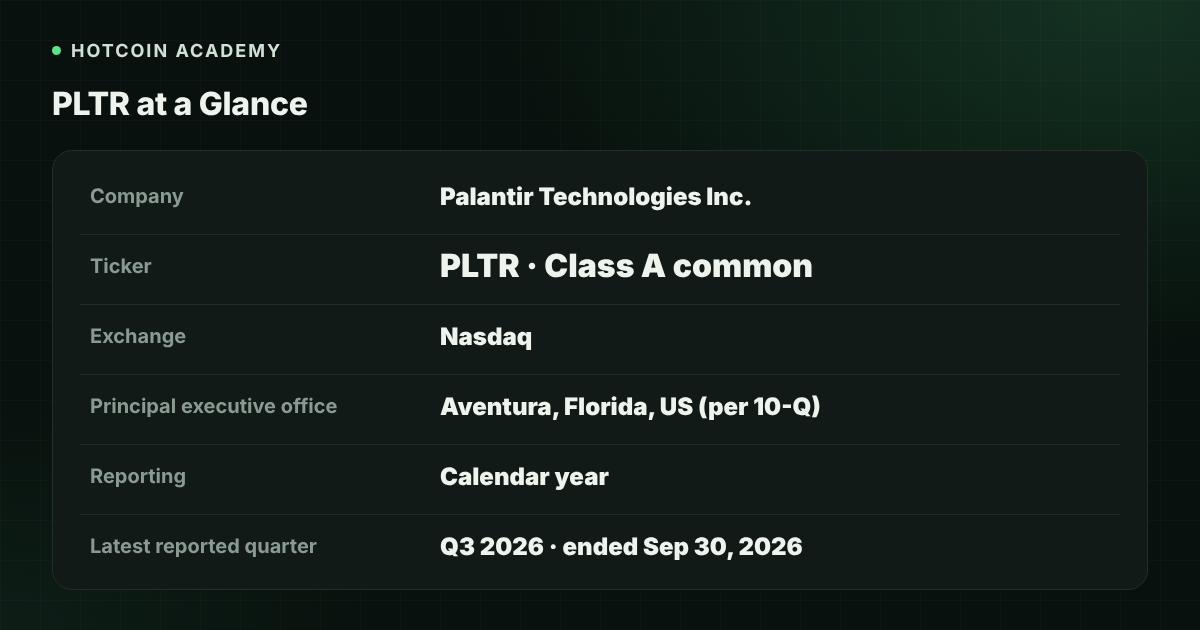
Palantir is a software company that primarily provides data processing, workflow, and artificial intelligence-related platforms to government and commercial organizations. According to the company's Q3 2026 Form 10-Q filed with the U.S. Securities and Exchange Commission, its principal executive office is located in Aventura, Florida, USA. Its stock is listed on Nasdaq, and PLTR is the ticker for its Class A common stock. The company reports on a calendar-year basis.
| Item | Details |
|---|---|
| Company name | Palantir Technologies Inc. |
| Ticker | PLTR (Class A common stock) |
| Exchange | Nasdaq |
| Principal executive office | Aventura, Florida, USA |
| Reporting cycle | Calendar year |
| Latest reported quarter | Q3 2026, ended September 30, 2026 |
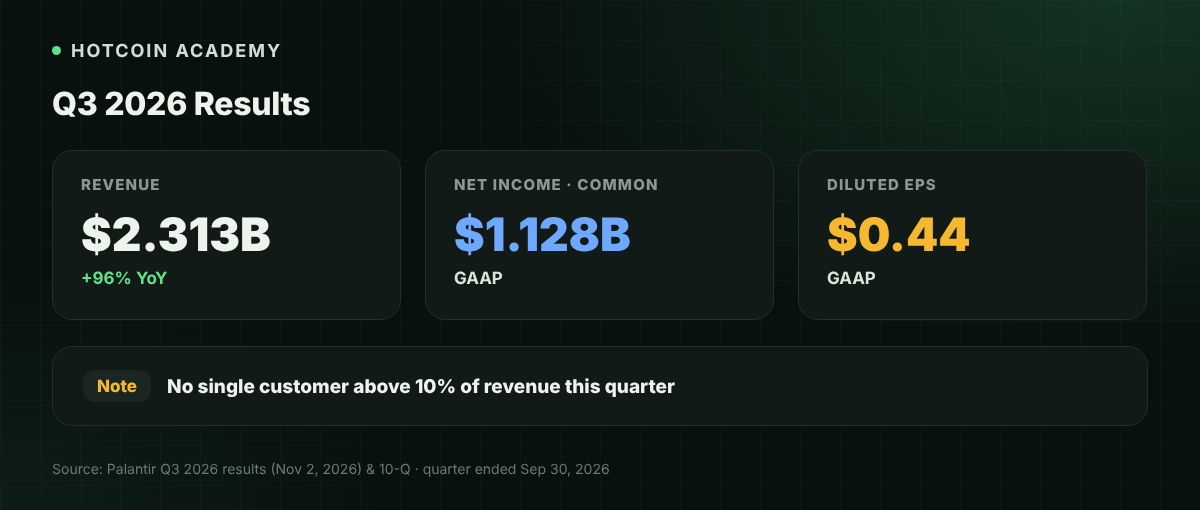
According to the Q3 earnings release published on Palantir's investor relations website on November 2, 2026, revenue for the quarter was $2.3134 billion, up 96% year over year; net income attributable to common stockholders was $1.1280 billion, and diluted earnings per share were $0.44. The same release also reported U.S. commercial revenue of $984 million, up 148% year over year, which exceeded U.S. government revenue of $953 million for the first time. It is important to distinguish: the "commercial slightly higher than government" in the summary is on a global segment basis, while U.S. commercial exceeding U.S. government is on a U.S. regional basis; the two sets of figures should not be mixed. These figures come from the company's published release and 10-Q and will be updated in subsequent quarters; please refer to the latest filings.
What businesses does Palantir make money from now?
In its 10-Q, the company divides its operating segments into Government and Commercial: the Government segment primarily serves U.S. and non-U.S. government agencies, while the Commercial segment primarily serves customers in non-government industries. These two segments reflect how management allocates resources and evaluates performance; they cannot be directly equated with the revenue of any single software product.
For Q3 2026, segment and regional revenue as reported in the 10-Q is as follows:
| Operating segment | Revenue for the quarter | Year-over-year |
|---|---|---|
| Government | $1.1455 billion | Up 81% |
| Commercial | $1.1679 billion | Up 113% |
| Region (by customer headquarters or agency location) | Revenue for the quarter | % of total revenue |
|---|---|---|
| United States | $1.9372 billion | 84% |
| Rest of world | $376.2 million | 16% |
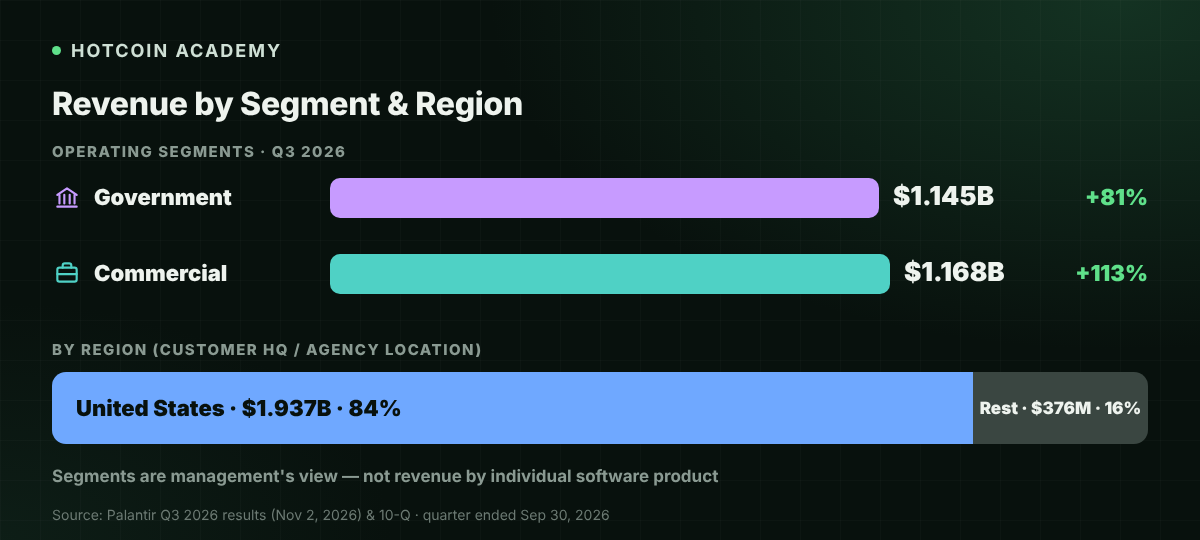
The earnings release also states that U.S. commercial revenue was $984 million and U.S. government revenue was $953 million; it also states that no single customer contributed more than 10% of total revenue in the quarter.
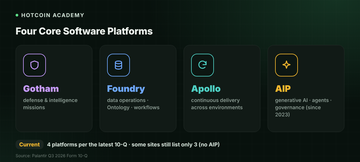
In its 10-Q, the company lists four core software platforms; names and descriptions are based on that document:
- Gotham: Combined with other platforms and defense-related products, it serves allied defense and intelligence missions.
- Foundry: A data operations foundation platform covering data management, logic orchestration, Ontology mapping, analytics, and workflows.
- Apollo: A continuous delivery platform used to coordinate upgrades, security updates, and configurations across different environments.
- AIP (Artificial Intelligence Platform): A generative AI platform used to connect large language models, build agents and automations on existing software platforms, and govern AI workflows in production environments. The company says deployment began in 2023, serving commercial and government customers.
When reading third-party quote pages or company profiles, note that some pages may still list only Gotham, Foundry, and Apollo, without AIP. The current core software platforms should be based on the four listed in the company's latest 10-Q.
Metrics such as contract value and remaining performance obligations help observe the pace of contract signing, but most contracts contain termination-for-convenience clauses. Total contract value should not be directly treated as recognized revenue, much less directly converted into a "fair stock price."
How to read PLTR's live chart?
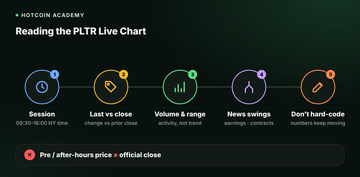
The live chart on a quote page comes from securities market trades. It is recommended to read it in the following steps:
- Confirm the trading session first: Regular U.S. trading hours are 9:30 to 16:00 New York time. The corresponding Beijing time differs by 12 or 13 hours depending on daylight saving time or standard time; refer to the time zone indicated on the page.
- Distinguish the latest price from the closing price: The latest price is the most recent trade price. Percentage changes are usually calculated relative to the previous trading day's official closing price. Pre-market and after-hours liquidity is often thin, so these prices should not be treated as a confirmed closing result.
- Consider volume and the day's high and low: These help judge whether intraday volatility is active, but they cannot alone prove that a trend has formed.
- Watch for volatility from earnings and contract news: Palantir draws high attention; earnings releases, large contracts, or changes in market sentiment can amplify short-term volatility. Single-day moves should not be extrapolated into long-term conclusions.
- Rely on the page's real-time data: This article does not hard-code the stock price, percentage change, or market cap at any specific moment.
How to read market cap?
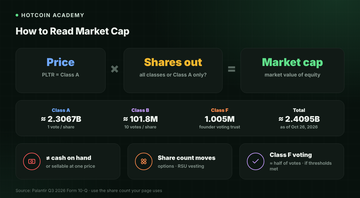
Market cap is generally estimated as follows:
Market cap ≈ Current stock price × Shares outstanding
The share count basis is subject to the explanation on the quote page. According to the 10-Q, as of October 26, 2026, there were approximately 2.3067 billion Class A common shares, approximately 101.8 million Class B shares, and 1.005 million Class F shares, totaling approximately 2.4095 billion shares. PLTR is only the ticker for Class A common stock. According to the 10-Q, Class A shares carry 1 vote per share and Class B shares carry 10 votes per share; Class F shares are held by founder-related voting trusts and, when the founders and related parties meet minimum ownership thresholds, generally allow the founders collectively to control close to half of the voting power. Different websites may calculate different market caps if they include only Class A shares or use share counts from different points in time.
When reading market cap, remember: it is not the cash on the company's balance sheet, nor does it equal the amount that could be obtained by selling all shares at once at the displayed price; employee option exercises and vesting of restricted stock will continue to change the share count.
Common Misconceptions
- "Palantir only does government or only does intelligence software": The company reports in two segments, government and commercial. In the quarter, commercial revenue was $1.1679 billion, slightly higher than government revenue of $1.1455 billion; in addition to Gotham, its platforms also include Foundry, Apollo, and AIP.
- "U.S. commercial exceeding U.S. government means the company no longer depends on government customers": The U.S. is only part of the regional breakdown. Globally, government and commercial still each account for a significant share, and government contracts are also subject to budgets, procurement, and termination clauses.
- "Total contract value or remaining contract value is revenue already booked": Metrics such as total contract value usually assume options will be exercised and contracts will not be terminated; actual revenue recognition is still subject to accounting standards and the current financial statements.
FAQ
Q1: On which exchange is PLTR listed? PLTR is the ticker for Palantir Technologies Inc.'s Class A common stock listed on Nasdaq. The company also has Class B and Class F common stock with different voting rights.
Q2: What are Palantir's main business segments now? The company reports in two operating segments: government and commercial. In Q3 2026, government revenue was $1.1455 billion and commercial revenue was $1.1679 billion. At the product level, the main platforms listed in the 10-Q are Gotham, Foundry, Apollo, and AIP, subject to the company's latest announcements.
Q3: How is PLTR's market cap calculated? It is generally calculated by multiplying the current stock price by shares outstanding. When calculating, confirm whether the quote page includes all classes of common stock and use the share count adopted by the page at that time.
Q4: Do pre-market or after-hours PLTR prices count as the official closing price? No. The official closing price usually corresponds to the result at the end of regular trading hours; extended-hours prices are a separate period of trading.
Q5: Can the stock price alone tell whether Palantir is expensive? No. The stock price does not include information such as share count, segment structure, and profit, and cannot alone constitute a basis for buying or selling.
Conclusion
PLTR is the ticker for Palantir's Class A common stock listed on Nasdaq. When looking at this stock, first confirm the revenue structure of its government and commercial segments, and understand the positioning of Gotham, Foundry, Apollo, and AIP according to the company's latest filings, then return to the quote page to read the live price and market cap; these figures will change with the market and share count, and should be based on the page's real-time display and the company's latest announcements.
If you also want to distinguish what "price" and "market cap" each explain and do not explain, you can first read What are market cap, circulating supply, and fully diluted valuation (FDV)?.
Risk warning: This article is for educational and informational purposes only and does not constitute any investment advice or buy/sell recommendation. The financial figures in this article come from the company's published financial statements or earnings releases and may be updated by subsequent filings. U.S. stock prices are highly volatile and may cause partial or total loss of principal. Please refer to the company's latest announcements and the real-time data on your page, and make decisions carefully based on your own risk tolerance.
Lectura recomendada
Ver más