Futures Platform Comparison: Fees, Depth and Mark Price
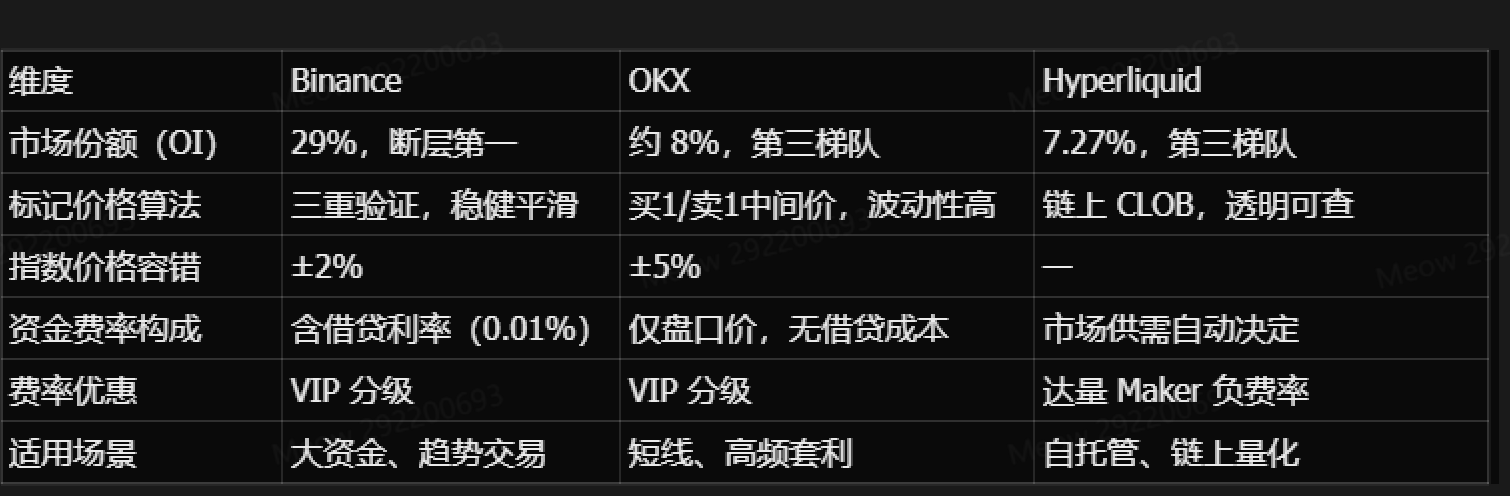
The core differences between futures trading platforms come down to three dimensions: the fee structure determines your trading cost, order book depth and liquidity shape how well large orders get filled, and the mark price algorithm directly affects liquidation risk in extreme markets. Binance leads by a wide margin with a 29% share of open interest (OI), while Bybit and MEXC rank second and third at 12.78% and 12.13% respectively, and OKX sits in the third tier. Market share alone does not tell the whole story, though — differences in the underlying algorithms can produce completely different experiences in real trading.
Fee Structure: How Maker and Taker Fees Work
Perpetual futures fees fall into two categories. Makers provide liquidity by placing orders that rest on the book, so their fees are usually lower and some platforms even offer a negative fee, meaning a rebate. Takers consume liquidity by filling at market, so their fees are relatively higher.
At Hotcoin, for example, USDT perpetual futures charge a 0.02% maker fee and a 0.06% taker fee. The formula is simple: fee = contract order value × fee rate. For high-frequency or large-scale traders, VIP tiers and fee deduction vouchers can lower the real cost further.
Fee structures vary widely across platforms. Hyperliquid rebates maker fees once a certain trading volume is reached, creating a negative-fee incentive, while OKX runs a full VIP tier system in which users with higher volume or balances enjoy tiered discounts.
Liquidity Depth: Who Holds the Most Leveraged Capital?
Open interest is the best indicator of an exchange's real capital pool. It represents the total of leveraged positions that have not yet been closed, and behind every unit of OI is margin genuinely committed by users and liquidation risk genuinely borne by the platform.
Based on April 2026 data, Binance averaged more than $23.6 billion in daily OI, leading by a wide margin with a 29% share and peaking at $26.55 billion — 2.3 times the $11.55 billion of second-place Bybit. That gap means Binance can absorb more large positions when the market moves violently, offering better execution quality for big orders.
The second tier is close together: Bybit (12.78%), MEXC (12.13%) and Gate (11.79%). The third tier includes OKX (8.0%), Bitget (7.62%), Hyperliquid (7.27%) and KuCoin (6.95%), and Hyperliquid is the only decentralized derivatives platform in the top group.
On major pairs, OKX and Hyperliquid also offer ample liquidity, and trades of tens of thousands to a few hundred thousand dollars usually cause no noticeable slippage. For very large orders or long-tail assets, however, Binance still has the edge in overall depth and instrument coverage.
Mark Price and Pin-Bar Risk: The Most Overlooked Difference
Mark price, not the latest traded price shown on the candlestick chart, is what determines whether a position gets forcibly closed. Differences in how exchanges calculate mark price explain why the same market move carries different liquidation risk on different platforms.
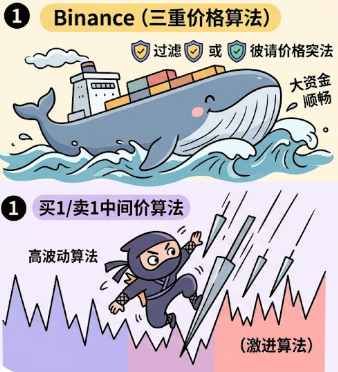
Binance uses a relatively conservative three-way verification mechanism: it takes the median of the spot index price, order book depth and actual contract trades. Volatility is smaller and momentary price spikes are filtered out effectively, which suits large capital looking for stability.
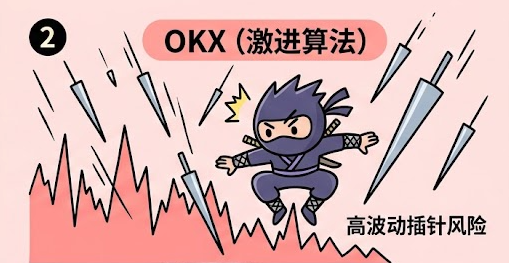
OKX is more aggressive. It uses only the midpoint between the best bid and best ask on the contract book — the taker price — without referencing order book depth. Volatility is higher, price converges back to spot faster, but pin bars are also more likely, and positions can be liquidated during a brief abnormal move. In addition, OKX allows its index price to deviate by ±5%, while Binance caps the deviation at ±2%, which further widens the difference in volatility during extreme markets.
In practice, OKX's mark price may reach the liquidation line earlier than Binance's under identical market conditions. Some traders describe it as OKX taking targeted shots at your account. For short-term traders, OKX's higher volatility means more frequent arbitrage opportunities; for large capital seeking stability, Binance's smoothing mechanism offers more protection.
Funding Rate: The Hidden Difference in Holding Cost
Funding rates in perpetual futures are also shaped by algorithmic differences. Binance factors both order book depth and borrowing rates (0.01% by default) into its funding rate, keeping it closer to real supply and demand and relatively steady. OKX calculates funding from order book prices alone without a borrowing-cost constraint, so the rate moves faster and more sharply.
That means the cost of holding a position over time can differ noticeably between platforms. For trend-following strategies, Binance's funding rate is more predictable, while OKX's swings can add unexpected costs while a position is open.
Comparison Overview
Three Tips for Choosing a Platform
- Look beyond fees to the algorithm and depth. Trading cost is not just the fee: it also includes slippage, funding rates and pin-bar liquidation risk, and these hidden costs are often far larger than the difference in headline fees.
- Understand the platform's mark price algorithm. If you trade on OKX, leave a wider safety margin for higher volatility; on Binance the mark price is steadier, but the futures-spot spread may converge more slowly.
- Make full use of platform features. Weigh market share, liquidity in the pairs you actually trade, historical funding rate behaviour, and whether stop orders can be triggered by a custom price type (mark price or last traded price).
FAQ
Q1: What is the difference between maker and taker fees?
A maker places an order that rests on the book and provides liquidity, so the fee is usually lower — as low as 0.02% on some platforms, or even negative. A taker fills immediately at market and consumes liquidity, so the fee is higher, typically 0.04%–0.06%. For high-frequency traders, maker orders can save considerable cost.
Q2: Is a platform with higher open interest always better?
Usually yes, but it is not the only standard. High OI means the platform carries more leveraged capital, offers deeper liquidity and produces lower slippage on large orders. You should also check whether funding rates are stable, whether the mark price algorithm suits your trading style, and whether the exchange holds sufficient reserve assets.
Q3: Why is the liquidation price different on different exchanges for the same market move?
The core difference lies in the mark price algorithm. Binance takes the median of three verification inputs, so volatility is smoother, while OKX references only the midpoint of the best bid and best ask and is more sensitive to brief price spikes. That makes OKX's liquidation trigger price easier to hit during a short pin bar.
Q4: How can you tell whether an exchange's liquidity is real?
Watch three dimensions. Open interest is the most honest measure of leveraged stock. The bid-ask spread matters too: the tighter the spread on major contracts, the better the market making depth. Finally, look at execution slippage on large orders — test the slippage of a $100,000 market order with a simulated order.
Related tutorials:
- Complete Guide to Futures Trading: From Basics to Risk Control
- Leverage Trading Explained: Bigger Gains, Bigger Risks
- Common Futures Trading Mistakes: 10 Errors Beginners Make
- Insurance Fund and ADL: Your Last Line of Defense
Recommended reading:
Lectura recomendada
Ver más