The Core Components of DeFi: DEXs, Lending, Stablecoins and Derivatives
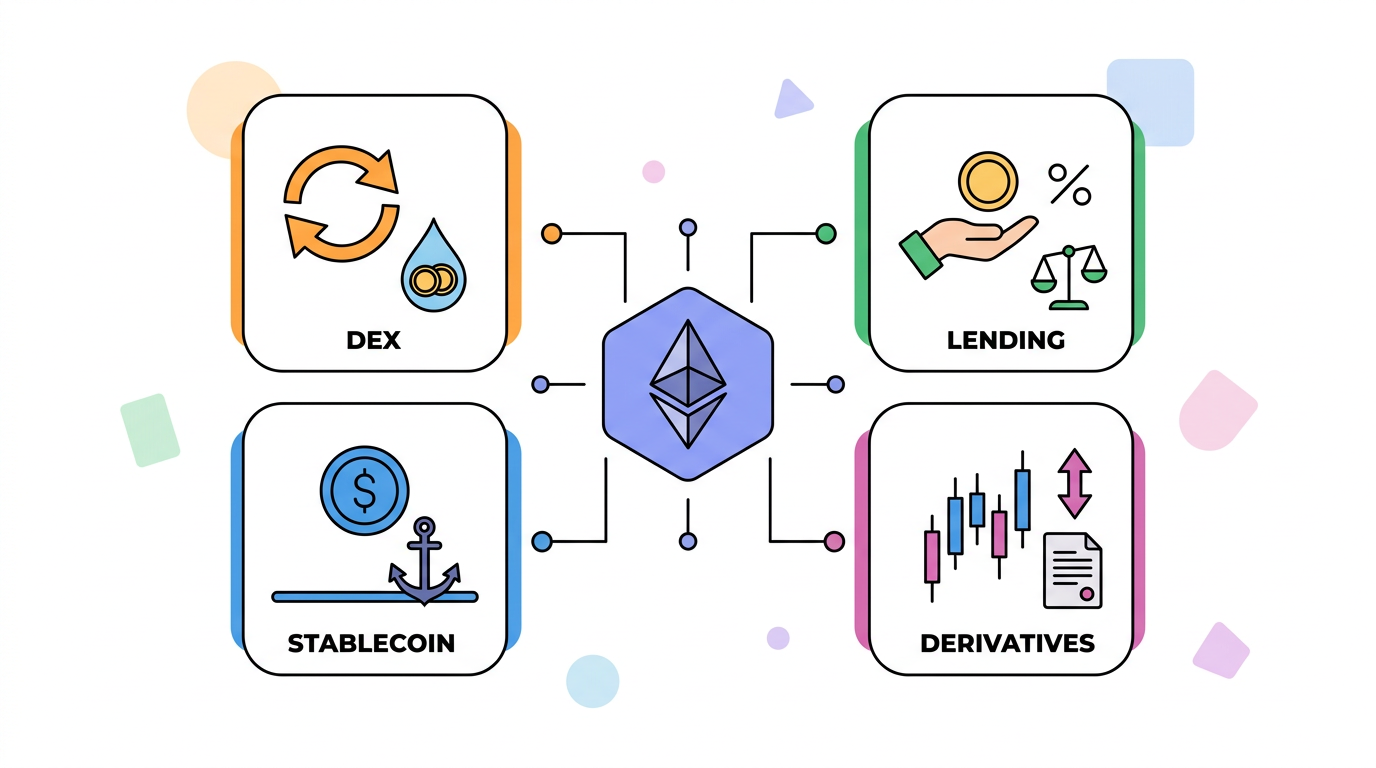
The core components of DeFi are mainly DEXs, lending, stablecoins and derivatives. They address, respectively, on-chain asset trading, the use of funds, value stability and risk management. They are not independent products; smart contracts let them combine with one another, together forming the basic financial system of DeFi.
In short: stablecoins settle what asset you trade with, DEXs handle how assets are exchanged, lending determines how funds are put to use, and derivatives manage price and risk.
1. Why are DEXs, lending, stablecoins and derivatives the core components of DeFi?
In the traditional financial system, payments, trading, lending, asset management and risk management are usually handled by different types of financial institutions.
DeFi splits these functions into protocols that can run on a blockchain.
A user might, for example, hold stablecoins, swap them for other digital assets through a DEX, deposit those assets into a lending protocol to earn interest, or hedge price swings through a derivatives protocol.
This makes DeFi look like a set of financial building blocks that can be freely combined.
The four core components can be understood as follows:

The key to really understanding DeFi is not memorizing these four terms, but understanding how they connect to one another.
2. What is a DEX, and why does DeFi need decentralized exchanges?
DEX stands for Decentralized Exchange.
The problem it mainly solves is:
How can users exchange digital assets without relying on a traditional centralized trading platform?
Traditional exchanges usually have the platform maintain the order book, match buyers and sellers, and provide the trading system.
A DEX instead uses smart contracts to execute trades on-chain. The mechanics differ from one DEX to another, and one important model is the AMM, or automated market maker.
Under the AMM model, users trade directly against a liquidity pool rather than waiting for a specific buyer or seller to be matched.
For example, a simple ETH/USDT liquidity pool holds both ETH and USDT:
User A provides liquidity → an ETH/USDT pool is formed → User B swaps USDT for ETH → the smart contract completes the asset exchange according to the protocol rules.
So a DEX is not just "a place to buy coins"; it is also key liquidity infrastructure in DeFi.
What are the core functions of a DEX?
The first is asset swapping.
Through trading pools or other trading mechanisms, users can exchange one on-chain asset for another.
The second is liquidity provision.
Some DEXs let users supply assets to liquidity pools and thereby take part in trading liquidity.
The third is price discovery.
Large volumes of buying and selling move trading prices, gradually producing a market price level.
A DEX does not mean trading is necessarily cheaper or safer, however.
Users still need to consider slippage, liquidity, gas fees, MEV and smart contract risk, among other factors.
3. What is DeFi lending, and why can funds be lent out on-chain?
DeFi lending addresses the second core question:
If users already hold on-chain assets, how can those assets be put to further use?
In traditional finance, banks can lend funds to borrowers and earn income from interest.
DeFi lending usually builds lending markets through smart contracts and on-chain collateral mechanisms.
A typical process is:
A user deposits assets → the assets enter the lending protocol → other users provide collateral → assets are borrowed → interest is paid according to the rules.
A user can, for example, deposit a digital asset into a lending market and become a liquidity provider, while another user collateralizes their own assets to borrow USDT, USDC or similar assets from the market.
Lending protocols set their rules based on supply and demand, collateral ratios, risk parameters and other factors.
Why does DeFi lending usually require collateral?
Because an on-chain protocol cannot necessarily judge a borrower's ability to repay through a complete credit system the way a traditional bank can.
As a result, many DeFi lending protocols use overcollateralization.
Put simply:
Loan value < collateral asset value
If the collateral price falls sharply enough to reach the liquidation condition set by the protocol, the liquidation mechanism may be triggered.
So collateral ratios and liquidation risk are key concepts in DeFi lending.
This is also why "how high is the lending rate" is not the only standard for judging a lending protocol.

4. What are stablecoins, and why do they run through almost the entire DeFi ecosystem?
Stablecoins are on-chain assets that try to maintain a relatively stable value, often aiming to peg to a fiat currency such as the US dollar.
They solve a very basic problem in DeFi:
If assets such as BTC and ETH keep fluctuating in price, what serves as a relatively stable unit of account for on-chain financial transactions?
Suppose a user buys an asset with ETH today; if ETH moves sharply within a short time, both sides of the trade face a sizable price change.
Stablecoins therefore become a very important medium for trading, collateral and settlement in DeFi.
Stablecoin mechanisms are not all the same today; common types include:
fiat-reserve-backed;
crypto-collateralized;
backed by other assets;
algorithmic or mechanism-driven.
Different types of stablecoins also differ in their stabilization mechanism, collateral approach and risk structure.
So "stablecoin" does not mean "it never fluctuates."
Users also need to look at the collateral assets, issuance mechanism, redemption mechanism and depegging risk.
What are stablecoins used for in DeFi?
First, trading.
Stablecoins can serve as an important trading asset on DEXs.
Second, lending.
Stablecoins can act as both a deposit asset and a borrowing asset in lending markets.
Third, collateral.
Some protocols allow users to use stablecoins as collateral or margin.
Fourth, settlement.
Because stablecoins usually try to maintain a relatively stable unit of account, they suit on-chain settlement of funds.
Stablecoins thus play one of the roles of "base money" in the DeFi ecosystem.
5. What are DeFi derivatives, and why trade derivatives on-chain at all?
If DEXs mainly handle asset trading and lending mainly handles the use of funds, derivatives handle:
how to use financial contracts to manage price changes, hedge risk or gain leveraged exposure.
DeFi derivatives can take different forms, including perpetual contracts, futures and options.
Perpetual contracts are one of the more common types of derivatives in digital asset markets.
Unlike holding ETH directly, when users trade ETH perpetual contracts they trade a contract position tied to ETH's price changes.
For example:
a user who expects ETH to rise can open a long position;
a user who expects ETH to fall can open a short position.
This way users do not necessarily have to buy or sell ETH directly to gain the corresponding price exposure.
Why are derivatives riskier?
Because derivatives usually involve leverage.
Suppose a user opens a larger notional position with 1,000 USDT of margin; even a relatively small adverse move in the ETH price can significantly affect that margin.
When account margin falls below the level required by the protocol, forced liquidation may be triggered.
Therefore:
Leverage magnifies the position, not only the potential profit — it magnifies potential losses too.
DeFi derivatives may also carry additional risks involving oracles, liquidity, funding rates, liquidation mechanisms and smart contracts.
6. How exactly do these four DeFi components relate to one another?
This is the most important part of understanding DeFi.
Do not think of DEXs, lending, stablecoins and derivatives as four completely separate products.
They can in fact form a complete on-chain financial flow.
For example:
A user holds ETH
↓
Swaps part of the ETH for stablecoins through a DEX
↓
Deposits the stablecoins into a lending protocol
↓
Other users borrow the stablecoins
↓
The borrowers use the funds to trade or for other on-chain activity
↓
The user can also hedge ETH price swings through derivatives
This is DeFi composability.
An asset provided by one protocol can become the input of another; liquidity generated by one protocol may also be used further by other applications.
DeFi innovation therefore comes not only from individual protocols, but from combinations of different financial components.
7. Where does each of the four components sit in DeFi?
They can be understood as four different layers of financial function.
DEX: the trading layer
It answers:
How are assets exchanged?
Its key words are trading, liquidity, market making and price discovery.
Stablecoins: the asset and settlement layer
They answer:
What serves as a relatively stable unit of account and medium of exchange on-chain?
Their key words are stable value, payments, settlement and collateral.
Lending: the credit and funding layer
It answers:
How do assets generate capital efficiency?
Its key words are deposits, borrowing, collateral, interest rates and liquidation.
Derivatives: the risk and strategy layer
They answer:
How do you manage price risk or gain exposure to a specific market?
Their key words are contracts, leverage, hedging, margin and liquidation.
Together, the four form a very important set of financial infrastructure in DeFi.
8. How do you judge whether a DeFi component deserves attention?
Do not look only at a protocol's advertised yield or token price; you can judge it along several dimensions.
1. Look at real usage demand
What problem does this protocol actually solve?
Are people genuinely trading, lending and using it, or does it mainly rely on incentives to attract funds?
2. Look at liquidity
Liquidity directly affects trade execution, slippage and the ability to exit.
For DEX, lending and derivatives protocols, liquidity is especially important.
3. Look at the size of funds
TVL helps users observe the scale of assets locked in a protocol or ecosystem at a given point in time, but it cannot by itself serve as the basis for judging safety or profitability.
To understand further how to read TVL, you can read What Is TVL? A Key Metric for Measuring the Value of DeFi Protocols.
4. Look at smart contract risk
Whether the protocol has been audited, how contract permissions are set and whether upgrade permissions exist are all issues worth watching.
5. Look at the liquidation mechanism
For lending and derivatives protocols, liquidation rules are especially important.
Users need to know:
Under what conditions is liquidation triggered? How is the liquidation price calculated? Who bears the loss after liquidation?
These questions are often more important than "what is the yield?"
9. How should you remember DEXs, lending, stablecoins and derivatives?
If you just want a quick overall grasp of DeFi, remember this sentence:
DEXs handle trading, stablecoins handle pricing and settlement, lending handles the use of funds, and derivatives handle risk and leverage.
Going one step further:
Stablecoins provide the unit of account commonly used in on-chain financial activity → DEXs provide asset exchange and liquidity → lending improves capital efficiency → derivatives provide leverage and risk management tools.
Smart contracts then connect these components so that different protocols can call on one another.
This is the essence of what DeFi calls "composability."
FAQ: Common questions about DeFi core components
What are the most core components of DeFi?
Common core components include DEXs, lending, stablecoins and derivatives. The DeFi ecosystem also includes other types of protocols such as staking, yield aggregation, insurance and asset management.
What is the difference between a DEX and a centralized exchange?
A DEX completes trades mainly through smart contracts and on-chain mechanisms, and users usually control their own wallet assets directly; a centralized exchange provides accounts, trade matching and asset custody through the platform. The two models differ clearly in how they are used, their risk structure and who bears responsibility.
Why are stablecoins important to DeFi?
Stablecoins can provide a relatively stable unit of account and medium of exchange, so they are widely used in DEX trading, lending, collateral and on-chain settlement. Without relatively stable assets such as stablecoins, a great deal of financial activity in DeFi would face more pronounced price volatility.
Does DeFi lending require no collateral?
Not necessarily. Many DeFi lending protocols use overcollateralization, and other types of on-chain credit mechanisms also exist. Whether collateral is required, what the collateral ratio is and when liquidation happens all depend on the specific protocol.
How do DeFi derivatives differ from simply buying BTC or ETH?
Buying an asset directly usually means holding spot; derivatives trading mainly gains some form of price exposure through contracts, and can go long, go short or hedge risk. Derivatives may also use leverage, so potential losses are usually faster and larger.
Can the four DeFi components be used together?
Yes, and this is an important feature of DeFi composability. Stablecoins, for example, can go into DEX trading or into lending protocols, and assets obtained through lending may in turn be used for trading or other on-chain strategies. How different protocols combine depends on the specific smart contracts and product design.
Risk disclosure
DeFi protocols carry relatively high technical and market risk. DEXs may face slippage, insufficient liquidity, MEV and smart contract risk; lending protocols may face falling collateral prices, liquidation and liquidity risk; stablecoins may face depegging, reserve or mechanism risk; and derivatives may see losses expand rapidly because of leverage.
Mechanisms and risks vary widely between protocols, and you cannot judge whether a protocol is safe based only on TVL, yield, trading volume or token performance. Before using DeFi products, you should fully understand their asset mechanisms, smart contract permissions, liquidity, liquidation rules and the potential scope of loss.
Lectura recomendada
Ver más