What Is the Difference Between Cryptocurrency and Traditional Money?
The biggest difference between cryptocurrency and traditional money is not that one lives on a phone while the other is printed on paper. They operate through different issuance systems, ledger structures, sources of trust, and legal frameworks.
Fiat money is normally issued by a national or regional central bank, while bank deposits are balances recorded on financial institutions' ledgers. Monetary policy, bank supervision, payment networks, deposit protection, and the legal system collectively support its use.
Cryptocurrency is generally issued through a blockchain protocol or smart contract. Transfers are authorized with private-key signatures and verified through network nodes and consensus. Users may self-custody their assets or entrust them to an exchange or another custodian.
The two are not simple substitutes. Fiat is better suited to wages, taxes, everyday pricing, and the legal settlement of debts. Cryptocurrency is useful for digital-asset transfers and programmable applications on open networks, but it introduces price, key-management, contract, platform, and regulatory risks.
For a broader framework covering definitions, history, categories, and risk, begin with the complete cryptocurrency beginner's guide.

What Is Traditional Money?
Traditional money usually refers to fiat currency in a sovereign monetary system. It includes banknotes, coins, and central-bank reserves, as well as commercial-bank deposits that can be redeemed at face value for central-bank money.
Modern fiat currencies generally do not promise conversion into a fixed quantity of gold or another commodity. The paper or metal has little intrinsic value. People accept it because of its legal status, tax demand, widespread use, the financial system, and the central bank's responsibility for price stability.
The money shown in a bank account is not identical to cash. Cash is central-bank money, while a bank deposit is normally a commercial bank's liability to its customer. When a user pays, banks and payment systems adjust accounts and complete settlement.
Traditional money is not limited to paper. Payroll transfers, bank cards, mobile payments, and banking apps are all digital ways to use fiat, but their underlying records remain managed by regulated institutions and payment networks.
What Is Cryptocurrency?
Cryptocurrency is a class of digital assets that uses cryptography, distributed ledgers, and network protocols to record ownership and transfers. Native assets such as Bitcoin are managed by their base protocols, while tokens may be issued through smart contracts on an existing blockchain.
Self-custody users sign transactions with private keys. Nodes verify them according to consensus rules and update the ledger. When an exchange has custody, the balance a user sees may initially exist only in the exchange's internal database; an on-chain transaction occurs only when funds are withdrawn.
There is no single cryptocurrency issuance model. Bitcoin follows predefined issuance and maximum-supply rules. Some networks issue assets through staking rewards. Stablecoins rely on issuers or collateral mechanisms to maintain a peg. Some tokens also allow administrators to mint, freeze, or upgrade them.
For a complete explanation of blockchains, keys, wallets, consensus, coins, and tokens, read What Is Cryptocurrency?.
What Actually Counts as Money?
Economics commonly evaluates money through three functions: a medium of exchange, a unit of account, and a store of value.
A medium of exchange is something people accept for goods and services, reducing the need for barter. Local fiat normally has the broadest acceptance among merchants and for wages, taxes, and bills.
A unit of account is the denomination used to price goods, debts, and contracts. Even when a merchant accepts cryptocurrency, it often sets the price in dollars, euros, or another fiat currency and converts that amount at the current exchange rate.
A store of value preserves purchasing power from today into the future. Fiat can lose purchasing power through inflation, while cryptocurrency can be highly volatile. Neither retains fixed purchasing power in every period and jurisdiction.
A crypto asset may serve one or two of these functions within a particular community without performing all three as broadly as a national currency.
How Do Issuers Differ?
Fiat currency is generally issued by a central bank under legal authority. Central banks also use interest rates, open-market operations, reserve tools, and other measures to conduct monetary policy. Their mandates and powers vary by jurisdiction.
Commercial banks participate in broad-money creation through lending and deposit activity. Bank deposits are institutional liabilities and remain subject to capital, liquidity, supervision, and payment-settlement rules.
A cryptocurrency may have no single issuer. Bitcoin's protocol distributes block rewards to miners, while network nodes collectively verify that issuance follows consensus rules.
A smart-contract token may instead have an identifiable team, foundation, DAO, or administrator. Issuance permissions may be encoded in the contract, but actual control may rest with one private key, a multisignature wallet, or governance voting.
Being issued on a blockchain does not mean an asset has no managers. Users should examine minting, burning, freezing, blacklisting, upgrade, and administrator powers instead of relying on decentralization claims.
How Do Money Supply and Monetary Policy Differ?
Central banks adjust policy in response to inflation, employment, financial stability, and economic conditions. Fiat supply is not a fixed number, but it should not be reduced to the idea of arbitrary money printing. Modern monetary systems also involve bank credit, fiscal policy, and market behavior.
Crypto supply rules vary widely. Some assets have a maximum supply and predetermined issuance schedule; others have no hard cap, can be adjusted through governance, or combine staking issuance with fee burning.
A fixed supply makes the rule more predictable, but it does not guarantee stable purchasing power. Price can still change sharply when demand changes.
An adjustable supply is not automatically untrustworthy. The important questions are who can change it, under what conditions, through what process, with what transparency, and whether holders can anticipate the risk.
A sound supply comparison includes maximum supply, circulating supply, future unlocks, minting authority, and holder concentration—not just a claim that supply is limited.
How Do Sources of Trust Differ?
Traditional money depends on national law, central banks, commercial banks, payment institutions, deposit-protection systems, courts, and regulators. Users do not personally verify every ledger entry, but they rely on institutions to perform their obligations.
Cryptocurrency shifts part of that trust to open protocols, cryptography, nodes, and economic incentives. Users may independently verify transactions and supply, yet they still rely on wallet software, hardware, smart contracts, oracles, bridges, and exchanges.
“Trustless” is therefore an oversimplification. Better questions are: who or what must be trusted, who can remedy a rule violation, and how much damage a single point of failure could cause.
Stablecoins add reliance on issuers, reserve banks and custodians, audit or attestation processes, redemption arrangements, and regulation.
Who Maintains the Ledger?
Cash can change hands without a central electronic ledger. Bank deposits, card payments, and mobile payments, however, are mainly recorded in centralized institutional databases.
Banks verify customer identity, balances, and authority, then settle with other financial institutions through payment systems. Suspicious transactions may enter manual review, freezing, or dispute processes.
Public blockchains are maintained by nodes running client software across different locations. Nodes receive transactions and validate signatures and state according to protocol rules. Miners or validators propose blocks, and the network uses consensus to confirm history.
Blockchain ledgers may be publicly queryable, but a block explorer only reads and indexes the ledger; it is not the ledger itself. Explorer labels, prices, and asset names can also be wrong.
Private chains, consortium chains, and more centralized public chains have different maintenance models. Not every blockchain is fully open or offers equal participation.
How Does Legal-Tender Status Differ?
Fiat is a legally recognized form of money. Within a jurisdiction, it normally plays a central role in taxes, public payments, and debt settlement, while local law determines the exact rules for accepting cash.
Most cryptocurrencies are not central-bank money and do not have universal legal-tender status. Merchant acceptance usually depends on voluntary agreement, platform capability, and local rules.
Not being legal tender does not mean an asset is illegal. A jurisdiction may permit people to own and trade crypto without requiring merchants to accept it, while restricting payments, advertising, derivatives, or unregistered platforms.
Likewise, the fact that an activity is technically possible does not mean it complies with law, tax obligations, sanctions, or platform terms.
Rules change over time. For a framework covering ownership, trading, payments, KYC, and tax, read Is Cryptocurrency Legal?.
How Does Price Stability Differ?
Central banks normally treat price stability as an important objective, but fiat purchasing power still changes with inflation, interest rates, growth, fiscal conditions, and exchange rates.
Major cryptocurrencies generally have no mechanism tied to local consumer-price stability. Market size, leverage, liquidity, and changing expectations can produce sharp volatility.
Small-cap tokens may also have concentrated ownership and thin market depth. A displayed price reflects marginal trades; it does not guarantee that a large position can exit at the same price.
A rising price does not mean that monetary utility is improving. The more volatile an asset is, the harder it becomes to use for merchant pricing, wages, and long-term contracts.
Stablecoins seek to reduce volatility relative to a fiat currency, but reserve, redemption, collateral, contract, liquidity, and regulatory problems can still break the peg.
Why Is Fiat Usually Better for Everyday Pricing?
Wages, taxes, rent, loans, and retail prices are usually denominated in local fiat. This creates a powerful network effect that lets households and businesses budget and fulfill contracts using the same unit of account.
If goods are priced in a highly volatile asset, merchants must update prices frequently and consumers struggle to compare purchasing power over time.
Many “crypto payments” are still priced in fiat. At checkout, a system simply converts the fiat amount due into the corresponding quantity of crypto.
Crypto can therefore act as a payment rail or settlement asset without becoming the primary unit of account used by both parties.
How Do Payment Speed and Operating Hours Differ?
Crypto networks generally operate around the clock without depending directly on bank opening hours. A user can broadcast a transaction at any time, but confirmation depends on block time, congestion, fees, and network finality.
Traditional payments are not always slow. Cash settles immediately in person, card authorization may take seconds, and many jurisdictions have 24/7 instant-payment systems. Their final settlement and refund rules can be more complex.
An on-chain confirmation does not guarantee that an exchange immediately credits spendable funds. Platforms may wait for more confirmations, risk review, or internal processing.
A cross-chain bridge is not an ordinary transfer. It adds source-chain, destination-chain, message-verification, liquidity, and contract risks, so the estimate shown by an interface is not a complete comparison.
Speed should be measured by when the recipient can finally use the funds, not merely by the time between clicking a button and seeing a status message.
How Do Payment Costs Differ?
Traditional payment costs may include merchant fees, banking fees, remittance charges, foreign-exchange spreads, and intermediary costs. A service that looks free to a consumer may still impose costs elsewhere in the system.
Crypto transactions normally pay a network fee. It may depend on computing resources, data size, and congestion rather than the amount transferred.
Smart-contract calls on networks such as Ethereum are usually more complex than basic transfers and can cost more. Layer 2 transactions may include both execution fees and the cost of publishing data to the base chain.
Exchange deposits, trading, and withdrawals can add platform fees, spreads, and fixed network charges. Moving a stablecoin between chains can add bridge and conversion costs.
The correct comparison covers the entire route: funding, foreign exchange, trading, withdrawal, network use, receipt, and eventual exit—not a single “zero-fee” line.
How Do Cross-Border Transfers Differ?
Traditional cross-border payments may pass through remittance providers, correspondent banks, foreign-exchange markets, and the recipient bank, with identity, sanctions, and anti-money-laundering checks along the way.
Cryptocurrency can move directly between addresses on the same network, reducing some intermediary and business-hour constraints, particularly when both parties already hold the same on-chain asset.
The full cross-border route often still includes fiat funding, purchase, an on-chain transfer, sale by the recipient, and bank withdrawal. Every step can introduce fees, exchange rates, platform eligibility, and tax consequences.
Some jurisdictions also require virtual-asset service providers to collect originator and beneficiary information. A blockchain transfer does not bypass legal or compliance duties.
Stablecoins may reduce one kind of price volatility while introducing issuer, reserve, redemption, and freezing risks.
How Does Transaction Reversibility Differ?
Cash is usually difficult to reclaim after delivery, but card, bank-transfer, and payment-account systems may offer cancellation, disputes, chargebacks, freezes, and judicial recovery.
A blockchain validates signatures and protocol rules; it does not know whether a user intended to pay, typed the wrong address, or was deceived. A confirmed public-chain transaction normally cannot be reversed by customer support.
Some token issuers or smart contracts can freeze, pause, or upgrade a particular asset, but that is not a universal recovery function of the blockchain.
Irreversibility can increase settlement certainty, yet it places more responsibility on users to verify the address, network, contract, and amount.
Before sending to a new address or network, make a small test transfer. After a scam, do not pay anyone who demands an “unlock fee” or “recovery charge.”
How Does Account Recovery Differ?
Bank access can generally be restored through identity documents, password resets, customer service, and internal procedures. Banks may also freeze suspicious activity or comply with court orders.
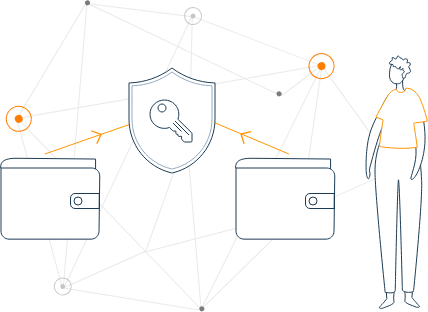
A self-custody wallet usually has no central recovery institution. A seed phrase, private key, hardware device, or configured social-recovery process determines whether the user can regain control.
A wallet password often unlocks local data only; it is not a substitute for the seed phrase. If a device fails and the recovery material is missing, the assets may become inaccessible.
Platform custody sits between these models. A user can reset an account password, but asset safety and withdrawals depend on the platform's key management, solvency, and compliance status.
Convenient recovery is not free protection. Centralized recovery requires personal information and institutional trust; self-custody requires durable backup and inheritance planning.
How Does Asset Custody Differ?
Holding cash means directly possessing notes and coins. Holding a bank deposit means owning an account claim against the bank under the local regulatory and protection framework.
With self-custodied crypto, the user controls the private key for an on-chain address. A leaked key may permit unauthorized transfers; losing every key and backup may permanently eliminate access.
With third-party crypto custody, an exchange or custodian controls the keys and the user has a claim recorded in a platform account. A hack, shutdown, or insolvency may prevent prompt withdrawal.
Users should determine whether customer assets are segregated, commingled, or rehypothecated; how hot and cold wallets are used; what insurance covers; and what creditor priority applies after failure.
Self-custody and third-party custody create different risks. Neither “not your keys” nor “a forgotten password can be reset” is a complete assessment.
How Do Privacy and Identity Verification Differ?
Banks and payment providers normally require verified identities, transaction monitoring, and regulatory reporting. Account records are not public to everyone, but institutions, regulators, and legally authorized parties may access them.
In-person cash offers stronger everyday privacy and does not require internet access or a public address, although large cash transactions may still face reporting and anti-money-laundering rules.
Most public chains use addresses rather than names, making them pseudonymous. Anyone can inspect balances, timing, and fund flows. Once an address is connected to KYC data, an IP address, or a real-world payment, its owner may be identified.
Crypto payments are not inherently anonymous. Address reuse, public wallet displays, and transfers between a user's own accounts increase linkability.
Privacy tools can add contract, liquidity, regulatory, and network-metadata risks. Users should check local rules before using them.
How Do Security Risks Differ?
Fiat systems face card fraud, online-banking phishing, identity theft, account takeover, insider fraud, and bank credit risk. Institutions provide controls, freezes, and dispute handling, but they cannot guarantee recovery of every loss.
Cryptocurrency adds seed-phrase theft, malicious signatures, fake wallets, smart-contract exploits, bridge attacks, stablecoin depegging, and wrong-network errors.
Private-key control increases autonomy while removing some human correction. A hardware wallet can isolate keys, but it cannot stop its owner from approving a malicious transaction.
Public on-chain data supports auditing but also lets attackers identify balances and interaction targets. High-value addresses are especially exposed to targeted phishing, address poisoning, and social engineering.
Security should not be reduced to asking which system “cannot be hacked.” Ask how losses occur, how damage can be limited, whether recovery is possible, and who bears responsibility.
How Does Transparency Differ?
Public-chain transactions, token supply, and smart-contract state can be queried openly, allowing users to verify asset movements without relying solely on an institution's report.
A public chain cannot automatically reveal off-chain liabilities, reserve ownership, key controllers, or legal contracts. A transparent stablecoin supply does not prove that bank reserves and redemption capacity are equally transparent.
Bank ledgers are generally not published transaction by transaction because of privacy and commercial confidentiality. Trust is instead supported through supervision, audits, capital requirements, and deposit arrangements.
Proof of reserves, on-chain addresses, and attestation reports each cover only part of the picture. A platform may show assets without showing customer liabilities, pledges, loans, or related-party exposure.
Useful transparency is not simply more data. The decisive issue is whether material rights, liabilities, and control powers can be understood and verified accurately.
How Does Programmability Differ?
Traditional banking and payment systems can also automate debits, escrow, conditional payments, and API transfers, but licensed institutions generally develop and control access to them.
Smart contracts deploy code to a blockchain that compatible addresses can call for trading, lending, staking, games, governance, and digital identity.
Open composability lets protocols connect like building blocks. A token may work across wallets, decentralized exchanges, lending markets, and payment applications.
Composition also transmits risk. A depegged base asset, incorrect oracle, or exploited protocol may affect several applications built above it.
Automatic execution does not guarantee fairness or legality. Smart contracts process inputs according to code, and bugs or malicious designs execute automatically too.
Do Stablecoins Eliminate the Differences?
Stablecoins try to combine fiat-denominated stability with blockchain transferability and programmability. They do not erase the difference between the two trust models.
Fiat-backed stablecoins rely on an issuer, banks, reserve assets, and redemption channels. Whether holders have a direct legal claim and can redeem at face value depends on the specific terms.
Crypto-collateralized stablecoins depend on collateral ratios, liquidation, oracles, and governance. Algorithmic systems may additionally depend on market incentives to maintain their peg.
A stablecoin may be stolen on-chain, frozen by its issuer, lose its peg through inadequate liquidity, or become part of a customer's claim in a platform bankruptcy.
Institutions including the BIS continue to assess stablecoins' effects on payments and financial stability. A price that normally stays near one unit of fiat should not be treated as proof that the token is a risk-free cash substitute.

Is a Central Bank Digital Currency Cryptocurrency?
A central bank digital currency is issued by a central bank and is a digital form of central-bank money. Public policy determines its legal status, account or token design, privacy model, and scope of use.
Cryptocurrencies are normally issued by open-network protocols or private smart contracts and are not central-bank liabilities. The use of distributed-ledger technology alone does not place both in the same category.
A balance shown in a banking app is not a CBDC either. It usually remains a commercial-bank liability accessed through a digital interface.
CBDCs, electronic money, stablecoins, and cryptocurrencies can all move digitally, but their issuers, legal claims, legal status, and privacy models differ.
Can Cryptocurrency Replace Traditional Money?
In the near term, the two are more likely to coexist in different roles. Traditional money benefits from established networks for wages, taxes, credit, legal contracts, and everyday prices. Cryptocurrency offers open settlement, self-custody, and programmable assets.
For crypto to perform everyday monetary functions broadly, it would need further progress in price stability, scalability, user experience, security, privacy, and regulatory integration.
Stablecoins can act as a bridge but still depend on fiat reserves and the banking system. The more widely they are used, the greater the need for strong reserves, redemption, and supervision.
Technical payment capability does not make an asset economically suitable as a unit of account or legally accepted everywhere. Replacement must be assessed by country, asset, and use case.
How Do Their Sources of Value Differ?
Fiat derives value from legal status, tax demand, broad acceptance, confidence in the state and central bank, productive and financial systems, and expectations of price stability.
Cryptocurrency may derive value from scarcity, network security, users and developers, settlement demand, collateral utility, governance rights, and market liquidity.
Value capture varies greatly among tokens. Heavy use of a protocol does not necessarily require ownership of its governance token, and rising token prices do not prove that an application creates durable value.
A stablecoin's value rests mainly on the credibility of its peg and redemption rather than the scarcity narrative associated with Bitcoin.
For a fuller framework on supply, consensus, demand, and market pricing, read Why Does Cryptocurrency Have Value?.
Which Type of Money Fits Different Situations?
Local fiat is usually best for wages, taxes, rent, loans, and domestic retail prices because the legal, accounting, and merchant networks already use it.
Cash works well for small offline payments that should not depend on a third-party device, though it is inconvenient for long-distance transfers and large-value storage.
Banks and instant-payment services suit recoverable, identity-based everyday spending. Users gain customer support and dispute handling but rely on institutions.
Cryptocurrency suits situations where both parties need on-chain settlement, self-custody, or smart contracts, provided they can manage network, address, gas, key, and contract responsibilities.
Stablecoins can support fiat-denominated on-chain applications and certain cross-border transfers, but users must verify the issuer, network, redemption, freezing powers, and local rules.
The Hotcoin MONEY Five-Dimension Comparison Method
This framework helps compare a specific currency or payment method. It is not an investment recommendation for any asset, platform, or stablecoin.
26.1 M: Maker — Who Issues It and Bears the Obligation?
Identify the central bank, commercial bank, protocol, smart contract, or stablecoin issuer, and determine whether holders have a clearly defined legal claim.
26.2 O: Operation — How Does the Ledger Work?
Understand accounts, cash, blockchains, nodes, consensus, payment clearing, and the distinction between interface completion, on-chain confirmation, and final availability.
26.3 N: Nominal Stability — Is the Unit Stable?
Evaluate inflation, exchange rates, crypto volatility, stablecoin pegs, and actual liquidity. A nominal price is not the same as purchasing power.
26.4 E: Exit and Error — How Can Users Exit or Correct Mistakes?
Check conversion, withdrawal, refunds, chargebacks, transaction irreversibility, key recovery, and procedures after an institution fails.
26.5 Y: Your Responsibility — What Must the User Manage?
Review passwords, private keys, seed phrases, KYC, taxes, networks, addresses, contracts, and records, and choose only a system you can maintain over time.
A Beginner's Checklist for Comparing Money
Confirm whether you are comparing cash, bank deposits, electronic money, native crypto assets, tokens, stablecoins, or a CBDC.
Identify the issuer, liability relationship, reserves, supply rules, and upgrade powers. Do not rely on a name containing “USD” or “stable.”
Confirm that the recipient accepts it, determine the unit of account and full cost, and find out when funds become finally usable.
Identify recovery and legal-recourse options after fraud, a wrong transfer, a lost key, institutional failure, or a depeg.
Make sure privacy, identity-verification, regulatory, tax, and recordkeeping duties comply with local requirements.
Match the amount at risk to your tolerance. Do not borrow to chase volatile assets, and do not treat stablecoins as risk-free deposits.
Frequently Asked Questions
28.1 Is the Balance in a Banking App Cryptocurrency?
No. A bank balance is normally a fiat deposit recorded in a commercial bank's account system and managed through banking and payment infrastructure.
28.2 Does “Not Legal Tender” Mean Cryptocurrency Is Illegal?
No. Legal-tender status is separate from the legality of owning, trading, or using an asset. Consult current local law and platform rules.
28.3 Is a Stablecoin as Safe as U.S. Dollar Cash?
No. A stablecoin depends on its issuer, reserves, redemption, banks, contracts, and network. It can depeg, be frozen, or lose liquidity.
28.4 Is a Crypto Transfer Always Faster Than a Bank Transfer?
No. Compare the full path, including block confirmations, exchange crediting, bridge use, and fiat entry or exit—not only broadcast speed.
28.5 Is Self-Custody Always Safer Than a Bank or Platform?
No. Self-custody reduces third-party custody risk but assigns key, backup, signing, and recovery duties to the user.
28.6 Can Cryptocurrency Be Anonymous Like Cash?
Most public chains cannot. Addresses are pseudonymous, transactions remain public, and KYC records, IP data, or fund flows may link them to identities.
28.7 Does a Fixed Supply Guarantee That Cryptocurrency Preserves Value?
No. Scarcity is only one factor. Price also depends on demand, liquidity, security, competition, regulation, and expectations.
Conclusion: Two Different Structures of Trust and Responsibility
Traditional money relies on sovereign law, central banks, commercial banks, and payment networks. It is well suited to local pricing, wages, taxes, credit, and recoverable payments.
Cryptocurrency relies on cryptography, blockchains, nodes, and protocol rules. It supports digital-asset transfers, self-custody, and smart contracts on open networks.
Neither category is a single form. Cash differs from a bank deposit, just as a native coin differs from a stablecoin. A proper comparison begins with the issuer, holder rights, ledger, price behavior, payment route, custody, and recovery model.
Stablecoins connect fiat and blockchains without removing issuer, reserve, redemption, and regulatory risks. Being digital does not by itself make money decentralized or safer.
For beginners, the goal is not to pick a side but to choose a tool whose risks fit a specific purpose: use fiat for everyday pricing and legally recognized payments, use crypto where on-chain functionality is genuinely needed, and verify the network, permissions, and exit path before every operation.
Continue with the complete cryptocurrency beginner's guide. For mobile prices and trading tools, visit the Hotcoin App. To connect an independent wallet to Web3 applications, use Hotcoin Web3 Wallet. Explore more educational material at Hotcoin.
Risk warning: This article is for education and information only. It is not investment, trading, legal, tax, payment, or cybersecurity advice. Cryptocurrency and stablecoins may involve price volatility, low liquidity, private-key theft, lost seed phrases, platform failure or withdrawal suspension, smart-contract vulnerabilities, depegging, freezing, bridge attacks, fraud, and regulatory change. Fiat, bank deposits, and payment tools also carry inflation, exchange-rate, account, institutional, and operational risks. Before use, verify current local rules, issuance and redemption terms, platform eligibility, network, contract, fees, and custody arrangements, and use only funds whose complete loss you can afford.
Lectura recomendada
Ver más