Trading Fees Explained: How to Read a Fee Schedule
A crypto trading fee is the cost an exchange charges on an order that has already been filled, and it is usually calculated from the executed amount and the rate that applies to you. When you are new to trading, staring at a single percentage is not enough: you also need to tell spot from futures, understand maker and taker roles and VIP tiers, and account for other costs such as spreads and slippage.
If you are just getting started with an exchange, read Crypto Exchange for Beginners: From Sign-Up to Your First Trade first to see how the whole process works. This article tackles a different, very practical question: what does the fee the exchange shows you actually mean, and how much will one trade really cost?
What is a crypto trading fee?
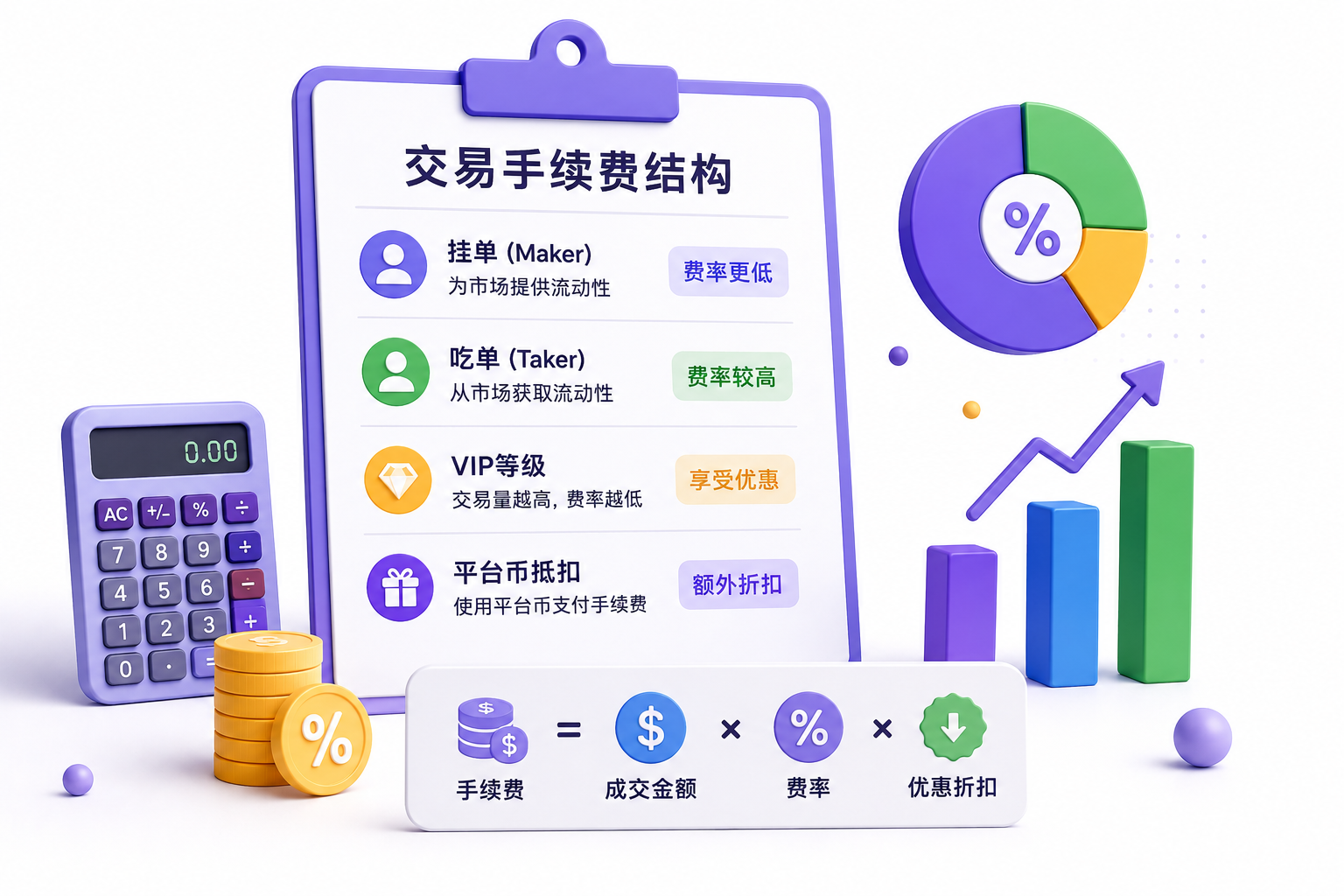
A trading fee is what you pay under the platform's rules after you buy or sell on an exchange. It is normally tied to the amount actually executed, so the larger the trade, the larger the absolute fee at the same rate.
For example, on a trade with an executed amount of 1,000 USDT at an applicable rate of 0.1%, the fee is:
1,000 × 0.1% = 1 USDT
The 0.1% here is only a calculation example; it is not the actual rate on every exchange or every account. In practice, your platform, product type, account tier and the rate shown on the final order screen are what count.
Hotcoin's own documentation draws the same line between trading fees, deposit fees and on-chain withdrawal fees: a trading fee arises when an order is filled inside the platform, while a withdrawal fee relates to moving assets out.
The real cost of a trade is more than the fee
Many beginners compare exchanges by asking only whether the fee is 0.1% or 0.2%, but that does not capture the full cost of trading. A more useful approach is to look at the trading fee, the bid-ask spread and slippage together, and to add withdrawal costs if you later move assets off the platform.
A simplified formula makes the point:
Real trading cost ≈ trading fee + bid-ask spread + slippage + later withdrawal cost
The trading fee is what the platform charges directly at your rate. The bid-ask spread is the gap between the best bid and the best ask. Slippage is the difference between the price you expected and the price you actually got.
That means an exchange advertising a lower fee may not end up cheaper: if the pair is thin, the spread is wider, or a large order moves the price noticeably, the final cost can still be higher. It is the main reason fee numbers alone should not decide which exchange you use.
What do maker and taker mean?
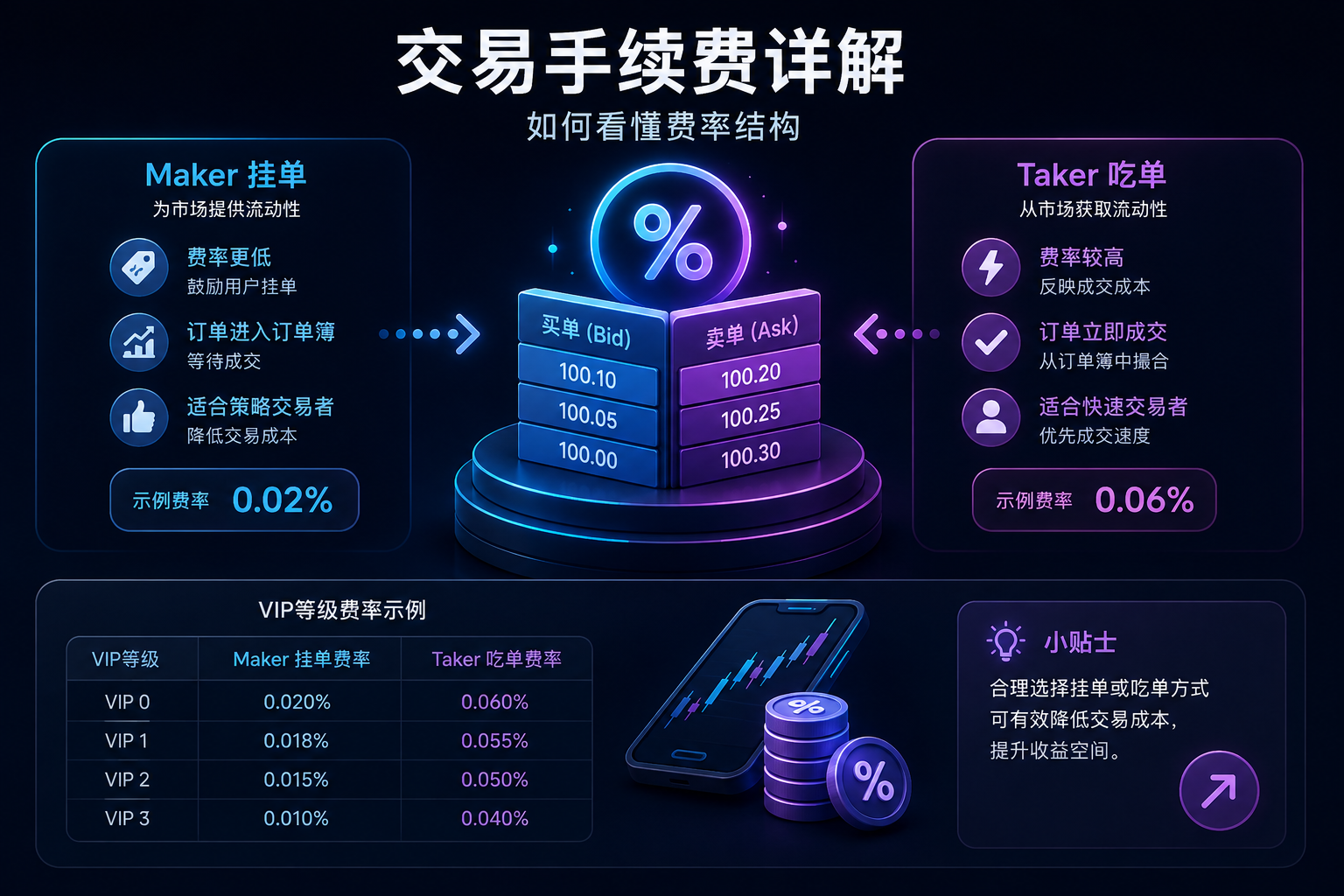
Maker and taker describe how an order interacts with the order book. A maker order usually rests in the book and waits for another trader to fill it, which adds liquidity to the market. A taker order matches orders that are already in the book, which removes liquidity.
Many platforms charge different rates for the two roles, with makers often paying less and takers paying more. Hotcoin's current fee documentation likewise treats maker or taker role, product type and VIP tier as key factors behind the fee you pay.
One point beginners often get wrong: a limit order is not automatically a maker order, and a market order is not the only test of your fee. If a limit order fills immediately against orders already in the book, it can be treated as a taker order. What decides the maker or taker role is how the order actually fills.
Are spot and futures fees the same?
No. Spot and futures are different products, and their fee calculation, rate structure and other trading costs can all differ, so a rate you see in one place cannot simply be applied everywhere.
Hotcoin's current official material shows that the fee structure varies with product type, order role and account tier. Its help centre currently lists a standard spot fee of 0.2% for standard users, noting that both limit and market orders pay the spot trading fee, while futures fees are split into maker and taker rates that differ on the standard user page.
Because rates can change, it is better not to memorise one fixed number but to build a habit: check the current rate before you trade → confirm your VIP tier → confirm the product type → confirm how the order will execute.
Where can you check Hotcoin's fees?
Before trading on Hotcoin, you can look up the rate and VIP tier that apply to your account. Hotcoin's official fee page lays out different structures for Spot, Futures and Withdrawal, and separates rates by account tier and trading volume.
Hotcoin's help material also notes that you can open "My Rate" from your profile avatar in the app to see your current rate and VIP tier, or check the VIP pages on the website.
This step matters because the base rate a platform publishes and the rate you actually pay are not necessarily the same thing. For anyone trading often, a change in account tier can shift long-run cumulative costs directly.
How is a trading fee calculated?
The simplest formula is:
trading fee = executed amount × applicable rate
Say you place a 5,000 USDT spot trade at an applicable rate of 0.2%:
5,000 × 0.2% = 10 USDT
The fee for that trade works out to 10 USDT. This is only a demonstration of the maths and not the current rate on every account; what is actually deducted is whatever the trading page and trade history show.
Note too that the executed amount and the amount you committed to the account are not always identical. If an order fills in several parts, each portion of the executed amount can take part in the fee calculation, so the final fee is usually best read from the filled-order details.
Do you pay a fee on both buys and sells?
Usually you have to treat the cost of buying and the cost of selling separately. If you buy an asset and later sell it, both fills carry their own fee even when the rate is identical both times.
If you buy BTC with 10,000 USDT and later sell that BTC, counting only the first purchase fee tells you very little. Judging whether the trade was profitable means counting the buy cost and the sell cost together.
So for any active strategy the useful question is not "what is the fee?" but how much total trading cost does one complete buy-to-sell round trip carry?
Why frequent trading feels fees more
Fees add up as the number of trades grows. A single trade may look like a tiny percentage, but a strategy that keeps opening and closing positions, or trades heavily every day, has fees deducted from its results again and again.
Suppose a strategy pays 0.2% in total fees per completed round trip and a trader completes 50 round trips. It would be wrong to assume the cost is still 0.2%. Every fill creates fresh trading cost, and over time fees can become a major influence on how a strategy performs.
That is why quantitative, grid and high-frequency strategies in particular need to watch fees. For a long-term holder who trades rarely, fees may not be the main cost; for a strategy that goes in and out constantly, whether the potential edge on a single trade can cover the fee becomes decisive.
How should you compare fees across exchanges?
When comparing exchange fees, do not build a simple league table of rates. Start from how you actually trade and weigh spot rates, the maker/taker structure, VIP conditions, market depth, bid-ask spreads and withdrawal costs.
If you are still choosing a platform, see Comparing and Choosing the Mainstream Global Crypto Exchanges, which puts fees into a wider framework of tradable products, liquidity, features and user experience instead of one percentage.
A practical test is to assume you trade 10,000 USDT, 50,000 USDT or 100,000 USDT a month, then estimate the cost on each platform at the rate that would really apply to you. That result is far more useful than comparing who advertises the lowest fee.
Is a lower fee always better value?
Not necessarily. The fee is only part of the cost of trading: a platform with a low rate but thin liquidity can lose that advantage to a wider spread or higher slippage.
Take a purely arithmetic example. Platform A charges 0.08% and Platform B charges 0.10%, so A looks cheaper. But if A's spread plus real slippage comes to more than 0.05% above B's, the final execution cost can be higher on A.
What you should really compare is how much a completed trade actually costs you. The fee is the visible cost; the spread and slippage are execution costs that beginners overlook most easily.
How can you reduce crypto trading fees?
Cutting fees starts not with hunting for the lowest rate but with removing unnecessary trading costs. Ordinary spot users can begin by trading less on impulse and by confirming their real account rate before each trade.
If your platform offers VIP tiers, check whether the requirements — trading volume, asset balance and so on — fit your own scale of trading. Hotcoin's official fee notes state that VIP tier affects the rate discount you receive and that the platform updates account tiers as those conditions change.
Order type matters too. If you do not need an immediate fill, look into how limit orders rest in the order book; if you must fill quickly, accept the taker cost and slippage that market execution can bring. Waiting stubbornly for a limit fill just to save on fees can cost more through missed opportunities.
Trading fee checklist
Before you place an order, run through these six checks:
① Product type: confirm whether you are trading spot or futures. ② Effective rate: confirm the rate that applies to your account, not an old figure you read online. ③ Maker or taker: confirm how the order will actually execute and the rate that goes with it. ④ Executed amount: calculate the fee from the amount actually filled. ⑤ Spread and slippage: judge whether the real execution cost is clearly higher than the fee itself. ⑥ Withdrawal cost: if you need to move assets out after the trade, work out the withdrawal fee separately.
This routine is more useful than memorising a number like 0.1%, because trading cost is not a fixed figure — it is set by the product, the account, the way the order executes and the state of the market together.
FAQ
What is a typical crypto trading fee?
There is no single rate that applies to every exchange and every user. The effective rate can vary with the platform, spot or futures product, maker or taker role, account tier and trading volume, so check the current official rates before you trade.
What are Hotcoin's spot trading fees?
Hotcoin's help centre currently lists a standard spot trading fee of 0.2% for standard users, stating that both limit and market orders pay the spot trading fee. Rates can change, so trade using the rate shown on your own account and the latest official fee page.
Which is cheaper, maker or taker?
Many platforms set a lower rate for makers than for takers, but that pattern is not a fixed rule across every product and platform. Check the current fee table for the platform you use and confirm the rate from how your order actually fills.
Is a limit order always cheaper than a market order?
No. A limit order usually has maker characteristics only when it does not match an existing order immediately and instead rests in the book. If it fills the moment it is submitted, it can be charged as a taker. The words "limit order" alone do not tell you the final fee.
Is a withdrawal fee a trading fee?
No. A trading fee arises when a buy or sell is filled inside the platform, while a withdrawal fee relates to moving assets off the platform. The two should be counted separately.
Why can the final cost still be high when the fee is low?
Because the fee is only the visible cost. The real cost can also be driven by the bid-ask spread and by slippage, which matter most when liquidity is thin, prices are moving fast or the order is large.
Risk notice
Trading fees affect your trading cost directly, but a low fee does not mean lower risk and does not mean a trade will be profitable. Crypto prices are highly volatile, and real trades can also be affected by slippage, thin liquidity, price jumps and changes to withdrawal rules.
The figures in this article only illustrate how fees are calculated; they are not the actual rates of any particular account or platform. Hotcoin's fees, VIP conditions and other trading rules may change, so check your account page and the latest official rules before trading. This article is not investment or trading advice.
Lectura recomendada
Ver más