Bitcoin Limit Order vs Market Order: Which Should You Use to Buy BTC?
If your priority is buying BTC immediately, a market order is usually more suitable. If your priority is setting the highest price you are willing to pay, a limit order is usually more suitable. A market order executes against prices currently available in the market and prioritizes speed. A limit order lets you set a price and executes only when the market can match that price or a better one. Neither is universally better; the choice depends on whether you value execution speed or price control more. Hotcoin spot trading currently supports limit orders, market orders, and other order modes.
What Is the Difference Between a Market Order and a Limit Order?
The biggest difference is who determines the execution price.
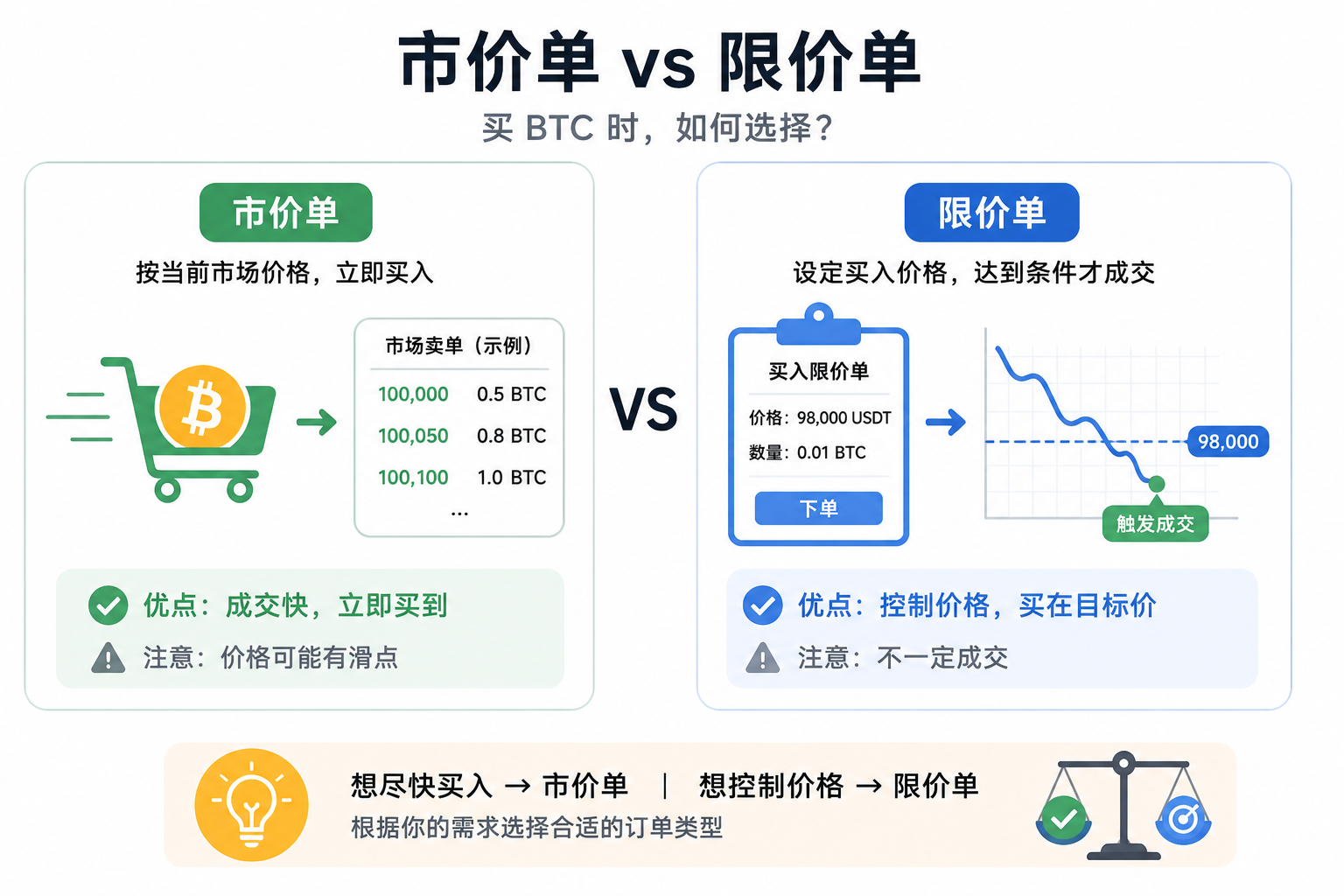
With a market order, you do not enter a BTC purchase price yourself. The system matches your order as quickly as possible against available orders in the order book. With a limit order, you set the price, and the order executes only when market conditions meet it. Hotcoin's official explanation makes the same distinction: market orders execute at the best prices currently available, while limit orders allow users to set an order price.
The simplest way to remember it is:
A market order answers “Can I buy now?” A limit order answers “What price am I willing to pay?”
What Is a Bitcoin Market Order?
A market order buys or sells BTC immediately at prices currently available in the market.
Suppose the BTC/USDT order book contains sell orders at several prices. When you submit a market buy that should execute immediately, the system starts matching it against the available sell orders.
A small order may fill mostly at the best available price. A larger order may continue into higher-priced levels. Therefore, the “price” of a market order is not a single number you lock in beforehand.
Hotcoin also explains that market orders execute at the best prices available at the time and do not require the user to set a price, although the final execution price can change in a fast-moving market.
What Is the Biggest Advantage of a Market Order?
Its biggest advantage is execution efficiency.
If BTC is moving quickly and you have already decided to complete the trade immediately, a market order avoids waiting for a limit order to fill.
For example, suppose you want to buy 500 USDT worth of BTC and your main objective is to establish a spot position quickly. Placing a limit order and waiting for the price to fall could leave the order unfilled.
The market-order workflow is straightforward:
No need to predict a price → Submit the order → Match at currently available prices.
However, this does not mean a market order always gives you the lowest price.
What Is a Bitcoin Limit Order?
A limit order lets you set the price at which you want to buy BTC.
Suppose BTC is trading near 100,000 USDT, but the most you are willing to pay is 98,000 USDT/BTC. You can place a buy limit order with:
- Price: 98,000 USDT
- Amount: 0.01 BTC
The order will execute only if the market later falls and the order book contains sell orders that can match it. If BTC remains near 100,000 USDT and never meets your condition, the order may remain open indefinitely.
Coinbase defines a limit order similarly: the user sets a price, and the order executes only at that price or a better one.
What Is the Biggest Advantage of a Limit Order?
The key advantage is:
You control the price you are willing to accept.
For a BTC purchase, a limit order effectively tells the market: “This is the most I am willing to pay.”
For example, BTC is currently 100,000 USDT and your target entry is 98,000 USDT. After you place a buy limit order at 98,000 USDT, it will not automatically buy at 100,500 USDT or 101,000 USDT simply because the market rises in the short term.
The trade-off is clear: the more price control you demand, the less certain execution usually becomes. If BTC never reaches your target price, the order will not fill.
Why Can a Market Order Experience Slippage?
This is one of the most important issues for beginners using market orders.
Slippage is the difference between the price you expect to see and the price at which the order actually executes.
Suppose BTC is displayed at 100,000 USDT and you decide to buy at market. The market changes as you submit the order, and there are not enough sell orders near 100,000 USDT. Your order then continues matching against higher-priced sell orders.
The result could be:
- Some BTC fills at 100,000 USDT;
- Another portion fills at 100,050 USDT;
- The remainder fills at 100,100 USDT.
Your final average execution price could therefore exceed the 100,000 USDT you initially saw. Coinbase also notes that market orders can experience slippage when liquidity is limited or the order is large, causing portions of the order to fill at higher prices.
Therefore, the latest price is not a guaranteed market-order execution price.
Why Might a Limit Order Remain Unfilled?
The main risk of a limit order is exactly this: you control the price, but you cannot guarantee execution.
Suppose BTC is currently 100,000 USDT and you place a buy limit at 95,000 USDT. If BTC rises to 105,000 USDT, your order will not fill. Even if BTC eventually climbs from 100,000 to 110,000 USDT, the 95,000 USDT limit order may still be sitting open.
A limit order does not mean “I can buy BTC at a lower price.” It means:
“I will buy only if the market is willing to sell to me at this price or lower.”
That distinction is essential.
When Is a Market Order Suitable for Buying BTC?
If your main requirement is completing the trade quickly, a market order is usually the more direct option.
You Have Decided to Buy BTC Immediately
If you have completed your analysis and do not want to miss the trade while waiting for a particular price, a market order can reduce the wait.
Your Trade Is Relatively Small
For a relatively small, liquid BTC/USDT order, market execution is usually straightforward.
However, there is no universal definition of “small.” What matters is the size of your order relative to current order-book liquidity.
Execution Matters More Than an Exact Price
If you can accept a difference of a few price units but want the order completed now, a market order may fit your objective better.
This does not mean the order has no cost. Its final execution price is still affected by order-book depth, volatility, and the bid-ask spread.
When Is a Limit Order Suitable for Buying BTC?
If you care more about controlling your entry price, a limit order is usually more suitable.
You Have a Clear Target Entry Price
Suppose BTC is currently 100,000 USDT, but you are willing to buy only at 98,000 USDT or lower. You can place a buy limit order at 98,000 USDT.
You Are Not in a Hurry to Fill
If you are willing to wait for the market to move, a limit order makes your trading condition explicit.
You Want to Control the Maximum Purchase Price
The central purpose of a buy limit order is to define the highest price you will accept in advance.
For buying BTC, the distinction can be summarized as:
- Market order: uncertain price, execution first.
- Limit order: defined price, wait for execution.
How Do Fees Differ Between Market and Limit Orders?
It is inaccurate to say that market-order fees are always higher and limit-order fees are always lower.
Actual fees depend on the platform's fee schedule, your account tier, Maker/Taker status, and how the order ultimately interacts with the order book.
Trading platforms often treat an order that immediately matches an existing order as a Taker order, while an order that adds liquidity to the order book may qualify as a Maker order. Specific rates and rules differ between platforms.
Therefore, do not rely only on the claim that “limit-order fees are low and market-order fees are high.” The more accurate approach is to check the platform's current Maker/Taker rates and order-execution rules.
Hotcoin's current spot order modes include limit orders, market orders, and trigger orders. The fees that apply should be confirmed on the trading page and in the platform's latest fee rules.
For a systematic explanation of BTC trading costs, read How Much Are Bitcoin Trading Fees?.
A Simple Example: Buying 1,000 USDT Worth of BTC
Suppose the BTC price is approximately 100,000 USDT/BTC, and you want to spend 1,000 USDT on BTC.
Using a Market Order
You submit a market buy, and the system matches it against prices available in the order book at that moment.
If liquidity is sufficient, the final execution price may be very close to the current quote. If the market is moving quickly, however, the amount of BTC you receive may differ from the simple calculation 1,000 ÷ 100,000 = 0.01 BTC.
Using a Limit Order
You decide that 98,000 USDT/BTC is an acceptable price and set Limit Price = 98,000 USDT.
The order fills only if BTC falls to that price and sufficient sell orders can match you. If BTC rises directly from 100,000 to 105,000 USDT, you may buy no BTC at all.
The core difference is not “which one always saves more money,” but what are you willing to give up?
- A market order gives up some price certainty in exchange for execution speed.
- A limit order gives up execution certainty in exchange for price control.
How Should You Choose Based on Your Needs?
Use the following decision framework:
- Need immediate execution and can accept a small price change: consider a market order first.
- Have a clear maximum entry price and can accept waiting or no fill: consider a limit order first.
- Your order is large relative to the order book: inspect depth and potential slippage before deciding whether to split it.
- Fees are important to you: check the platform's current Maker/Taker rates and execution rules first.
Do not assume that limit orders are inherently more professional or that market orders are only for beginners. They solve different problems.
Which Order Should You Choose for Your First BTC Purchase?
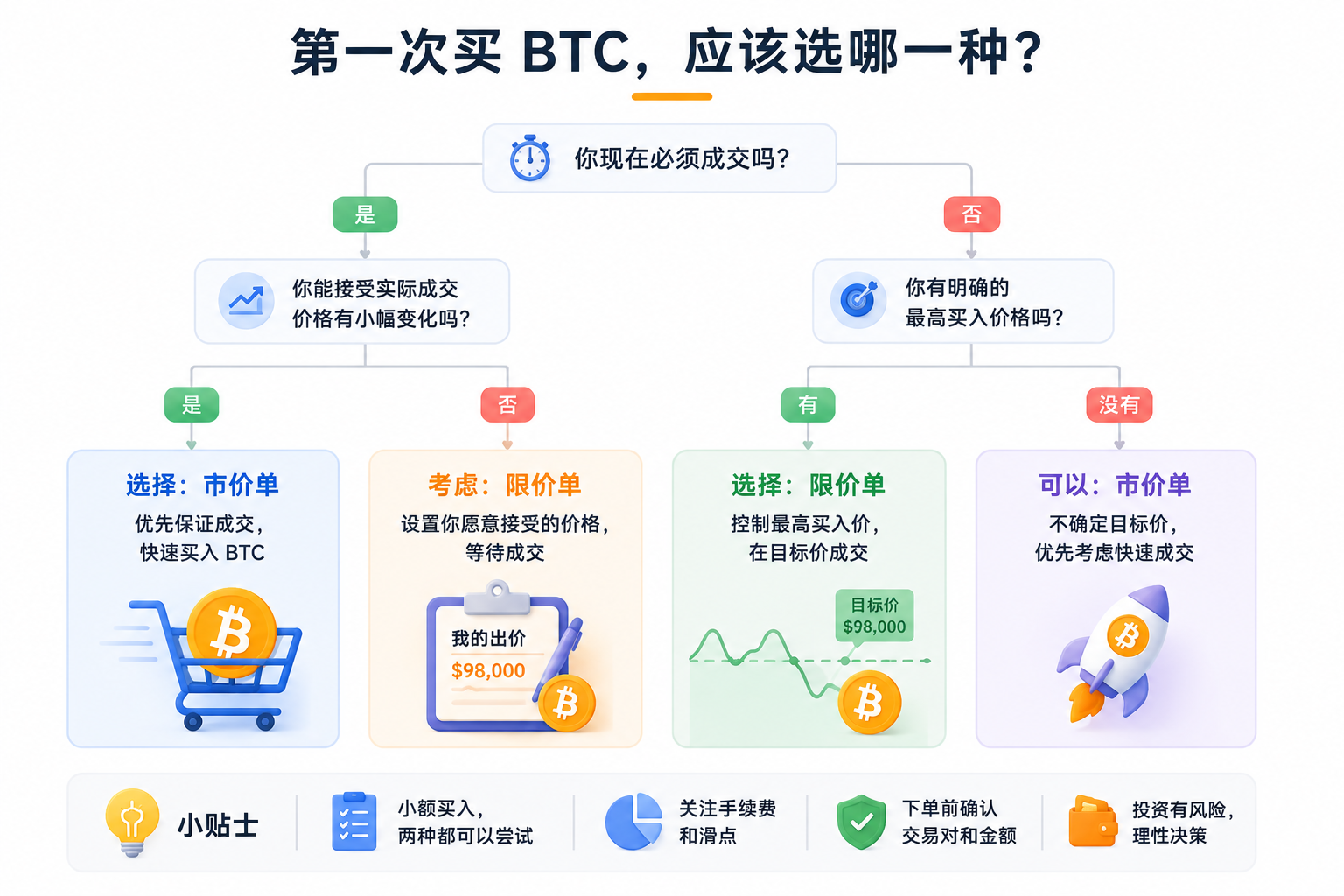
If this is your first time buying BTC, ask yourself two questions:
Question 1: Must I execute now?
If the answer is yes, focus on a market order.
Question 2: Do I have a clear maximum purchase price?
If the answer is yes, focus on a limit order.
If both answers are uncertain, do not choose a limit order merely because it seems more sophisticated. Understanding the basic order logic is more important than using a more complex order type blindly.
Hotcoin's spot trading page supports pairs such as BTC/USDT and provides market and limit orders. Its official app guide shows that users can enter the Spot page, select a pair, choose an order type, enter an amount, and submit the trade.
Checklist Before Using a Limit or Market Order
Before submitting an order, quickly check the following:
- Am I buying spot BTC? Confirm that you are on the Spot page, not Futures or another derivatives market.
- Did I select BTC/USDT? Confirm that the pair matches the asset you intend to spend.
- If I use a market order, can I accept a change in the actual execution price? This matters especially during rapid moves or for larger orders.
- If I use a limit order, can I accept that it may not fill? If you cannot wait, do not simply set the price far below the market.
- Did I check the fees? Consider the trade amount, rate, and final amount received together.
- Did I confirm execution after submitting? “Order submitted” and “order filled” are not the same thing.
FAQ
Which Is Better, a Market Order or a Limit Order?
There is no absolute answer. A market order emphasizes execution speed, while a limit order emphasizes price control. Consider a market order if you want to complete the trade immediately. Consider a limit order if you have a target price and are willing to wait.
Is a Limit Order Always Cheaper Than a Market Order?
No. Actual fees depend on the platform's Maker/Taker rules, account tier, and order execution. Even if the fees are equal, the final trading cost can differ because of execution prices and slippage.
Why Has My Limit Order Not Filled?
The market may not have reached your order condition, or there may not have been enough matching volume after it reached that price. A limit order controls price but does not guarantee execution.
Can a Market Order Make Me Pay Too Much?
It can. A market order matches against prices available at the time. If order-book depth is limited or the market is moving rapidly, the actual execution price may differ from the price displayed when you submitted the order. That difference is commonly called slippage.
Should a Beginner Use a Limit Order or a Market Order to Buy BTC?
If you want to complete a small spot BTC purchase quickly and can accept a modest change in the actual execution price, consider a market order. If you care more about the entry price and can accept that the order may not fill, consider a limit order.
Learn More About BTC/USDT Trading
If you are unfamiliar with the BTC/USDT pair, start with BTC/USDT Trading for Beginners: Understanding a Bitcoin Trading Pair.
Once you understand the pair, price, amount, and order book, choosing between a limit order and a market order becomes easier.
For your first BTC purchase, you can also read Hotcoin's Guide to Buying BTC for the First Time.
Risk warning: Bitcoin is a highly volatile crypto asset whose price can rise or fall rapidly. This article explains limit and market orders in BTC spot trading and does not constitute investment advice. Fees, order types, minimum order amounts, and trading rules may change. Always rely on the information displayed by the trading platform when you place an order.
Lectura recomendada
Ver más