
Prediction Markets vs Traditional Futures: Main Differences
Are prediction markets just a modern twist on traditional futures, or do they function in an entirely different way? They are fundamentally different. Traditional futures give you continuous exposure to an asset’s price movement with leverage and daily settlement. Prediction markets let you buy a pure probability on a specific Yes-or-No event, with risk that can never exceed the amount you paid. That distinction determines which instrument actually fits your trade.
“Most traders who first see prediction markets assume they are simply futures with a different interface. That assumption costs them clarity, capital efficiency, and the right risk profile.”
Once that gap becomes visible, curiosity follows naturally. Why would anyone choose a $0.40 Yes share on a Fed decision instead of a leveraged interest-rate futures contract? Why does a Bitcoin price-threshold market feel nothing like a perpetual futures position? The answers below close that gap and show exactly when each tool is the superior choice.
What Each Market Actually Trades
Traditional futures are standardized contracts to buy or sell an underlying asset—oil, gold, the S&P 500, or Bitcoin—at a future date or, in the case of perpetual contracts, indefinitely. Profit and loss move with every tick of the price. The market exists so producers, consumers, and investors can hedge or speculate on continuous price risk.
Prediction markets trade outcomes, not assets. Participants buy shares that pay $1 if a defined event occurs and $0 if it does not. Typical questions include “Will the Federal Reserve cut rates at its next meeting?”, “Will Bitcoin close above $100,000 by year-end?”, or “Will Candidate X win the election?” The price of a Yes share is the market’s collective probability estimate. A share trading at $0.68 implies a 68 percent chance of that outcome (PredictEngine 2026; Wealthsimple 2026).
“One market prices movement. The other prices occurrence. Confusing the two is the most common and most expensive mistake new participants make.”
Related Article: The Reinvention of Perpetual Futures
Profit, Loss, and Risk Profiles
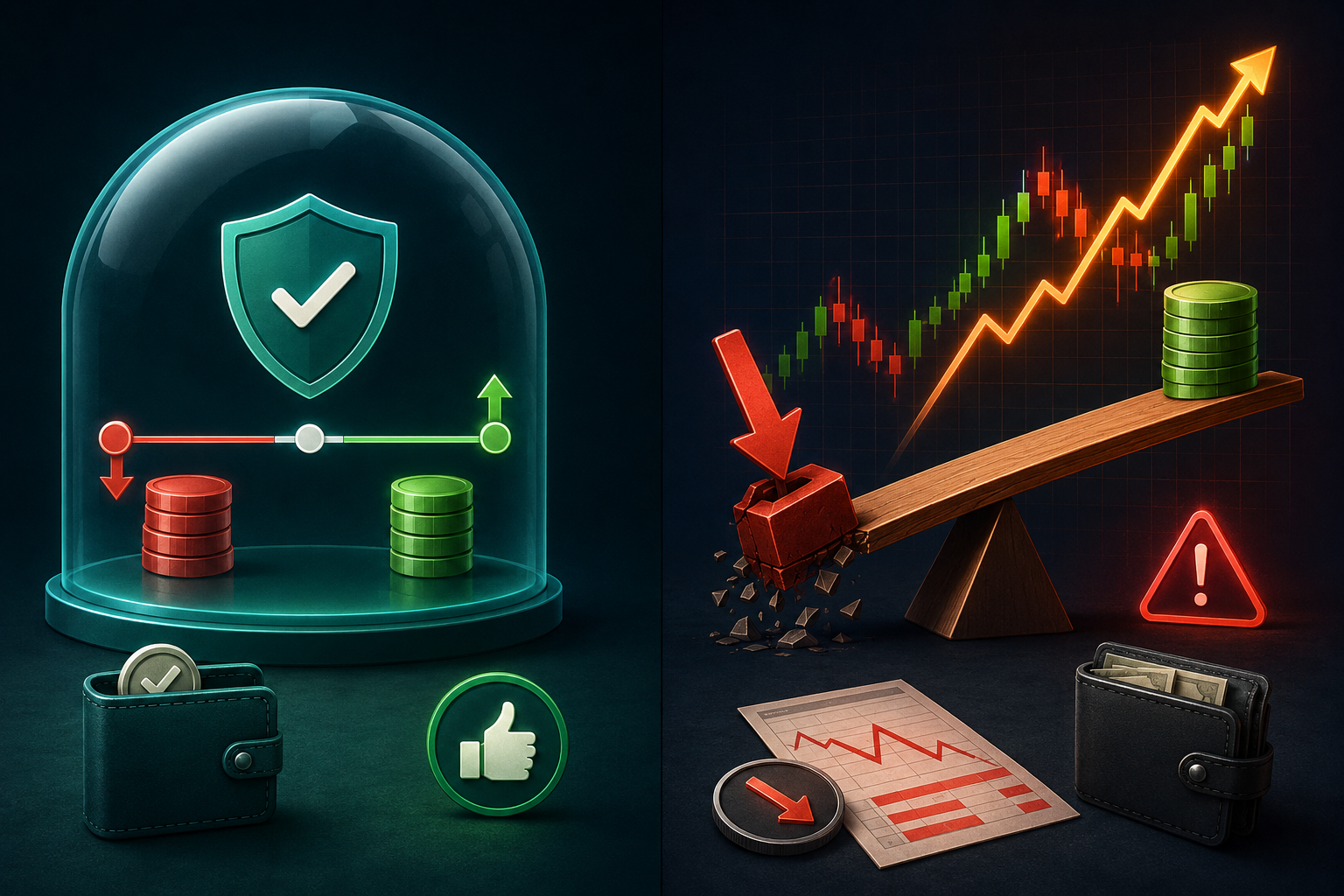
The risk consequences of that structural split are large. In a prediction market, if you pay $0.35 for a Yes share, your maximum loss is $0.35 and your maximum gain is $0.65. There is no conventional leverage, no margin call, and no liquidation. Downside is fully known the moment the trade is entered.
Futures work in the opposite direction. A leveraged position can amplify gains dramatically, but losses can exceed the initial margin. Daily mark-to-market realizes gains and losses every day. Sharp adverse moves can force additional capital or automatic position closure. Risk relative to posted margin is open-ended (Fidelity 2026; Phemex 2026).
Traders who prefer defined risk and dislike liquidation risk naturally prefer prediction markets. Traders who want capital efficiency and continuous price exposure stay with futures.
“Bounded risk versus open-ended risk is not a minor technical detail. It changes how positions are sized, how capital is allocated, and how sleep is affected overnight.”
Leverage and Capital Efficiency
Futures offer explicit leverage, often ranging from 2x to 100x depending on the contract and exchange. A small amount of capital controls a large notional position. That efficiency is powerful for short-term directional views and precise hedging.
Prediction markets offer only implicit leverage through probability pricing. Buying a Yes share at $0.10 delivers a 10x payout if the event occurs. The return looks leveraged, yet the maximum loss remains the $0.10 paid. There is no mechanism to lose more than the original stake.
Related Article: What Are the Differences Between Spot ETFs and Futures ETFs?
Settlement Mechanics and Time Horizon
Futures settle daily and, for dated contracts, on a final expiration date that may involve cash or physical delivery. Perpetual futures never expire; funding rates keep the contract alive indefinitely.
Prediction markets settle once—at the moment the event is resolved. There is no daily mark-to-market. The position simply sits until the outcome is known. This design makes prediction markets better suited to multi-week or multi-month event horizons, while futures dominate intraday and short-term price speculation.
Practical Use Cases That Separate the Two
Choose traditional futures when the goal is continuous exposure, precise hedging of an existing portfolio, scalping, or high leverage on a directional price view. They remain unmatched for managing commodity, equity-index, or currency risk at institutional scale.
Choose prediction markets when the edge lies on a discrete event rather than continuous price movement. Election outcomes, central-bank decisions, inflation prints, regulatory rulings, and specific price thresholds by a calendar date are natural fits. The bounded risk also makes them attractive for traders who want asymmetric bets without the operational complexity of margin management (FT 2026).
In practice, sophisticated participants sometimes combine both. A trader may hold futures for baseline price exposure and add prediction-market positions for specific catalyst events that futures cannot isolate cleanly.
“The right question is never ‘Which market is better?’ It is ‘What kind of view do I actually have—continuous movement or a binary occurrence?’ Matching the instrument to the view is the entire game.”
Scale, Liquidity, and Regulatory Reality
Size still favors futures by a wide margin. A single day of trading in major CME contracts can exceed the entire annual volume of current prediction platforms. Depth, institutional participation, and hedging infrastructure remain far more developed in traditional markets.
Regulation is also more mature for futures. Prediction markets are increasingly treated as event contracts under the CFTC framework rather than pure gambling, yet the perimeter continues to evolve, particularly around political and sports-related contracts. That evolving status creates both opportunity and residual uncertainty for participants.
Why the Distinction Matters More Than Ever
As prediction platforms expand the range of events they cover—economic data, policy decisions, corporate milestones, and crypto thresholds—they fill gaps that traditional futures leave open. Futures cannot cleanly isolate the probability of a single discrete outcome without residual price noise. Prediction markets cannot give continuous exposure to an asset’s full price path.
The result is two complementary tools rather than competing ones. Traders who treat them as interchangeable keep making suboptimal choices. Those who match the instrument to the nature of the view—continuous movement versus binary occurrence—gain clearer risk control and better alignment between thesis and payoff.
The practical takeaway is direct. If conviction centers on how far and how fast a price will move, futures remain the sharper instrument. If conviction centers on whether a specific event will happen, prediction markets deliver a cleaner, fully defined risk profile. Mastering that difference is no longer optional for anyone serious about modern event-driven and price-driven trading.
Related Article: Predicting the Market Surge
References
Fidelity. 2026. “What Are Prediction Markets and How Do They Work?” Fidelity Learning Center. https://www.fidelity.com/learning-center/trading-investing/prediction-markets.
Financial Times. 2026. “Are Prediction Markets Superior to Financial Markets?” Financial Times, February 19. https://www.ft.com/content/f898acde-f34d-4ee3-8f20-28465ddfcb70.
Phemex. 2026. “Prediction Market vs. Crypto Futures: What’s the Difference?” Phemex Blog, April 27. https://www.phemex.com/blogs/prediction-market-vs-crypto-futures.
PredictEngine. 2026. “Futures vs Prediction Markets: Key Differences (2026 Guide).” PredictEngine, February 28. https://www.predictengine.ai/blog/polymarket-futures-vs-prediction.
Wealthsimple. 2026. “Predictions vs. Futures: Key Differences Explained.” Wealthsimple, July 2. https://www.wealthsimple.com/en-ca/learn/predictions-vs-futures.
Lectura recomendada
Ver más
Explore Mainchains and Sidechains
Basic Concepts
What is Distributed Validator Technology (DVT)?
Basic Concepts
What is NFT Floor Price?
Basic Concepts

Contactos de servicio
Service@hotcoin.com
Comentarios sobre el producto
Product@hotcoin.com
Cooperación empresarial
Business@hotcoin.com
Contactos Legales
Casecn@hotcoin.com
Sobre nosotros
producto
Servir
soporte
©2017-2026