
Hotcoin Research | The Reinvention of Perpetual Futures: From Crypto-Native Leverage to Global Asset Pricing Infrastructure
TL;DR
-
Regulatory Progress: U.S. regulators are beginning to establish compliant frameworks for perpetual futures, while HYPE-related ETFs are providing traditional investors with exposure to Perp DEX infrastructure.
-
Asset Boundary Expansion: RWAs, Pre-IPO assets, and event markets are expanding the reach of perpetual futures beyond crypto-native assets.
-
Market Structure Shift: CEXs remain the dominant gateway, while Perp DEXs gain momentum as ETFs and prediction markets join the competition.
-
Value Repricing: Perpetual futures enable continuous price discovery, global liquidity aggregation, greater capital efficiency, and broader asset innovation.
-
Risk Spillover: Weak price anchors, fragmented liquidity, oracle limitations, regulatory uncertainty, and expectation-driven speculation introduce new structural risks.
-
Outlook and Conclusion: Perpetual futures are entering a second stage of development, shifting from crypto-native leverage products to global asset pricing infrastructure.
Perpetual futures are one of the most important crypto-native products in the digital asset market. They have no expiration date and use funding rates to keep contract prices aligned with underlying markets, allowing traders to maintain leveraged long and short exposure through margin. For traders, perpetuals are a leverage tool. For exchanges, they are a major source of fees and liquidity. For the broader market, they serve as one of the primary mechanisms for price discovery and the expression of market sentiment. Recently, however, perpetual futures have begun to undergo a deeper transformation. They are no longer limited to trading crypto assets such as Bitcoin, Ethereum, Solana, and other altcoins. Increasingly, perpetual futures are being applied to new categories of assets and markets, including RWAs, Pre-IPO valuations, commodities, equity indices, and event-driven markets. As a result, perpetual futures are expanding beyond their role as crypto leverage products and becoming tools for pricing risk across a broader range of global assets.
I. Role Reshaping: From Crypto-Native Instruments to Regulated Financial Products
The early success of perpetual futures was closely tied to the structure of crypto markets themselves. With round-the-clock trading, global liquidity flows, high volatility, and fragmented spot markets, crypto provided a natural environment for perpetual futures, a product built around continuous trading, funding-rate mechanisms, and margin-based exposure.
1.1 Changes in the Perpetual Futures Market
Over the past several years, perpetual futures have remained a core source of revenue for major CEXs such as Binance, OKX, Bybit, and Bitget. On the decentralized side, perpetual trading has gone through multiple waves of development, from early platforms such as dYdX and GMX to newer entrants including Drift, Jupiter Perps, and Hyperliquid.
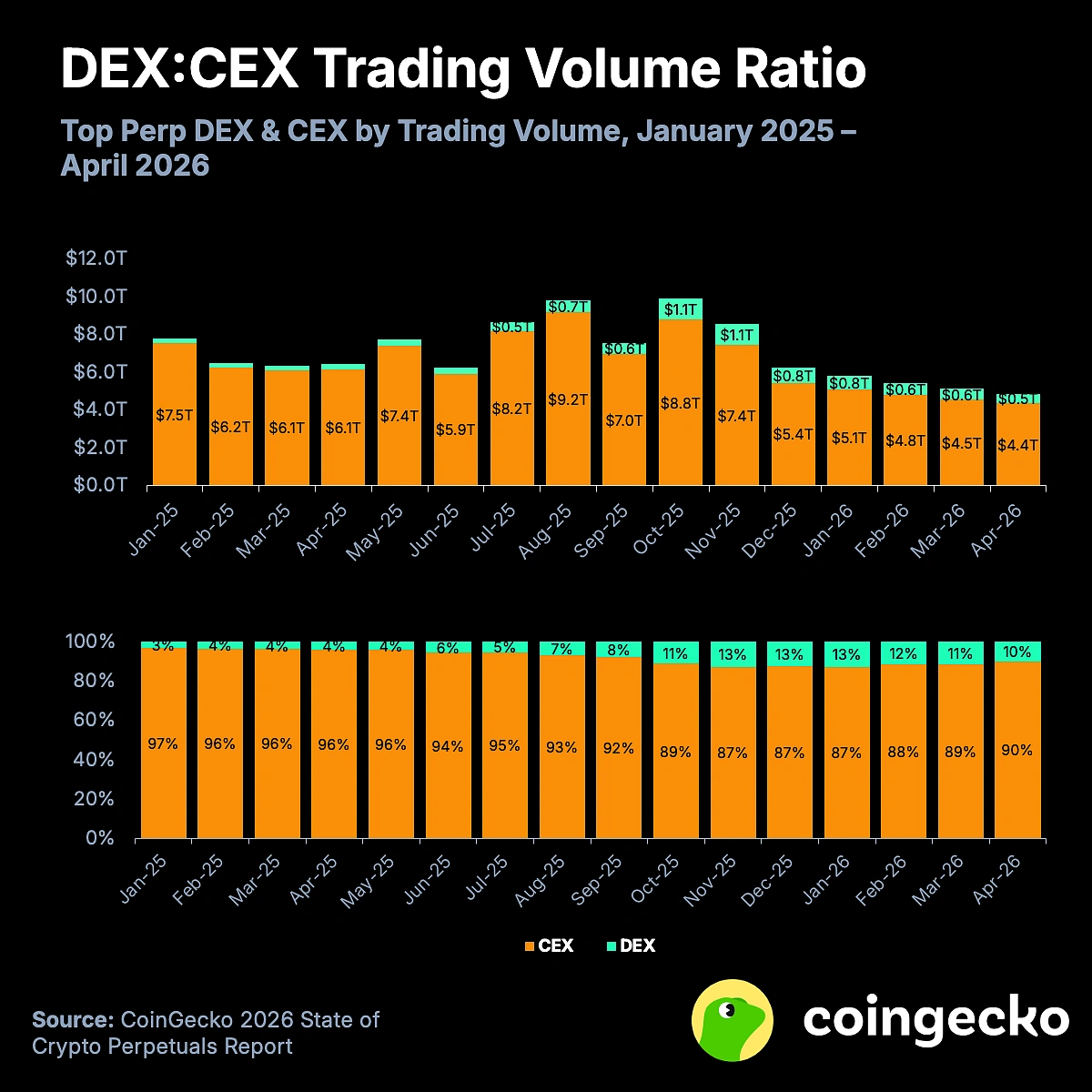
According to CoinGecko's 2026 Crypto Perpetuals Report, CEXs remain the dominant gateway to the perpetual futures market. However, the market share of DEX perpetual trading platforms has continued to grow since 2025 and is now estimated at approximately 10%–13% of total perpetual futures trading activity. While CEXs continue to dominate the market, platforms such as Hyperliquid are steadily eroding their market share.
Source: https://www.coingecko.com/research/publications/state-of-crypto-perpetuals-report-2026
1.2 U.S. Regulators Begin Exploring Regulatory Pathways for Perpetual Futures
On May 29, the U.S. Commodity Futures Trading Commission (CFTC) approved KalshiEX to list BTCPERP contracts and brought them under the futures contract regulatory framework. This marked one of the first clear regulated listing cases for crypto perpetual futures in the United States. On the same day, CFTC staff issued interpretive guidance and a no-action letter to Coinbase Financial Markets, confirming that certain crypto perpetual futures may be treated as offshore futures and allowing eligible FCMs to transfer customer crypto assets to offshore brokers as margin. These developments provide another compliant pathway for U.S. clients to access the global crypto derivatives market through regulated intermediaries.
They also signal a shift in how perpetual futures are positioned in the market: once viewed mainly as high-leverage instruments in offshore crypto markets, perpetual futures are now moving closer to the mainstream financial system.
1.3 Institutional Capital Begins Pricing On-Chain Derivatives Platforms
Institutional capital is entering the on-chain perpetual futures sector through ETFs. Following the launch of THYP and TXXH by 21Shares, Bitwise launched BHYP, while Grayscale introduced HYPG, with management fees as low as 0.29%. Unlike traditional crypto ETFs, the underlying asset of these products is not Bitcoin or Ethereum, but Hyperliquid, one of the largest on-chain perpetual futures trading platforms.
This means the market is beginning to view on-chain derivatives exchanges themselves as investable assets. Investors are no longer allocating only to the HYPE token, but also to the trading volume, fee revenue, liquidity network, and ecosystem growth represented by Hyperliquid. If Bitcoin ETFs made Bitcoin an allocatable asset for traditional finance, HYPE ETFs suggest that on-chain perpetual futures platforms are beginning to enter institutional portfolios.
II. Asset Boundary Expansion: From Crypto Assets to RWAs, Pre-IPOs, and Event Markets
If the emergence of regulatory frameworks and ETFs signals growing recognition of perpetual futures within mainstream finance, an equally important development is the expansion of the asset universe they support. From commodities and equities to private-company valuations and event markets, a growing number of risk assets that traditionally belonged to the conventional financial system are now entering the perpetual futures framework.
2.1 RWA Perpetual Futures
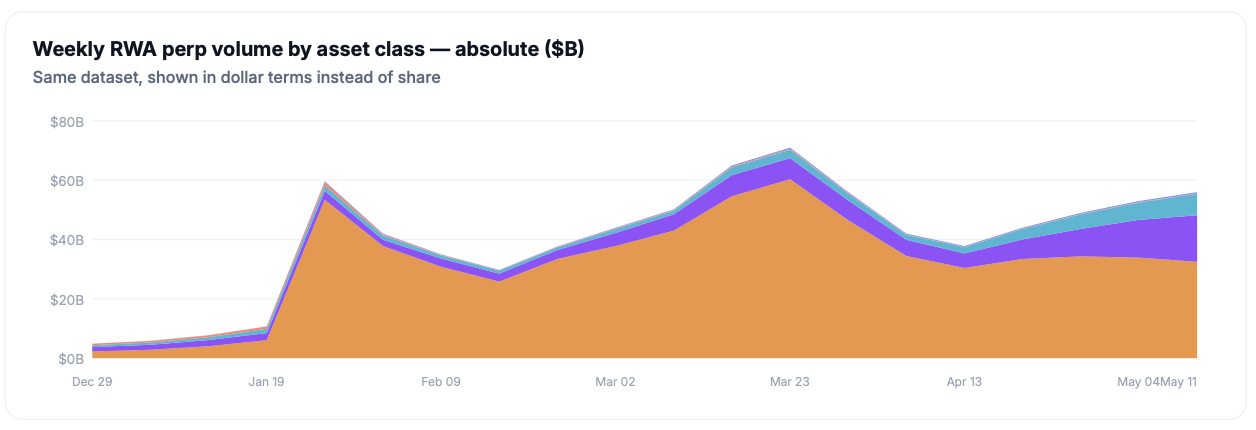
According to the RWA PERPETUALS State of the Market report released by CoinMarketCap Research in May 2026, cumulative trading volume in non-crypto perpetual futures (RWA Perpetuals) reached $821.8 billion across 17 centralized and decentralized trading venues. The data suggests that the market has moved beyond the proof-of-concept stage and is gradually evolving into a market with meaningful trading scale.
Source: https://coinmarketcap.com/academy/article/rwa-perpetuals-state-of-the-market-%E2%80%94-may-2026
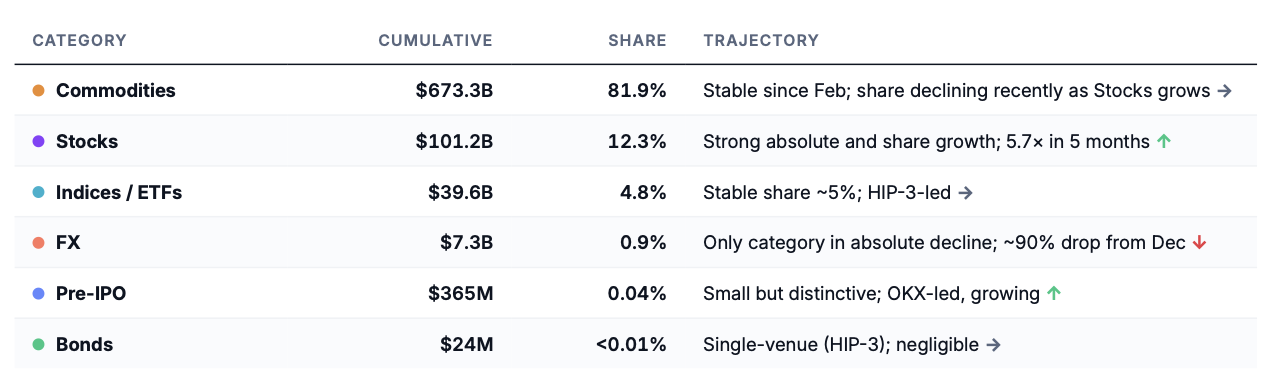
From an asset composition perspective, commodities are the dominant segment of the RWA perpetual futures market. Assets such as gold, silver, WTI crude oil, and Brent crude oil accounted for approximately 81.9% of cumulative trading volume. These assets benefit from mature spot markets, globally recognized pricing benchmarks, and long-standing hedging demand, making them particularly well-suited to perpetual futures trading.
Equities ranked second, contributing approximately 12.3% of total trading volume. Trading activity was concentrated in high-profile technology and growth stocks, including Tesla, NVIDIA, Circle, and Intel. Compared with commodities, equity perpetual futures rely more heavily on company-specific narratives and event-driven catalysts. However, as demand for U.S. equity exposure continues to grow among on-chain traders, this segment has been expanding more rapidly than most other asset categories.
Index and ETF-related products accounted for approximately 4.8% of trading volume, primarily including the S&P 500, Nasdaq-100, and related ETF products. These assets more closely resemble beta-exposure instruments in traditional financial markets. Their pricing sources are transparent, and oracle implementation is comparatively straightforward, making them one of the most promising areas for future institutional participation in on-chain derivatives markets.
Forex perpetual futures currently account for only around 0.9% of total trading volume, with representative products including USDJPY and USDTRY. Traditional foreign exchange markets already offer deep liquidity and mature leverage infrastructure, leaving limited room for on-chain forex perpetual futures to establish a clear competitive advantage. As a result, the segment remains relatively small. Pre-IPO and bond perpetual futures account for less than 0.1% of total trading volume and have yet to develop into meaningful markets.
Overall, the current RWA perpetual futures market exhibits a clear structure characterized by commodity dominance, equity growth, and index exploration. While emerging sectors often attract the most attention, the foundation of the RWA perpetual futures market continues to be traditional risk assets such as gold and crude oil, which benefit from mature pricing mechanisms and deep global liquidity.
2.2 Pre-IPO Perpetual Futures
May 2026 saw a wave of Pre-IPO perpetual futures launches. On May 7, OKX listed pre-market perpetual futures including SPACEX/USDT, OPENAI/USDT, and ANTHROPIC/USDT. On May 17, Trade.xyz, a project within the Hyperliquid ecosystem, launched a SpaceX Pre-IPO perpetual futures product. On May 21, Binance introduced Pre-IPO perpetual futures and subsequently launched products based on the expected public-market valuations of companies such as SpaceX and OpenAI. Hotcoin has also listed pre-market perpetual futures tied to SpaceX, OpenAI, Anthropic, and Anduril. These developments reflect the expansion of perpetual futures beyond crypto assets and into the valuation expectations of private companies.
The essence of these products is not stock trading, but the trading of valuation expectations for private companies. SpaceX, OpenAI, and Anthropic do not have publicly traded spot shares, and their equity cannot be freely transferred. As a result, Pre-IPO perpetual futures are better understood as synthetic price markets built around IPO expectations. Their value lies in allowing users to express views on the valuations of high-profile private companies before they go public. Their risk lies in the fragility of the price anchor.
On May 28, the SPACEX-USDH perpetual futures contract on Hyperliquid fell from approximately $2,277 to $1,254 within about 30 minutes, a decline of roughly 45%, triggering liquidations with a notional value of approximately $1.51 million. The incident highlighted a key challenge facing Pre-IPO perpetual futures. While these products create a new channel for price discovery around private-company valuations, the absence of a publicly traded spot market makes prices more vulnerable to liquidity conditions, shifts in expectations, and changes in market sentiment. As a result, the price discovery process itself becomes increasingly fragile.
2.3 The Perpetualization of Event Markets
Traditional prediction markets trade discrete event outcomes, such as election results, economic data releases, policy decisions, and sporting events. Participants trade the probability of a particular outcome, and markets ultimately settle on a binary basis, such as "Yes" or "No." Perpetual futures, by contrast, trade continuous prices. Their core mechanism relies on funding rates to maintain alignment between market prices and reference prices. Historically, these two markets operated with distinct product structures and user bases. In 2026, however, the boundary between them began to blur.
In April, Polymarket announced plans to launch perpetual futures products. In May, Hyperliquid introduced Offchain Event Contracts and began exploring the trading of macro and event-driven price expectations. During the same month, Kalshi announced regulated perpetual futures products and plans to launch multiple crypto perpetual futures contracts. Prediction market platforms are beginning to incorporate perpetual futures mechanisms, while perpetual futures platforms are starting to support event-based trading. Two markets that previously evolved along separate paths are gradually converging.
The more fundamental shift behind this trend is that market attention is moving from event outcomes to event expectations. What matters is no longer simply whether an event occurs, but how expectations surrounding that event change and whether those changes create trading opportunities. This suggests that the core function of perpetual futures is no longer leverage alone. Instead, it is the ability to transform any quotable expectation into a continuous market. As long as an asset, event, or expectation attracts sufficient market attention, can establish a reference price, and can sustain trading through funding-rate mechanisms or contract design, it may ultimately be incorporated into the perpetual futures framework.
III. Platform Divergence: The Battle for User Access Among CEXs, Perp DEXs, Prediction Markets, and ETF Issuers
In the past, users could access perpetual futures markets only through exchanges. Going forward, however, exchanges, Perp DEXs, ETFs, and prediction markets may collectively form a multi-layered access structure for perpetual futures trading.
3.1 CEXs: Still the Dominant Gateway, but Expanding into RWAs and Pre-IPOs
CEXs remain the primary source of liquidity in the perpetual futures market. According to CoinGecko data, the Top 11 Perp CEXs recorded an average monthly trading volume of $4.69 trillion during the first four months of 2026, accounting for approximately 90% of total perpetual futures trading volume. Binance and OKX alone represented 33% and 15% of the Perp CEX market, respectively. Despite the rapid growth of on-chain perpetual futures in recent years, the market remains highly centralized, with the majority of trading activity, liquidity, and price discovery concentrated on leading exchanges.
CEXs maintain several key advantages. First, they offer deep liquidity and can efficiently aggregate market makers and user orders. Second, they are able to list new products quickly. Third, they benefit from mature risk-management systems, including margin mechanisms, liquidation engines, funding-rate frameworks, position limits, and user-tier structures.
At the same time, CEXs also face several limitations. Their operations are less transparent, pricing methodologies rely on centralized rules, and users must trust exchanges to manage settlement processes and risk parameters. As Pre-IPO perpetual futures gain traction, another challenge is becoming increasingly important: how exchanges determine index prices, funding rates, and post-IPO settlement rules for assets that lack publicly traded spot-market references.
3.2 Perp DEXs: Hyperliquid Leads the Market, but Competition Is Just Beginning
Hyperliquid is currently the leading platform in the Perp DEX sector. According to CoinGecko data, Hyperliquid accounts for approximately 3.9% of total perpetual futures trading volume across all CEXs and DEXs, ranking ninth among all perpetual futures exchanges. At the same time, it represents more than 50% of DEX perpetual futures open interest, making it the most dominant platform in the on-chain perpetual futures market today.
What distinguishes Hyperliquid is that it is not a traditional AMM-based protocol, but an on-chain order book built on its own Layer 1 blockchain. This allows it to offer a trading experience closer to that of a CEX while maintaining on-chain settlement, transparency, and ecosystem extensibility. Through HIP-3, third parties can deploy additional RWA, index, commodity, and Pre-IPO markets, further expanding Hyperliquid’s role from a crypto-native Perp DEX to a multi-asset perpetual futures infrastructure platform.
Competition within the Perp DEX sector, however, is far from over. Emerging platforms such as Pacifica, Extended, and Variational continue to gain market share and have already surpassed established on-chain derivatives platforms such as Jupiter and dYdX. Meanwhile, Lighter, edgeX, Aster, Ostium, and Avantis are also expanding across different segments of the market.
The strengths of Perp DEXs lie in transparency, global accessibility, rapid asset innovation, and their ability to attract stablecoin liquidity from crypto-native users. Their weaknesses are equally clear. Oracle design, liquidation mechanisms, MEV, market-making depth, risk controls, and on-chain execution costs remain long-term challenges.
The sharp decline in Hyperliquid’s SpaceX perpetual futures contract highlights these risks. Even when a leading Perp DEX possesses a highly capable order book, markets tied to Pre-IPO assets without public spot-market references remain vulnerable to liquidity shortages and liquidation-driven volatility.
3.3 New Gateways: ETFs and Prediction Markets Compete for Users
Competition in the perpetual futures market is increasingly shifting from product competition to competition for user access. In the past, users seeking leveraged exposure to crypto assets typically had to trade through centralized exchanges such as Binance and Hotcoin or through on-chain perpetual futures platforms such as Hyperliquid. Today, however, new channels are beginning to emerge.
ETFs are among the most notable examples. Institutions such as 21Shares, Bitwise, and Grayscale have launched or proposed HYPE-related ETFs, allowing traditional investors to gain exposure to on-chain derivatives infrastructure without directly using Hyperliquid, managing wallets, or participating in on-chain transactions. For institutional capital, ETFs provide a more familiar and compliant access route. For on-chain protocols, they represent a growing recognition of exchanges and trading platforms as investable assets.
At the same time, prediction markets are expanding into the perpetual futures space. Polymarket has announced plans to launch perpetual futures products, while Kalshi has introduced BTCPERP and other regulated perpetual futures offerings following regulatory approval. Prediction market platforms are extending from event-outcome trading into continuous price trading, while perpetual futures platforms are increasingly exploring the pricing of macro events, policy expectations, and real-world developments.
Over the longer term, the key competitive dynamic may no longer be the rivalry between CEXs and DEXs. Instead, it may revolve around which platforms can attract users, liquidity, and price-discovery activity. Exchanges, on-chain protocols, ETF issuers, and prediction market platforms are all competing to become key gateways to the next generation of global risk-asset markets.
IV. The Dual Nature of Perpetual Futures: 24/7 Price Discovery and Risk Amplification
As regulatory frameworks, asset coverage, and market access channels continue to expand, perpetual futures are evolving from crypto-native derivatives into trading infrastructure for global risk assets. Their value no longer lies solely in providing leverage, but increasingly in enabling continuous trading, price discovery, and liquidity aggregation across a growing range of assets and market expectations.
At the same time, the expansion of asset coverage and the increasing complexity of market structures are introducing new sources of risk. As perpetual futures extend into new asset classes and new forms of market participation, the balance between price discovery and price distortion becomes increasingly important.
4.1 Value Repricing: From a Trading Tool to a Global Price Discovery Layer
The expansion of perpetual futures into new markets reflects a broader shift in their role. Historically, perpetual futures primarily served leveraged trading in crypto assets. Today, as commodities, equities, indices, Pre-IPO assets, and event markets enter the perpetual futures framework, their function is increasingly expanding toward a broader price discovery layer.
-
24/7 Price Discovery: Traditional financial markets operate within fixed trading hours. When major events occur overnight, during weekends, or across different time zones, prices often cannot adjust immediately. Perpetual futures markets, by contrast, operate continuously and provide investors with a real-time mechanism for risk pricing. Research from TD Securities shows that crude-oil-related markets on Hyperliquid reflected approximately 80% of oil-price movements before traditional markets opened, highlighting the potential of on-chain markets as a complementary price discovery layer.
-
Global Liquidity Aggregation: Stablecoin settlement reduces cross-border trading frictions, allowing users from different regions to trade the same risk assets within a shared market. For crypto-native participants, this creates access to traditional financial exposures such as gold, crude oil, equity indices, and Pre-IPO valuations without leaving the on-chain ecosystem.
-
Improved Capital Efficiency: Perpetual futures provide market exposure without requiring ownership of the underlying asset or physical settlement. As a result, they allow investors to express views and allocate capital more efficiently. Compared with the account structures, custody arrangements, and settlement processes commonly found in traditional financial markets, perpetual futures offer a more streamlined trading framework.
-
Asset Innovation: The introduction of commodities, equities, indices, Pre-IPO assets, and event markets into the perpetual futures framework demonstrates that perpetual futures have evolved beyond a single crypto product and increasingly function as a general-purpose trading container. Assets and expectations that were previously difficult to bring on-chain or lacked sufficient liquidity are now gaining access to price discovery and trading through perpetual futures markets.
The greater the role of perpetual futures in price discovery, however, the broader the scope of the risks they may transmit. As more assets and markets lacking unified pricing systems enter the perpetual futures framework, the boundary between price discovery and price distortion becomes increasingly difficult to define.
4.2 Risk Spillover: From Leverage Volatility to Expectation Distortion
The expansion of perpetual futures does not eliminate risk. Instead, the sources of risk are becoming increasingly complex.
-
Weak Price Anchors: BTC and ETH benefit from mature spot markets, while gold and crude oil rely on globally recognized pricing systems. By contrast, Pre-IPO assets such as SpaceX, OpenAI, and Anthropic do not have continuously traded public spot markets. Their valuations are often derived from private funding rounds, over-the-counter transactions, media reports, and market sentiment. In the absence of reliable price anchors, what appears to be price discovery can quickly become a market driven by expectations.
-
Limited Liquidity in Long-Tail Assets: In May 2026, the SpaceX perpetual futures contract on Hyperliquid fell by approximately 45% within about 30 minutes, triggering large-scale liquidations. The incident demonstrated that even on leading on-chain trading platforms, Pre-IPO assets and long-tail RWAs remain vulnerable to sharp price swings caused by limited liquidity, concentrated positions, or liquidation dynamics.
-
Oracle Constraints and Market Timing Gaps: Equities, commodities, and indices all operate within fixed trading hours, while on-chain perpetual futures markets typically trade 24/7. When the underlying reference market is closed, price updates rely more heavily on oracle feeds and market expectations. This can lead to early price adjustments, opening gaps, and distortions in funding rates. Around earnings releases, macroeconomic data announcements, and unexpected events, oracle delays themselves may become a source of risk.
-
Regulatory Uncertainty: The gradual integration of crypto perpetual futures into regulatory frameworks is a positive development. However, the regulatory challenges surrounding RWA perpetual futures, single-stock perpetual futures, Pre-IPO perpetual futures, and event-based perpetual futures are considerably more complex. Single-stock products may fall within securities regulation, Pre-IPO products may face restrictions related to private equity transfers, and prediction markets may be subject to overlapping commodity, gaming, and state-level regulatory requirements.
-
Expectation Pricing and Sentiment Amplification: As event markets, Pre-IPO markets, and real-world assets continue to enter the perpetual futures framework, the object of trading is expanding from asset prices to future expectations. When prices become increasingly dependent on expectations rather than on spot-market anchors, perpetual futures can function both as efficient price-discovery tools and as mechanisms that amplify sentiment- and narrative-driven volatility.
The future of perpetual futures is therefore not simply about supporting more asset classes. It is about finding a new balance among asset innovation, liquidity depth, price anchoring, and regulatory frameworks. Perpetual futures may evolve into a 24/7 pricing layer for global risk assets, but they may also become a new mechanism for amplifying market sentiment and expectation-driven volatility.
V. Outlook and Conclusion: Phase Two of Perpetual Futures
Perpetual futures are entering a second stage of development.
The first stage was defined by their role as crypto-native leverage instruments. During this period, they primarily served the trading of BTC, ETH, and other crypto assets. Competition centered on liquidity, leverage, trading fees, and listing speed. They became one of the most important sources of revenue for crypto exchanges and one of the market’s primary tools for expressing directional views.
The second stage is defined by a new role: infrastructure for global risk-asset pricing. Commodities, equities, indices, Pre-IPO assets, event markets, and RWAs are increasingly being incorporated into the perpetual futures framework. Meanwhile, regulators are beginning to explore compliant pathways for these products, and institutional capital is starting to price on-chain derivatives platforms through ETF structures. Taken together, these developments suggest that perpetual futures are moving beyond their original role as crypto trading instruments and gradually becoming infrastructure for global risk-asset pricing. As a result, the focus of competition is gradually shifting. The question is no longer who can offer higher leverage, but who can support more assets, attract more liquidity, and facilitate more effective price discovery.
Three signals are worth watching in the years ahead:
-
Will market structure continue to move on-chain? CEXs still account for approximately 90% of perpetual futures trading volume, but DEXs have demonstrated stronger expansion potential in RWAs and emerging asset categories. Continued growth in on-chain open interest would suggest that perpetual futures are evolving from trading venues into broader markets for risk transfer and allocation.
-
Can non-crypto assets become the next growth engine? At present, RWA perpetual futures remain dominated by commodities such as gold, silver, and crude oil. Equities, indices, and Pre-IPO markets are still in the early stages of development. If these asset classes are able to sustain liquidity and trading activity, they may become increasingly integrated into traditional asset-pricing systems.
-
Will regulatory frameworks continue to mature? The launch of Kalshi’s BTCPERP contract, the CFTC’s no-action position involving Coinbase, and the emergence of HYPE-related ETFs all indicate growing regulatory and institutional engagement. Ultimately, however, the long-term ceiling of the market will depend on the sustainability of price discovery mechanisms, liquidity depth, and regulatory frameworks.
Conclusion
Perpetual futures originally solved a technical problem: how to enable continuous trading without expiration dates. Today, however, they are beginning to serve a much broader function: providing a continuous pricing layer for an expanding range of global risk assets. The boundaries of perpetual futures are no longer defined by asset classes, but by price discovery. Any asset or expectation capable of attracting market attention, establishing a reference price, and sustaining liquidity may ultimately be incorporated into this framework.
The most important question going forward may not be who lists the most trading pairs or offers the highest leverage. Instead, it may be who can establish the most credible prices, aggregate the deepest liquidity, and earn recognition from both regulators and the market. The endgame of perpetual futures may not be a competition among trading products, but a competition for global asset pricing power.
About Us
Hotcoin Research, the core research and investment arm of Hotcoin Exchange, is dedicated to turning professional crypto analysis into actionable strategies. Our three-pillar framework—trend analysis, value discovery, and real-time tracking—combines deep research, multi-angle project evaluation, and continuous market monitoring.
Through our Weekly Insights and In-depth Research Reports, we analyze market dynamics and highlight emerging opportunities. With Hotcoin Selects—our exclusive dual-screening process powered by both AI and human expertise, we help identify high-potential assets while minimizing trial-and-error costs.
We also engage with the community through weekly livestreams, decoding market hot topics, and forecasting key trends. Our goal is to empower investors of all levels to navigate cycles with confidence and capture long-term value on Web3.
Risk Disclaimer
The cryptocurrency market is highly volatile, and all investments carry inherent risks. We strongly encourage investors to remain informed, assess risks thoroughly, and adhere to strict risk management practices to protect their assets.
Connect with Us
Website:https://www.hotcoin.com/en_US/learn/index/
X: x.com/HotcoinAcademy
Email: labs@hotcoin.com
Recommended
View more
Hotcoin Research | Telegram Founder Arrested: Can the TON Ecosystem Survive the Storm?
In-depth Research

Hotcoin Research | Telegram Takes Over TON: Can a Billion-User Gateway Truly Lift the On-Chain Ecosystem?
In-depth Research

What is Bifurcation?
In-depth Research

Service Contacts
Service@hotcoin.com
Product Feedback
Product@hotcoin.com
Business Cooperation
Business@hotcoin.com
Legal Contacts
Casecn@hotcoin.com
About us
Service
Support
©2017-2026