
Web3 Domains: The Value and Use of ENS and .eth
What Is ENS?
ENS stands for Ethereum Name Service. It is an open naming system built within the Ethereum ecosystem that maps human-readable names to complex on-chain addresses and other information.
A typical Ethereum wallet address looks like this:
0x1234567890abcdef1234567890abcdef12345678
With ENS, users can associate an address with a readable name, such as:
gary.eth
In wallets and applications that support ENS, a user can enter gary.eth, and the system resolves the name to the corresponding wallet address.
ENS serves a role similar to DNS on the internet. DNS converts domain names such as example.com into server addresses, while ENS can convert example.eth into a wallet address, another crypto asset address, a content hash, or public profile information.
For an introduction to the broader concept of Web3, see What Is Web3? A Complete Guide to the Next Generation of the Internet.
Why Do We Need Web3 Domains?
Wallet addresses contain long strings of letters and numbers. They are difficult to remember and easy to get wrong when copying, pasting, or checking them.
Web3 domains mainly address the following issues:
2.1 Making Addresses Easier to Identify
Compared with 0x71C...93A8, gary.eth is easier to read, remember, and verify. In applications that support ENS, users can enter a domain name instead of the full address.
2.2 Creating a Unified On-Chain Name
Users can apply the same ENS name to a wallet, profile, social identity, or on-chain application, helping others recognize the associated address.
2.3 Linking Multiple Public Records
ENS can store more than Ethereum addresses. Through resolvers, it can link addresses on other chains, avatars, email addresses, website content hashes, and social profiles.
This information may be public. Users should not put home addresses, identity document details, phone numbers, or other sensitive information in ENS records.
2.4 Creating Subdomains
ENS domain holders can create subdomains such as:
pay.gary.eth team.gary.eth member.gary.eth
Organizations, communities, and projects can assign readable subdomains to members. Control, validity periods, and management methods depend on the parent domain's settings.
How Does ENS Work?
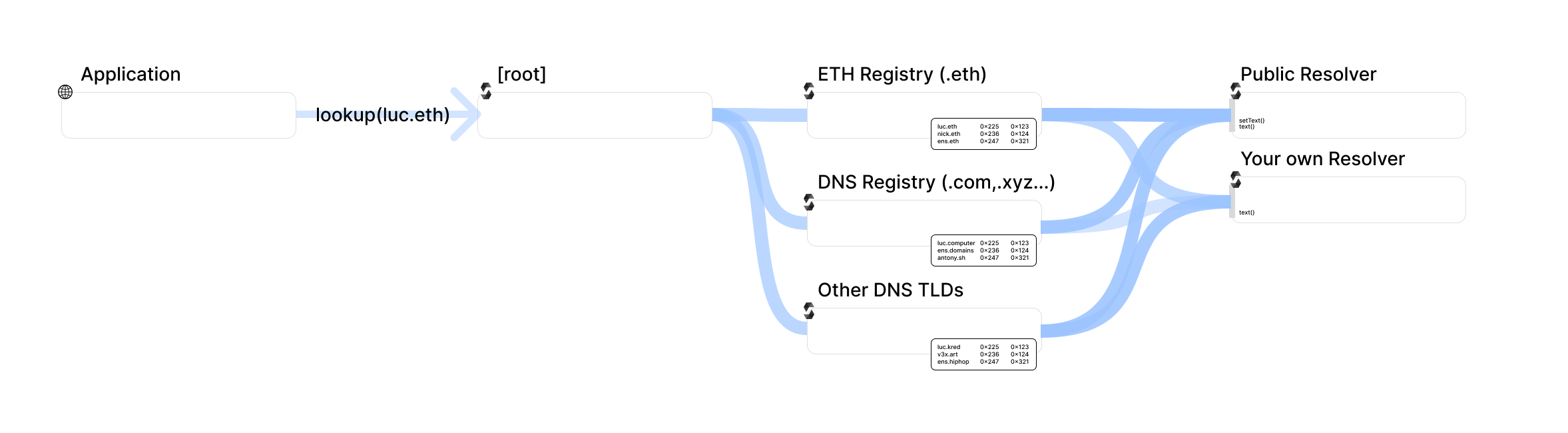
ENS resolution primarily involves the registry, registrars, and resolvers.
3.1 ENS Registry
The ENS registry is the system's core smart contract. It records the controller, resolver, and related settings for each domain.
When a user queries an ENS name, the system first accesses the registry to determine which resolver should be used to read the relevant records.
3.2 Registrars
Registrars define the allocation rules for specific top-level domains. For example, the .eth registrar manages the registration and renewal of .eth names.
After obtaining a .eth name, a user can manage its records, transfer control, or create subdomains during its registration period.
3.3 Resolvers
A resolver is a smart contract that reads domain records. It can answer questions such as:
- Which wallet address does this ENS name point to?
- Which avatar is set for this name?
- Is a website content hash linked?
- Are addresses on other chains configured?
- Is any public text information stored?
3.4 Forward Resolution
Forward resolution converts an ENS name into a wallet address:
gary.eth → 0x1234...5678
3.5 Reverse Resolution
Reverse resolution converts a wallet address into a primary name:
0x1234...5678 → gary.eth
To prevent errors or spoofing, an application should perform forward resolution after reverse resolution to confirm that the name points back to the original address.
How Do ENS, Traditional Domains, and DIDs Differ?
ENS can provide a readable on-chain name, but it is not a complete digital identity system. Owning gary.eth only proves that the corresponding wallet controls the name; it does not automatically prove the holder's real name, occupation, or education.
DIDs focus more on identifiers and cryptographic verification, while verifiable credentials are used to prove specific identity attributes. For related information, see the companion article Web3 Identity (DID): The Vision of Self-Sovereign Identity.
What Can ENS Domains Be Used For?
5.1 Receiving On-Chain Assets
In a wallet or application that supports ENS, the sender can enter a .eth name. The system resolves it to the corresponding address before the asset is sent.
Users should still check the resolution result, network, and recipient address before confirming a transaction. ENS makes input easier but cannot replace final verification.
5.2 Setting a Primary Name
Users can set a primary name for a wallet address. After reverse resolution, applications that support ENS can display gary.eth instead of a long address.
5.3 Presenting a Web3 Identity
ENS can link an avatar, biography, social accounts, or website information, turning the domain into a public on-chain profile entry point.
5.4 Publishing a Decentralized Website
Through content hashes, ENS can link to website content stored on networks such as IPFS. Direct access depends on browser, gateway, and application support.
5.5 Creating Community Subdomains
Projects can issue subdomains to community members for membership, contribution records, or application sign-in. For example, a community could create alice.community.eth.
How Do You Register a .eth Domain?
A .eth name must be registered through the official ENS application using a compatible Ethereum wallet.
Step 1: Open the Official ENS Application
Use the official ENS App. Do not follow links in unsolicited messages or advertisements.
Step 2: Connect a Wallet
Select the wallet address that will hold the domain. Connecting a wallet generally does not transfer assets, but users should still inspect any signature request.
Step 3: Search for a Name
Enter the name you want to register. The page will show whether it is available, already registered, in the grace period, or subject to a temporary premium.
Shorter names are generally scarcer and may cost more to register. Refer to the ENS App for the actual fee.
Step 4: Choose a Registration Period
Choose how long you want to register the name. A .eth name is not permanently owned after a single payment; it must be renewed before it expires.
A longer registration period generally costs more in total but reduces the risk of forgetting to renew.
Step 5: Confirm the Transaction
Registration requires an on-chain transaction through the wallet, along with payment of the registration fee and Ethereum network gas.
Prepare enough ETH before starting. See the Ethereum asset page for related asset information.
Step 6: Wait for Registration to Complete
After the transaction is confirmed, view the domain under “My Names” in the ENS App. You can then set its address, avatar, and other public records.
How Do You Configure ENS Resolution Records?
After registration, users need to associate the .eth name with the wallet address they intend to use.
Common settings include:
- ETH address: Point the domain to an Ethereum wallet address;
- Other chain addresses: Add asset addresses for supported networks;
- Primary name: Allow applications to reverse-resolve and display the ENS name;
- Avatar: Set a public avatar;
- Text records: Add a website, email address, or social account;
- Content hash: Link website content on IPFS or another network;
- Subdomains: Create and manage lower-level names.
Changing records generally requires a wallet signature, and some operations also require a gas fee. Before saving, confirm that the connected wallet has the appropriate management permissions.
How Do You Transfer Assets Using a .eth Name?
If a wallet or DApp supports ENS, users can enter a .eth name in the recipient field.
The basic process is:
- Open the wallet's send page;
- Select the asset and network;
- Enter the ENS name in the recipient field;
- Wait for the wallet to resolve the corresponding address;
- Check the domain, full address, and target network;
- Make a small test transfer first;
- Complete the remaining transfer after confirming the result.
Do not skip address verification simply because the input is a readable domain. Lookalike characters, spelling errors, incorrect resolution records, and phishing domains can still cause asset loss.
What Is an ENS Primary Name?
A primary name is a bidirectionally verified relationship between a wallet address and an ENS name.
For example:
gary.eth → 0x1234...5678 0x1234...5678 → gary.eth
When forward and reverse resolution agree, applications that support ENS can safely display gary.eth as the address's primary name.
If an application only performs reverse resolution without checking that the name resolves forward to the original address, it may display an incorrect or spoofed name. Wallets and developers should therefore complete both checks.
Are the ENS Protocol and ENS Token the Same Thing?
No.
The ENS protocol is a Web3 naming system whose main function is to map readable names to wallet addresses and other records.
The ENS token is associated with protocol governance. Holding ENS tokens does not automatically grant ownership of a .eth domain, and registering a .eth name generally does not require buying ENS tokens.
Users can view the ENS asset page for basic information and market data about the token.
When reading project information, distinguish among:
- The ENS protocol;
- .eth domains;
- The ENS governance token;
- The registration and control of a specific domain.
Do ENS Domains Expire?
.eth names must be registered and renewed for a defined period. Users should check the expiration date in advance and reserve enough ETH for the renewal fee and gas.
Under current ENS rules, an expired name generally enters a grace period. During that period, the previous holder can still renew it, while others cannot register it.
After the grace period, the name may enter a temporary premium phase and gradually become available for registration again. Users who fail to renew may ultimately lose control of the name.
For long-term use of an ENS name:
- Check the expiration date regularly;
- Renew it in advance;
- Ensure the management wallet remains accessible;
- Do not rely solely on unofficial expiration reminders;
- Verify the official ENS domain and contract operation when renewing.
What Risks Should You Consider When Using ENS?
12.1 Phishing Websites
Attackers may imitate the official ENS website to trick users into connecting wallets or signing malicious transactions. Access the official application through a trusted source and verify the domain.
12.2 Lookalike Characters
Some letters, numbers, and special characters look similar. Check every character in an ENS name rather than sending assets based only on an avatar or display name.
12.3 Incorrect Resolution Records
If a domain points to the wrong address, assets sent to it may reach the wrong wallet. Make a small test transfer after changing records.
12.4 Domain Expiration
Failure to renew can eventually allow someone else to register the domain. Domains used publicly over the long term should be renewed in advance.
12.5 Privacy Exposure
ENS domains and their records are generally publicly queryable. Linking a domain to a real-name social account may allow others to analyze the associated address's transaction activity.
12.6 Loss of a Wallet Private Key
If the private key for the wallet controlling an ENS domain is lost, the user may be unable to manage, transfer, or update the domain.
12.7 Application Compatibility
Not every wallet, blockchain, or website supports ENS. Confirm that the target application can correctly resolve .eth names before use.
How Can You Explore On-Chain Features with Hotcoin Web3 Wallet?
A Web3 wallet helps users manage addresses, assets, and transaction signatures. It is also an important gateway to on-chain applications such as ENS.
Visit Hotcoin Web3 Wallet to explore related features, or download the Hotcoin App for mobile access.
Before connecting to ENS or another DApp:
- Verify the website domain;
- Confirm the wallet network;
- Read the signature and transaction details;
- Never disclose a seed phrase or private key;
- Use a small amount for the first transaction;
- Review wallet approvals regularly.
Conclusion
By mapping complex wallet addresses to readable .eth names, ENS improves the experience of on-chain transfers, identity presentation, and DApp interactions. Users can also link avatars, websites, social profiles, and addresses on other chains through resolution records, or assign community members names through subdomains.
However, an ENS domain is not the same as a verified real-world identity, nor does it eliminate transfer and phishing risks. When using a .eth name, users still need to verify the resolved address, protect wallet private keys, monitor expiration dates, and avoid placing sensitive information in public records.
Visit the Hotcoin website for more information about the platform and its products.
Lectura recomendada
Ver más
service hotcoin.com
producthotcoin.com
businesshotcoin.com
casecnhotcoin.com