
Bitcoin P2P Trading Guide: Buy BTC Without P2P Fees
Bitcoin P2P trading allows buyers and sellers to exchange fiat currency and crypto assets directly through a platform. It can often reduce or eliminate platform-level P2P trading fees, but “no P2P fee” does not mean the entire process of buying BTC is cost-free. If you ultimately buy BTC on the BTC/USDT spot market, you may still pay spot trading fees, face a bid-ask spread, or incur payment-channel charges. Hotcoin currently states that ordinary users are generally not charged transaction fees when buying or selling digital assets on its P2P marketplace, but the latest platform rules always apply.
What Is BTC P2P Trading?
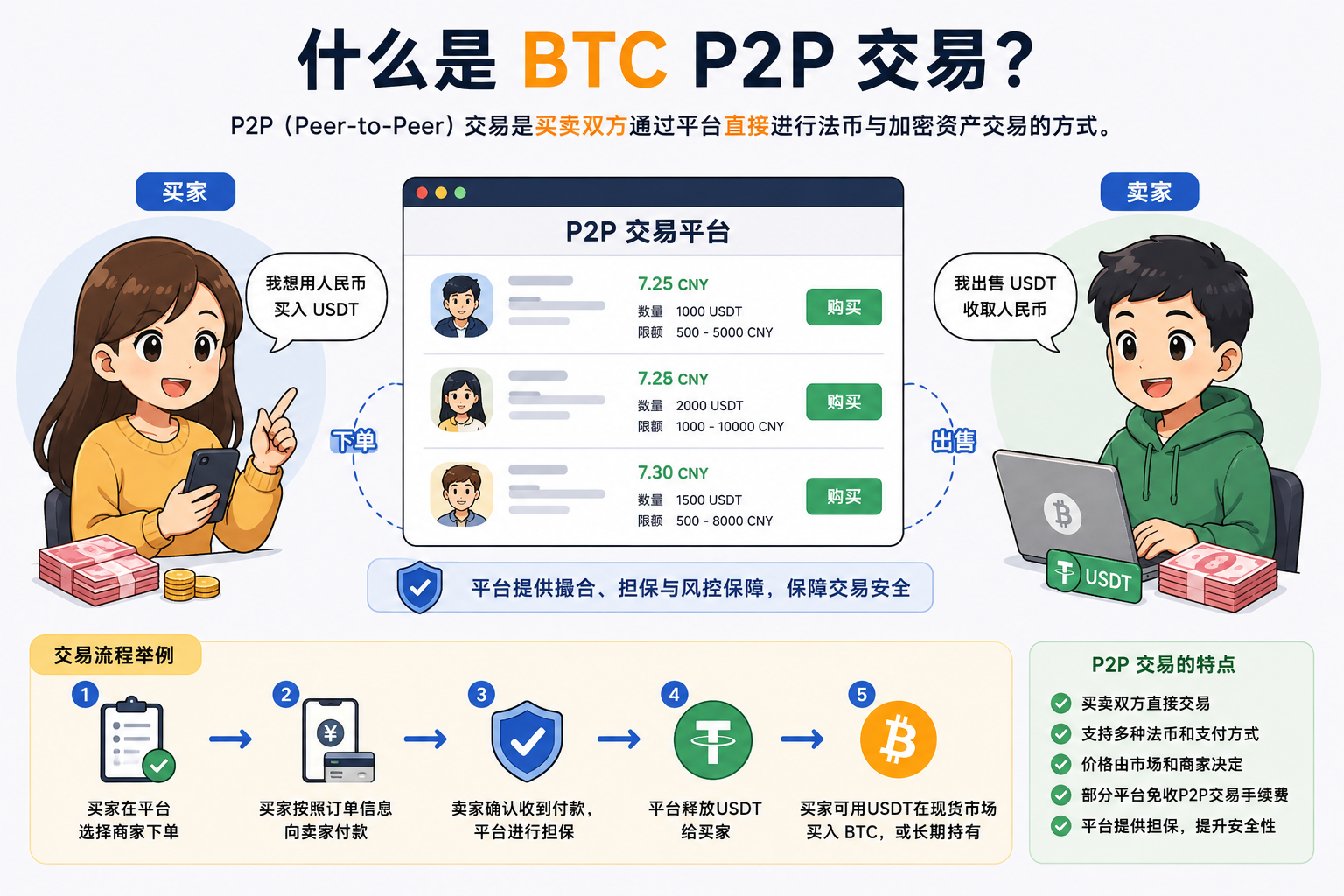
P2P, or peer-to-peer, trading means that users buy and sell directly with one another. The platform provides the marketplace, order matching, and relevant transaction safeguards, while the buyer and seller complete the trade according to the price, amount, and payment method stated in the order.
Unlike going directly to the BTC/USDT spot market, P2P trading primarily solves the problem of converting fiat currency into crypto assets.
For example, if you hold CNY, USD, JPY, or another fiat currency but do not have USDT, you can use a P2P marketplace that supports your currency to buy USDT. You can then use that USDT to buy BTC on the BTC/USDT spot market.
For a beginner, the path is easy to understand:
Fiat → P2P → USDT → BTC/USDT spot market → BTC
According to Hotcoin's official materials, its P2P service supports multiple fiat currencies, including USD, EUR, GBP, AUD, JPY, and CNY. Users can select a matching market and merchant for their currency.
Is Buying BTC Through P2P Really “Fee-Free”?
You need to distinguish between P2P transaction fees and the actual cost of purchasing BTC.
If a platform explicitly states that ordinary users do not pay P2P transaction fees, you may not need to pay an additional platform fee on the P2P order. Hotcoin's current P2P FAQ states that ordinary users are generally not charged transaction fees when buying or selling digital assets in the P2P marketplace.
However, that does not mean you can necessarily obtain BTC at zero cost.
For example:
Buy USDT through P2P → possibly no platform P2P fee → buy BTC through BTC/USDT → possible spot trading fee.
P2P merchant quotes may also differ, and bank transfers or other payment methods may involve additional charges.
A more accurate statement is:
P2P trading may be free of platform P2P transaction fees, but the complete process of buying BTC is not necessarily cost-free.
To learn how spot trading fees are calculated, read How Much Are Bitcoin Trading Fees? A Detailed Rate Guide.
How Do You Buy BTC Through P2P?
If the platform's P2P marketplace directly lists BTC offers, you can select BTC and buy it. If the marketplace mainly offers assets such as USDT, you can first acquire USDT through P2P and then buy BTC on the BTC/USDT spot market.
Using Hotcoin's current P2P process as an example, users first select the fiat currency they want to use and then browse the corresponding merchant listings. Each offer typically shows the available quantity and the minimum and maximum order amounts.
The basic process is:
Open P2P → select fiat currency → browse merchants → compare quotes and limits → select a payment method → create an order → pay according to the order details → confirm payment → wait for the assets to be released.
If your final goal is BTC but you purchased USDT on the P2P page, enter the BTC/USDT spot market after completing these steps and buy BTC.
Step 1: Select a Fiat Currency and P2P Merchant
After opening the P2P page, first choose the fiat currency you intend to use.
For example, choose the CNY market if you hold Chinese yuan, or the JPY market if you use Japanese yen.
You will then see quotes from different merchants.
Do not look only for the “lowest” or “highest” price. At a minimum, also check:
Per-order limits: Whether they cover your intended purchase amount;
Available quantity: Whether the merchant has enough assets;
Payment method: Whether you can use the supported method normally;
Merchant history: The merchant's transaction activity and account performance;
Final payment amount: The exact fiat amount you need to transfer.
Hotcoin's official P2P page displays each merchant's available quantity and order limits, allowing users to filter offers that meet their needs.
Step 2: Create a P2P Order
After selecting a suitable offer, enter the amount you want to buy.
For example, if you plan to spend 1,000 CNY on USDT, the page calculates the corresponding amount of USDT from the merchant's quote.
Do not rush to pay. First check:
Purchase quantity × merchant quote = actual payment amount
Also confirm the minimum and maximum order limits.
If your order falls outside the merchant's limits, choose another offer instead of trying to complete the trade privately through another method.
Step 3: Pay According to the Order Details
After you create the order, the platform normally displays the seller's designated payment method.
Pay only according to the information displayed on the order page.
Do not transfer funds simply because the seller sends a different bank card, QR code, or receiving account in the chat.
Hotcoin's P2P FAQ explicitly requires the payment method used in a P2P trade to match the identity verification information on the user's account.
Before paying, check again:
Recipient name → receiving account → payment amount → order status
Transfer the funds only after all the details match.
Step 4: Confirm Payment and Wait for Asset Release
After completing the fiat transfer, follow the instructions on the platform page to confirm that you have paid.
Never click “Paid” before you have actually transferred the funds.
Likewise, do not skip the platform process because the seller pressures you to do so.
Under normal circumstances, once the seller confirms receipt of a compliant payment, the seller releases the corresponding crypto assets through the platform process.
If your payment succeeded but the assets have not arrived, first check:
Whether the transfer was successful;
Whether the recipient account matches the order;
Whether the payment channel is experiencing a delay;
The current order status.
If the issue remains unresolved, use the platform's customer support or appeal process. Hotcoin's official FAQ also recommends checking the receiving information and possible payment-channel delays when a payment succeeds but the seller has not received it.
If You Bought USDT Through P2P, How Do You Convert It to BTC?
This is one of the most common points of confusion for first-time P2P users.
P2P trading and BTC spot trading are two separate markets.
For example:
Step 1: Buy USDT with CNY through P2P.
Step 2: Open the BTC/USDT spot market.
Step 3: Use the USDT you just acquired to buy BTC.
In other words:
CNY → USDT → BTC
If you are not yet familiar with what BTC/USDT means, read BTC/USDT Trading for Beginners: Understanding the Bitcoin Trading Pair.
This helps you avoid confusing “buying USDT through P2P” with “buying BTC on the spot market.”
What Are the Main Risks of P2P Trading?
P2P trading is flexible, but it is not risk-free.
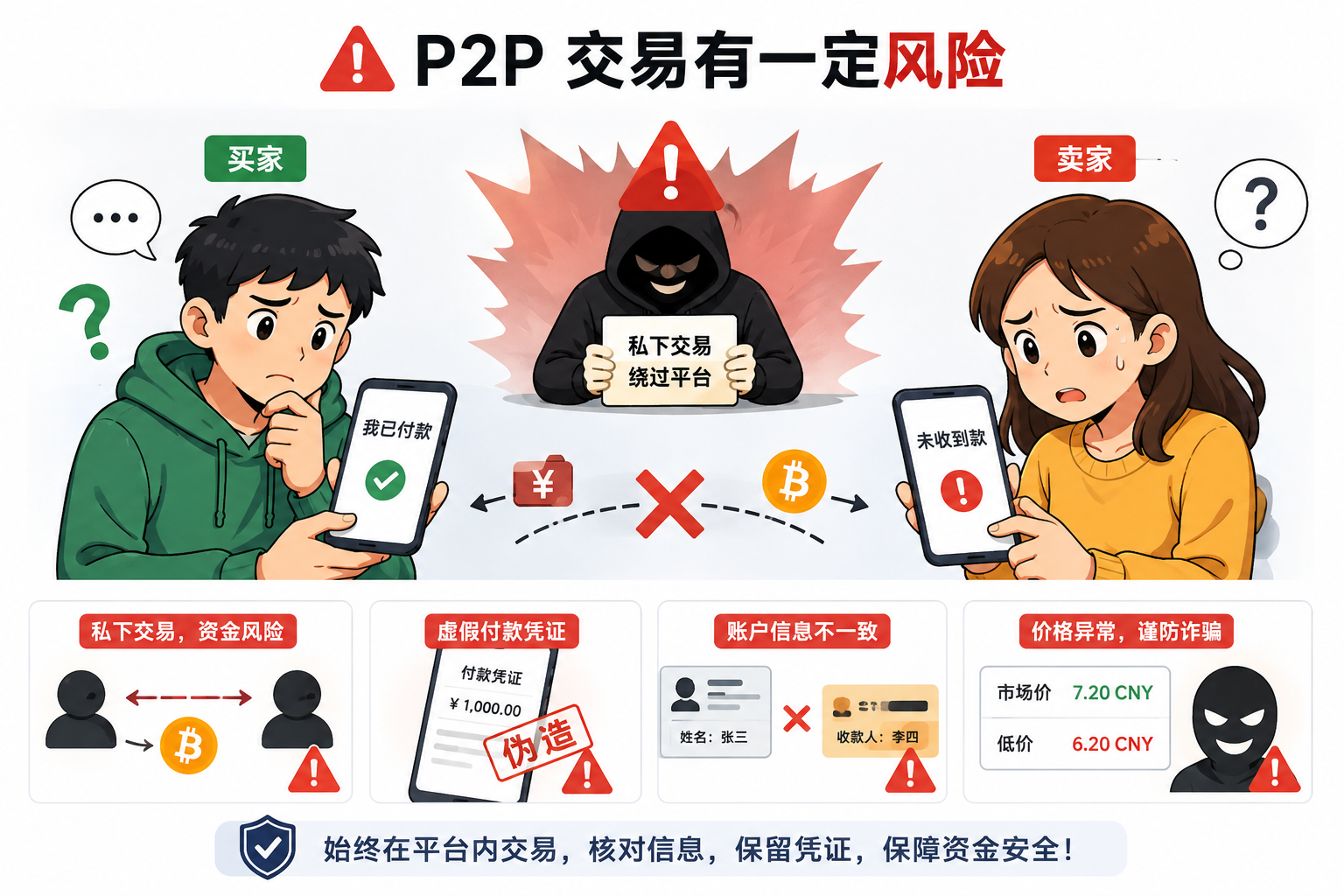
The most important rule is to never complete the trade outside the platform.
If a seller asks you to cancel the order and pay privately to another account, resolving a dispute becomes more difficult. Be especially cautious if the payment involves an unfamiliar recipient account, a third-party payer, or an account that does not match the order information.
You should also be wary of offers with unusually attractive prices.
If a quote differs substantially from other merchants in the same market, do not place an order solely because it is cheaper. The apparent price advantage may come with payment restrictions, different trading conditions, or other risks.
A simple rule is:
Place the order on-platform, communicate on-platform, pay according to the order, and retain proof of payment.
Do not ignore transaction safety just because the trade is advertised as “fee-free.”
Checklist Before Buying BTC Through P2P
The point of this checklist is: do not check only whether the fee is zero. Check the total cost of completing the transaction and whether the order is safe.
FAQ
Is Buying BTC Through P2P Always Free of Fees?
No. Some platforms may not charge a platform transaction fee in their P2P marketplace, but actual costs may still come from differences in merchant quotes, payment-channel fees, and the spot trading fee incurred when you later buy BTC. Always refer to the platform's current rules.
What Is the Difference Between Buying BTC Through P2P and Buying BTC Directly?
P2P involves users exchanging fiat currency and crypto assets directly with one another. Direct purchase or spot trading may use other platform mechanisms. P2P emphasizes fiat payment methods and merchant quotes, while spot trading primarily relies on trading pairs and an order book.
Why Did I Receive USDT Instead of BTC Through P2P?
Supported assets vary by platform, fiat market, and merchant. If the current P2P marketplace mainly offers USDT, you can first acquire USDT through P2P and then buy BTC on the BTC/USDT spot market.
What Should I Do If the Seller Does Not Release the Crypto After I Pay?
Do not resolve the matter privately, and do not cancel the order and pay again. First check the payment status, order status, and receiving information, then use the platform's appeal or customer support process. Keep your bank transfer record and order details to support later verification.
Can I Pay for a P2P Trade With Someone Else's Bank Card?
Do not assume this is permitted. Requirements differ between platforms. Under Hotcoin's current P2P rules, the payment method must match the account's identity verification information, so confirm the latest platform requirements before trading.
Making Your First P2P Crypto Purchase
Once you understand the basic P2P process, the next step is to learn about the BTC/USDT spot trading pair, so you can connect the complete “fiat → USDT → BTC” journey.
BTC/USDT Trading for Beginners: Understanding the Bitcoin Trading Pair
You can also continue with:
Hotcoin Guide to Buying BTC for the First Time
Risk warning: P2P trading involves fiat payments and transactions between users. Actual risks depend on the platform rules, payment method, merchant, and your jurisdiction. This article explains the P2P buying process and does not constitute investment advice. Before trading, confirm the platform's current service coverage, fees, identity requirements, and trading rules. Never pay an account that is not shown in the order details.
Lectura recomendada
Ver más

Service@hotcoin.com
Product@hotcoin.com
Business@hotcoin.com
Casecn@hotcoin.com