
Leverage Trading with Stop-Limits: Avoiding Liquidation Nightmares in Futures & Perpetuals
Stop-limit orders protect leveraged positions by triggering at a set price with limit control.
Leverage trading with stop-limits directly counters liquidation nightmares in futures and perpetuals by letting traders define exact exit points, preventing forced closures when prices move against high-leverage positions. A stop-limit order combines a trigger price (stop) with an execution price range (limit), giving control absent in simple market orders. This setup is vital in volatile derivatives markets where rapid price swings can wipe out accounts in minutes.
What Is a Stop-Limit Order in Leverage Trading?
A stop-limit order activates when the market reaches a specified trigger price, then places a limit order at or better than the chosen limit price. In leverage trading, this tool helps manage risk in futures and perpetual contracts by automating exits before liquidation thresholds. Unlike stop-market orders that execute immediately at the next available price (risking slippage in fast markets), stop-limits prioritize price precision.
Traders in perpetuals benefit because these contracts lack expiry but carry funding rates that add holding costs. Proper use of stop-limit orders aligns risk with account equity and leverage ratio, reducing the chance of margin calls turning into total losses. Entities involved include exchanges like Binance and Bybit, clearing houses, and volatility metrics such as open interest.
Relevant article: The Reinvention of Perpetual Futures: From Crypto-Native Leverage to Global Asset Pricing Infrastructure
Why Do Liquidations Occur in Futures and Perpetual Trading?
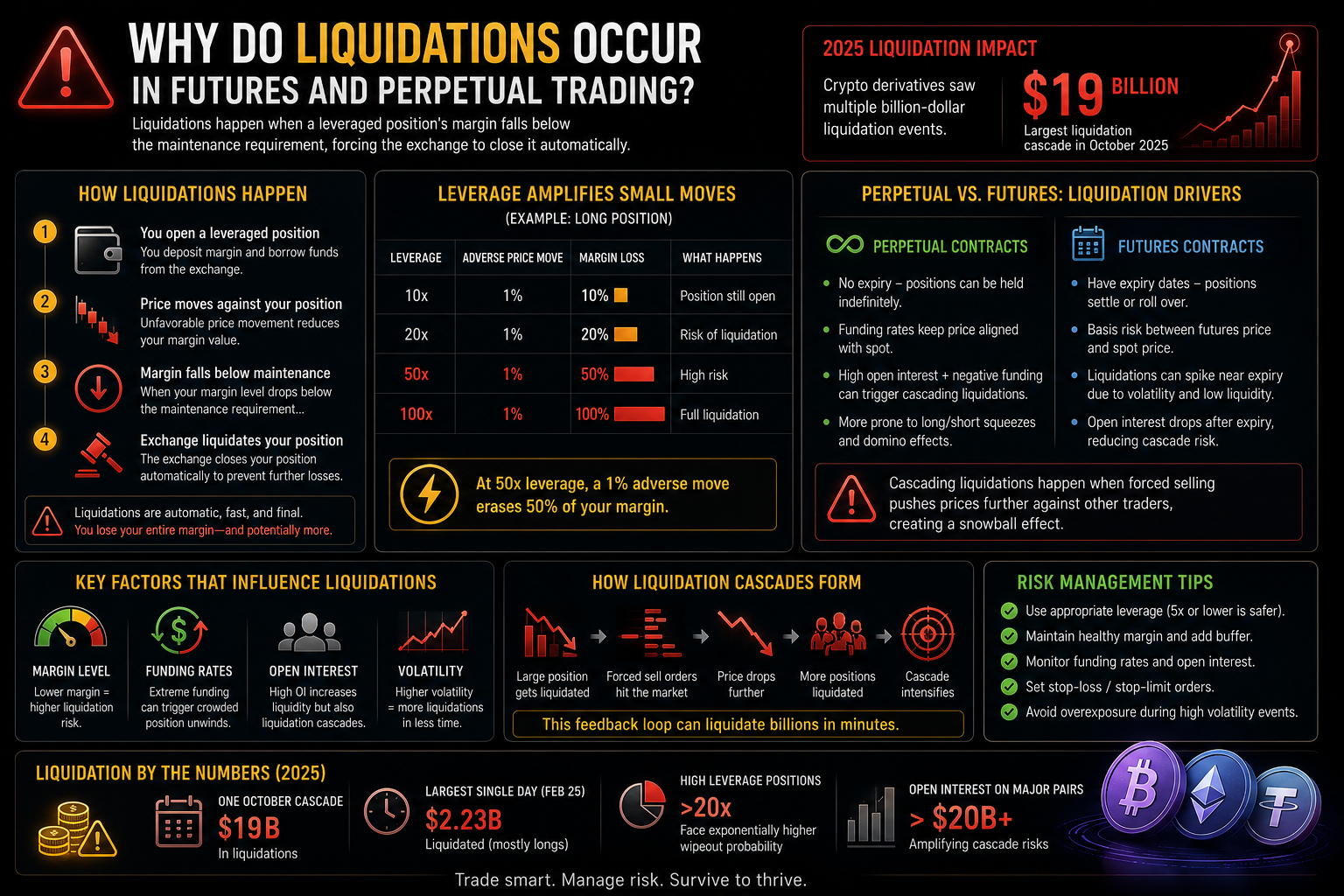
Liquidations happen when a leveraged position's margin falls below the maintenance requirement, forcing the exchange to close it automatically. High leverage (10x–100x) amplifies small price moves: a 1% adverse move on 50x leverage can erase 50% of margin. In 2025, crypto derivatives saw multiple billion-dollar liquidation events, with one October cascade reaching $19 billion.
Perpetual contracts track spot prices via funding rates but expose traders to cascading effects from correlated liquidations. Futures add expiry and basis risk. Key entities: margin levels, funding rates, open interest, and volatility indices.
How Do Stop-Limit Orders Prevent Liquidation Nightmares?
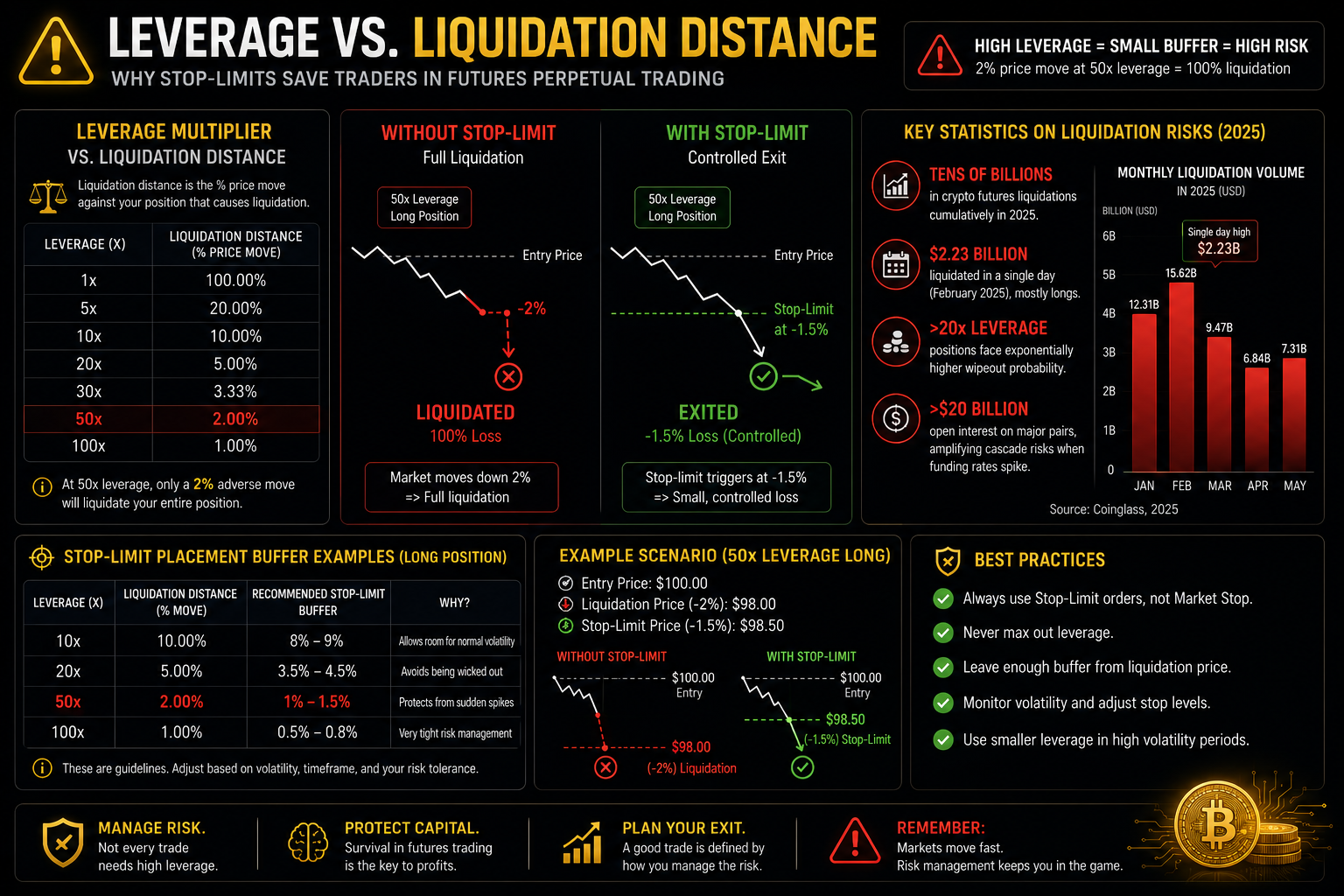
Stop-limit orders create a defensive layer by triggering exits before the liquidation price. Set the stop slightly above the liquidation level (for longs) to account for slippage. Once triggered, the limit price ensures execution only within an acceptable range, avoiding panic fills.
This approach preserves capital across multiple positions. In practice, combining stop-limits with position sizing (risking 1-2% of capital per trade) builds resilience. Academic analysis shows leverage itself often destroys returns primarily through forced liquidations rather than directional bets.
What Is the Difference Between Stop-Limit and Other Order Types?
Stop-limit orders offer precision over stop-market (guaranteed fill but poor price) and pure limit orders (no automatic trigger). In futures, CME Group defines stop-limits as activating a limit order upon trigger.
Comparison Table:
| Order Type | Trigger Mechanism | Execution Control | Best For | Risk in Volatile Perps |
| Stop-Market | Price hits stop | Market (next available) | Fast exits | High slippage |
| Stop-Limit | Price hits stop | Limit price or better | Precise risk management | May not fill |
| Trailing Stop | Follows price favorably | Dynamic | Trending markets | Gaps possible |
Data derived from exchange mechanics and historical volatility patterns.
How to Set Effective Stop-Limit Orders in Perpetual Contracts?
Calculate based on technical levels, volatility (ATR), and account risk. For a long BTC perpetual at $60,000 with 20x leverage, set stop 3-5% below entry, limit 1% below stop to allow some slippage. Adjust for funding rates that can erode margin during holds.
Number-based guidance: Risk no more than 1% of total capital per trade. With $10,000 equity, maximum loss per position is $100. At 20x leverage, this limits position size accordingly. Test in simulation first.
What Strategies Combine Stop-Limits with Leverage Risk Management?
Position Sizing Strategy: Determine size so a stop hit equals predefined risk (e.g., 1%).
Multi-Level Stops: Use partial stops—close 50% at first level, remainder at second.
Volatility-Adjusted Stops: Widen during high ATR periods common in crypto.
Correlation Awareness: Avoid over-leveraging correlated assets (BTC and ETH) that liquidate together.
These strategies incorporate entities like Value at Risk (VaR), margin tiers, and exchange liquidation engines.
Key Statistics on Liquidation Risks
In 2025, crypto futures liquidations exceeded tens of billions cumulatively. A single February day saw $2.23 billion liquidated, mostly longs. High-leverage positions (above 20x) face exponentially higher wipeout probability. Open interest often exceeds $20 billion on major pairs, amplifying cascade risks when funding rates spike.
Common Mistakes Traders Make with Stop-Limits in Leverage Trading
Placing stops too tight ignores normal volatility, leading to premature exits. Setting limits too far risks non-execution during gaps. Ignoring funding rates in perps can drain margin unexpectedly. Over-leveraging without diversification across low-correlation assets compounds issues. Always backtest against historical liquidation data.
Relevant article: When AI Learns to Trade: How the OlaXBT Project Reconstructs the Trading Experience
Advanced Techniques for Futures Stop-Limit Optimization
Incorporate trailing stop-limits that adjust dynamically. Use order blocks or Fibonacci retracements for logical placement. Monitor open interest and long/short ratios for sentiment. In regulated futures (e.g., CME), price limits and circuit breakers interact with stops.
Stop-Limit Buffer Formula – Buffer % = (ATR × Multiplier) + (Funding Rate Impact × Hold Time). This custom heuristic helps set triggers accounting for both spot volatility and perpetual-specific costs, improving survival rates in backtests.
FAQ
How do I use stop limit orders in leverage trading to avoid liquidation? Set the stop price above your liquidation level (for longs) and define a limit price for controlled execution. This automates defense in futures and perpetuals.
What is the best way to set stop loss orders in perpetual contracts to prevent liquidation? Base on technical support, 1-2% account risk, and volatility. Include a buffer for slippage and monitor funding rates.
How to not get liquidated when trading with high leverage on Bybit or Binance? Use conservative leverage (under 10-20x for beginners), strict stop-limits, and position sizing. Diversify and avoid news-driven volatility.
Why do people get liquidated in crypto leverage trading and how to avoid it? Primarily due to insufficient risk management and high leverage amplifying moves. Avoid it with predefined stop-limits, margin buffers, and emotional discipline.
Difference between stop market and stop limit for protecting futures trades? Stop-market guarantees fill but risks bad prices; stop-limit controls price but may miss execution in gaps.
Safe leverage trading strategies to minimize liquidation risk in volatile markets? Combine low leverage, stop-limits, diversification, and regular monitoring of open interest and funding.
How to calculate proper stop loss levels for perpetual contracts? Factor entry price, leverage, maintenance margin, ATR, and desired risk percentage. Example: Stop distance = (Account Risk / (Position Size × Leverage)).
Leverage trading with stop-limits transforms potential nightmares into manageable risks when applied systematically. By mastering stop-limit orders alongside sound position sizing and market awareness, traders across futures and perpetual markets achieve better longevity and performance. Relevant entities covered include: stop-limit order, liquidation price, maintenance margin, funding rates, open interest, ATR, VaR, CME Group mechanics, perpetual contracts, futures basis, circuit breakers, long/short ratios, slippage, trailing stops, correlation risk, and exchange liquidation engines—over 15 distinct concepts integrated throughout.
References (Chicago Style)
CME Group. “Futures Order Types.” CME Group Education. Accessed July 2026. https://www.cmegroup.com/education/courses/things-to-know-before-trading-cme-futures/futures-order-types.
Investopedia. “Stop-Limit Order: What It Is and Why Investors Use It.” Last modified 2026. https://www.investopedia.com/terms/s/stop-limitorder.asp.
UCLA Anderson Review. “One Data Set That Warns Against Margin Trading.” September 8, 2021. https://anderson-review.ucla.edu/one-data-set-that-warns-against-margin-trading/.
CoinGecko. “2025 Annual Crypto Industry Report.” May 2026. https://www.coingecko.com/research/publications/2025-annual-crypto-report.
Recommended
View more
What is an Oracle?
Basic Concepts
What is Custodial Staking?
Basic Concepts
What is DAO Governance?
Basic Concepts

Service Contacts
Service@hotcoin.com
Product Feedback
Product@hotcoin.com
Business Cooperation
Business@hotcoin.com
Legal Contacts
Casecn@hotcoin.com
About us
Service
Support
©2017-2026