
The Blockchain Trilemma: Decentralization, Security, and Scalability
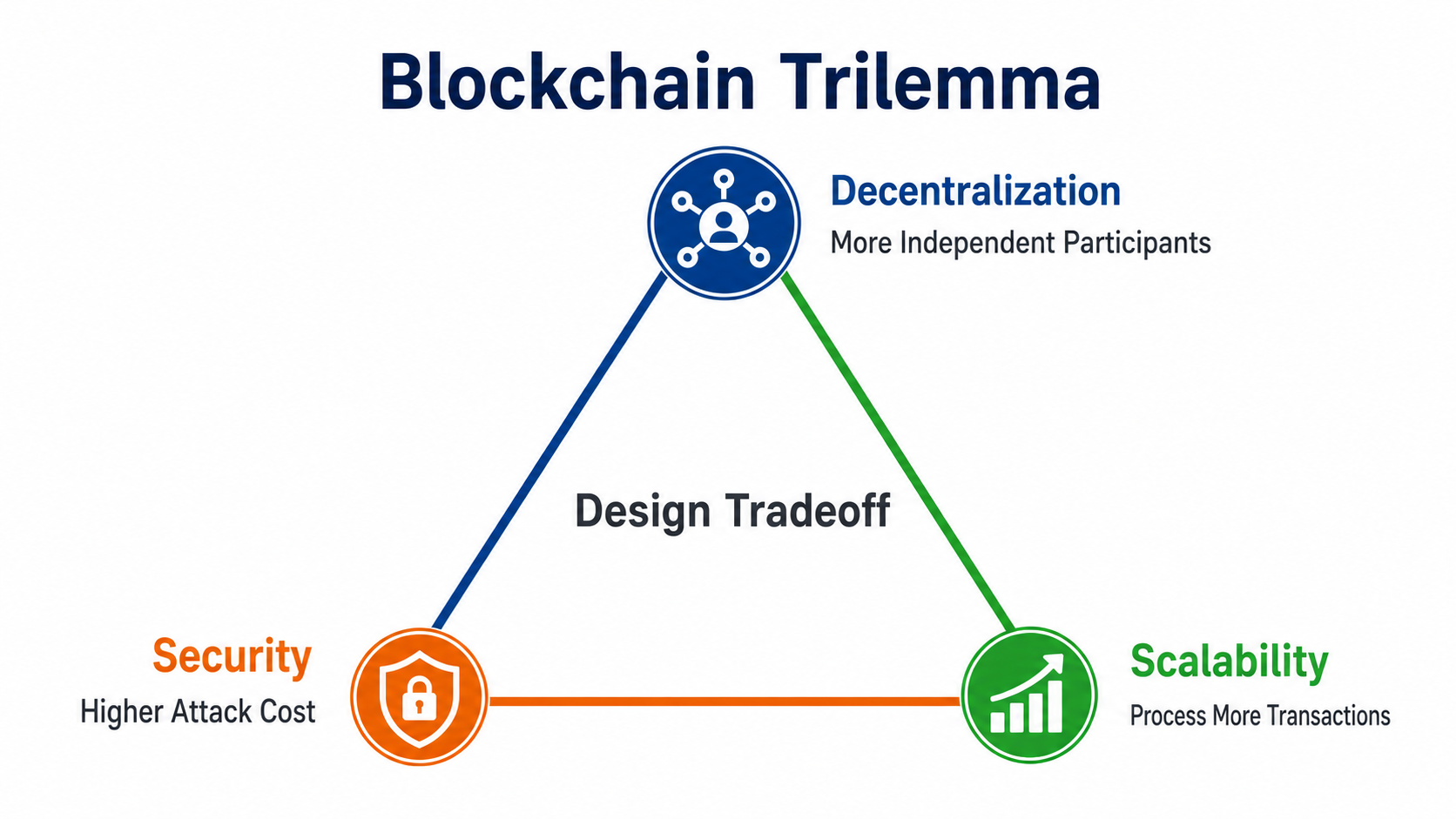
The blockchain trilemma describes a design trade-off: open networks struggle to maximize decentralization, security, and scalability at the same time. Improving one metric often changes the barrier to running a node or the system's trust assumptions.
It is not a mathematical theorem proving that every blockchain can choose only two of the three. Instead, it is an evaluation framework. Scaling solutions rearrange responsibility for computation, data, and verification rather than making the costs disappear.
What Does Each of the Three Goals Mean?
Decentralization considers how many independent participants can verify the network and whether block production, governance, or clients are controlled by a small number of entities. Node count is only one metric; whether ordinary devices can participate is equally important.
Security considers the cost an attacker must bear to forge history, censor transactions, or disrupt finality. It also covers client vulnerabilities, key management, network partitions, and data availability.
Scalability considers whether a system can process more transactions as its user base grows while maintaining acceptable fees, latency, and synchronization costs. Peak TPS in a test environment alone does not represent real-world scalability.
Why Can Higher Throughput Affect Decentralization?
The most direct approaches are to increase block size, shorten block times, or allow more computation in each block. These changes can process more transactions, but they also raise bandwidth, CPU, storage, and synchronization requirements.
If ordinary users cannot run validating nodes, they will turn to a small number of RPC providers or data services. Slower block propagation also favors producers with better network locations and infrastructure, increasing the probability of temporary forks or missed blocks.
Conversely, strict block-resource limits can keep validation requirements low, but periods of high demand will cause congestion and fee competition. Neither outcome can be reduced to “faster is better” or “slower is safer.”
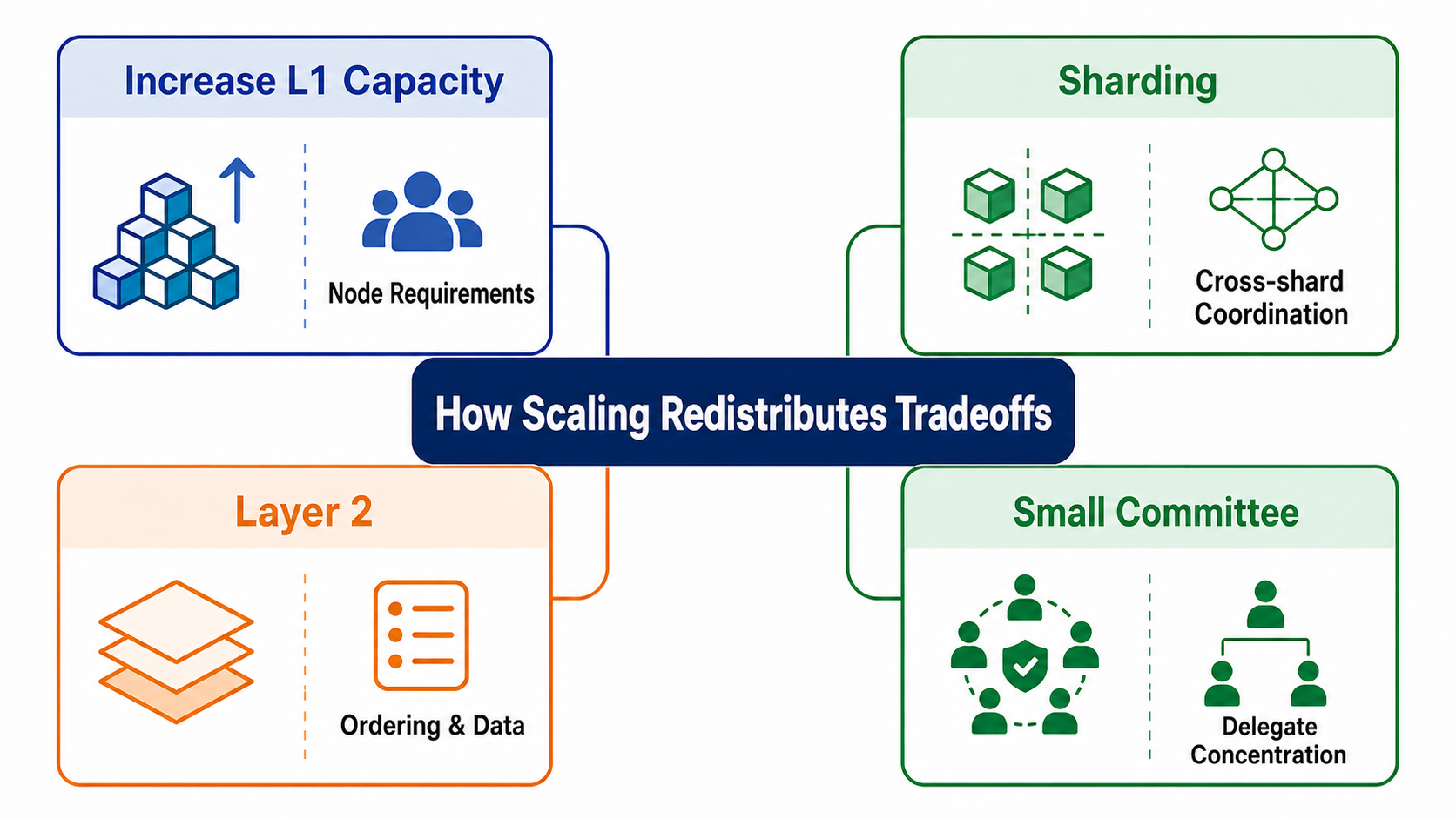
How Do Common Scaling Approaches Redistribute the Trade-Offs?
| Approach | Main method | Trade-offs to examine |
|---|---|---|
| Increase L1 capacity | Enlarge blocks or raise execution limits | Whether node hardware requirements, propagation costs, and state growth increase too quickly |
| Sharding | Assign data or execution tasks to different shards | How cross-shard communication, data availability, and shared security are implemented |
| Layer2 | Execute transactions in batches off-chain, then submit data or proofs to L1 | Trust assumptions involving sequencers, withdrawals, proof systems, and data publication |
| Sidechain | Process transactions on an independent consensus chain connected to the main chain | Whether security is inherited from the main chain and how bridged assets are protected |
| Small committee | Let fewer validators vote quickly | Committee selection, rotation, and collusion risks |
Layer2 allows the main chain to focus on settlement and data security while moving substantial execution to external systems. It can increase overall capacity, but users must still evaluate sequencer failures, challenge periods, proofs, and cross-layer bridges.
For more Layer2 approaches, see the Complete Guide to Layer2 Scaling Solutions.
How Do Consensus Mechanisms Affect the Trilemma?
PoW bases security on the cost of computing power. Slower block propagation helps more nodes keep up with the network, but specialized mining hardware and mining pools may become concentrated. PoS reduces energy demand and can provide finality, but it must address stake concentration, complex voting, and client-related risks.
Small DPoS or BFT committees can confirm blocks quickly with lower communication and coordination costs, but they have fewer active validators. Increasing committee size can broaden participation while also increasing message propagation and aggregation overhead.
For a detailed comparison of the two leading mechanisms, read PoW vs. PoS: A Comprehensive Comparison. For the relationships among the overall components, return to the Consensus Mechanisms Guide.
How Can You Tell Whether a Project Has Really Solved the Trilemma?
First determine whether its performance figures were measured on a testnet, a single-machine environment, or a public mainnet. Then examine node hardware requirements, validator count, the number of independent operators, and data-availability requirements.
If a project moves transactions off-chain, continue by asking who orders them, who stores the data, whether users can exit independently, and what happens when proofs fail. If the system relies on a small number of authorized nodes, also inspect their replacement rules and governance permissions.
A more practical comparison records which assumptions each improvement changes. Higher throughput is only the result; whether the trade-off is acceptable depends on who bears the validation cost, whether the system stops during failures, and whether users can verify it independently.
Frequently Asked Questions
Is the Blockchain Trilemma a Strict Mathematical Theorem?
No. It is an empirical framework for explaining design constraints in distributed ledgers. New protocols can improve several metrics, but they must still disclose their hardware, networking, and trust assumptions.
Can Shorter Block Times Alone Solve Scalability?
No. Faster block production increases propagation and fork pressure, while per-block execution capacity may remain unchanged. Data volume, finality, and node synchronization speed must also be considered.
Does Having More Validators Always Reduce Throughput?
Not necessarily. Communication methods, committee sampling, signature aggregation, and network topology all affect performance. More participants generally increase coordination overhead, but a well-designed protocol can reduce the need for fully connected messages in every round.
Does Layer2 Make the Trilemma Disappear?
No. Layer2 moves execution, sequencing, or proof generation to different layers, redistributing performance and trust assumptions. Evaluators must still examine the scope of security inherited from the main chain and the Layer2 system's own failure modes.
Recommended
View more


service hotcoin.com
producthotcoin.com
businesshotcoin.com
casecnhotcoin.com