
What is a Modular Blockchain
Monolithic blockchains—where one chain handles consensus, security, execution, and data availability—have hit clear performance ceilings. A modular blockchain flips the design by decoupling those four core functions and assigning each to a dedicated layer that can be combined as needed.
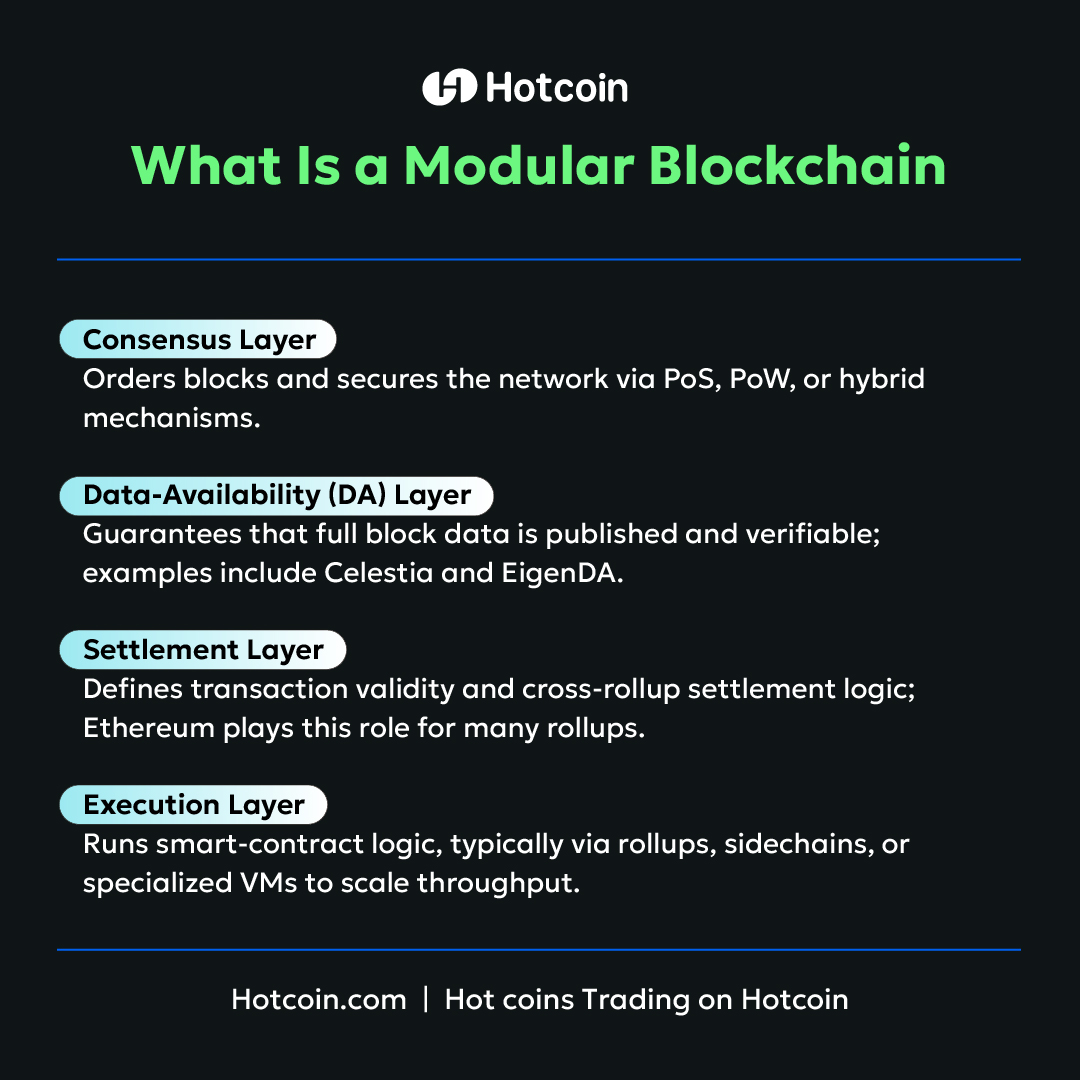
Consensus Layer – Orders blocks and secures the network via PoS, PoW, or hybrid mechanisms.
Data-Availability (DA) Layer – Guarantees that full block data are published and verifiable; examples include Celestia and EigenDA.
Settlement Layer – Defines transaction validity and cross-rollup settlement logic; Ethereum plays this role for many rollups.
Execution Layer – Runs smart-contract logic, typically via rollups, sidechains, or specialized VMs to scale throughput.
Why it matters
Elastic scaling. Developers can assemble the optimal stack for their use case, easing the perennial “throughput vs. decentralization” trade-off.
Lower launch cost. New chains plug into existing consensus or DA services instead of building everything from scratch.
Specialization & competition. Independent layers can iterate quickly, driving continuous performance gains.
Key challenges
Cross-layer trust & incentives. Robust economic designs are needed to keep a DA layer honest and prevent settlement rollbacks.
User-experience fragmentation. Multiple layers mean multiple accounts, fees, and bridges unless harmonized by wallets and standards.
In essence, a modular blockchain is like LEGO for distributed ledgers: clearly defined safety boundaries let builders mix and match secure components, delivering sustainable performance and economics for mass-scale Web3 applications.
Recommended
View more