
A Quick Overview of the SEC's Regulatory Responsibilities and Policy Developments on Crypto Assets
As the core regulatory body of the U.S. securities market, the Securities and Exchange Commission (SEC) plays a pivotal role in regulating crypto assets. In early 2025, with the inauguration of the Trump administration, the SEC’s regulatory approach underwent a notable shift—from primarily focusing on enforcement to emphasizing both rulemaking and support for innovation.
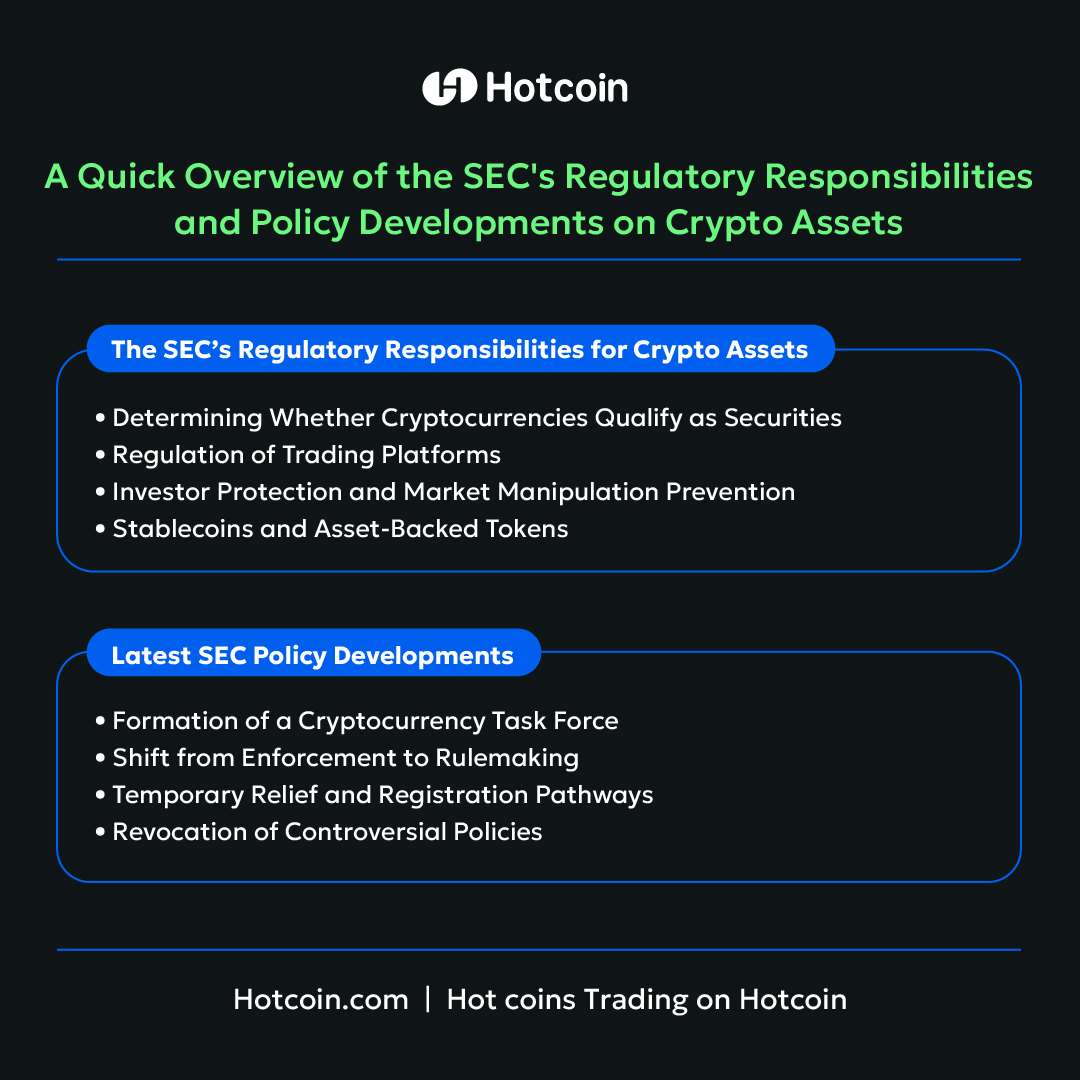
The SEC’s Regulatory Responsibilities for Crypto Assets
The SEC’s oversight of crypto assets primarily covers the following areas:
Determining Whether Cryptocurrencies Qualify as Securities
The SEC uses the Howey Test to decide if a crypto asset should be classified as a security. If it is deemed a security, its issuance, sale, and trading must comply with the SEC’s registration requirements or qualify for an exemption. Many Initial Coin Offerings (ICOs) have been deemed illegal securities offerings by the SEC due to unregistered public sales, resulting in investigations and penalties.
Regulation of Trading Platforms
If a crypto trading platform offers assets that are deemed securities, it must register with the SEC or comply with alternative regulatory frameworks. For example, the SEC requires certain decentralized finance (DeFi) projects to follow securities trading rules; otherwise, they may face compliance risks.
Investor Protection and Market Manipulation Prevention
The SEC actively combats fraud and market manipulation, including misleading statements, pump-and-dump schemes, and insider trading.Moreover, the SEC warns investors to be wary of unregistered investment products and projects that may involve Ponzi schemes
Stablecoins and Asset-Backed Tokens
The SEC is closely monitoring stablecoins, particularly when their structure resembles that of securities or investment contracts. Certain stablecoins backed by underlying assets may be regarded as securities and thus subject to SEC regulation. Additionally, the SEC collaborates with other agencies (such as the Commodity Futures Trading Commission, or CFTC) to jointly develop a regulatory framework for crypto assets.
Latest SEC Policy Developments
Formation of a Cryptocurrency Task Force
In January 2025, the SEC announced the creation of a Cryptocurrency Task Force led by Republican Commissioner Hester Peirce. The task force is charged with establishing a clear, comprehensive regulatory framework for crypto assets, examining how crypto assets interact with clearing agencies and transfer agent rules, and exploring regulatory updates for special-purpose broker-dealers.
Shift from Enforcement to Rulemaking
Following the inauguration of the Trump administration, the SEC has reduced its enforcement activities in the crypto domain and reassigned some of its attorneys and staff to other divisions. This move signifies a transition from an “enforcement-first” stance to one that emphasizes rulemaking and support for innovation.
Temporary Relief and Registration Pathways
The Cryptocurrency Task Force is considering offering both prospective and retroactive relief for token issuances, enabling issuers to operate legally under certain conditions (such as specific disclosures and jurisdictional agreements). In addition, the task force has proposed amendments to existing registration pathways, providing more feasible compliance options for crypto asset issuers and intermediaries.
Revocation of Controversial Policies
The SEC has rescinded the much-debated Staff Accounting Bulletin No. 121 (SAB 121), which had required banks to include clients’ crypto assets on their balance sheets, increasing compliance burdens for financial institutions. This action is viewed as a welcoming gesture by the SEC toward the crypto industry.
These latest policy developments suggest that U.S. crypto asset regulation is evolving toward greater clarity and a more supportive stance, injecting fresh momentum into the crypto market. Going forward, industry participants should closely track the SEC’s policy changes and proactively adapt to the new regulatory environment to achieve a win-win scenario of compliance and innovation.
Recommended
View more



Service@hotcoin.com
Product@hotcoin.com
Business@hotcoin.com
Casecn@hotcoin.com