
A Quick Overview of U.S. Crypto Asset Regulatory Agencies and Their Roles
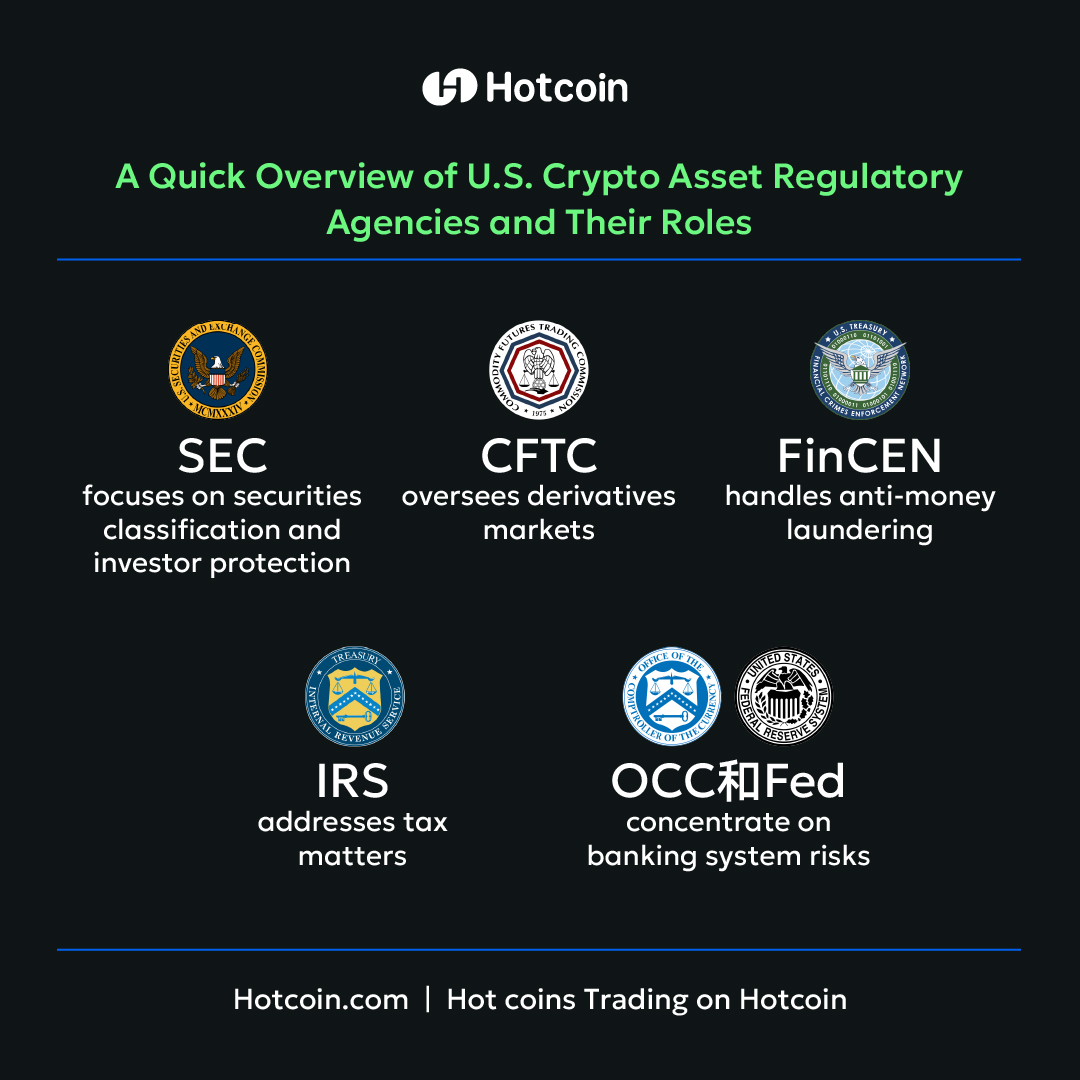
The U.S. crypto asset regulatory framework is composed of multiple agencies, each with distinct responsibilities. This multi-agency oversight leads to what some call a “patchwork” of regulations. The primary regulators include the Securities and Exchange Commission (SEC), the Commodity Futures Trading Commission (CFTC), the Financial Crimes Enforcement Network (FinCEN), the Internal Revenue Service (IRS), the Office of the Comptroller of the Currency (OCC), and the Federal Reserve System (Fed).
SEC
The SEC determines whether certain crypto assets qualify as securities by applying the “Howey Test.” If deemed a security, issuance, trading, and relevant disclosures must comply with the Securities Act. The SEC also oversees exchanges and other intermediaries, protects investors’ interests, and takes enforcement action against unregistered securities issuances.
CFTC
Charged primarily with overseeing commodities and derivatives, the CFTC treats Bitcoin, Ethereum, and other crypto assets as commodities and regulates their futures, options, and related derivatives. The CFTC focuses on preventing market manipulation and fraud, reviewing crypto derivative platforms to maintain fair and transparent markets.
FinCEN
An agency of the U.S. Treasury Department, FinCEN is responsible for anti-money laundering (AML) and counter-terrorist financing (CTF). It mandates that crypto exchanges and virtual currency service providers register as Money Services Businesses (MSBs) and implement robust Know Your Customer (KYC) and suspicious activity reporting measures to prevent illicit use of crypto assets.
IRS
The IRS classifies crypto assets as property for tax purposes, applying taxes to trading gains and mining income. Taxpayers must report crypto-related transactions and holdings, reinforcing compliance with U.S. tax obligations.
OCC and the Fed
The OCC and the Federal Reserve address risk management and capital adequacy issues when banks engage in crypto-related activities. They also guide financial institutions in using blockchain technologies and stablecoins for clearing and settlement, ensuring the stability of the overall financial system.
Overall, U.S. crypto asset regulation operates through a coordinated network of agencies: The SEC focuses on securities classification and investor protection; the CFTC oversees derivatives markets; FinCEN handles anti-money laundering; the IRS addresses tax matters; while the OCC and the Fed concentrate on banking system risks. These regulators cooperate by sharing information and collaborating across departments to maintain market integrity while fostering innovation.
Recommended
View more


Service@hotcoin.com
Product@hotcoin.com
Business@hotcoin.com
Casecn@hotcoin.com