What Are Tokenized Stocks and How Do They Enable 24/7 US Stock Trading?
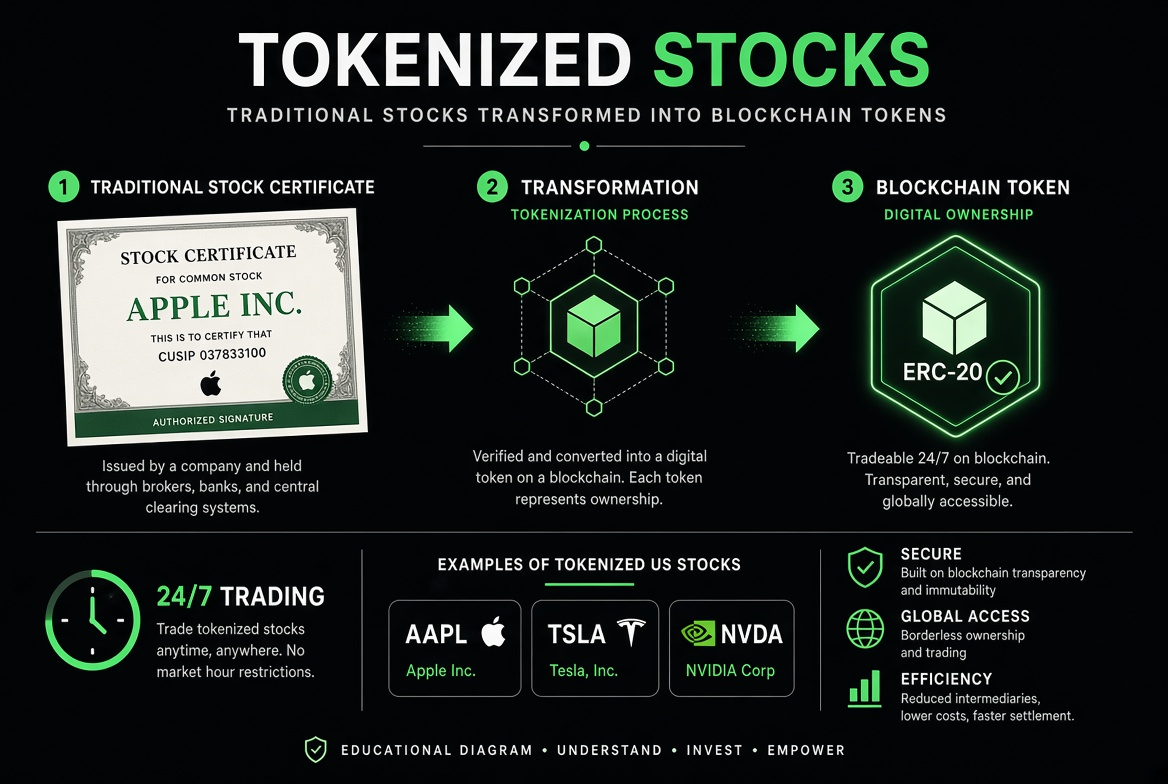
Tokenized stocks are digital assets that represent traditional securities such as US equities in the form of blockchain tokens, allowing users to trade them on crypto platforms for close to 24 hours a day without waiting for traditional market hours.
Tokenized stocks convert the rights or price performance of real-world shares into tokens that can circulate onchain. They let investors buy and sell US stock exposure during crypto trading hours, breaking through the time limits of traditional exchanges. Below we explain what tokenized stocks are, how they work, and the key points to watch when you take part.
What Are Tokenized Stocks
A tokenized stock is a digital mapping of the price performance or related rights of a traditional stock in the form of a blockchain token.
Common structures include:
Synthetic assets / price-tracking tokens: the token price is pegged to or tracks the live price of a specific US stock.
Custody-backed mapping: an institution holds the real shares in custody and issues corresponding tokens onchain.
Derivative structures: price exposure is provided through smart contracts or centralized mechanisms.
What you buy is a token, not a direct holding of shares in a traditional brokerage account. As a result, it differs clearly from traditional stocks in trading hours, settlement method and accessibility.
How Tokenized Stocks Enable Near 24/7 Trading
Traditional US stock trading hours are bound by the opening times of the NYSE and Nasdaq, while tokenized stocks rely on crypto platforms and generally offer the following features:
Longer trading hours: most platforms support trading on weekends and during US market closures.
Faster settlement: settlement happens onchain or inside the platform, with no need to wait for the traditional T+1 or T+2.
Global accessibility: anyone can participate as long as the platform supports their region.
Crypto-denominated pricing: stablecoins such as USDT and USDC are commonly used as the medium of exchange.
Note that even when a platform supports "24/7", liquidity, spreads and the price-pegging mechanism can still deviate while traditional markets are closed.
Key Differences Between Tokenized and Traditional Stocks
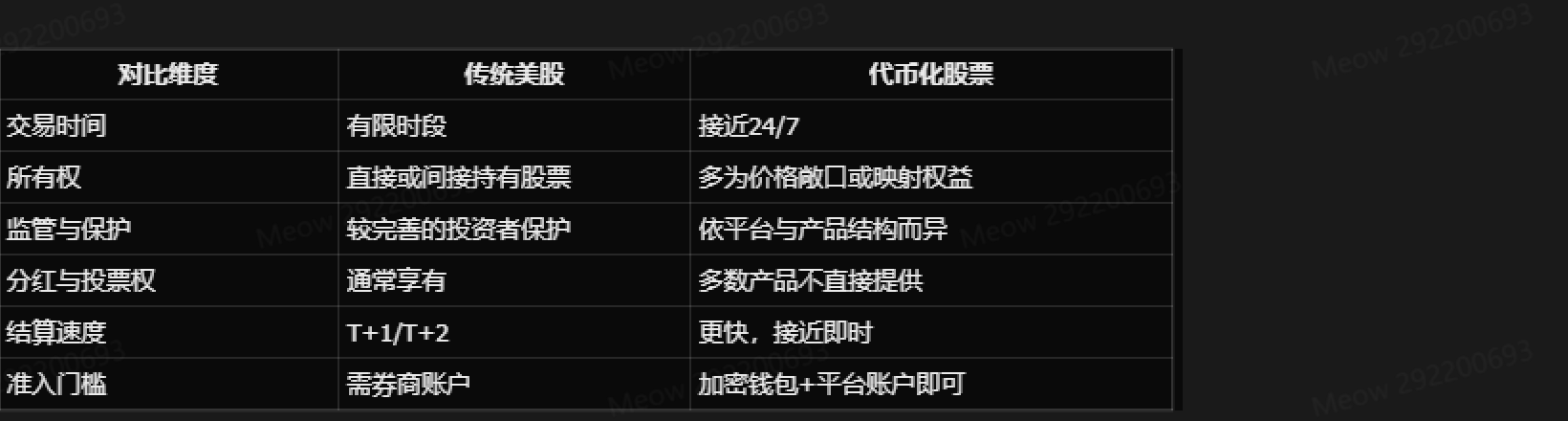
Understanding these differences helps you avoid treating tokenized stocks as exactly the same as traditional stocks.
How to Trade Tokenized Stocks (General Steps)
Choose a compliant platform that supports tokenized stocks and confirm whether your region is supported.
Complete registration and KYC identity verification.
Deposit stablecoins or other supported crypto assets.
Search the trading section for the token tied to your target stock (for example, tokens related to AAPL or TSLA).
Read the product description to confirm whether it is price tracking, a synthetic asset or another structure.
Place your buy or sell order and set proper risk controls (stop-loss, position limits).
Regularly check platform announcements, liquidity and changes to product rules.
Before trading, always read the product terms to understand whether redemption is supported, whether a lock-up period applies, and how the price is pegged.
Main Benefits and Risks
Benefits:
Breaks through traditional trading-hour limits
Lowers the entry barrier in some regions
More efficient settlement and transfers
Managed alongside your crypto asset account
Main risks:
Counterparty and platform risk: depends on the issuer's or platform's ability to perform
Price deviation: the price may diverge from the real share price while markets are closed
Liquidity risk: some tokens trade in low volume with wide spreads
Regulatory uncertainty: jurisdictions take different approaches to tokenized securities
No traditional shareholder rights: generally no voting rights or dividends
Risk warning: tokenized stocks are not stock investments in the traditional sense and carry the possibility of losing your principal. This article is for educational purposes only and is not investment advice. Before participating, fully understand the product structure, the platform's qualifications and your own risk tolerance, and comply with your local laws and regulations.
FAQ
Q1: Are tokenized stocks real US stocks? A: Usually not. Most products provide price exposure or mapped rights rather than direct ownership of listed company shares.
Q2: Why can US stocks be traded on weekends? A: Because trading happens on crypto platforms and does not depend on the opening hours of traditional stock exchanges, although price discovery may differ from normal trading sessions.
Q3: Do tokenized stocks pay dividends? A: It depends on the specific product design. Some products reflect dividends by adjusting the token quantity or price, while others do not support them.
Q4: Are tokenized stocks safe? A: Safety depends on issuer transparency, custody arrangements, smart contract audits and the platform's level of compliance. They cannot simply be treated as "low risk".
Q5: What should beginners confirm first? A: First confirm how the product pegs to the share price, whether redemption is supported, whether the platform operates legally in your region, and the level of risk you can bear.
With the explanation above, you should now understand what tokenized stocks are and how they support near 24-hour US stock-related trading. These products lower time and entry barriers, but they also bring a risk structure that differs from traditional stocks. Put thorough research and risk control first, and participate rationally.
Đề xuất đọc
Xem thêm