What Are Meme Coins? Investment Risks & Popular Meme Coins Explained
How can a meme or an animal image turn into a tradable token? The most attractive part of meme coins is the attention driven by community spread. The most easily overlooked part is who will still be willing to buy at the price you see after the hype fades.
Meme coins are also commonly called meme tokens. To understand them, you cannot look only at the gainers leaderboard. You also need to distinguish cultural symbols, token identity, and trading liquidity, and avoid mistaking the ability to spread for investment value.
Key Takeaways
- Meme coins usually build communities around internet memes, people, animals, or trending topics, and their value narrative often depends on attention and trading demand.
- A cheap unit price does not mean a low valuation. You must look at supply, market cap, and liquidity together.
- Many tokens share the same name, so you should verify the network and the full contract address.
- High volatility, concentrated holdings, contract permissions, and liquidity withdrawal can all lead to major losses.
What Is a Meme Coin
Meme coins usually spread through internet culture, community identity, or trending topics. Projects vary widely: some form long-term communities and develop applications, some mainly revolve around short-term attention trading, and some use the same name and hype to commit fraud.
It is not a unified technical standard, nor does it mean all projects have the same rights, functions, or legal attributes. The label "meme coin" itself cannot prove a project is safe, nor does it automatically determine how it is regulated in a given region.
Compared with cash-flow assets, many meme coins lack income or redemption mechanisms that can directly anchor valuation, making their prices more susceptible to sentiment, liquidity, and token distribution. Even an active community cannot guarantee there will be enough buyers in the future.
Why Do Meme Coins Rise and Fall So Fast
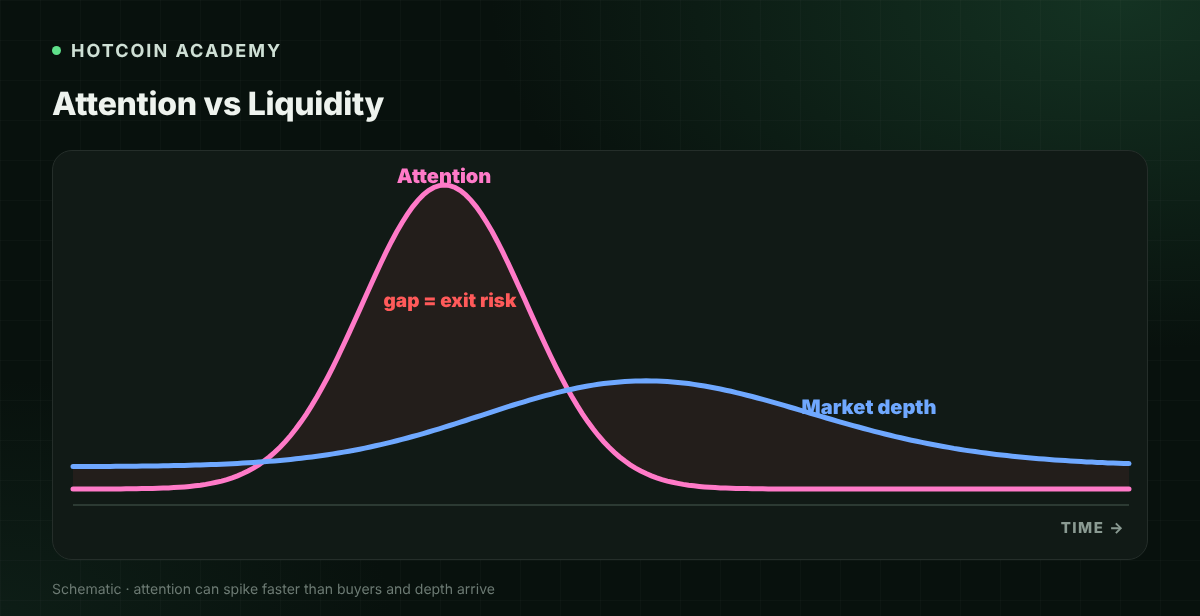
Attention can expand in a very short time, but market depth does not necessarily increase at the same pace. If tradable supply is small, new buy orders may quickly push up the price. When sell orders appear in a concentrated way, they may also consume the limited buy orders.
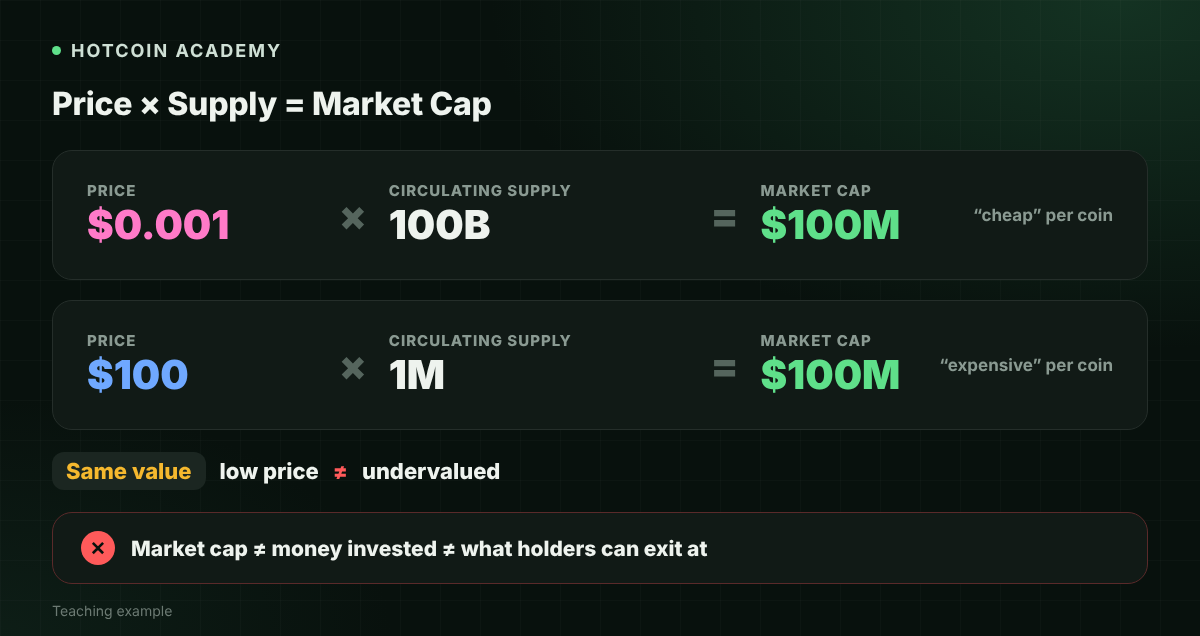
Market cap is price multiplied by the corresponding supply. It does not equal the money that has flowed into the project, and it certainly does not mean all holders can exit at the current price. Trading volume also needs to be judged together with depth; you cannot look only at a very large number.
| Easily Confused Metric | What It Means | What It Cannot Tell You |
|---|---|---|
| Unit price | The transaction price per token | That a low unit price is cheap or safe |
| Circulating market cap | Price × circulating supply | That everyone can sell at that price |
| Fully diluted valuation | Valuation calculated on the corresponding supply basis | That all future supply is already in circulation |
| Trading depth | The tradable volume within a price range | That liquidity will definitely remain in the future |
For example, a teaching example assumes a token price of $0.001 and a circulating supply of 100 billion, giving a circulating market cap of $100 million. Many digits after the decimal point do not mean it is more undervalued than another asset priced at $100.
What Are Some Popular Meme Coins
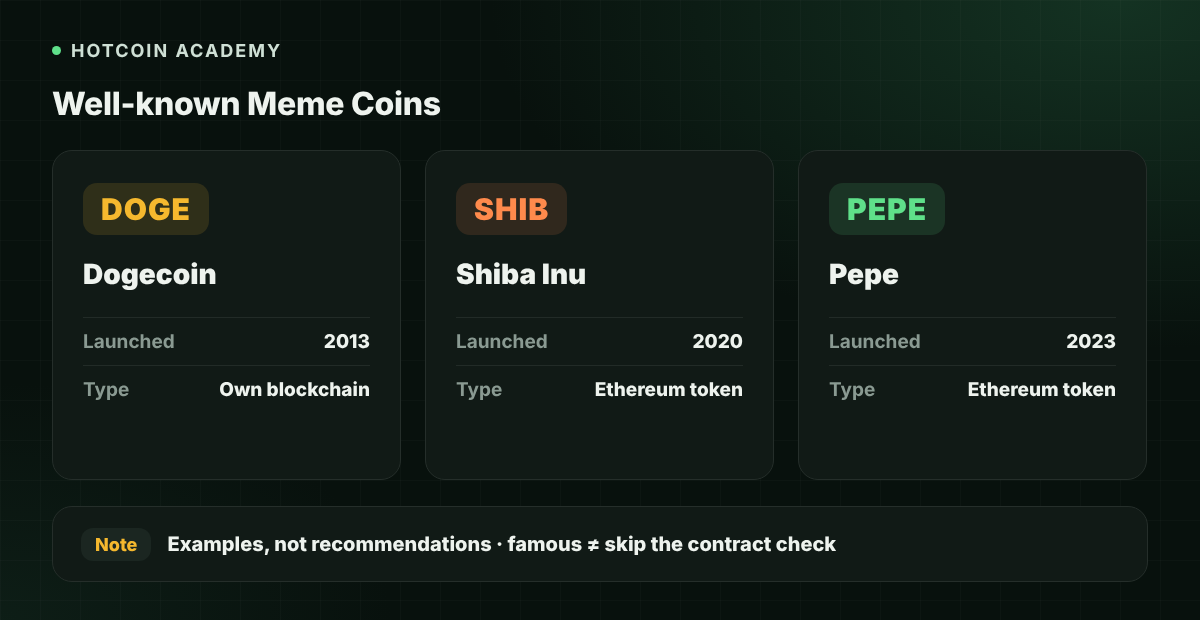
The following are representative cases that are often discussed, used to understand categories. They are not a real-time popularity ranking, recommendation list, or exchange listing list. Project status and market attention will change.
| Case | Common Cultural Symbol | What to Distinguish |
|---|---|---|
| Dogecoin (DOGE) | Doge Shiba Inu meme | The native coin differs from same-name mapped tokens on other chains |
| Shiba Inu (SHIB) | Shiba Inu community narrative | SHIB cannot be confused with other tokens in its ecosystem |
| Pepe (PEPE) | Frog meme culture | A same-name or similar ticker cannot replace contract verification |
Dogecoin official materials record that it launched in 2013, showing that meme coins are not only recently issued new assets. But a longer history does not equal future price stability. Cases such as SHIB and PEPE likewise cannot skip identity and risk checks just because they are well known.
What Are the Main Risks of Meme Coins
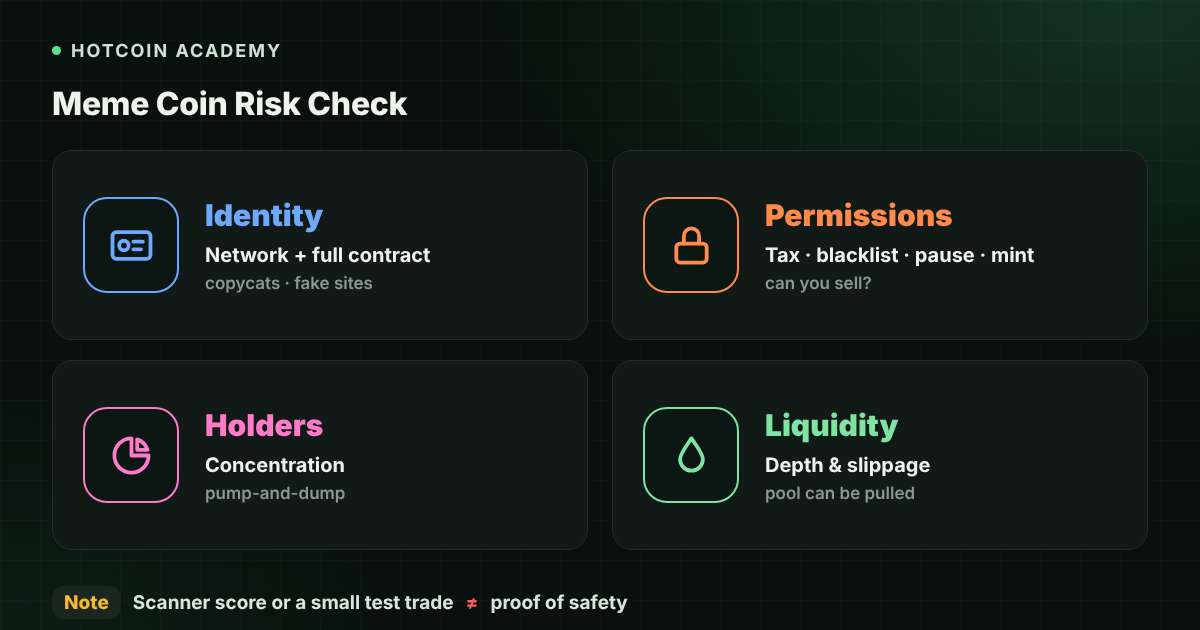
Price and liquidity risk. A rising quote does not mean you can sell a sufficient amount. Concentrated selling may cause significant slippage. When funds in the trading pool decrease, exiting may be difficult even if the balance is still there.
Concentrated holdings and pump-and-dump. A small number of addresses may hold a large amount of tradable tokens and sell after building hype to attract buyers. The CFTC has specifically warned about pump-and-dump risks in virtual currency markets, and "coordinated pump times" in community chats should not be treated as reliable opportunities.
Contract and permission risk. Some tokens may set extra transfer taxes, blacklists, pause or mint permissions, and may also restrict selling. Being able to buy, having viewable source code, or having a scanner score does not mean risks can be ruled out.
Identity and spread risk. Fake websites, same-name contracts, false celebrity endorsements, and group chat screenshots can all mislead. Follower counts and reposts can be manipulated and cannot directly show a project's credibility.
How to Do Basic Checks When Reading Meme Coin Information
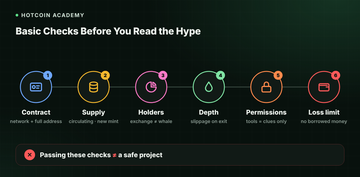
- Confirm the network and full contract. Cross-check reliable channels and do not enter through links received in unsolicited private messages.
- Look at circulating supply and new supply rules. Distinguish circulating supply, total supply, and potential minting, and do not look only at price.
- Look at holder distribution. Identify the purpose of large addresses; exchanges, burn addresses, and liquidity pools cannot be directly treated as the same kind of "whale."
- Look at market depth and sell conditions. Assess the slippage that your actual trade size may cause, and do not treat the displayed price as a guaranteed execution price.
- Check contract permissions and approvals. If you are not familiar with code, scanner tools can only provide clues; a successful small transaction cannot prove long-term safety.
- Clarify the loss you can bear. Do not borrow money to chase hype, and do not ignore overall exposure because of short-term profits.
These checks can help identify obvious problems, but they cannot certify that a project is safe. Unknown permissions, related addresses, and future behavior usually cannot be fully ruled out with only a few pages of public information.
Common Misconceptions
- "I'll get rich as long as it rises to $1." You should first calculate the supply and valuation implied by that price, not look only at the unit price.
- "If liquidity is locked, there is no risk." Risks still exist, including contract, concentrated holdings, and other liquidity pools.
- "Everyone is talking about it, so there should still be time." Widespread spread may also happen exactly when early holders are preparing to exit.
FAQ
Q1: What is the difference between meme coins and ordinary tokens? Meme coins place more emphasis on culture and community narrative, but the boundary is not strictly unified. Specific rights, functions, and risks must be analyzed project by project.
Q2: Are all meme coins scams? You cannot generalize. Even without fraud, demand decline and insufficient liquidity can still cause huge losses.
Q3: Does a very low unit price mean more upside? No. Unit price must be read together with supply and valuation. Splitting into more tokens does not create value out of thin air.
Q4: Can a contract audit guarantee no loss? No. Audits have scope and time limits, and they do not guarantee market prices, liquidity, or the future behavior of operators.
Q5: Are highly popular coins suitable for long-term holding? Popularity is not a maturity match or a value judgment. Long-term holding still bears risks from demand changes, project development, and market structure.
Conclusion
The spread story of meme coins is easy to understand, but trading risks cannot be judged by stories. First confirm what you are buying, then look at supply, permissions, and whether you can exit. That is more useful than chasing the next popular meme.
Risk warning: This article is for educational and informational purposes only and does not constitute investment advice or token recommendations. Meme coins may experience extreme volatility, inability to sell, and total loss of principal. Regulatory requirements may differ by region.
Đề xuất đọc
Xem thêm