ETH/USDT Trading Guide: Ethereum Spot Trading Tutorial
ETH/USDT spot trading means buying or selling ETH with USDT without using futures leverage. The basic process is: open spot trading → select ETH/USDT → choose an order type → enter the price and amount → place the order → confirm the fill → review your assets.
The title follows the “2025” version in the content-cluster plan. Information about Hotcoin’s current interface, order types, and fees is based on official material that could be verified as of August 2026.
What Does ETH/USDT Mean?
ETH/USDT is an ETH trading pair quoted in USDT. Put simply, ETH is the asset you buy or sell, while USDT is the asset used to quote the price and settle the trade.
For example, if ETH/USDT is shown at 3,000, it generally means that the market price of 1 ETH is about 3,000 USDT. With 3,000 USDT, you could buy roughly 1 ETH at the prevailing execution price. Conversely, if you hold ETH, you can sell it for USDT.
Hotcoin’s current spot trading guide lists ETH/USDT as a USDT-quoted spot pair and explains that spot trading exchanges assets at spot prices without involving futures contracts or leverage.
The most important first step is to distinguish the two directions:
Buy ETH: pay USDT and receive ETH.
Sell ETH: pay ETH and receive USDT.
Therefore, a rise in ETH/USDT usually means that 1 ETH can be exchanged for more USDT, while a decline means that 1 ETH can be exchanged for less USDT.
What Is the Difference Between ETH/USDT Spot and ETH Futures Trading?
ETH/USDT spot trading involves directly buying or selling ETH, so after settlement you own ETH itself. Futures trading uses derivatives to gain exposure to ETH price movements and commonly involves margin, leverage, and liquidation risk.
For someone learning to trade ETH, the key question is not which product is “more profitable,” but what you are actually buying and what risks you are accepting.
Hotcoin’s official definition likewise states that spot trading does not involve futures contracts or leverage.
This guide focuses only on ETH/USDT spot trading and does not mix futures or leveraged products into the operating steps.
How Do You Find ETH/USDT on Hotcoin?
To trade ETH/USDT spot on Hotcoin, first open the trading page, search for ETH/USDT, and enter the corresponding spot market.
Hotcoin’s current official guide gives this path:
Trade → Spot Trading → Select Trading Pair → ETH/USDT.
In the app, open the Trade page, enter ETH/USDT in the pair search field at the top, and select the pair. The official tutorial also shows that the trading page includes buy and sell controls, a price chart, the order book, open orders, and trade history.
When you first enter the ETH/USDT market, do not rush to place an order. Learn these four areas first:
Candlestick or price chart
Buy and sell order book
Buy and sell order-entry panel
Open orders and historical fills
The order book and order-entry panel determine how your order executes—not any single candle on the chart.
How Do You Read the ETH/USDT Order Book?
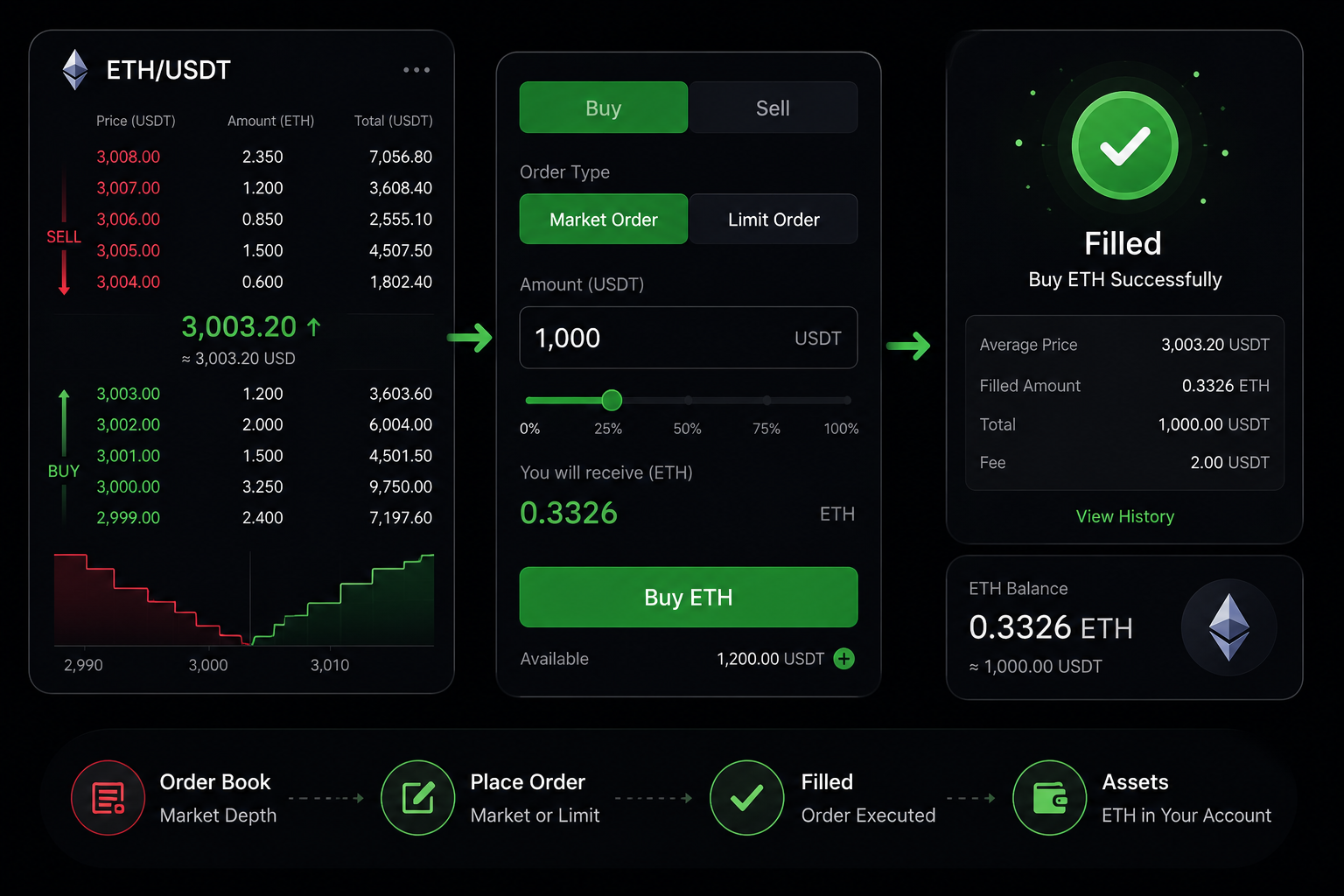
The order book is the collection of buy and sell orders currently waiting to be matched.
In general:
The sell side shows the prices and amounts at which other traders are willing to sell ETH.
The buy side shows the prices and amounts at which other traders are willing to buy ETH.
The area near the center usually contains the closest available buy and sell prices.
Assume that sell orders are listed at 3,000, 3,005, and 3,010 USDT.
If you submit a relatively large market buy, it may first fill against the sell order at 3,000 USDT and then continue consuming orders at 3,005, 3,010, and higher prices.
This is why the ETH price displayed on screen is not necessarily the same as your final average execution price.
Hotcoin’s description of market orders explains a similar mechanism: a market buy begins with the lowest available sell order and can fill across several price levels. The final execution price is therefore a weighted average of multiple fills.
The practical lesson is to consider order-book depth rather than looking only at the latest ETH quote.
How Do You Trade ETH/USDT With a Market Order?
The purpose of a market order is to complete a trade as quickly as possible at prices currently available in the market.
On Hotcoin’s current spot trading page, you can choose to buy or sell at the market price. A market order executes at the best available prices at that time, so you do not enter a specific execution price yourself.
For an ETH purchase, the basic process is:
Open ETH/USDT → choose Buy → select Market Order → enter the amount of USDT or ETH → review → submit the order.
Market orders are simple and usually execute quickly.
However, they have one crucial characteristic: you can control the order amount, but you cannot lock in the final execution price in advance.
If the market is volatile or your order is large relative to available liquidity, the final execution price may differ from the quote you saw when submitting the order.
A market order may be suitable when:
You want to complete the trade quickly.
The trade is small relative to order-book liquidity.
Execution matters more to you than precise price control.
If precise price control matters more, consider a limit order.
How Do You Trade ETH/USDT With a Limit Order?
A limit order lets you set your own order price.
Suppose ETH/USDT currently trades at 3,000 USDT and you only want to buy after ETH falls to 2,900 USDT. You could place a buy limit order with:
Buy price: 2,900 USDT
Buy amount: 0.5 ETH
Until the market meets your condition, the order remains in the order book waiting to be matched.
Hotcoin’s current rules state that a limit order can execute at your specified price or a better price. If matching liquidity is already available, the order may execute immediately.
The key characteristic of a limit order is that you can control the price, but execution is not guaranteed.
This is a common source of confusion for beginners.
If you set a buy price of 2,900 USDT while ETH continues trading around 3,000 USDT, the order may remain unfilled.
Even if the market briefly touches your price, you should not assume that the order is guaranteed to fill. Queue priority and available liquidity also affect execution.
Should You Choose a Market Order or a Limit Order?
Neither market nor limit orders are inherently better. The important distinction is whether you prioritize execution speed or price control.
Hotcoin’s current spot system also supports advanced limit-order instructions, including Post Only, FOK, and IOC.
If you are just beginning with ETH/USDT spot trading, however, you do not need to use every advanced order type immediately.
Understanding standard market and limit orders is enough for most basic spot trading activity.
How Are ETH/USDT Trading Fees Calculated?
Current official Hotcoin material states that the standard spot trading fee is 0.2% for both limit and market orders. Different VIP tiers may have different effective rates, and you can check the rate applied to your account under “My Fee Rate” in the Hotcoin app.
The basic formula is:
Trading fee = executed value × effective fee rate
The following is only a calculation example and does not establish Hotcoin’s current rules.
Assume that you complete a 1,000 USDT ETH spot trade and that the applicable fee rate is 0.2%:
1,000 × 0.2% = 2 USDT
The example fee for this trade would therefore be 2 USDT.
In practice, your effective rate may differ, and the executed value can also be affected by the prices at which the order fills.
It is also important to distinguish an ETH/USDT spot trading fee from an Ethereum gas fee.
If you are only trading ETH/USDT within Hotcoin, you should not treat Ethereum network gas as a spot trading fee.
What Is Slippage in ETH/USDT Trading?
Slippage is the difference between the execution price you expect and the price at which the trade actually executes.
It is especially important for market orders.
Suppose ETH/USDT is trading near 3,000 USDT and you are about to place a relatively large immediate purchase.
If there is not enough sell-side liquidity at 3,000 USDT, your order may continue matching sell orders at 3,005, 3,010, and other higher prices.
Your final average execution price may therefore be higher than the quote visible when you submitted the order.
A simple formula is:
Average execution price = total executed value ÷ total ETH filled
The following is only a calculation example and does not represent current Hotcoin market data.
Assume:
0.5 ETH × 3,000 USDT = 1,500 USDT
0.5 ETH × 3,010 USDT = 1,505 USDT
Then:
Total executed value = 3,005 USDT
Total amount filled = 1 ETH
Average execution price = 3,005 USDT/ETH
Although the lowest sell price was 3,000 USDT when the order began, the final average price is 3,005 USDT.
For this reason, a large market order should be evaluated against order-book depth, not just the latest price.
How Can You Reduce Slippage in ETH/USDT Trading?
Reducing slippage is not about finding a “magic” order button. It is about reducing the impact of your order on available liquidity.
Focus on three factors:
First, Review Order-Book Depth
If you plan to buy a large amount, first review how much sell-side liquidity is available at different prices.
The thinner the sell side, the more likely your order is to cross several price levels.
Second, Avoid Large Market Orders During Sharp Volatility
When the market moves rapidly, the order book can change just as quickly.
The difference between the price you see and the actual fill price may become more pronounced.
Third, Consider a Limit Order
If you have a strict maximum purchase price, a limit order can provide price control.
You must accept the trade-off: the stricter your price requirement, the greater the chance that the order will not execute.
That is the fundamental spot-trading trade-off between price and execution.
Where Can You Find ETH After Buying It?
After the order fills, open the Assets section in Hotcoin to view your ETH.
Hotcoin’s current official spot guide shows that you can open Assets and then select Spot Account to review purchased assets.
You should also check the order status rather than relying only on the asset balance.
The following records answer different questions:
Open orders: Is the order still waiting to execute?
Order history: Has the order been completed?
Trade history: How much ETH was actually filled, and at what price?
Asset balance: How much ETH is now in the account?
These records serve different purposes.
For example, a limit order may have been submitted but not filled. Treating “order submitted” as “ETH purchased” is a common operating mistake.
What Should You Do if an ETH/USDT Limit Order Does Not Fill?
An unfilled limit order does not necessarily indicate a system problem.
The most common reason is that the market has not reached your specified price.
For example:
Current ETH/USDT price = 3,000 USDT
Your buy limit = 2,900 USDT
The order can only execute when the market approaches your target and the matching conditions are satisfied.
If your trading plan changes, you can cancel the existing order according to its current status and then place a new order at a different price.
Hotcoin’s spot trading guide includes order-management and cancellation functions. The exact buttons and locations may change as the app and website are updated.
Do not keep raising your bid solely to “make the order fill.”
First reconsider whether your target price remains valid.
If it does, you can continue waiting. If your plan has changed, place a new order based on the revised plan.
How Do You Sell ETH/USDT?
Selling ETH is the reverse of buying it.
If you hold ETH and want to exchange it for USDT:
Open ETH/USDT → choose Sell → select the order type → enter the ETH amount or corresponding value → review the order → wait for execution.
A market sell executes against available buy orders. A limit sell lets you specify the minimum price you are willing to accept.
Suppose you hold 1 ETH and want to convert it back to USDT.
With a market sell, the final amount of USDT received depends on the actual execution prices.
With a limit sell, you can set the minimum acceptable price, but the order may not execute if the market does not meet that condition.
The two directions are symmetrical:
Buy ETH: USDT → ETH
Sell ETH: ETH → USDT
How Should You Read Candlesticks When Trading ETH/USDT?
Candlesticks are primarily used to observe price changes; they do not guarantee order execution.
For basic ETH/USDT spot trading, you should at least understand:
Current price
Time interval
24-hour high and low
Trading volume
Buy- and sell-side depth
Different time intervals convey different information.
For example:
A one-minute chart emphasizes very short-term fluctuations.
A one-hour chart shows a broader short-term trend.
Four-hour or daily charts are better for examining larger price structures.
Do not equate a rising candle with an automatic reason to buy.
Candlesticks show what happened in the past and what is happening now; they cannot guarantee how the next trade will perform.
If your primary goal is to complete a spot transaction, the order type, execution price, and risk controls are usually more important than stacking many technical indicators.
How Do You Calculate the Real Cost of an ETH/USDT Trade?
You cannot evaluate a trade by comparing only the buy and sell prices.
A more complete expression is:
Total trading cost ≈ purchase cost + buy fee + sale cost + sell fee + other actual charges
For the spot trade itself, the net result can be simplified as:
Net result = sell proceeds − purchase value − fees charged on both sides
The following is only a calculation example and does not establish Hotcoin’s current rules.
Assume:
ETH purchase value: 1,000 USDT
Buy fee: 2 USDT
Later sale proceeds: 1,050 USDT
Sell fee: 2.10 USDT
Ignoring other costs:
Net difference = 1,050 − 1,000 − 2 − 2.10 = 45.90 USDT
This example only demonstrates the calculation and does not represent an actual trading result.
Real trades must also account for changing execution prices, order-book depth, and the effective fee rate.
A Beginner’s ETH/USDT Spot Trading Checklist
If this is your first ETH/USDT spot trade, follow this sequence:
Prepare USDT or another asset that can be used for trading.
Open the Hotcoin spot trading page.
Search for ETH/USDT.
Review the current price and order book.
Choose Buy or Sell.
Select a market or limit order.
Enter the trade value or ETH amount.
Review the expected execution and fee.
Submit the order.
Check whether the order has executed.
Review the actual filled amount and average price.
Confirm the asset balance in Spot Account.
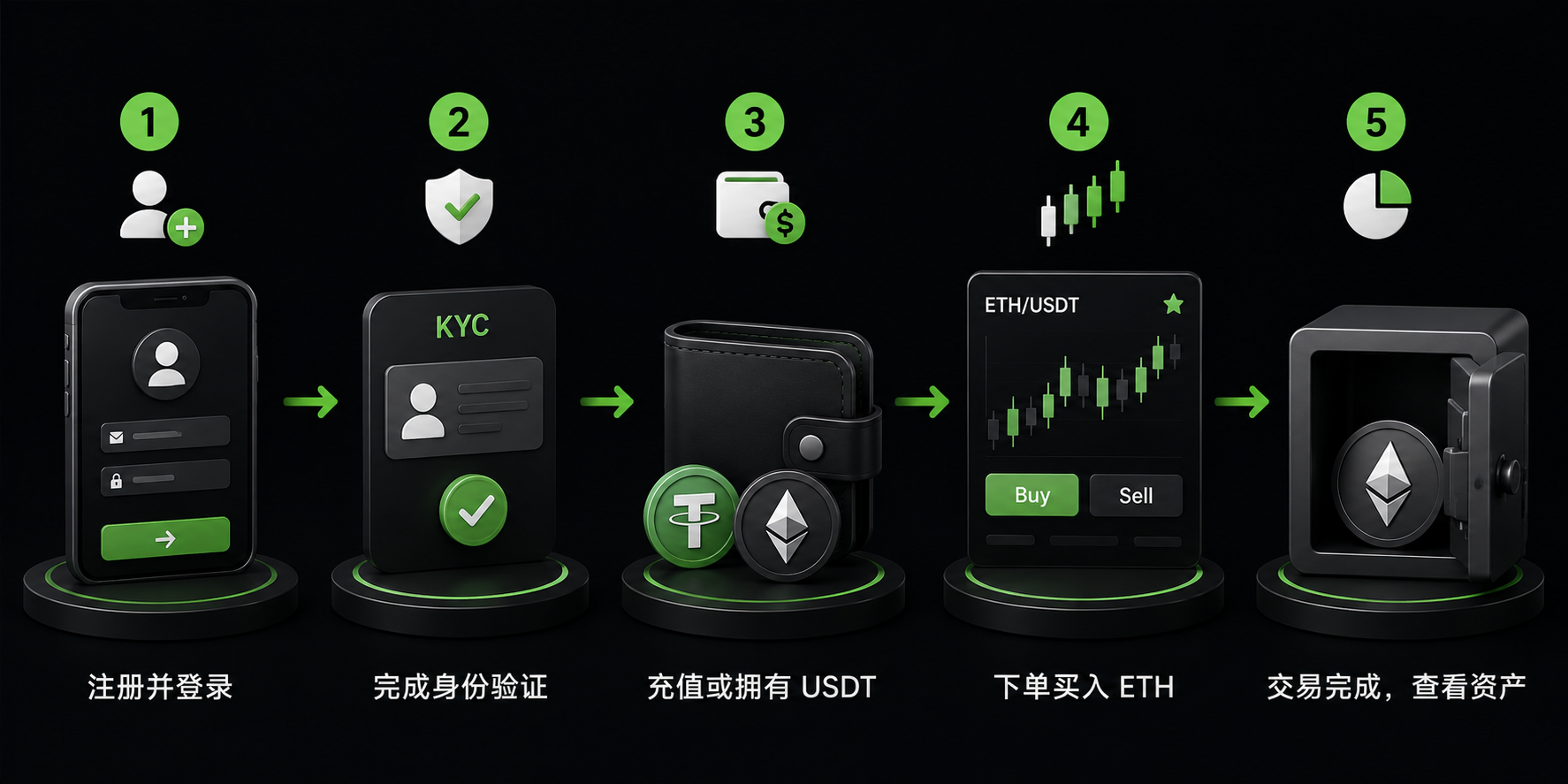
Hotcoin’s current official tutorial follows a similar basic path: sign in, deposit or purchase assets, open Spot Trading, select the pair, place the order, and then review the assets in Spot Account.
The habit worth developing is simple: inspect the order book before placing an order and review the fill afterward, rather than merely clicking Buy or Sell.
Six Common ETH/USDT Spot Trading Mistakes
Confusing Spot and Futures
After buying ETH on the spot market, you hold ETH itself. Do not assume spot and futures are the same product simply because both interfaces show “ETH/USDT.”
Looking Only at the Latest Price
For larger market orders in particular, order-book depth directly affects the final average execution price.
Assuming a Limit Order Must Fill
A limit order controls the price but does not guarantee execution.
Assuming a Market Order Fills at the Displayed Price
A market order matches available liquidity and may execute across multiple price levels.
Ignoring Trading Fees
The effective fee should be included when evaluating trading costs.
Failing to Check the Order Status
A limit order can remain open even after it has been successfully submitted.
ETH/USDT Spot Trading FAQ
What Does ETH/USDT Mean?
ETH/USDT is an ETH trading pair quoted in USDT. Buying generally exchanges USDT for ETH, while selling exchanges ETH for USDT.
Does ETH/USDT Spot Trading Require Leverage?
No. Spot trading does not depend on leverage, and Hotcoin defines spot as asset trading that does not involve futures contracts or leverage.
Is a Market or Limit Order Better for Beginners?
A market order is more direct if quick execution is the main goal. A limit order may be preferable when price control matters more. Neither is always better; the trade-off is execution speed versus price control.
Why Has My ETH Limit Order Not Filled?
The market may not have reached your limit price, or there may not be enough matching liquidity at that price. A limit order does not guarantee execution.
How Much Are ETH/USDT Trading Fees?
Current official Hotcoin material states that the standard spot trading fee is 0.2% for both market and limit orders, while VIP tiers may have different rates. Check “My Fee Rate” and the final trade record for the rate actually applied to your account.
Does ETH/USDT Spot Trading Incur a Gas Fee?
An ETH/USDT spot trade matched within a trading platform should not be confused with Ethereum network gas. A separate network fee may apply if you later make an on-chain transfer or interact with a smart contract.
Risk Notice
ETH is highly volatile, and spot trading can result in loss of principal. A market order may execute at a price different from the displayed quote, while a limit order may not execute at all.
The calculations in this guide explain trading mechanics only. They do not represent future prices, actual returns, or the final execution result for any specific Hotcoin account.
Before trading ETH/USDT, choose a position size based on your finances and risk tolerance. Do not use funds you cannot afford to lose, and do not treat any order type as a profit guarantee.
Learn More About Buying ETH
If you have not yet completed your first ETH purchase, continue with:
How to Buy Ethereum (ETH): 2025 Complete Guide
After you understand ETH/USDT spot trading, whether you need to consider Ethereum gas fees depends on whether you plan to deposit, withdraw, or perform an on-chain action.
If You Are Preparing to Buy BTC on Hotcoin for the First Time
Continue with:
Hotcoin First BTC Purchase Guide
Start Trading ETH/USDT Spot
If you understand the pair, order types, and execution mechanics, you can enter the trading platform through Hotcoin’s official website:
Đề xuất đọc
Xem thêm