Crypto Sector Rotation Logic: L1 → DeFi → Meme → GameFi
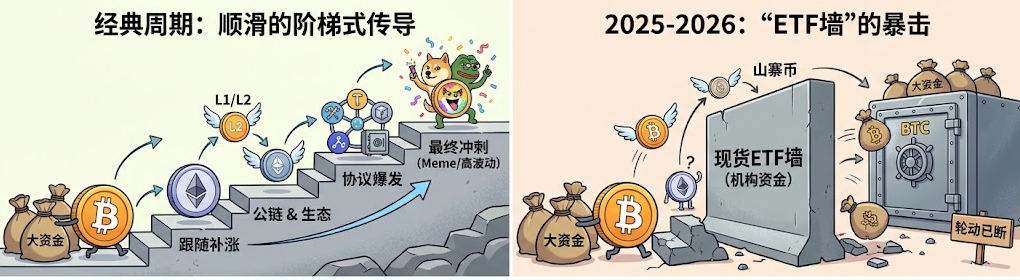
Crypto sector rotation is essentially capital chasing attention and narratives as it moves through different sectors in a stepwise chain. The classic path starts with Bitcoin, then flows to Ethereum (ETH), mainstream L1/L2 infrastructure and DeFi protocols, and finally rotates into highly volatile sectors such as Meme coins and GameFi. But the 2025-2026 market is going through a structural shift: the "institutional wall" built by spot ETFs has cut off the traditional spillover path, and altcoin rotation has turned from a broad rally into fast switches driven by isolated narratives.
The Classic Rotation Path: BTC → ETH → L1 → DeFi → Meme/GameFi
For the past decade, crypto rotation has followed an almost iron rule: Bitcoin rises first to establish the trend, Ethereum catches up, capital then spreads to mainstream L1 chains and DeFi protocols, and Meme coins and GameFi take the final leg of the move in the highest-risk sectors.
The mechanism behind this chain is the "capital spillover effect". Large capital enters Bitcoin first to lock in safety; once BTC has run up, some of the profit starts looking for higher-beta targets, and ETH plus leading public chains become the second stop. DeFi, oracles and other "mainstream altcoins" absorb the third wave. Only when sentiment turns euphoric does money hit Meme coins and small-cap projects, completing the rotation loop.
History has validated this path across multiple cycles: DeFi Summer in 2020, the NFT and P2E/GameFi boom in 2021, and the L1/L2 chain race in 2022 all followed a similar rhythm of narrative turnover.
What Altcoin Season Is and How to Spot It
The quantitative definition of altcoin season was introduced by BlockchainCenter and is now widely used: over a rolling 90-day window, if at least 75% of the top 50 cryptocurrencies (excluding stablecoins) outperform Bitcoin and the Altcoin Season Index rises above 75, the market is considered to be in altcoin season.
The key leading indicators for the start of altcoin season include:
BTC Dominance keeps falling: when dominance slides from a high, it usually means capital is leaving Bitcoin for altcoins. In 2025, BTC's share of total market value spiked to 59-60%, a multi-year high, which shows just how concentrated capital was in Bitcoin.
A strengthening ETH/BTC ratio: ETH rising against BTC is usually an early signal of broader rotation.
Broadening altcoin participation: more than half of the top 50 altcoins beating BTC over 30 days is the key confirmation that rotation is actually underway.
Funding rates and volume: spot volume in altcoins expanding while funding rates do not spike in tandem shows real money is buying rather than leveraged speculation leading the move.
The 2025-2026 Structural Shift: the "ETF Wall" Blocks Traditional Rotation
In 2025 the crypto market split in a way never seen before: BTC touched $125,000 on institutional inflows, while most altcoins were down 80-95% from their 2021 highs and the Altcoin Season Index stayed below 20 all year (above 50 marks altcoin season), the longest slump on record.
The dividing line was the launch of spot Bitcoin ETFs. Traditional asset managers such as BlackRock and Fidelity opened the door for BTC as a "compliant asset", but their clients — pension funds, family offices and the like — only want BTC and will not touch altcoins. ETF flows stay locked inside the Bitcoin ecosystem and barely spill over into the altcoin market at all.
Research from Wintermute further reveals the structural change: the historical pattern of Bitcoin inflows moving into ETH, then blue chips, then altcoins has weakened significantly. At the same time, altcoin rotations have become much shorter — about 19 days on average in 2025, versus 61 days the year before. Sector rotation has not disappeared, but it moves far faster and hits far softer.
The New Rotation Themes of This Cycle
Even with the traditional path blocked, capital keeps looking for new narratives. In 2026, attention is shifting toward the following sectors:

The intersection of AI and crypto: decentralized AI model training and AI agents (autonomous AI that can control wallets and interact through social media) are among the most attractive new narratives. But the rotation hype around AI memecoins also reflects a lack of consensus on how to capture AI growth in crypto markets.
RWA (real-world assets): stablecoins have expanded from a pure trading medium into cross-border settlement infrastructure, with USDT market value above $184 billion and monthly settlement volume of $1.79 trillion, showing growth driven by real demand.
Layer 1 and Layer 2 infrastructure: high-performance chains such as Solana and Sui, plus the Ethereum L2 ecosystem (Base, Arbitrum and others), keep attracting developers and capital, but generic blockspace is now in surplus, so a differentiated ecosystem is the key to competing.
DeFi's "PMF era": the market is moving from narrative-driven to product-market-fit (PMF) driven — only projects that generate real revenue and hold a stable user base will survive.
A Practical Framework for Rotation Strategy
A three-layer portfolio structure is the core framework for today's market:
Core layer (BTC, ETH): the ballast of the portfolio, defending against systemic risk
Growth layer (quality altcoins): capturing sector-level growth opportunities
Speculative layer (new narratives, Meme): a small allocation to high-elasticity assets for explosive upside
When a sector overheats, the system trims automatically; when a sector is undervalued, it adds automatically, removing emotional decision-making. At the same time, keep a close eye on exchange net flows (inflows = preparing to sell, outflows = accumulation), funding rates (whether leverage is excessive) and open interest to help judge the pace of rotation.
FAQ
Q1: Why does crypto sector rotation exist?
Because capital follows profit — large capital entering the market first picks BTC for its safety and liquidity, then looks for higher-return targets once it is in profit, creating a stepwise chain from low-risk to high-risk assets. This spillover effect shows up along a similar path in every cycle.
Q2: Why did altcoin season not arrive in 2025?
The main reason is the "institutional wall" of spot ETFs — tens of billions of dollars flowing in through ETFs were locked inside the Bitcoin ecosystem and could not spill over into altcoins. At the same time, AI and tech stocks absorbed risk capital that might otherwise have gone into crypto. In 2025 the Altcoin Season Index stayed below 20 all year, the lowest on record.
Q3: Which sectors are worth watching in this cycle?
In 2026 the market is focused on AI plus crypto (AI agents, decentralized compute), RWA and stablecoins (tokenization of real-world assets), high-performance L1/L2 infrastructure (Solana, Sui, the Ethereum L2 ecosystem) and DeFi projects with real revenue. The logic of rotation is shifting from narrative-driven to product-market-fit driven.
Q4: How do you run a rotation strategy in today's market?
Use a three-layer allocation (core BTC/ETH + growth-layer quality altcoins + a speculative layer of new narratives and Meme), and set rebalancing triggers. Watch BTC dominance, the ETH/BTC ratio, funding rates and exchange net flows, and follow the trend once it is confirmed.
Related tutorials:
Crypto Market Cycle Analysis: From Bull-Bear Transitions to Sector Rotation
On-Chain Data for Beginners: Exchange Inflows and Outflows, MVRV, NUPL
Fear and Greed Index: A Quantitative Guide to Market Sentiment
Recommended reading:
Đề xuất đọc
Xem thêm