Crypto Futures Trading for Beginners: A Complete First-Step Guide
Crypto futures trading for beginners means learning perpetual or futures contracts from zero and completing a first simulated or live trade through a step-by-step process. The focus is understanding leverage, margin, and risk control.
Futures let you gain a larger position exposure with less margin, and let you go long or short, but risk is magnified in the same way. For beginners, the priority is not rushing to place an order. Learn the basic concepts first, then complete your first trade through the right process. The clear steps below walk you through the whole beginner workflow.
What Is Crypto Futures Trading?
Crypto futures, most commonly perpetual futures, are a derivative: you trade price movements rather than directly holding spot assets.
Key features:
Go long when you expect a price rise, or short when you expect a fall
Use leverage, which magnifies both gains and losses
Post margin to open a position
Perpetual futures usually include a funding rate mechanism
Adverse price movement can trigger forced liquidation
The biggest difference from spot trading is this: with spot, losses stop when your capital runs out, while high-leverage futures can wipe out your margin much faster.
Concepts You Must Understand Before Your First Trade
- Margin
The funds actually occupied when opening a position.
- Leverage
For example, 10x leverage means 1,000 USDT can open a position worth about 10,000 USDT in notional value.
- Maintenance margin
The minimum margin level required to keep a position open. Falling below it may trigger liquidation.
- Liquidation price
The price at which the system forcibly closes your position when account equity is insufficient.
- Cross margin and isolated margin
Isolated margin: risk is separated and only affects that position's margin
Cross margin: the entire account balance shares the risk
Beginners should prioritize isolated margin with low leverage.
From First Step to Order Placement: A Step-by-Step Process
These are general steps. Specific button names vary by platform.
Step 1: Choose a compliant platform and complete registration
Choose a platform that supports futures trading, then complete registration and the required identity verification (KYC).
Step 2: Practice on a demo account first
Most platforms offer simulated trading. Make sure you complete the full cycle of opening a position, setting a stop loss, and closing it on a demo account first.
Step 3: Deposit funds and transfer them to your futures account
Deposit assets such as USDT to the platform, then transfer them to your futures account.
Step 4: Choose a trading pair and direction
For example, the BTCUSDT perpetual contract.
Choose long (Long/Buy) if you are bullish
Choose short (Short/Sell) if you are bearish
Step 5: Set your leverage
Beginners should start at 2x to 5x, or even 1x to 2x to get familiar with how it feels.
Step 6: Decide position size and margin mode
Choose isolated margin, then enter the position size or margin amount.
Check the estimated liquidation price before opening the position.
Step 7: Set a stop loss and take profit (strongly recommended)
Set a stop loss when placing the order or immediately after it fills, so you avoid emotional decisions.
Step 8: Confirm the order and keep monitoring it
After the order fills, watch:
Unrealized PnL
Distance to the liquidation price
Margin ratio
Funding rate, if you hold the position across a settlement time
Step 9: Close the position and end the trade
Close manually, or let your take profit or stop loss trigger.
Review the reason for the trade, how you executed it, and the result.
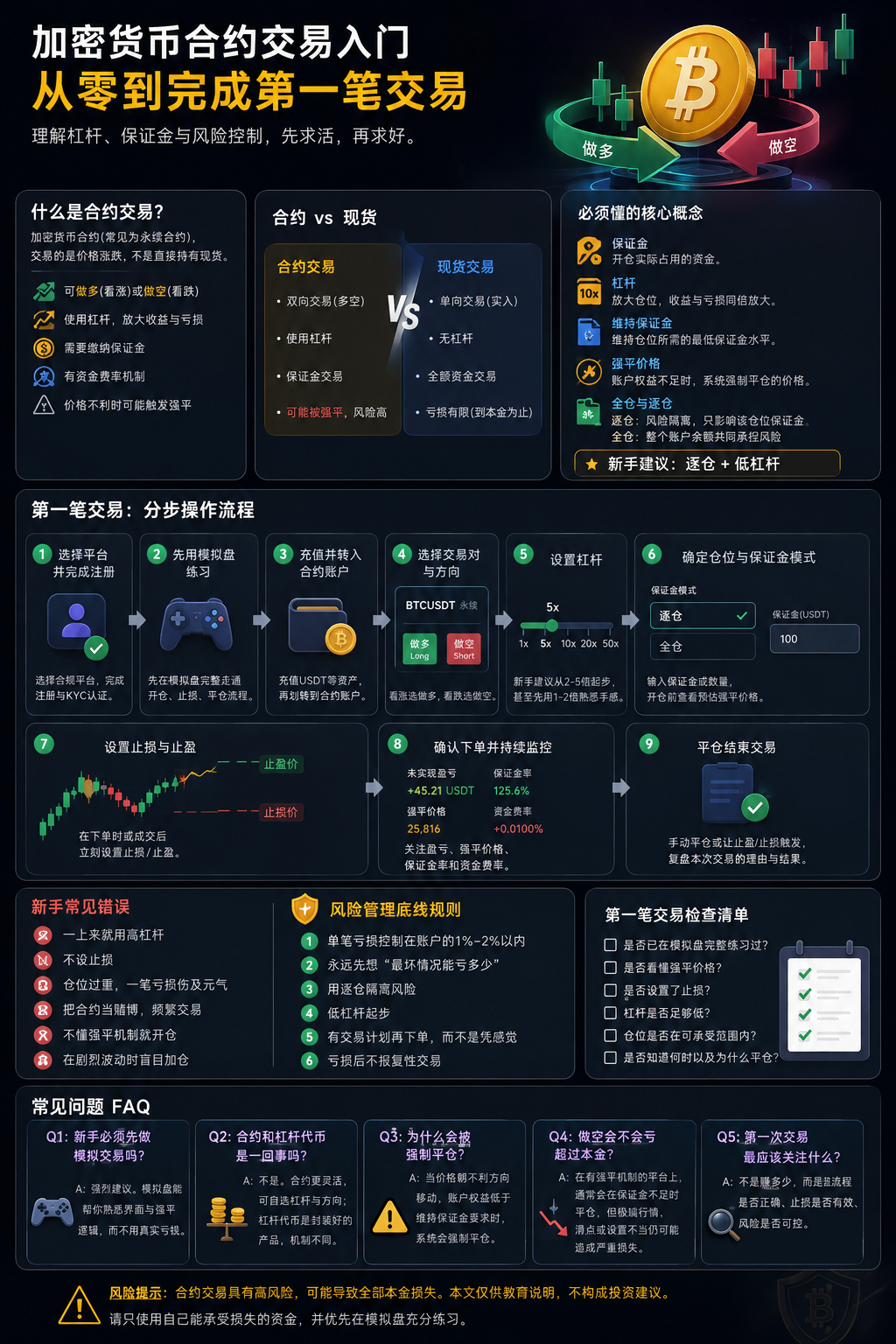
Common Beginner Mistakes
Using high leverage right from the start
Trading without a stop loss
Taking a position that is too large, so a single loss does serious damage
Treating futures as gambling and trading too frequently
Opening a position without understanding liquidation
Blindly adding to a position during violent price swings
Non-Negotiable Risk Management Rules
Keep the loss on a single trade within 1% to 2% of your account
Always ask first how much you could lose in the worst case
Use isolated margin to contain risk
Start with low leverage
Place orders from a trading plan, not from a feeling
Do not revenge trade after a loss
Risk notice: Futures trading is high risk and can result in the loss of all of your capital. This article is for educational purposes only and does not constitute investment advice. Use only funds you can afford to lose, and practice thoroughly on a demo account first.
First-Trade Checklist
Have you practiced the full workflow on a demo account?
Do you understand the liquidation price?
Have you set a stop loss?
Is your leverage low enough?
Is your position size within what you can bear?
Do you know when and why you will close the position?
Only after confirming all of these should you consider placing a small live trade.
Frequently Asked Questions
Q1: Do beginners have to trade on a demo account first?
A: It is strongly recommended. A demo account helps you get familiar with the interface and liquidation logic without losing real money.
Q2: Are futures and leveraged tokens the same thing?
A: No. Futures are more flexible, since you choose your own leverage and direction. Leveraged tokens are packaged products with different mechanics.
Q3: Why does a position get forcibly liquidated?
A: When price moves against you and account equity falls below the maintenance margin requirement, the system forcibly closes the position to control risk.
Q4: Can a short lose more than the principal?
A: On platforms with a liquidation mechanism, the position is usually closed when margin runs short, but extreme market conditions, slippage, or incorrect settings can still cause severe losses.
Q5: What should a first trade focus on most?
A: Not how much you earn, but whether the process is correct, whether the stop loss works, and whether the risk is controllable.
Through the steps above, you now understand the core concepts of crypto futures trading for beginners and how to complete your first trade. Survive first, then aim to do well; manage risk first, then talk about profit. Building a solid foundation matters far more than rushing to catch every price swing.
Đề xuất đọc
Xem thêm