

Crypto Exchange Hacks: Mt.Gox, Bybit and Recent Cases and Lessons
A crypto exchange hack usually means the keys or transaction authorizations the platform uses to safeguard user assets have been taken over by someone else, and funds have been moved out of platform wallets. This is not the same category of event as a user falling for a phishing scam and handing over a seed phrase. The now-defunct Mt.Gox filed for civil rehabilitation with the Tokyo District Court in 2014 and announced that a large amount of Bitcoin was missing; more recently, there have also been large-scale exchange thefts publicly reported by law enforcement. These events show that keeping assets on a trading platform means relying on its custody, internal controls and incident-response capabilities at the same time.
Reading about historical events helps clarify that failure can come from a technical intrusion, or from client assets not being effectively segregated. It cannot be used to infer that any platform still in operation "will" or "will not" run into problems, nor does it replace your own checks on custody models, reserve disclosures and withdrawal capability.
Key Takeaways
- First distinguish where the funds went: When analyzing a security incident, first determine whether it was the platform wallet that was stolen (an exchange hack) or a personal address/account that was compromised (phishing, mistakenly signing an authorization).
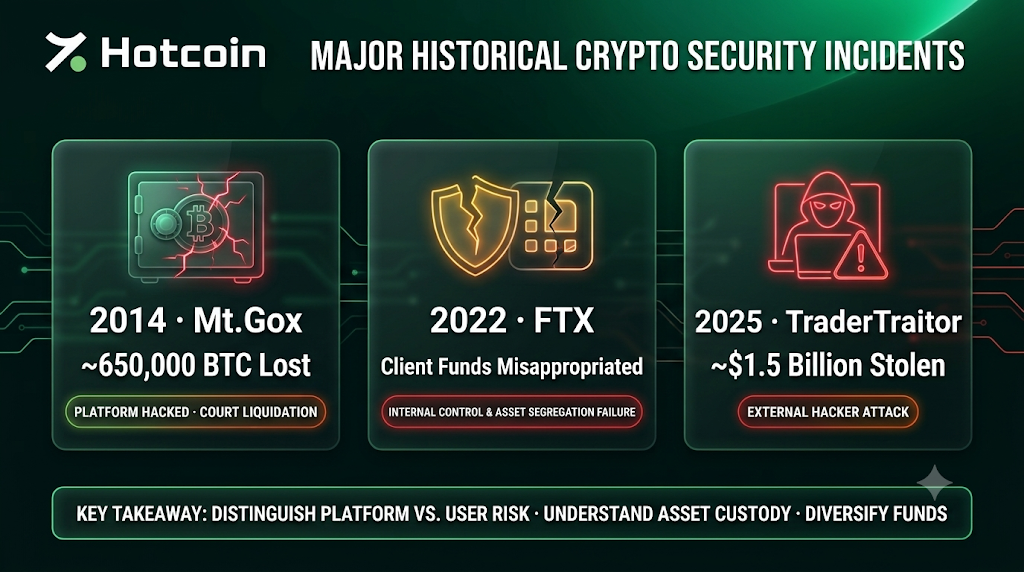
- Mt.Gox (judicial liquidation case): When it filed for civil rehabilitation with the Tokyo District Court on February 28, 2014, it announced that about 750,000 user BTC and 100,000 of its own BTC were missing, with a fiat currency discrepancy still under investigation; on March 20, about 200,000 were recovered from old wallets, and the missing estimate fell to about 650,000 (still subject to change as the investigation proceeds). The platform never resumed operations, and compensation is handled by the rehabilitation trustee under court procedures.
- FTX (internal risk-control failure): Public U.S. Department of Justice cases show that its collapse was not solely due to external intrusion, but also involved misappropriation of client funds and false statements about asset segregation — a normal-looking interface cannot substitute for asset segregation and internal controls.
- February 2025 theft: The FBI (via IC3) announced that North Korea-related cyber actors (TraderTraitor) stole about US$1.5 billion in virtual assets from a major exchange on around February 21, and called on virtual asset service providers to block money-laundering addresses.
- What users should do: Clarify who custodies your assets, review proof of reserves, withdrawals and security settings, and never put all long-term funds into a single custody entry point; historical cases cannot guarantee that losses will not happen again.
First Distinguish: A Platform Hack Is Not the Same as an Account Hack
When discussing "exchange hacks," first confirm which layer the loss occurred at.
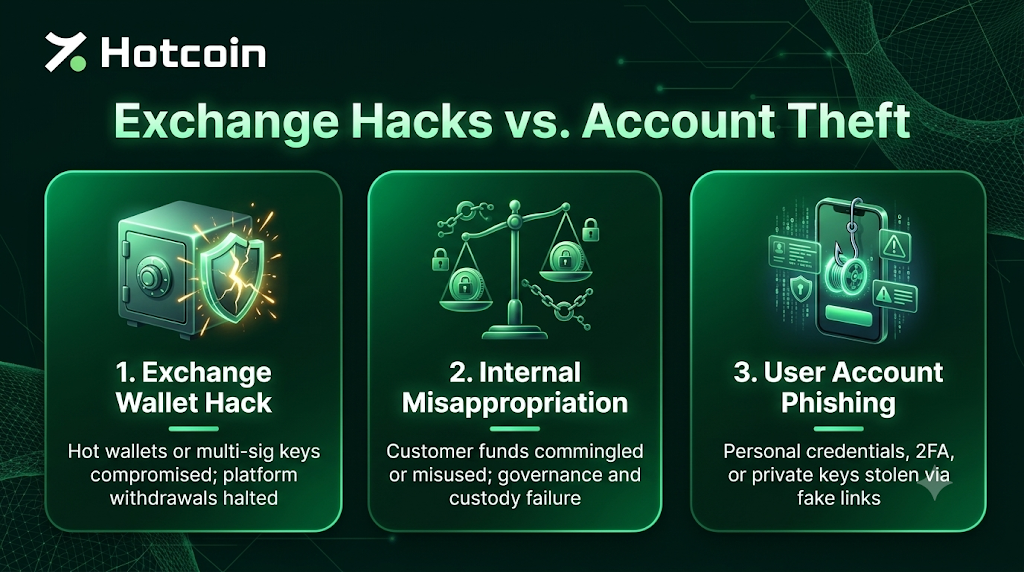
Platform wallet hack: Attackers gained control of the exchange's hot wallets, multisig or related authorizations, and funds were transferred out of platform addresses. What users see is often suspended withdrawals, official statements or abnormal on-chain outflows (for example, the February 2025 theft of about US$1.5 billion from Bybit's multisig wallet, or the historical Mt.Gox incident).
Internal loss of control or misappropriation of client assets: It may not look like a hacker intrusion on the surface, but client funds may already have been used for other purposes. This type of problem is closer to a custody and governance failure (for example, the FTX collapse).
User account or personal wallet hack: Attackers obtained login credentials, withdrawal permissions or private keys through phishing, trojans, phishing signatures or social engineering. In this case funds often leave from user accounts or user addresses, which does not necessarily mean the platform's hot or cold wallets were breached (for example, the 2024 theft of Binance user accounts caused by the malicious browser extension Aggr hijacking cookies, or the common case of clicking a phishing link or mistakenly signing an authorization that drains a personal wallet).
Historical Events: What Mt.Gox Announced in 2014
Mt.Gox was once an important early Bitcoin trading platform; it has now entered judicial proceedings led by Japanese courts and is no longer an operating exchange.
According to the company's civil rehabilitation application statement published in English on February 28, 2014:
- On the day of application, it filed for civil rehabilitation with the Tokyo District Court and was subject to court preservation measures including a prohibition on repayment and on transferring assets.
- Total assets listed at the time were about 3.84 billion yen, and current liabilities about 6.50 billion yen.
- The company said that in early February 2014 it discovered a Bitcoin system vulnerability that could be abused, and after an internal investigation concluded that about 750,000 BTC deposited by users and about 100,000 BTC of its own were missing, and that they had likely been stolen.
- Around the same period, the company also found a discrepancy of about 2.8 billion yen between cash at financial institutions and user fiat balances, the cause of which was still under investigation.
- The company shut down its website at noon (Japan time) on February 25 and said it would cooperate with Japanese and overseas authorities.
The large-scale theft at Mt.Gox did not happen because it was breached in a single moment; it was the combined result of chaotic underlying key management, missing hot/cold wallet segregation and long-term failure of account reconciliation. As an early exchange, it had serious flaws in private key safekeeping, permission control and asset auditing: attackers are suspected to have been continuously moving funds out since as early as 2011 by stealing private keys or exploiting system vulnerabilities, while the platform, over a period of several years, failed to notice that its book records and actual on-chain holdings had long diverged severely, until a withdrawal run in early 2014 fully exposed the massive asset hole.
After the hole was exposed, the event quickly moved into a long accounting and judicial process:
- Asset counts changed repeatedly: When it filed for civil rehabilitation in February 2014, Mt.Gox initially announced that about 850,000 BTC were missing (about 750,000 user coins and about 100,000 of its own). On March 20 of the same year, the company announced again that on March 7 it had confirmed about 200,000 BTC (199,999.99 BTC) still present in old-format wallets used before June 2011; adding about 2,000 coins already known before the application, total holdings were about 202,000, and the missing estimate was adjusted to about 650,000. The announcement also noted that the cause and exact number of the missing coins were still under investigation and that the figures could still change.
- Judicial liquidation measured in years: On June 22, 2018, the Tokyo District Court issued a decision to commence civil rehabilitation proceedings for MTGOX Co., Ltd. and appointed a rehabilitation trustee. According to a notice published on October 16, 2026, with court permission the deadlines for base repayment, early lump-sum repayment and interim repayment were changed from October 31, 2026 (Japan time) to October 31, 2027 (Japan time), and those deadlines may still be adjusted in the future. The trustee has also repeatedly reminded users that all progress should be checked on the official website and to beware of counterfeit sites collecting personal information.
Looking back at Mt.Gox, exchange theft often begins with a long-term absence of key management and asset reconciliation; and once a large shortfall forms, users seeking to recover assets enter judicial and repayment procedures measured in years, during which figures and deadlines may keep changing with investigations and court arrangements. This must never be simplified into "just wait and you will certainly get everything back in the original coin."
Historical Events: The FTX Collapse — an "Internal Hollowing-Out" Ignited on Social Platforms
If Mt.Gox was a "leaky ship" slowly hollowed out by hackers, the FTX collapse in late 2022 was a financial avalanche ignited by a few public statements while the whole internet watched. It was once one of the world's leading crypto exchanges, with a valuation that reached US$32 billion, yet it crumbled within a single week — the trigger was a head-on clash on social platforms between Binance founder Changpeng Zhao (CZ) and FTX founder Sam Bankman-Fried (SBF).
The turning point came in early November 2022. Media exposed the balance sheet of SBF's affiliated trading firm Alameda Research, and the outside world was startled to find that the bulk of this giant's assets was FTT, the platform token issued by FTX itself.
On November 6, CZ publicly stated that, in light of "recent revelations," he had decided to liquidate the remaining FTT on the books:
Changpeng Zhao (CZ), public statement on November 6, 2022:
"Due to recent revelations that have came to light, we have decided to liquidate any remaining FTT on our books."
This statement instantly ignited market panic, FTT fell sharply, and FTX suffered an unprecedented withdrawal run. Facing a flood of questions, SBF quickly fired back the next day, accusing "a competitor is trying to go after us with false rumors" and publicly assuring users worldwide:
SBF's public response on November 7, 2022 (the post was subsequently deleted):
"A competitor is trying to go after us with false rumors. FTX is fine. Assets are fine. FTX has enough to cover all client holdings. We don't invest client assets."
However, SBF soon deleted this reassuring post. Just days later, FTX suspended withdrawals, the acquisition fell through, and it filed for bankruptcy protection — the seemingly glamorous trading empire instantly revealed its long-hollowed-out hand.
The truth was fully exposed in the subsequent U.S. judicial proceedings: The main storyline of FTX's collapse was not an external hacker intrusion at all, but outright internal misappropriation and false statements.
According to a press release issued by the U.S. Attorney's Office for the Southern District of New York on March 28, 2024, SBF was sentenced that day to 25 years in prison for multiple fraud schemes. The charges the jury found included wire fraud, wire fraud conspiracy, securities fraud conspiracy, commodities fraud conspiracy and money laundering conspiracy. Prosecutors explicitly stated that SBF promised customers, investors and the public that "client deposits would be safely held, segregated from company assets and not used by FTX," while secretly misappropriating billions of dollars of client funds held at FTX and deceiving investors and lenders who had extended loans to Alameda Research.
In addition to imprisonment, the court sentenced him to three years of supervised release and more than US$11 billion in forfeiture; the judge authorized the government to use the forfeited proceeds to compensate victims (how much can actually be compensated and when it will be paid depends on subsequent judicial and bankruptcy proceedings, and this article makes no promise about the outcome).
Reviewing Mt.Gox and FTX together maps exactly onto the two major historical lessons of exchange risk: one is that keys or systems held by the platform are breached externally and assets disappear from wallets; the other is that client assets are never truly segregated inside the platform. For ordinary users, the results look identical on the surface — withdrawals suddenly stop, and book balances cannot be recovered as expected. Therefore, evaluating an exchange cannot rely only on its security marketing or the founder's verbal assurances; it must look at who actually controls the assets, how client funds are segregated, and whether the platform's liabilities and reserves (PoR) can be truly verified.
Recent Large Exchange Thefts: What Can Be Written Based on Public Notices
Large trading platforms still in operation also face external attack risk. For example, in February 2025, Bybit suffered a theft of about US$1.5 billion in virtual assets, and the U.S. Federal Bureau of Investigation (FBI) subsequently issued a public notice through the Internet Crime Complaint Center (IC3) attributing it to North Korea-related cyber actors (TraderTraitor); this case can be treated as an objective industry-level fact.
On February 26, 2025, the FBI issued a public service announcement through the Internet Crime Complaint Center stating that cyber actors related to the Democratic People's Republic of Korea stole about US$1.5 billion in virtual assets from a cryptocurrency exchange on or around February 21, 2025; the FBI refers to this activity as TraderTraitor. The notice also said the actors were moving quickly, had already converted some stolen assets into Bitcoin and other virtual assets and dispersed them across a large number of addresses on multiple chains, and were expected to launder further and eventually convert to fiat currency. The FBI called on entities including exchanges, cross-chain bridges, decentralized services and other virtual asset service providers to block transactions related to the relevant addresses and their derivative funds, and to provide information to the FBI or the Internet Crime Complaint Center.
Such notices show several things that matter to users:
- Large platforms can also be high-value targets, and thefts can reach the publicly disclosed level of billions of dollars.
- Stolen assets are then quickly split, swapped and moved, and ordinary users can hardly recover them by "watching an address in a browser."
- One focus of law enforcement action is asking virtual asset service providers to promptly restrict further transfers from the addresses involved. For users, the earlier an anomaly is reported through official channels, the better the information can reach the party that may take restrictive measures — but the outcome still cannot be guaranteed.
What Verifiable Lessons These Events Leave
Turning historical events into checks you can do now is more useful than repeatedly asking "which one will be next."
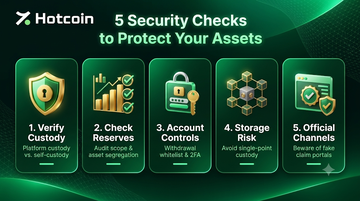
First, confirm which custody relationship the assets are under. Once funds are deposited to an exchange, the on-chain wallets are usually controlled by the platform or a custodian, and the balance you see in your account is the platform's bookkeeping result. To distinguish custody, self-custody and multi-party computation arrangements, read Crypto Exchange Custody Models. Custody brings the convenience of account recovery, order matching and unified risk control, but it also means you rely on the platform's key management, approval processes and solvency.
Second, look separately at "does it have a security team" and "are client assets segregated, and can reserves and liabilities be verified." Proof of reserves can help show the reserve situation at a certain point in time and within a certain scope, but it is usually not equivalent to a full financial statement audit and cannot guarantee that funds will not be moved afterward. For how to read such disclosures, see What Is Proof of Reserves.
Third, pay attention to the exit and security settings you control. For example: whether you can complete a small withdrawal test, whether there is a waiting period after security settings are changed, and whether withdrawal whitelists, two-factor authentication and session management are enabled. These settings cannot prevent external breaches of platform wallets, but they help reduce the speed of loss when an account is taken over individually.
Fourth, do not put all long-term assets into the same custody entry point. No assessment can eliminate the possibility of a technical, governance or legal event at a single platform. Layered storage should be based on your own trading needs, safekeeping ability and what you can bear in the worst case, rather than looking for a place that is "absolutely problem-free."
Fifth, learn about progress only from official platform announcements, the official help center and entry points you saved yourself. After large-scale incidents, fake customer service, fake repayment websites and paid recovery scams often follow. The Mt.Gox rehabilitation trustee has also specifically reminded users that only the website it publishes is the official information channel.
Common Misconceptions
- "Only small platforms get hacked; historically large platforms are safe enough" — Mt.Gox and FTX were also important platforms at the time. Scale can change attackers' target selection, but it cannot by itself prove that key management, segregation and solvency are sound.
- "This is a hacker intrusion, so it has nothing to do with client asset segregation" — Some events are mainly wallet thefts, while others are mainly misappropriation and false statements. Both can leave users unable to recover assets as originally expected, and the evidence needs to be examined separately.
- "If a platform has proof of reserves, it won't be hacked or unable to process withdrawals" — Proof of reserves usually shows part of the facts at a certain point in time and cannot guarantee that control, liquidity or withdrawals will not be affected afterward.
- "I enabled two-factor authentication, so a platform hack won't affect me" — Two-factor authentication mainly reduces the risk of someone else logging into your account. When platform wallets are stolen or client assets are misappropriated, user-side verification cannot change control on the platform side.
- "After a hack or blow-up, all you have to do is wait and you will certainly get all assets back in the original amount" — Judicial repayment, insurance or compensation arrangements vary by event, often take an extremely long time, and may not pay out in the original asset or original amount. For example, FTX went bankrupt in November 2022, and it took more than two years before the first batch of small payments began in February 2025, with large repayments extending into 2026; payments are converted at bankruptcy-date USD prices (for example, BTC at about US$16,800) rather than returned in the original coin, so rumored timelines or ratios should not be treated as universal rules.
- "Any 'official repayment portal' found in a search engine or chat can be used" — Rely on the official website published in advance by the platform or trustee. Fake repayment, claims and customer service are common secondary risks after such events.
Frequently Asked Questions
Q1: After an exchange hack, are users guaranteed compensation? Not necessarily. Whether there is insurance, a compensation fund, judicial recovery or distribution in bankruptcy or rehabilitation proceedings depends on the specific event and applicable law. Public historical cases show that processing can take years, and outcomes cannot be guaranteed in advance.
Q2: Why doesn't this article list the names of recent platforms one by one? For trading platforms still in operation, naming their hack timelines or trading situations is beyond the scope of this article. This article only uses historical events that have collapsed or entered judicial proceedings, and public notices that can stand even without restating platform names in the main text, to explain industry risks and verifiable lessons.
Q3: Does FTX count as "hacked"? Public U.S. Department of Justice cases describe it as a criminal case of fraud and misappropriation of client funds, not as a simple external hacker intrusion. It is included in this article to show that exchange risk does not only come from external attacks, but also includes whether client assets are truly segregated.
Q4: If I move coins to my own wallet, do I no longer need to care about exchange security? Self-custody reduces reliance on a single platform's keys and solvency, but it puts backup, phishing signatures, device security and inheritance issues on yourself. The two arrangements solve different problems; it is not simply a matter of one being better than the other.
Q5: If I see a large abnormal outflow on-chain, can I confirm that a platform was hacked? You cannot conclude from a single transfer or a circulated screenshot. Wait for official platform statements, regulatory or law enforcement notices, and verify that the statement comes from an official entry point. Forwarding addresses and "inside information" in unofficial groups may be inaccurate and may also lead you into new scams.
Q6: When an incident occurs, what should users do first? First check announcements and account status through the official app or website you saved yourself, and do not click links of unknown origin. At the same time, protect your login email, authenticator and withdrawal settings, and beware of fake customer service. If reporting or claims are involved in your jurisdiction, use local official channels and keep account records and official notices.
Conclusion
An exchange hack or collapse can come from wallets and authorizations being externally controlled, or from client assets not being effectively segregated. Mt.Gox and FTX, as historical events that have entered judicial proceedings, and law enforcement public notices on recent large thefts, all show that custody risk cannot be ruled out simply because "the platform looks big" or "the interface is all normal." What users can do now is clarify who holds the funds, verify reserves and withdrawal-related evidence, manage the security settings they control, and avoid putting all long-term assets into a single entry point. These preparations can reduce the impact of a single-point event, but they cannot promise that losses will not occur.
If you want a more systematic check by entity, custody, reserves and exit capability, start with How to Evaluate the Security and Credibility of a Crypto Exchange.
Risk warning: This article is for educational and informational purposes only, does not constitute investment, legal or claims advice, and makes no guarantee about the repayment outcome of any historical event or future platform security. The amounts, deadlines and characterizations in historical cases are based on official announcements, court or law enforcement documents at the time and may be adjusted by subsequent proceedings. Please learn about event progress only through official entry points, and do not transfer money to or provide documents or verification codes to anyone claiming to recover funds or speed up repayment on your behalf.
Đề xuất đọc
Xem thêm