Brent Crude Oil Price | Live Trends, Historical Data and Key Drivers
The "international oil price" in the news may refer to Brent or to WTI. Both are quoted in US dollars per barrel, but they correspond to different benchmarks and trading structures, so the headline number alone does not tell you which is cheaper.
When checking the live Brent crude price, confirm the latest data timestamp, the quotation unit and the price type at the same time. This article explains how to read trends and historical data; it does not give a fixed "today's price." All examples below are hypothetical and must not be treated as current market conditions or a promise of execution.
Key Takeaways
- Brent crude is commonly read in US dollars per barrel; a price figure must always be read together with its unit.
- Spot, benchmark pricing, specific-month futures and retail products may each correspond to different prices.
- Historical trends should use a consistent source, contract and data-processing method.
- Price direction does not equal position return; fees, leverage and contract rolls all change the actual result.
What Does the Brent Crude Oil Price Mean?
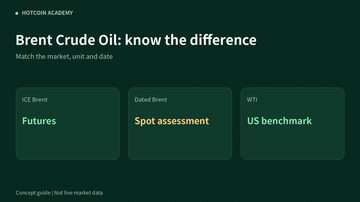
Brent is a benchmark system widely used in global crude oil trade. ICE Brent crude oil futures are one standardized contract within it; it is linked to spot assessment references such as Dated Brent, but the various Brent figures must not all be treated as the same quote.
When reading the ICE Brent crude oil futures contract specification, separate the quote from the contract size: the standard contract code referenced here is B (ICE), with a contract size of 1,000 barrels. Mini contracts or products on other exchanges may differ and should not be applied directly.
How to Read Live Trends and Historical Data
First identify "which market, which product, which time," then look at the move. The latest traded price reflects the most recent transaction; bids and asks reflect current orders in different directions; the settlement price is a value formed under exchange rules. They can coexist and need not be equal.
Intraday highs and lows should use the same trading session, and the comparison base for percentage changes should also be consistent. A trading day may differ from the calendar day in your region; prices shown while the market is closed may be the last trade or settlement value, and the presence of a number on the page does not mean it is still updating in real time.
When reading historical data, first confirm whether it is the same specific contract. Continuous futures charts link different months by rule, and some also apply back-adjustment or spread adjustment. Therefore, a jump around a roll date does not necessarily mean the same holdable asset produced the same return at that instant.
| Data type | What it is good for observing | What to check when using it |
|---|---|---|
| Spot or spot assessment | Current physical market and reference prices | Location, quality, assessment time and method |
| Specific-month futures | Price expectations for a given delivery period | Contract month, expiry and liquidity |
| Continuous futures chart | Longer-term trend display | Roll rules and whether historical prices are adjusted |
| Retail or investment products | The quote for the product you actually buy | Fees, premiums, leverage and subscription/redemption terms |
How to Convert Quotation Units and Amounts
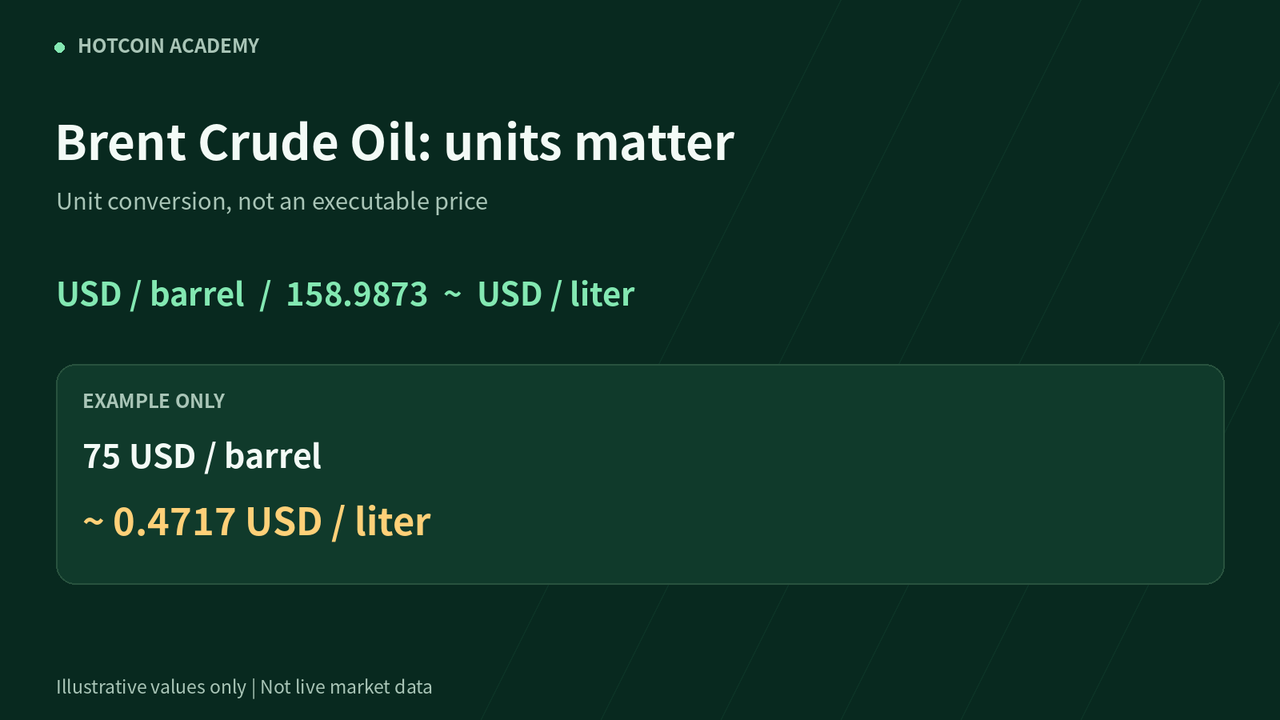
USD/barrel ÷ 158.9873 ≈ USD/liter.
Suppose Brent crude is 75 USD/barrel. Using 1 barrel ≈ 158.9873 liters, the crude volume converts to about 0.4717 USD/liter. This is not the retail gasoline price and does not include refining, transport or taxes. All calculations are only for standardizing the basis and do not include the fees, premiums or taxes of actual products.
| Unit or basis | Meaning |
|---|---|
| 1 standard oil barrel | 42 US gallons, about 158.9873 liters |
| Futures quote | USD/barrel, not the total price of one contract |
| Refined product retail | Different product type and cost structure |
If you use a futures quote to calculate the notional size of one contract, multiply the unit price by the contract's standard quantity. Margin is only the funding arrangement needed to open and maintain a position; it does not replace the total contract value and is not a loss cap.
What Factors Affect the Brent Crude Oil Price?
The Brent price is affected by global seaborne crude supply and demand, policies in major producing regions and transport risks. Conflict or shipping disruption may add a risk premium, but whether prices keep rising also depends on supply substitution, inventory buffers and changes in demand.
| Factor to watch | Link to price |
|---|---|
| Global supply, demand and production policy | Watch whether supply execution and consumption expectations change together |
| Shipping and geopolitical risk | Transport distance, routes and insurance costs change trade flows |
| Benchmark structure and monthly spreads | Different months of the same benchmark can also show significant price gaps |
You can also refer to the EIA oil market explanation to continue checking product information. When judging the market, especially distinguish between supply and demand changes that have already occurred and market expectations: data beating expectations and the data itself rising are not necessarily the same thing.
How Does Brent Crude Differ from Similar Products?
"Brent is more expensive than WTI" cannot be treated as an eternal rule. Quality, location, logistics and market balance change the spread; if two charts use different months, or one is spot and the other is futures, the comparison is even more likely to be distorted.
Prices for different maturities may also show contango or backwardation. When holding futures or related products that need to be rolled, besides direction, check the roll mechanism, financing and management fees; do not directly copy the underlying spot gain as the product return.
Common Pitfalls
- Looking only at the move, not the unit. The same price number can mean something completely different when converted to different weights, energy units or currencies.
- Treating a historical curve as a directly realizable return. Continuous charts, spot curves and specific investment products may differ due to rolls and costs.
- Predicting a certain rise or fall from a single news item. It is a misunderstanding that "all quotes with Brent in the name can be stitched into one historical series." First confirm the assessment institution, price type, currency and delivery period.
FAQ
Q1: Are the Dated Brent spot assessment and ICE futures the same thing? No. The former relates to physical market assessment references, while the latter is a standardized futures contract; delivery month, pricing method and trading mechanism must each be checked separately.
Q2: Why do two websites show different Brent crude prices? First check whether they use the same market, spot or futures type, contract month, currency and update time; do not just compare the last decimal on the screen.
Q3: Can the all-time high be used directly as a future target? No. A historical high reflects the supply, demand, monetary and market conditions of that time, and may belong to a different contract or data basis; there is no guarantee it will recur.
Q4: The chart shows a rise, so why has the product I bought not risen that much? The product may contain different maturity exposure, leverage, FX, management fees or roll arrangements; read the documentation of the product you actually hold.
Q5: Can the Brent crude price alone tell me whether it is worth buying? Not enough. You also need to consider the specific product, holding period, trading costs, acceptable loss and exit conditions; a quote alone cannot determine a position size suitable for you.
Conclusion
Reading the Brent crude oil price starts with confirming the quoted object and unit. Check the time basis of live data, how the historical series is processed and the actual product costs before discussing trends, so you do not mistake numbers from different markets for the same investment result.
Risk notice: This article is for educational and informational purposes only and does not constitute investment advice. Commodity prices can fluctuate sharply, and derivatives leverage and delivery arrangements may bring additional risks; actual trading is subject to the rules of the relevant product.
Đề xuất đọc
Xem thêm