
Solana: Technical Advantages and Ecosystem Overview
Solana is a smart contract network designed for high throughput and low latency on a single chain. Programs remain stateless, data is stored in separate accounts, and the runtime schedules transactions in parallel after they declare which accounts they will read and write.
This does not mean that every transaction simply runs at the same time. Only transactions with nonconflicting access sets can execute in parallel; when many users compete for the same account or market, hotspots can still form.
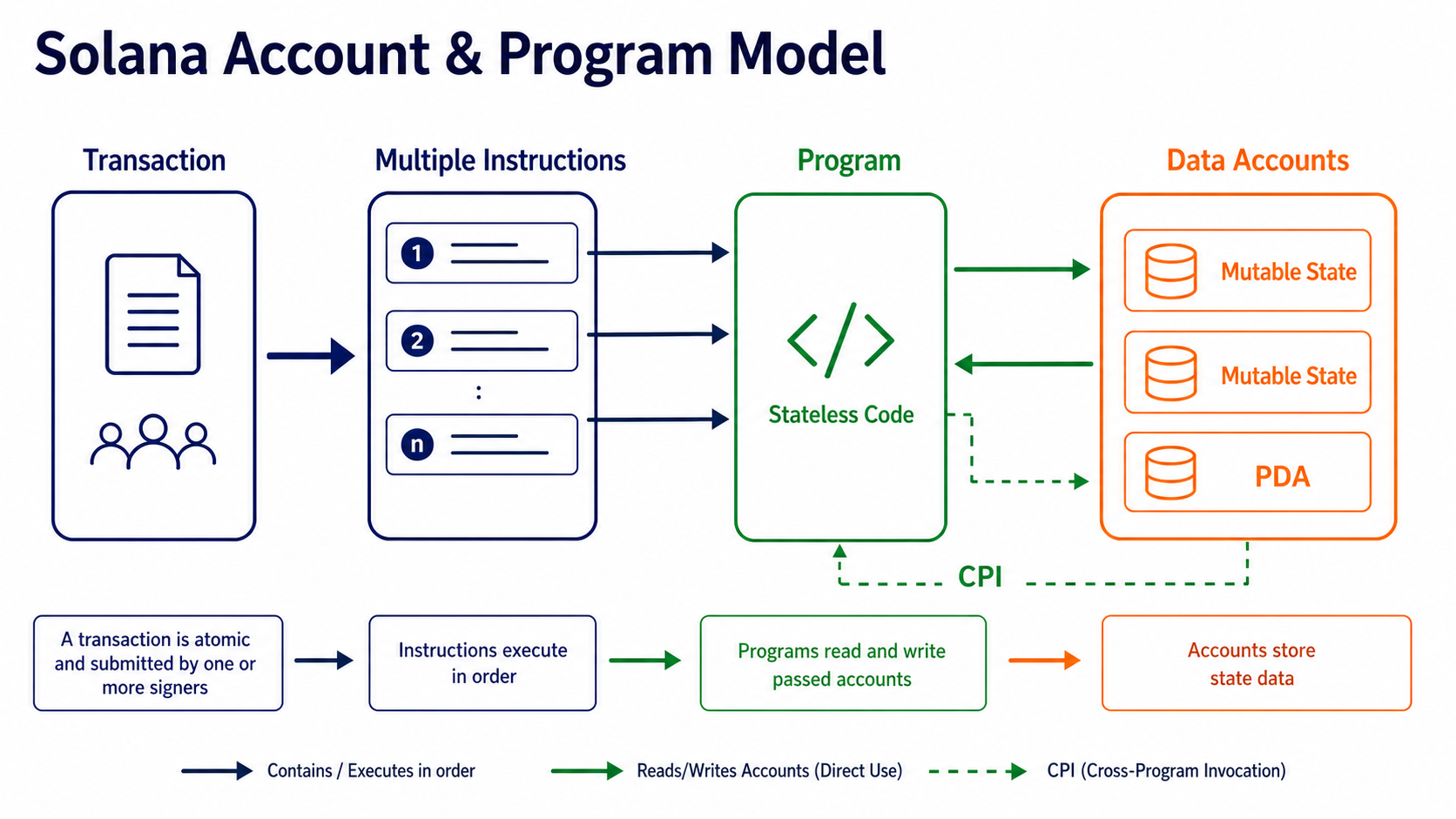
How Do Solana's Account and Program Models Work?
Solana programs are executable code deployed on-chain and generally do not store mutable state within the programs themselves. Balances, orders, positions, and application settings live in separate data accounts, which programs read or modify through instructions.
A transaction can contain multiple instructions and lists the account addresses, signers, and read or write permissions required for execution. The runtime uses this information to determine which transactions do not conflict.
| Component | Function |
|---|---|
| Account | Stores SOL, program code, or application data |
| Program | Defines how inputs are validated and account data is modified |
| Instruction | Invokes a program with an account list and parameters |
| Transaction | Combines one or more instructions as an atomic execution unit |
| PDA | A deterministic address derived from a program ID and seeds |
| CPI | A call from one program to another during execution |
This model supports parallel processing and makes data dependencies explicit, but developers must design account boundaries, permissions, and ownership checks correctly.
What Does PoH Do in Solana?
Proof of History (PoH) provides a verifiable source of time and event ordering; it is not a complete consensus mechanism by itself. A continuous hash sequence gives transactions and messages a verifiable order, reducing the coordination overhead among validators.
Solana also relies on PoS, leader scheduling, Tower BFT, and other components to select blocks, vote, and handle forks. Treating PoH as the entire consensus system overlooks validator weights, network propagation, and the conditions required for finality.
For a broader comparison, see this overview of other consensus mechanisms.
How Does Parallel Execution Increase Capacity?
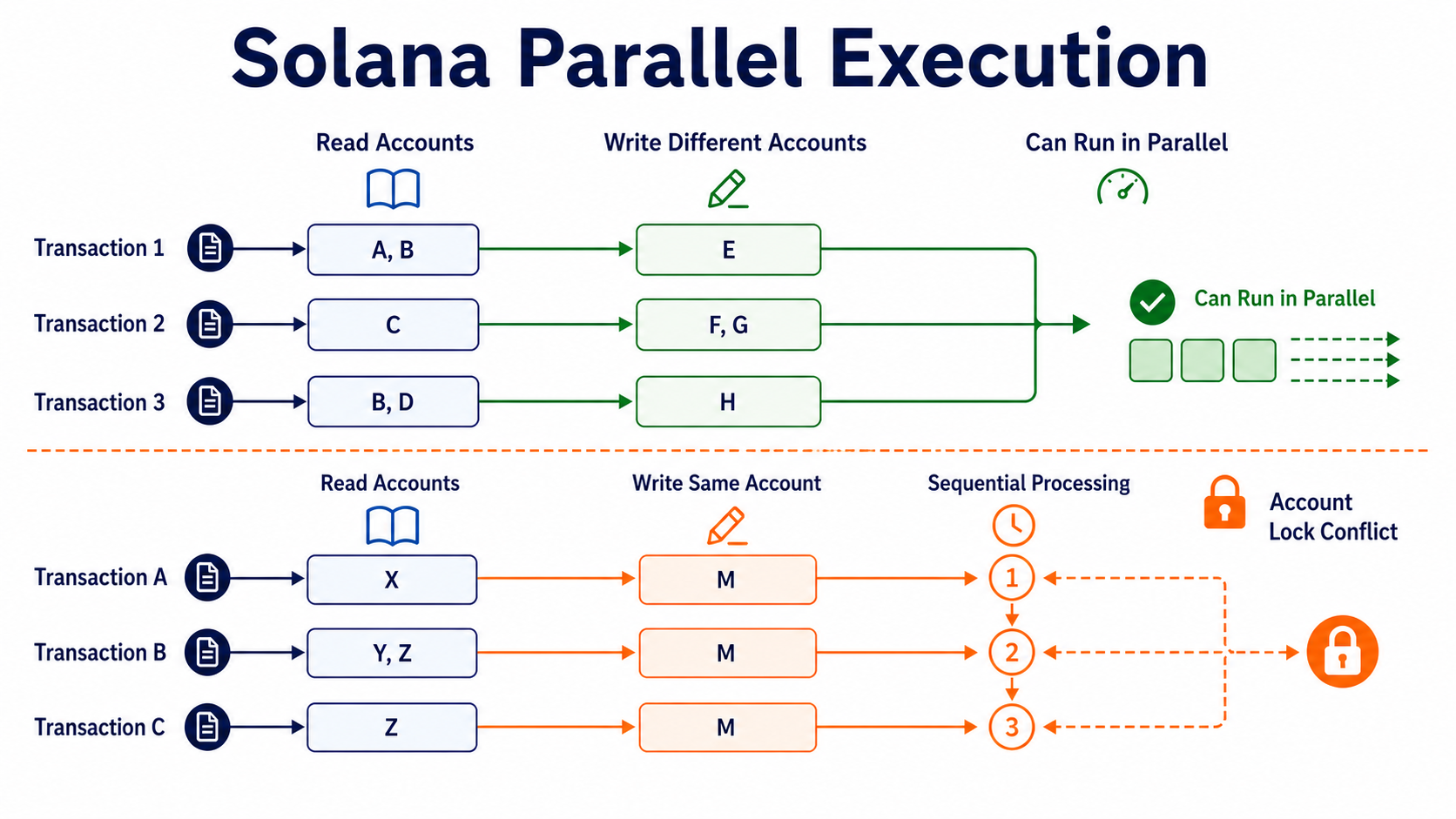
The scheduler can execute transactions that access different accounts simultaneously. For example, two users interacting with unrelated program accounts can follow parallel execution paths. If both transactions need to write to the same liquidity pool account, they must be processed in sequence.
| Scenario | Parallelization potential |
|---|---|
| Reading the same account only | Concurrent reads are generally possible |
| Writing to different accounts | Can execute in parallel |
| Writing to the same account | Must be ordered and may create account-lock contention |
| Accounts declared incorrectly | The transaction cannot execute as intended |
| Excessive computation | May exceed the compute-unit limit |
High performance also depends on validator CPU, memory, storage, and networking. Keeping execution pressure within one shared state can reduce cross-chain fragmentation, but it also raises infrastructure requirements for nodes.
What Makes Up SOL Transaction Fees?
A transaction typically includes a base signature fee and an optional priority fee. Program execution is subject to compute-unit limits, and users can specify a compute budget and the priority fee they are willing to pay.
Low average fees do not guarantee that every transaction will succeed immediately. During popular events, account contention, block space, RPC congestion, expired blockhashes, or slippage limits can all cause failures. Applications should support retries and state verification instead of repeatedly broadcasting the same signed transaction.
SOL is also used for staking and protocol security. Delegating stake does not give a validator the owner's private key, but delegators should still consider validator performance, commission, and stake concentration.
Which Applications Suit the Solana Ecosystem?
Solana's shared state and low latency are well suited to on-chain trading, payments, games, and digital asset applications that require frequent interaction. SPL Token and Token-2022 provide token standards, while cross-program invocations enable composable applications.
Transaction count alone is not enough to evaluate the ecosystem. Voting transactions, program activity, bots, and user actions may be measured differently. More practical indicators include actual paying users, stablecoin settlement, application revenue, failure rates, and ongoing developer maintenance.
For comparison with an EVM-compatible approach, read about the BNB Chain ecosystem. To explore differences among newer execution models, see the Sui, Aptos, and NEAR comparison. For the broader landscape, refer to the overview of leading Layer 1 ecosystems.
Frequently Asked Questions
Why Do Solana Addresses Usually Not Start With 0x?
Solana public keys are typically represented in Base58, unlike EVM address formats. When withdrawing from an exchange, you must select the Solana network rather than relying only on the token name.
Is a Solana Program the Same as an Ethereum Smart Contract?
They serve similar purposes but organize data differently. Solana programs are generally stateless, with mutable data held in external accounts; Ethereum contracts usually own their storage directly.
Why Can a Signed Transaction Still Fail?
A signature proves authorization only. Changes in account state, an expired blockhash, compute limits, fees, or program conditions can still prevent the transaction from reaching a final state.
Can SOL Be Transferred Immediately After Delegated Staking?
Stake-account activation and deactivation are processed by Epoch. After undelegating, users generally need to wait for the status to change. Specific wallets may also offer different liquid staking products.
Đề xuất đọc
Xem thêm
service hotcoin.com
producthotcoin.com
businesshotcoin.com
casecnhotcoin.com