
Layer2 and Layer1: Complementary or Competitive?
Layer1 and Layer2 are complementary at the protocol level: L2 handles large volumes of transaction execution, while L1 provides data, proof verification, and final settlement. Yet they also compete for users, fees, liquidity, and application access.
It is incomplete to say either that “L2 replaces L1” or that “L2 is merely an application on L1.” A transaction delegates some responsibilities to L2 while retaining part of its worst-case protection on L1.
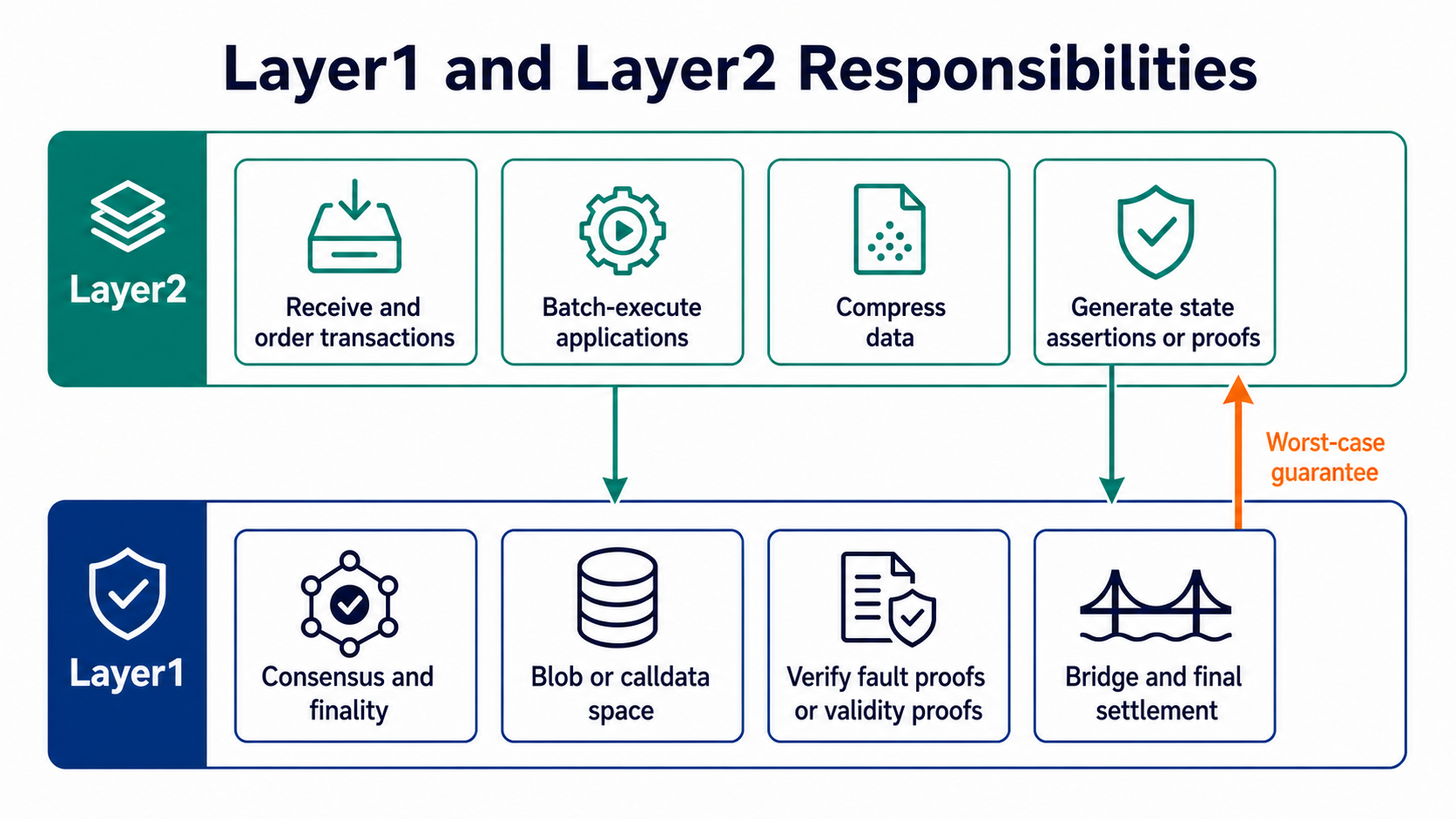
What Are Layer1 and Layer2 Responsible For?
Using Ethereum rollups as an example, an L2 sequencer receives user transactions and executes EVM state changes, a batching component compresses the data, and a proving system creates a state claim or validity proof. Ethereum stores data commitments, verifies proofs, and executes bridge and dispute contracts.
| Responsibility | Layer1 | Layer2 |
|---|---|---|
| Consensus and finality | Validates L1 blocks and determines canonical history | Follows L1 state while providing fast local confirmations |
| Transaction execution | Executes L1 transactions and L2 verification contracts | Executes user transactions and application contracts in batches |
| Data availability | Provides blob or calldata space for rollups | Compresses and publishes the data needed to reconstruct state |
| State verification | Verifies fault proofs or validity proofs | Produces state claims, execution traces, and proofs |
| User experience | Higher fees with unified assets and settlement | Lower fees with more network and application choices |
This division of responsibilities does not apply to every network that calls itself an L2. Validiums keep data off L1, while sidechains use their own consensus. You must first identify the specific architecture before judging what it inherits from L1.
Why Are the Two Layers Mainly Complementary?
If L1 directly executed every user transaction, blockspace and node hardware would limit capacity. L2 moves computation away from the mainnet and lets many transactions share the cost of one data publication and verification process, increasing the amount of activity the overall system can support.
In return, L2 needs L1. A rollup publishes batch data to the mainnet, uses L1 contracts to verify state and manage asset exits, and may depend on L1 forced-inclusion and dispute paths when a sequencer stops or behaves maliciously.
L1 upgrades also change L2 costs. EIP-4844 introduced blobs and a separate fee market for rollups, reducing data-publication costs. As L2 activity grows, demand for L1 data space, proof verification, and cross-layer messaging generally grows as well.
Does Layer2 Take Value Away from Layer1?
It changes how fees are distributed, but “takes everything away” is an inaccurate summary. When users move high-frequency execution to L2, they pay less in direct L1 execution fees; however, L2 still pays L1 for batch data and proof transactions.
Rollup revenue and costs can be simplified as:
L2 operating margin = L2 fees paid by users - L2 execution costs - L1 data and settlement costs
This formula describes protocol fee flows only. It is not a token valuation or profit promise. Different networks also allocate fee burns, sequencer revenue, and ecosystem incentives differently.
Where Do the Two Layers Compete?
Both Layer1 and Layer2 can host transactions and applications, so they compete in several areas:
- User access. Wallets and exchanges may route users to a particular L2 by default instead of L1.
- Liquidity. The same asset is spread across multiple chains and bridged versions, fragmenting market depth.
- Developer deployment. Projects must choose whether to support L1 first, one L2, or maintain several chains at once.
- Fee revenue. Whether high-value activity remains on L1 or moves to L2 changes the fee structure of each layer.
- Governance and standards. Different technology stacks seek to become the shared development and interoperability standard for more chains.
This competition does not cancel the complementary relationship. An L2 can compete for the user interface and execution revenue while continuing to depend on L1 data and settlement services.
What New Problems Do Multiple Layer2 Networks Create?
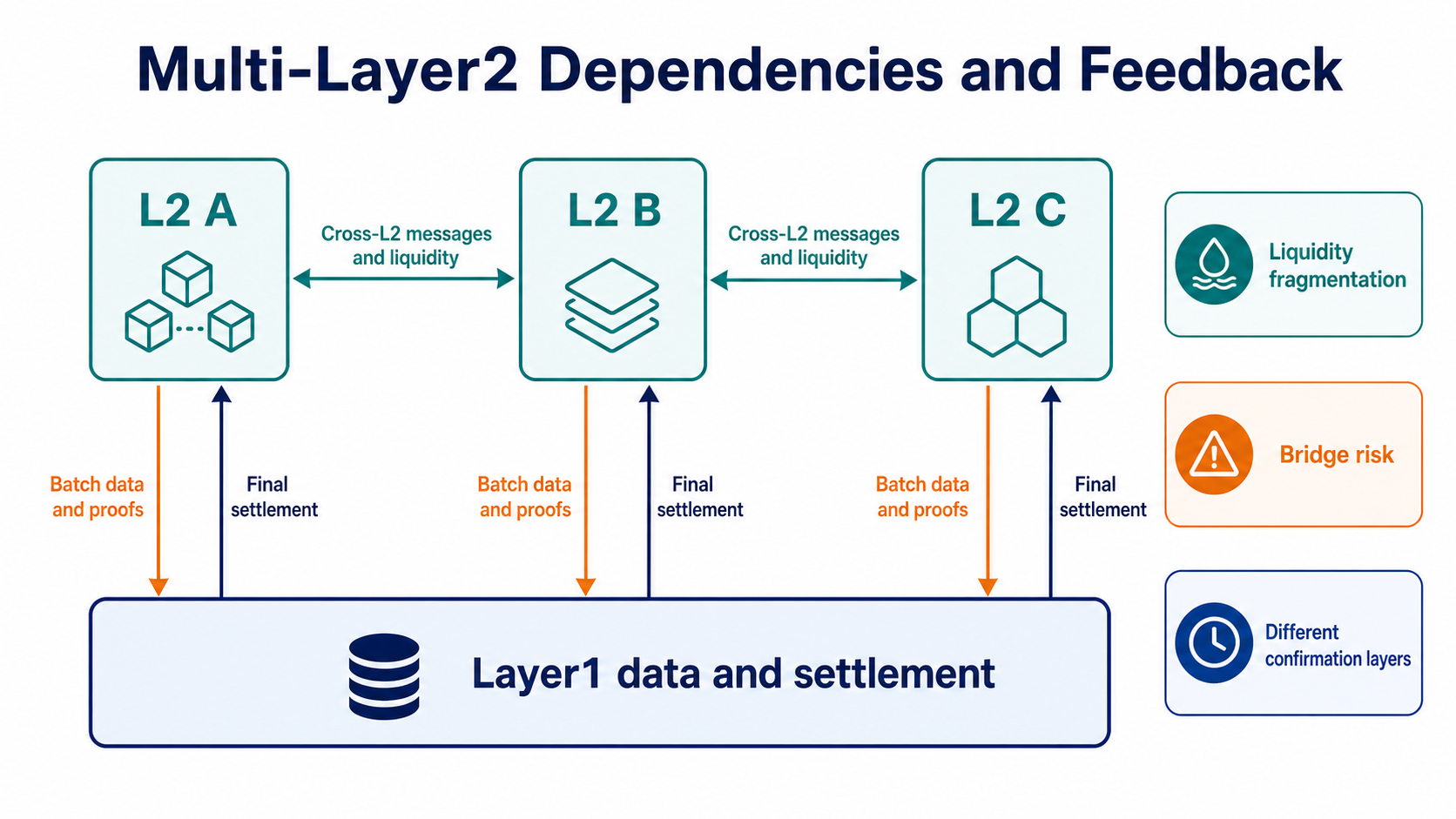
A multi-L2 system turns congestion on a single mainnet into network-selection and interoperability problems. Users must manage different gas assets, RPC endpoints, bridge messages, and token versions, while applications must synchronize contracts, oracles, and liquidity.
The most common new costs include:
- Liquidity fragmentation. The same trading pair has different depth across chains, creating differences in prices and slippage.
- Bridge risk. Moving across L2 networks often involves L1 or a third-party messaging bridge, adding contracts and waiting periods.
- Unsynchronized state. When an application is deployed on multiple chains, its orders, collateral, and governance state are not automatically shared.
- Differences in fast confirmations. Different sequencers and proof frequencies mean that “confirmed” can represent different levels of security.
Interoperability protocols can improve the experience, but they do not eliminate the underlying trust boundaries. A single “cross-chain swap” may simultaneously rely on a liquidity provider, message verification, and a contract on the destination chain.
Which Layer Should Applications and Users Choose?
High-value, low-frequency operations that need direct L1 settlement may be better suited to mainnet. High-frequency trading, games, social applications, and small payments usually prioritize low fees and fast confirmations, making a mature L2 more suitable.
The practical choice also depends on whether the target application is deployed there, available asset liquidity, official exit routes, and sequencer and upgrade permissions. A chain is not automatically appropriate for every task merely because it is an L2.
For the technical differences between the two major rollup types, see Optimistic Rollups and ZK-Rollups. For an overall classification, see the Layer2 Scaling Guide.
Frequently Asked Questions
Do Layer2 Transactions Increase Ethereum State Size?
L2 nodes maintain most L2 user state, but a rollup stores batch commitments, bridge and verification contract state on Ethereum and consumes data space. This differs from directly executing every L1 transaction.
Can an L2 Keep Operating If Ethereum Stops Producing Blocks?
A sequencer may continue providing local results for a short time, but data submission, proof settlement, and official exits will be disrupted. Whether sequencing continues and how the network recovers depend on its specific rules.
Is Layer2 Still Necessary If Layer1 Gas Fees Fall?
Yes. Increasing L1 capacity can reduce some congestion, but global execution and state growth still have limits. L2 continues to provide additional capacity and room for application-specific customization through batching.
Can an L2 Change Its Settlement Layer?
It can technically redeploy or migrate, but its assets, contracts, state proofs, and bridges must all be redesigned. For users, this is not an invisible configuration change; it is a major change to security assumptions and asset exit paths.
Đề xuất đọc
Xem thêm

service hotcoin.com
producthotcoin.com
businesshotcoin.com
casecnhotcoin.com