
Famous DAO Case Studies: MakerDAO, Uniswap DAO, and Arbitrum DAO
MakerDAO, Uniswap DAO, and Arbitrum DAO often appear on lists of prominent DAOs, but they do not govern the same kind of system. MakerDAO and its current Sky governance framework resemble an on-chain monetary and risk committee. Uniswap DAO mainly governs DEX protocol permissions, its treasury, and fee mechanisms. Arbitrum DAO must address Layer 2 network upgrades, a large treasury, its relationship with the Foundation, and the Security Council.
The value of these examples is not their token prices or proposal counts. Each illustrates a difficult category of DAO work: continuously managing financial risk, governing an open protocol separately from an independent development company, and establishing a constitution-like upgrade process for a blockchain network. Understanding those differences matters more than arguing over which DAO is “more decentralized.”
For the basic relationships among members, proposals, voting, execution, and treasuries, read the Complete Guide to Decentralized Autonomous Organizations.
Why Use These Three DAOs as Case Studies?
First, all three directly govern systems with real economic consequences. Governance decisions can change collateral ratios, stablecoin interest rates, protocol fees, treasury spending, contract ownership, or network upgrades. Their votes are not nonbinding community surveys.
Second, each has faced visible institutional pressure. Maker went through severe market volatility and a complex organizational restructuring. Uniswap has long faced delegate concentration, quorum, and fee-switch debates. Arbitrum encountered a legitimacy crisis around AIP-1 shortly after its DAO launched.
Third, none of them is a single contract. Foundations, development companies, delegates, service providers, committees, and legal entities participate at different stages. Any analysis must distinguish what token holders can control from the products and assets they cannot control.
Under common classifications, all three are protocol DAOs, yet stablecoins, DEXs, and Layer 2 networks operate on very different risk schedules. For other organizational models, see DAO Types: Protocol, Investment, Social, and Service DAOs.
Which Dimensions Matter When Analyzing a DAO?
Start with the object of governance. Does the DAO control core contracts, parameters, a treasury, a brand, or a legal entity? If its permissions cover only one part of the system, the entire ecosystem cannot accurately be described as community-owned.
Next, examine voting power. Determine whether tokens must be delegated, how proposal thresholds and quorum are calculated, whether delegates are concentrated, and whether the team or a foundation retains substantial weight.
Third, trace the proposal path. Who handles forum discussion, off-chain temperature checks, on-chain voting, the Timelock, and final execution? That path determines how opinions turn into power.
Fourth, examine exceptional mechanisms. Public procedures are easy to design during calm periods. The hard question is who can pause, cancel, or fast-track an upgrade when a vulnerability, market crash, malicious proposal, or legal event occurs.
Finally, review execution and accountability. Governance quality depends on whether approved votes execute automatically, working groups deliver, foundations disclose budgets, and delegates explain their votes.
Why Is MakerDAO Considered a DeFi Governance Pioneer?
MakerDAO developed around the DAI stablecoin and a collateralized lending system. Users deposit approved assets into Vaults to generate DAI, while governance sets collateral types, debt ceilings, stability fees, liquidation parameters, savings rates, oracles, and security modules. It is not a product upgraded occasionally; it is a financial system requiring continuous management.
MKR holders carried out the early governance. MKR did more than express community sentiment: it influenced the protocol’s risk policy and execution. After Multi-Collateral DAI launched in 2019, governance expanded from one collateral type to many assets and complex risk parameters, increasing the importance of research, oracles, liquidation, and execution.
The Maker Foundation once performed development and coordination work, then completed its dissolution in 2021. Protocol governance and operations progressively moved to the DAO, core contributor teams, and delegates. This evolution made Maker a leading example of progressive decentralization, not an organization that was fully autonomous on its first day.
Why Is MakerDAO Now Called Sky?
MakerDAO entered a Sky branding and governance restructuring phase in 2024. The ecosystem introduced USDS and SKY while retaining legacy assets and migration paths involving DAI and MKR. By 2025, official governance materials described SKY as the sole governance token of Sky Protocol, and the current voting interface used Sky Governance.
This article retains “MakerDAO” in the title because it is the best-known historical case, but uses Sky when discussing the current system. Users should not treat the old Maker Portal, MKR tutorials, and current SKY governance as identical, nor should they operate through an old page simply because it appears in search results.
Sky’s organizational framework is more layered than early Maker. Atlas records core rules and authorizations. Stars, Prime Agents, Facilitators, and specialist service providers handle different areas of operations and risk. SKY holders amend rules, approve proposals, and oversee execution through governance.
The restructuring attempts to address early DAO governance overload: token holders cannot manage every collateral asset, budget, and technical task individually. Yet additional layers also make effective control harder for ordinary participants to assess, so mandates, proxy contracts, budgets, and reports must remain traceable.
How Does a Sky Vote Reach Protocol Execution?
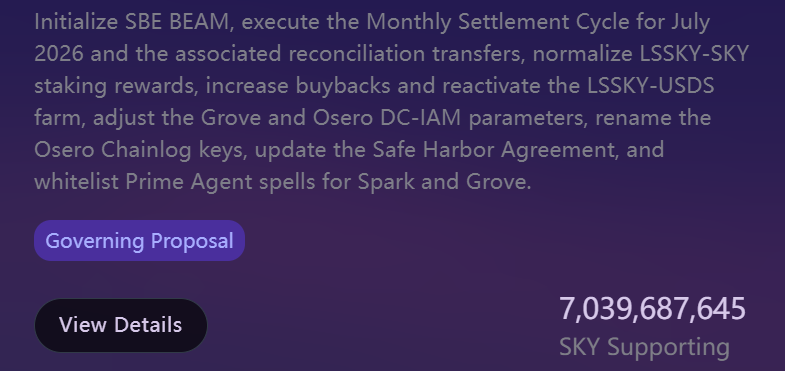
Sky governance broadly separates opinion polls from executive proposals. A Governance Poll confirms a direction, parameter, or rule change. Once approved, the relevant change is usually assembled into a later Executive Vote. An executive proposal contains the Spell that actually changes protocol state, and SKY holders place voting power behind the proposal they support.
Passing an executive proposal does not make it effective immediately. Official proposal pages in 2026 showed that ordinary changes generally still passed through the GSM Pause Delay. The commonly listed delay at the time was 24 hours and could include a weekday execution window. This interval gives the community time to verify the Spell, detect anomalies, and respond.
The advantage is a review layer between policy and code. The cost is that members must understand the distinction among Polls, Atlas authorizations, Spells, and execution status. A natural-language summary cannot replace contract verification, and one executive proposal may bundle operations with very different risk profiles.
What Governance Lessons Does MakerDAO/Sky Offer?
First, financial protocol governance requires specialization. Collateral, interest rates, liquidation, and real-world assets cannot be assessed through token-holder intuition alone. A DAO needs risk teams, oracles, and legal and technical providers, but it must prevent experts from becoming irreplaceable centers of power through informational advantage.
Second, extreme markets test the entire institution. Severe market declines and Ethereum congestion in 2020 put Maker’s collateral auctions and DAI liquidity under strain, driving further improvements to liquidation, Keepers, oracles, and risk parameters. Stress tests, contingency plans, and layered defenses matter more than participation rates during quiet periods.
Third, organizational restructuring is itself a risk. The transition from Maker to Sky spans branding, tokens, rules, delegated organizations, and user entry points. Even when governance approves every step, old documentation, legacy tokens, and phishing pages can still confuse ordinary users.
Fourth, progressive decentralization is not a one-time event. Dissolving a foundation, layering work teams, or migrating a token does not automatically eliminate concentration. The meaningful questions concern budget dependence, delegate concentration, contract permissions, and whether critical service providers can be replaced.
What Does Uniswap DAO Actually Govern?
Uniswap Governance launched with UNI in 2020. UNI holders activate voting power through delegation and can govern the community treasury, protocol fees, certain contract permissions, and the governance system. Official documentation also states that governance has bounded authority to mint additional UNI, but that authority does not give holders equity in Uniswap Labs.
The Uniswap protocol, Uniswap Labs, Uniswap Foundation, DUNI, and the governance community are separate actors. Labs builds products and interfaces, the Foundation supports the ecosystem and governance, DUNI provides a legal structure for governance participation, and the DAO controls specifically enumerated protocol permissions and treasury assets through contracts.
This boundary is essential to understanding Uniswap. A DAO proposal can allocate treasury funds or change protocol fees without controlling Labs employees, websites, APIs, or commercial decisions. Equating the entire branded ecosystem with UNI voting power exaggerates what the token controls.
What Is Uniswap’s Current Governance Process?
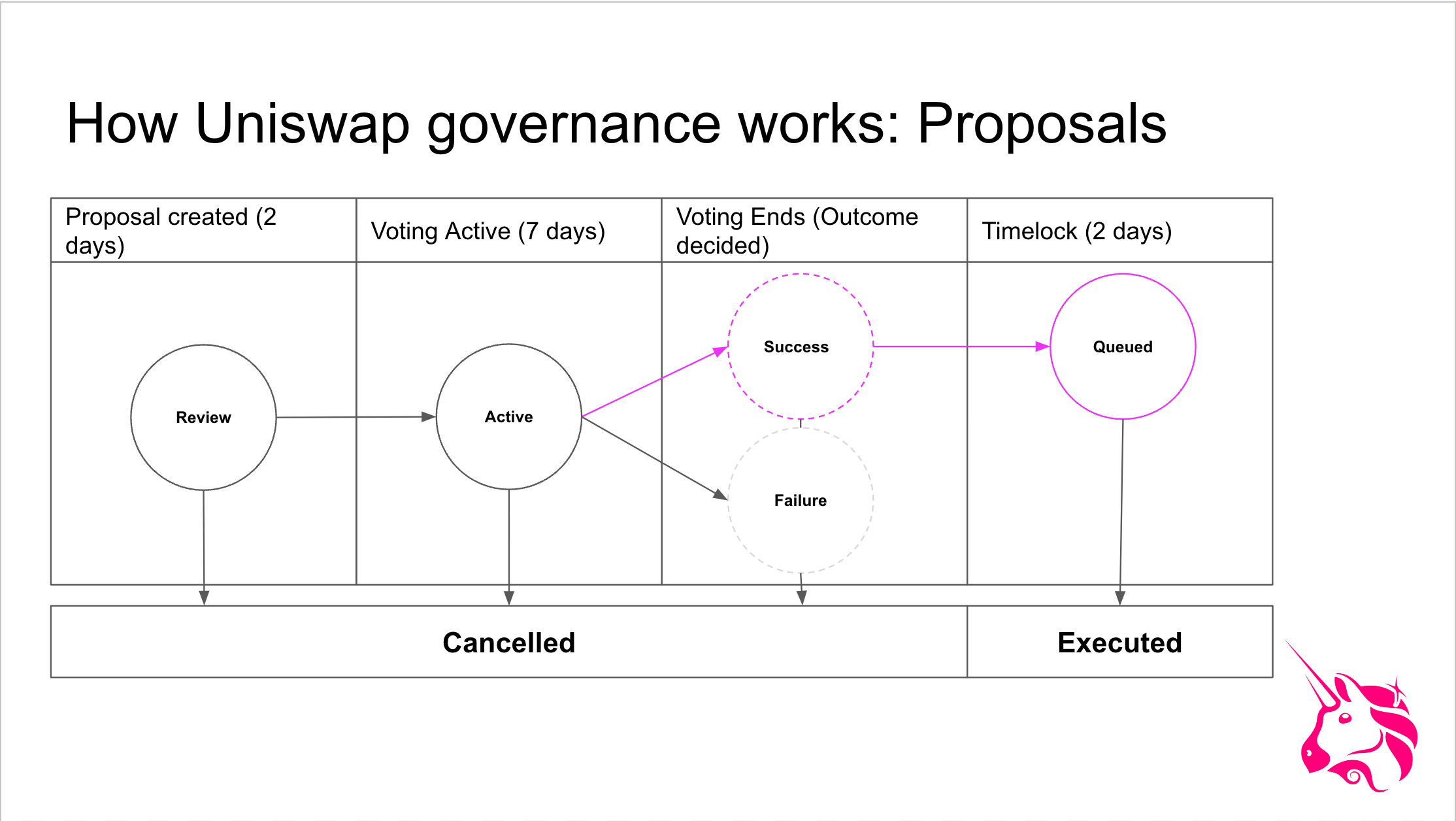
As of August 2026, Uniswap’s official developer documentation divided ordinary governance into three stages. The first is an RFC, which remains on the forum for at least seven days while its author revises the plan in response to feedback.
The second stage is a five-day Snapshot temperature check. It requires at least 10 million UNI in affirmative votes before advancing. Snapshot expresses community support but does not automatically execute an on-chain operation.
The third stage is an on-chain vote. A proposer needs at least 1 million delegated UNI. The proposal passes through a two-day Voting Delay and seven days of voting, with 40 million affirmative UNI required. If approved, it enters a two-day Timelock before its prewritten calls can be executed.
These thresholds deter spam and malicious proposals, but they also make it difficult for small holders to advance an issue independently. Delegates and delegation therefore become core infrastructure. Complex proposals also require Calldata simulation so that forum language matches the state changes that would occur.
What Did DUNI and UNIfication Change?
In 2025, Uniswap Governance adopted a Wyoming DUNA structure in the United States and named it DUNI. Official explanations stressed that DUNI did not change the existing on-chain governance process. Instead, it enabled governance to sign contracts, hire service providers, and address potential tax and compliance matters while offering participants a degree of legal protection.
DUNI demonstrates that an on-chain DAO and a legal entity can complement one another. Smart contracts handle voting and execution, while the legal wrapper handles real-world obligations. However, the legal entity’s administrators, agency agreements, and applicable jurisdictional rules must remain public. Registration does not automatically immunize every participant worldwide.
UNIfication, approved in December 2025, also materially changed protocol fees and the UNI mechanism. Current official documentation states that collected protocol fees are used to burn UNI through an on-chain mechanism, while governance can continue adjusting fee parameters and coverage.
This point is easily misunderstood: UNI holders do not have an individual or proportional claim on protocol revenue. The value of fees is expressed through the burn mechanism and future governance authority, not a dividend available merely for holding tokens. Any fee configuration may also affect liquidity providers, traders, and the protocol’s competitiveness.
What Are Uniswap DAO’s Strengths and Limitations?
One strength is relatively clear authority and execution. GovernorBravo, the Timelock, UNI delegation, and on-chain proposals are verifiable, and complex changes can be simulated before execution. The community has also adapted participation by modifying proposal thresholds, delegate programs, and procedures.
A second strength is increasingly explicit organizational boundaries. Although the relationships among DUNI, the Foundation, Labs, and the DAO are complex, they define responsibility more clearly than placing all activity behind an anonymous multisig. Each actor can handle the on-chain or off-chain work it is suited to perform.
The limitations include high thresholds and delegate concentration. A 40 million UNI affirmative threshold improves security but also makes large delegates decisive to a proposal’s success. Treasury delegation can mitigate low participation, yet it may grant substantial governance power to institutions without an equivalent economic exposure.
Another limitation is the separation between protocol and product. The DAO’s control over some protocol authority does not let it command every front end or development team. This separation reduces single-point control for users, but it can also create inconsistent perceptions of the brand, roadmap, and accountability.
Why Is Arbitrum DAO More Like a Network Government?
Arbitrum DAO launched with ARB in 2023. Its scope includes certain upgrade rights for Governed Chains such as Arbitrum One and Nova, the DAO treasury, relations with the Foundation, and Security Council elections. It does not govern a single DeFi application; it governs Layer 2 infrastructure that hosts many applications.
Network upgrades have broader external effects. An incorrect change can affect contract compatibility, cross-chain messages, validation mechanisms, and user assets, so formal proposals need longer review and execution paths. At the same time, the DAO decides ecosystem grants, incentives, committee structures, and operational budgets, continuously mixing technical governance with resource allocation.
Arbitrum Foundation, Offchain Labs, and Arbitrum DAO are not the same actor. The Foundation supports the ecosystem and governance operations, Offchain Labs is a major developer, and the DAO exercises defined authority under its constitution and on-chain contracts. Proposal analysis must identify who develops, approves, executes, and assumes off-chain responsibility.
How Does Arbitrum’s AIP Process Work?
Arbitrum distinguishes Constitutional AIPs from Non-Constitutional AIPs. The former may alter the protocol, constitution, or key governance structures, while the latter more often concerns funding, operations, and non-core rules. Different categories use the Core Governor, Treasury Governor, and distinct execution paths.
Proposals usually begin with forum discussion and off-chain signaling before moving to an on-chain vote. Network-level changes must pass through a Voting Delay, voting, an L2 Timelock, L2-to-L1 message confirmation, and an L1 waiting period. This longer route gives users time to inspect and exit, but is unsuitable for fixing a publicly known vulnerability immediately.
The current DAO Procedures approved in 2026 established a more predictable cadence, including at least one week of forum discussion in principle, fixed voting start days, conflict-of-interest disclosure, and election standards. OpCo maintains the procedures through a public mechanism, while material objections can still be put to a community vote.
This framework shows that governance efficiency does not come only from smart contracts. It also depends on calendars, templates, meetings, reminders, and conduct rules. A fixed cadence can reduce delegate fatigue, while urgent security incidents still require a separate process.
What Does the Arbitrum Security Council Do?
Arbitrum intentionally makes ordinary DAO upgrades slow, but a critical vulnerability may demand immediate remediation. The Security Council therefore has emergency upgrade authority. Official materials state that the council has 12 members and that a fast upgrade requires nine signatures.
The council is a compromise between efficiency and decentralization. It can protect the network during an attack window, but it also creates a small, highly privileged group. Security depends on member diversity, key management, elections, terms, permission boundaries, and post-event disclosure—not merely the 9-of-12 threshold.
Emergency authority should not replace ordinary governance. Upgrades, funding decisions, and political disputes that can be disclosed in advance should still follow the DAO process. The council should address only security events permitted by the constitution and explain its reasons and actions afterward.
What Did the AIP-1 Controversy Teach Arbitrum?
When the DAO launched in 2023, AIP-1 attempted to approve a governance framework, Foundation documents, and a 750 million ARB administrative budget at once. The community discovered that the relevant tokens had already been allocated to a Foundation-controlled wallet before the vote, while the proposal described the action in the future tense. This created intense concern that the vote merely ratified a fait accompli.
AIP-1 ultimately failed. Subsequent governance divided the issues into more focused AIP-1.1 and AIP-1.2 proposals and added lockups, budgeting, transparency, and clearer terms for the relationship between the Foundation and DAO. After AIP-1.2 passed on-chain, the constitution and Foundation documents also gave a clearer account of DAO authority.
The dispute shows that on-chain transparency is not the same as communication transparency. Public transactions can prove that funds moved, but not that the community understood and authorized the reason. Proposal tense, budget context, legal documents, and execution order all affect governance legitimacy.
It also shows that rejection can be constructive. After the DAO rejected the initial proposal, operations did not stop. The rejection forced the plan to be separated, disclosures to be expanded, and the institution to be revised. Governance should be measured not only by proposal approval rates, but also by whether an organization respects opposition and corrects its procedures.
What Are the Core Differences Among the Three DAOs?
In governance scope, Sky manages a stablecoin, collateral, and capital allocation, requiring frequent risk decisions. Uniswap governs a DEX protocol, fees, and a treasury, with relatively infrequent changes to core contracts. Arbitrum governs a Layer 2 network, treasury, and constitution, where technical upgrades have the broadest systemic externalities.
In execution, Sky connects policy and code through Polls, Executive Spells, and a Pause Delay. Uniswap progresses through RFCs, Snapshot, GovernorBravo, and a Timelock. Arbitrum adds a Security Council fast path alongside multiple waiting periods.
In organizational boundaries, Sky uses Atlas, Stars, Agents, and specialist Facilitators. Uniswap distinguishes DUNI, the Foundation, Labs, and governance contracts. Arbitrum includes the DAO, Foundation, Offchain Labs, OpCo, and Security Council. All three cases show that a DAO does not eliminate organizational layers.
Their primary risks also differ. Sky faces expert dependence, financial parameters, and restructuring complexity. Uniswap faces quorum, delegate concentration, and the protocol/product boundary. Arbitrum faces long execution cycles, Foundation legitimacy, and emergency council authority. For a broader security analysis, read DAO Challenges: Governance Attacks, Voter Apathy, and Efficiency Bottlenecks.
The Hotcoin REALMS Six-Dimension Case Analysis Method
REALMS can be used to compare different DAOs. It is not a project rating; it is a checklist for reading governance materials.
16.1 R: Rights—Who Has Voting Power?
Check the governance token, delegation, proposal threshold, quorum, and large holders to determine whether holding tokens automatically produces effective voting power.
16.2 E: Execution—Who Implements the Result?
Distinguish automatic contract execution, Timelocks, Spells, multisigs, foundations, and security councils. Confirm whether execution remains possible if a front end becomes unavailable.
16.3 A: Accountability—Who Is Responsible?
Review delegate rationales, working-group reports, budget audits, service contracts, and removal mechanisms. Anonymity and distribution cannot excuse a lack of accountability.
16.4 L: Legitimacy—Was the Process Truly Authorized?
Determine whether a decision was approved before execution or ratified afterward, and whether members had enough time to discuss and oppose major changes.
16.5 M: Mission—Does the Governance Scope Match the Mission?
Stablecoins, DEXs, and Layer 2 networks need different decision frequencies and expert structures. Do not mechanically copy another DAO’s thresholds and procedures.
16.6 S: Safeguards—How Is the System Protected in an Exception?
Check snapshots, Voting Delays, Timelocks, pauses, cancellations, emergency upgrades, and exit paths, and confirm that highly privileged roles are constrained by terms and disclosure duties.
How Can Ordinary Users Participate in These Three DAOs?
Before participating in Sky, confirm that you are using the current Sky Governance interface, understand the relationship among SKY, MKR, USDS, and DAI, and distinguish a Poll from an executable proposal. Do not sign an asset operation through an old tutorial or counterfeit migration page.
Before participating in Uniswap Governance, self-delegate or delegate to a representative in advance. Review the forum, Snapshot, and on-chain Calldata together, and remember that UNI is not equity in Uniswap Labs and does not automatically grant a protocol-fee dividend.
Before participating in Arbitrum DAO, distinguish Constitutional from Non-Constitutional AIPs, identify the Governor receiving the proposal, estimate the execution timeline, and check whether the Security Council is involved. Large grants also require review of milestones, recipient addresses, and follow-up reports.
For all three, use a dedicated governance wallet, connect through an official entry point, and verify the domain, network, contract, and signature type. Delegation normally does not transfer tokens, but a phishing site can disguise an approval or transfer as ordinary delegation.
To understand the differences among Snapshot, Governor, Timelock, and governance front ends, continue with DAO Governance Tools: Snapshot, Tally, and Governor.
Frequently Asked Questions
18.1 Does MakerDAO Still Exist?
MakerDAO remains an important historical name, but the current ecosystem and governance have moved to Sky. DAI, MKR, and legacy materials may still exist; participation in current governance should rely on official Sky entry points, SKY rules, and the latest migration guidance.
18.2 Can MKR Still Participate Directly in Sky Governance?
Do not assume that an old MKR governance tutorial remains valid. Official materials define SKY as Sky Protocol’s sole governance token. Verify migration terms, legacy interfaces, and regional restrictions against the latest official documentation.
18.3 Are Uniswap DAO and Uniswap Labs the Same Company?
No. The DAO uses UNI governance contracts to manage specified protocol permissions and treasury assets. Uniswap Labs is an independent development company, while Uniswap Foundation and DUNI perform other functions.
18.4 Can UNI Holders Receive Protocol Fees Directly?
The current mechanism is not a distribution proportional to holdings. Official documentation states that protocol fees are used to burn UNI through an on-chain mechanism; holders have no individual or proportional claim on protocol revenue.
18.5 Is Arbitrum Foundation the Same as Arbitrum DAO?
No. The Foundation is a legal entity that supports the ecosystem and performs off-chain tasks. The DAO is defined by ARB governance, its constitution, contracts, and proposal process. They are related but have different authority and responsibilities.
18.6 Can the Security Council Change Arbitrum at Will?
It has highly privileged emergency upgrade authority, but that authority should be constrained by the constitution, a 9-of-12 signature requirement, elections, and disclosure rules. Ordinary budgets and non-emergency upgrades should still go through the DAO process.
18.7 Which DAO Is the Most Decentralized?
There is no single answer. Sky’s specialized financial governance, Uniswap’s on-chain execution, and Arbitrum’s network constitution each have strengths and points of concentration. Compare voting power, executors, legal boundaries, and emergency authority separately.
Conclusion: A Mature DAO Is an Institution That Keeps Correcting Itself
MakerDAO/Sky, Uniswap DAO, and Arbitrum DAO do not share perfect decentralization. They share a decision to place part of the authority over high-value systems into public, modifiable governance procedures. All three rely on delegates, experts, foundations, or committees, and all three have adjusted their institutions after incidents, disputes, or weak participation.
Sky shows that a financial protocol needs continuous risk governance and specialist agents. Uniswap shows that a protocol, development company, and legal entity can exist in separate layers. Arbitrum shows that network upgrades require both lengthy review and a constrained emergency path. Mature DAOs do not hide these centers of power; they give them authorization boundaries, reporting duties, and replacement mechanisms.
For participants, the most important sequence is to identify what a DAO truly controls, then who can vote, who can execute, and who can bypass the ordinary process in an emergency—and only afterward discuss token value. A high approval rate, large treasury, or active forum cannot independently prove governance quality.
Return to the Complete Guide to Decentralized Autonomous Organizations to place these cases within the broader relationships among members, proposals, tools, execution, treasuries, and legal structures. The purpose of case analysis is not to find one universal template, but to recognize the cost of each autonomous structure.
To manage multichain assets and connect to governance applications, use Hotcoin Web3 Wallet. For mobile market and trading tools, visit Hotcoin App. Browse more educational content at Hotcoin.
Risk warning: This article is for education and information only and does not constitute investment, legal, or tax advice. DAO tokens, brands, voting rules, contract permissions, governance tools, legal structures, and project status may change. Before participating, verify the latest official documentation, contract addresses, proposal payloads, wallet signatures, and rules in your jurisdiction.
Đề xuất đọc
Xem thêm

Service@hotcoin.com
Product@hotcoin.com
Business@hotcoin.com
Casecn@hotcoin.com