
What Is Dollar-Cost Averaging (DCA), and Who Is It For?
Dollar-cost averaging (DCA) is a strategy of investing the same amount in the same asset at fixed intervals without changing the plan in response to short-term price movements. The same amount buys more units when the price is lower and fewer units when the price is higher, spreading purchases across multiple points in time. However, DCA cannot guarantee a profit or eliminate the risk of the asset declining.
How Does DCA Work?
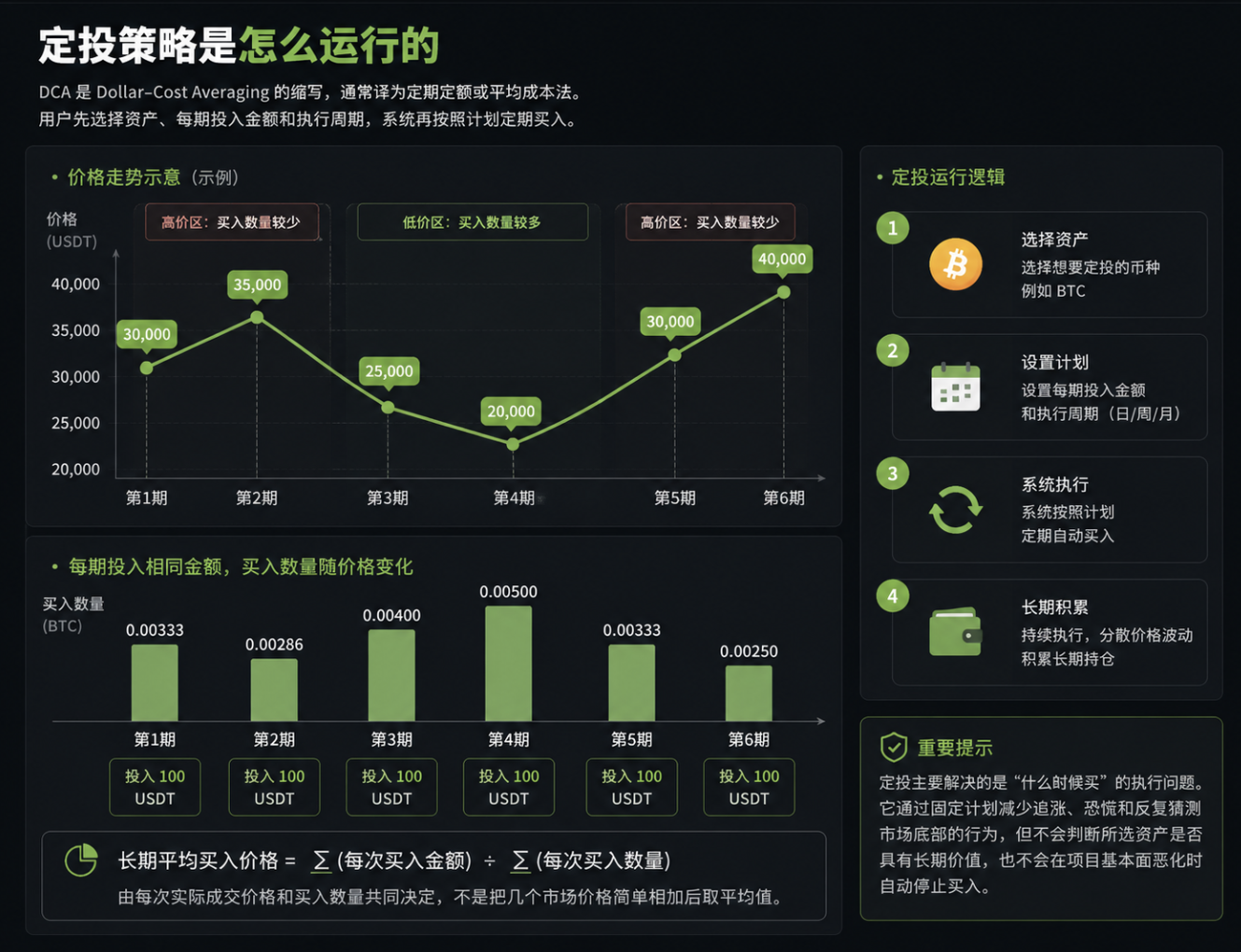
DCA stands for dollar-cost averaging, also known as a fixed-amount recurring investment or average-cost method. A user selects an asset, an amount for each purchase, and an execution frequency, after which the system buys according to the schedule. Hotcoin's spot recurring-buy feature currently lets users choose a cryptocurrency, an amount, and a daily, weekly, or monthly frequency for automatic execution.
When the amount invested each time stays the same, the number of units purchased increases as the asset price falls and decreases as the price rises. The long-term average purchase price depends on both the actual execution price and the quantity bought in every transaction. It is not a simple average of several market prices.
DCA mainly addresses the execution question of when to buy. A fixed plan can reduce chasing rallies, panic buying or selling, and repeated attempts to guess the market bottom. It does not determine whether the selected asset has long-term value, nor will it automatically stop purchases if the project's fundamentals deteriorate.
Who May Be Better Suited to DCA?
DCA may be more suitable for users with stable cash flow, the ability to follow a long-term plan, and no desire to time every short-term entry. Suitability depends less on investment experience than on whether the funding is sustainable, whether the user can tolerate volatility, and whether they understand and genuinely intend to hold the chosen asset over the long term.
-
Users with relatively stable income and cash flow: DCA requires ongoing contributions. Each amount should come from investable funds left after essential living expenses, short-term obligations, and cash reserves, not from borrowing or temporary financing.
-
Users who cannot or do not want to time the market frequently: A fixed plan can reduce impulsive changes driven by short-term news, FOMO, or panic, although the asset and its risks still require regular review.
-
Users planning to accumulate over the long term: DCA usually needs to run through multiple market phases to spread entry points effectively. It is unsuitable for money that will be needed within a few weeks.
-
Users who can accept unrealized losses: The price may remain below the average cost for an extended period. Continuing the plan requires the ability to tolerate volatility and possible loss of principal.
-
Users with a clear view of the asset: A user should understand the project's purpose, liquidity, historical risks, and reasons for holding it instead of assuming that a falling price automatically makes it a better buy. Kraken also stresses researching an asset and its risks before committing to long-term DCA.
Who Should Not Start DCA Without Further Consideration?
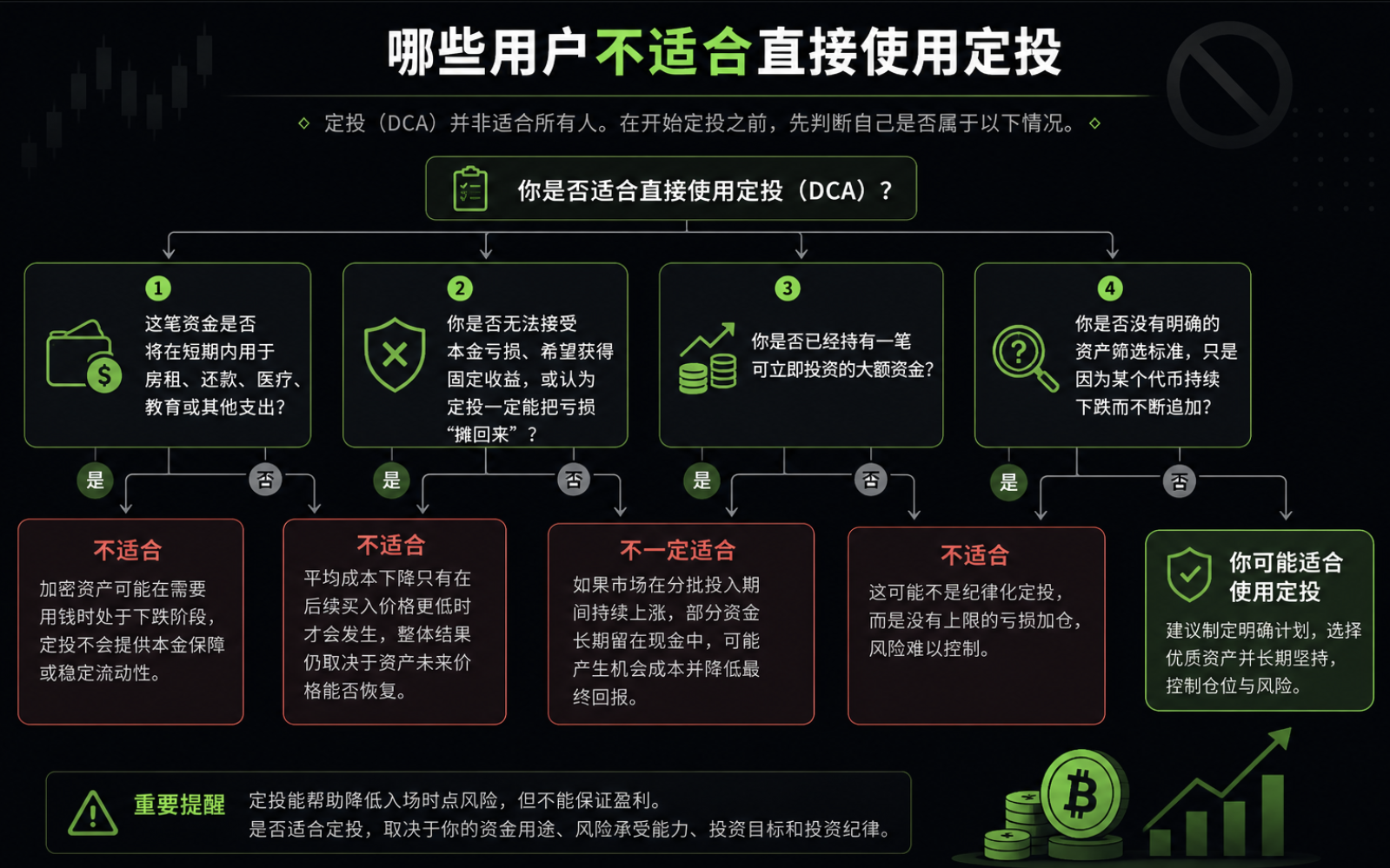
DCA is unsuitable when the money will soon be needed for rent, loan repayments, healthcare, education, or other short-term expenses. A crypto asset may be sharply lower precisely when the funds are needed, and DCA provides neither principal protection nor stable liquidity.
Users who cannot accept losses, expect fixed returns, or believe DCA will always average away a loss are also poorly suited to the strategy. The average cost falls only when later purchases occur below the existing average, while the overall outcome still depends on whether the asset's future price recovers.
DCA is not necessarily better than a lump-sum investment for someone who already has a large amount available to invest immediately. If the market keeps rising during the staggered investment period, leaving part of the money in cash can create an opportunity cost and reduce the final return. DCA is primarily intended to reduce short-term entry-timing risk, not to guarantee a higher return.
If a user has no clear asset-selection criteria and keeps adding to a token simply because its price continues to fall, the approach may be unlimited loss averaging rather than disciplined DCA.
What Are the Benefits and Limitations of DCA?
DCA's main advantages are its simple execution rules, its ability to spread purchases across different points in time, and its potential to reduce repeated decision changes caused by short-term volatility. Investing a fixed amount also naturally results in buying more units at lower prices and fewer at higher prices.
Its limitations are equally clear. DCA cannot assess asset quality, stop a market from continuing to fall, or guarantee that the average cost will remain below the future market price. If an asset loses value over the long term, continued buying only increases the position and the loss.
A high execution frequency may also increase the number of transactions. Fixed per-order charges, minimum fees, spreads, or high immediate-execution costs can gradually erode the result, and every investment cost reduces the funds that remain in the portfolio.
DCA performance should therefore be assessed using more than the average purchase price. Users should also review the total amount invested, position size, current total value, transaction costs, and the asset's share of their overall funds.
What Should You Confirm Before Starting DCA?
Complete these five checks before starting:
-
Write down the reason for holding: Explain why you chose the asset and which changes to the project, liquidity, or risk profile would invalidate the original view.
-
Set a sustainable budget: Use only investable funds left after essential expenses, emergency savings, and short-term obligations.
-
Choose a fixed frequency: Align the schedule with when income or investable funds become available. There is no need to keep changing it in search of the “best date.”
-
Check transaction costs: Confirm the fee, spread, minimum order size, and execution method for every purchase.
-
Define review conditions: Pause and reassess instead of executing mechanically if income falls, the intended use of funds changes, asset risk rises, or the position becomes substantially larger than planned.
This checklist adds a practical element often missing from basic DCA explanations. A recurring investment plan must answer not only when to buy, but also why to continue and under what conditions to stop.
Frequently Asked Questions
Does DCA always lower the average cost?
No. If later purchases occur below the existing average cost, they may lower it. If the market continues rising, additional purchases may instead raise the average cost.
What is the difference between DCA and buying the dip?
Classic DCA follows fixed times and fixed amounts without relying on price judgments. Buying the dip first requires a definition of “low,” and both the timing and amount may change with market conditions.
Should I continue DCA if the price keeps falling?
The decision should not be based on the price decline alone. Reassess the asset, the intended use of the funds, and the original reasons for holding it. If the underlying thesis no longer holds, continuing DCA may only increase the risk.
Is DCA suitable for short-term trading?
Usually not. DCA is primarily used to spread long-term purchase timing, whereas short-term trading focuses more on specific price structures, execution costs, and exit conditions.
Usage Note
DCA reduces the effect of a single entry point on the outcome; it does not reduce the investment risk inherent in the asset itself. Users should regularly review asset quality, their financial position, and portfolio allocation rather than treating automatic execution as automatic profit.
Risk Warning
Crypto assets are highly volatile. DCA may result in prolonged losses, and some or all of the principal may be lost. This article is for educational and informational purposes only and does not constitute investment, financial, legal, or tax advice.
Đề xuất đọc
Xem thêm


Service@hotcoin.com
Product@hotcoin.com
Business@hotcoin.com
Casecn@hotcoin.com