What is x402? The New Standard Powering Internet-Native Payments
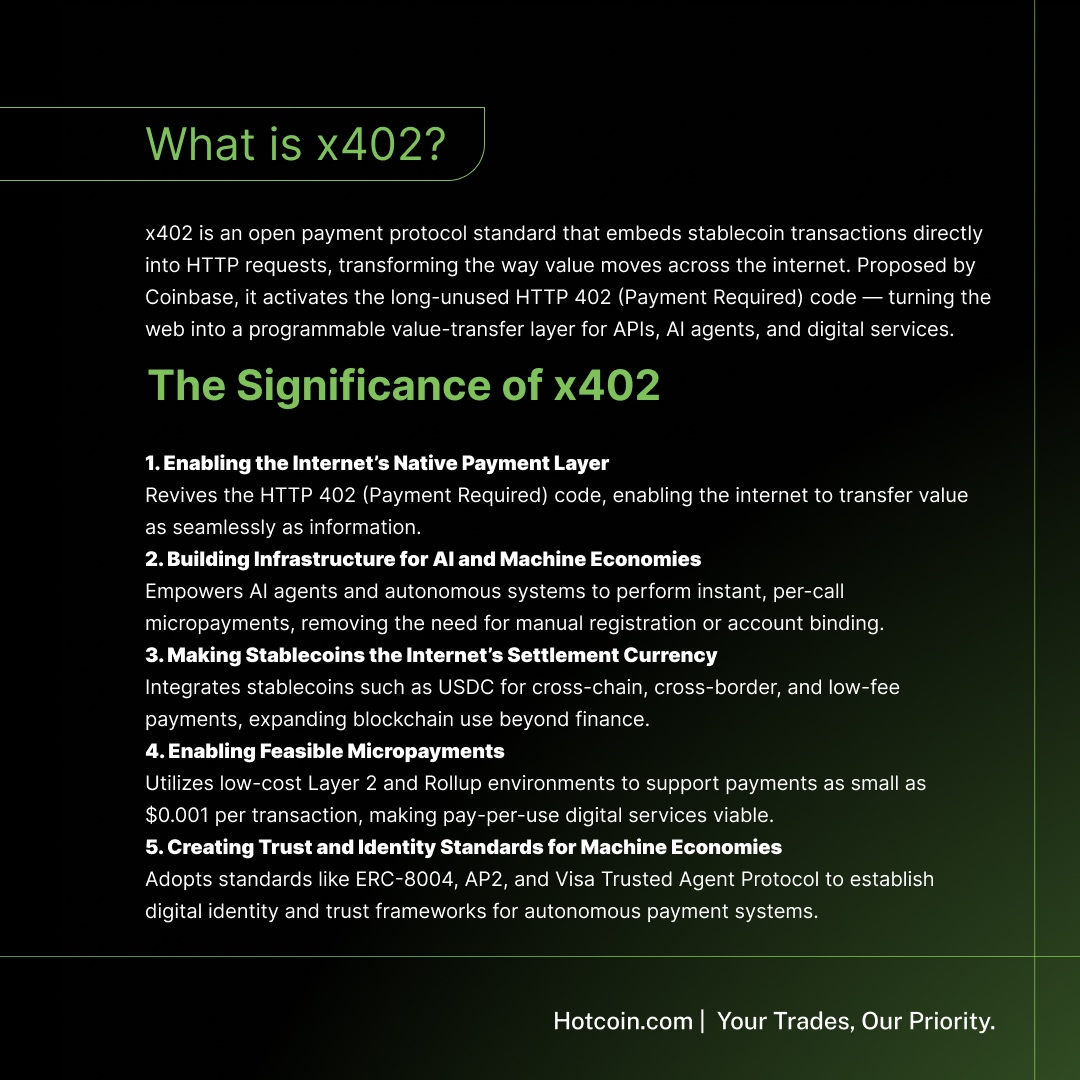
Recently, x402 has gained attention as a new payment protocol standard proposed by Coinbase. Designed as an “internet-native” protocol, it embeds stablecoins (such as USDC) directly into HTTP requests, enabling instant micropayments for APIs, AI agents, web content, and other digital services.
I. Understanding x402
x402 is an open payment standard that activates the long-unused HTTP status code “402 Payment Required”, transforming it into a native value-transfer layer for the internet. While protocols like HTTP and DNS enable instant global data exchange, they lack a built-in payment mechanism — the 402 code was originally reserved for this purpose but never implemented.
The core concept of x402 is straightforward: when a client (a human, browser, app, or AI agent) requests data or a service, the server responds with an HTTP 402 message containing payment details, such as the amount, asset type, and payment destination. The client then completes the payment on-chain or via a settlement layer and, once confirmed, resends the request to access the resource.
The entire process is programmable, automated, and accountless, eliminating the need for traditional intermediaries or manual approval steps.
II. The Significance of x402
1.Enabling the Internet’s Native Payment Layer
x402 revives the long-dormant HTTP 402 (Payment Required) code, allowing the internet to:
-
Go beyond transferring information to enable native value transfer
-
Establish a built-in payment mechanism at the protocol layer
-
Transform the web into a true transactional network
2. Powering AI and Machine Economies
As AI agents, automated APIs, and intelligent robots proliferate, x402 provides the infrastructure for machine-to-machine (M2M) transactions by:
-
Enabling instant, per-call payments between autonomous systems
-
Removing the need for manual registration, account binding, or subscriptions
-
Allowing AI to initiate and settle payments independently
-
Laying the foundation for a self-sustaining machine economy
3. Making Stablecoins the Internet’s Settlement Currency
x402 brings stablecoins like USDC into the core of the internet’s payment stack by:
-
Supporting cross-chain and cross-border transactions
-
Offering low-cost, efficient settlements
-
Enabling mainstream adoption of stablecoins across digital services
-
Expanding blockchain utility beyond finance into daily online interactions
4. Enabling True Micropayments
By leveraging low-cost Layer 2 and Rollup environments, x402 makes small-scale transactions viable by:
-
Supporting payments as low as $0.001 per transaction
-
Making pay-per-article content and API billing practical
-
Unlocking micro-tipping and usage-based payment models
-
Reducing friction for on-demand digital services
5. Establishing Trust and Identity Standards for Machine Economies
x402 integrates with emerging identity and trust protocols such as ERC-8004, AP2, and Visa Trusted Agent Protocol, helping to:
-
Provide verified digital identities for AI agents
-
Enable secure, trust-based interactions between autonomous systems
-
Introduce payment identities for machines
-
Form the infrastructure layer for future AI-driven economies
III. Technical Flow of x402
-
A client (browser, app, or AI agent) sends a request for a resource.
-
If payment is required, the server responds with an HTTP 402 message that includes:
-
Payment amount
-
Network or blockchain
-
Recipient address
-
The client constructs a payment payload and sends the payment information via HTTP headers (e.g., X-PAYMENT) to complete the on-chain payment or facilitator verification.
-
After verifying the payment (either directly or through a facilitator), the server returns an HTTP 200 OK response with an X-PAYMENT-RESPONSE header confirming successful settlement.
-
Once confirmed, the requested resource is delivered to the client.
IV. Trends, Ecosystem, and Challenges
Scalability and Performance
-
Large-scale machine-to-machine (M2M) micropayments could strain blockchain networks.
-
It remains uncertain whether settlement speed and validation capacity can scale to support millions of real-time transactions.
Regulation and Compliance
-
Automated and cross-border payments introduce complex AML, KYC, and monetary policy requirements.
-
Global regulatory frameworks may need to adapt to stablecoin-based internet payments.
Adoption and Ecosystem Maturity
-
The protocol’s success depends on developer and service provider adoption.
-
Infrastructure readiness and tooling maturity remain early-stage challenges.
-
Broader integration across APIs, payment facilitators, and AI frameworks will be key to mainstream use.
Security and Trust
-
Risks include payment verification exploits, smart contract vulnerabilities, and forged agent identities.
-
Building robust authentication and verification standards will be essential to ensure trust in autonomous transactions.
Conclusion
x402 is an innovative payment protocol designed for the future internet and machine economy, seamlessly merging value flow with data flow. It enables programmable, instant, and account-free transactions for a new era where every request may include a payment.
While challenges around scalability, security, and adoption remain, x402 represents a fundamental shift — from today’s human-driven information web to an intelligent, machine-powered economic internet.
Đề xuất đọc
Xem thêm