
What is DAO Governance?
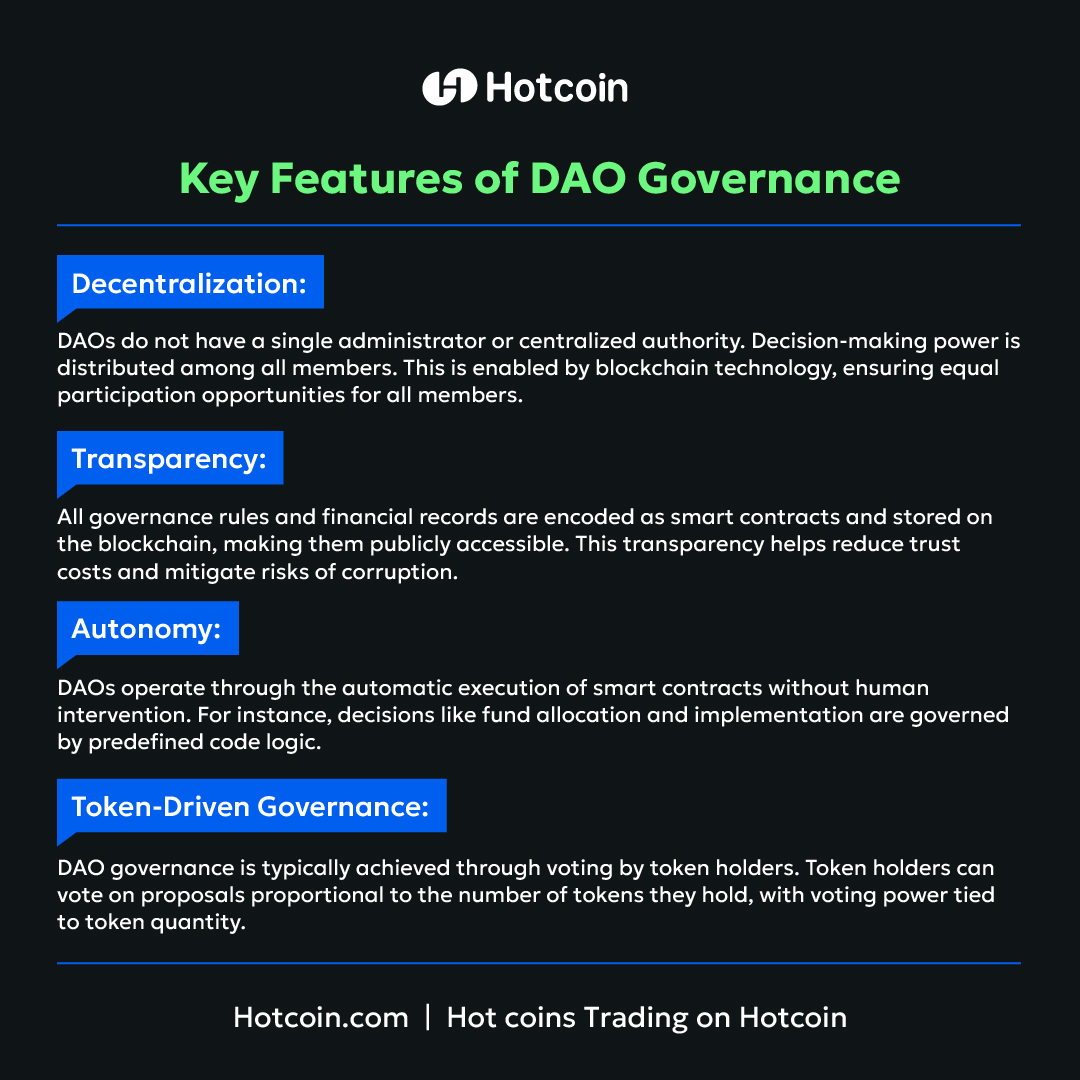
DAO governance (Decentralized Autonomous Organization governance) refers to a distributed organizational model based on blockchain technology. It uses transparent rules and collective decision-making mechanisms implemented through smart contracts to manage organizational affairs and assets. The core features of DAO governance include decentralization, transparency, and autonomy.
Key Features of DAO Governance:
Decentralization:
DAOs do not have a single administrator or centralized authority. Decision-making power is distributed among all members. This is enabled by blockchain technology, ensuring equal participation opportunities for all members.Transparency:
All governance rules and financial records are encoded as smart contracts and stored on the blockchain, making them publicly accessible. This transparency helps reduce trust costs and mitigate risks of corruption.Autonomy:
DAOs operate through the automatic execution of smart contracts without human intervention. For instance, decisions like fund allocation and implementation are governed by predefined code logic.Token-Driven Governance:
DAO governance is typically achieved through voting by token holders. Token holders can vote on proposals proportional to the number of tokens they hold, with voting power tied to token quantity.
The DAO Governance Process:
Proposal Submission:
Members can submit governance proposals, such as fund usage plans or project directions.Discussion:
Proposals typically enter a discussion phase where members share opinions within the community to refine the proposal content.Voting:
All token holders vote on the proposal, and the blockchain records every vote and its result.Execution:
Approved proposals are executed automatically via smart contracts without requiring manual intervention.
Challenges of DAO Governance:
Technical Risks:
Vulnerabilities in smart contracts may be exploited, leading to asset losses.Governance Participation:
Low voter turnout can affect the organization's vitality and decision-making quality.Legal Compliance:
The legal status of DAOs remains unclear in certain jurisdictions.Whale Effect:
"Whales" (holders of large amounts of tokens) may exert excessive influence over decisions, undermining the principle of decentralization.
DAO governance is one of the key innovations in the Web3.0 space, with broad applications in decentralized finance (DeFi), NFT projects, public resource management, and more. It is redefining traditional organizational governance models.
Đề xuất đọc
Xem thêm

Service@hotcoin.com
Product@hotcoin.com
Business@hotcoin.com
Casecn@hotcoin.com