
What Is a Privacy Network?
In the public imagination, blockchain is often synonymous with transparency. On networks such as Ethereum or Bitcoin, anyone can view the timestamp, amount, and address of every transaction—seemingly leaving no room for privacy. However, this very transparency also introduces challenges: users’ financial histories are fully exposed, businesses face difficulties handling sensitive on-chain transactions, and individuals can be tracked simply by revealing their wallet addresses. To address these issues, privacy networks have emerged.
Definition of Privacy Networks
A privacy network is a blockchain specifically designed to protect transaction privacy and data confidentiality. These networks embed cryptographic algorithms into their consensus mechanisms, account models, and transaction structures, making it extremely difficult for outsiders to interpret or link on-chain information. This allows users to interact with the blockchain anonymously, while preserving the underlying security and integrity of the system.
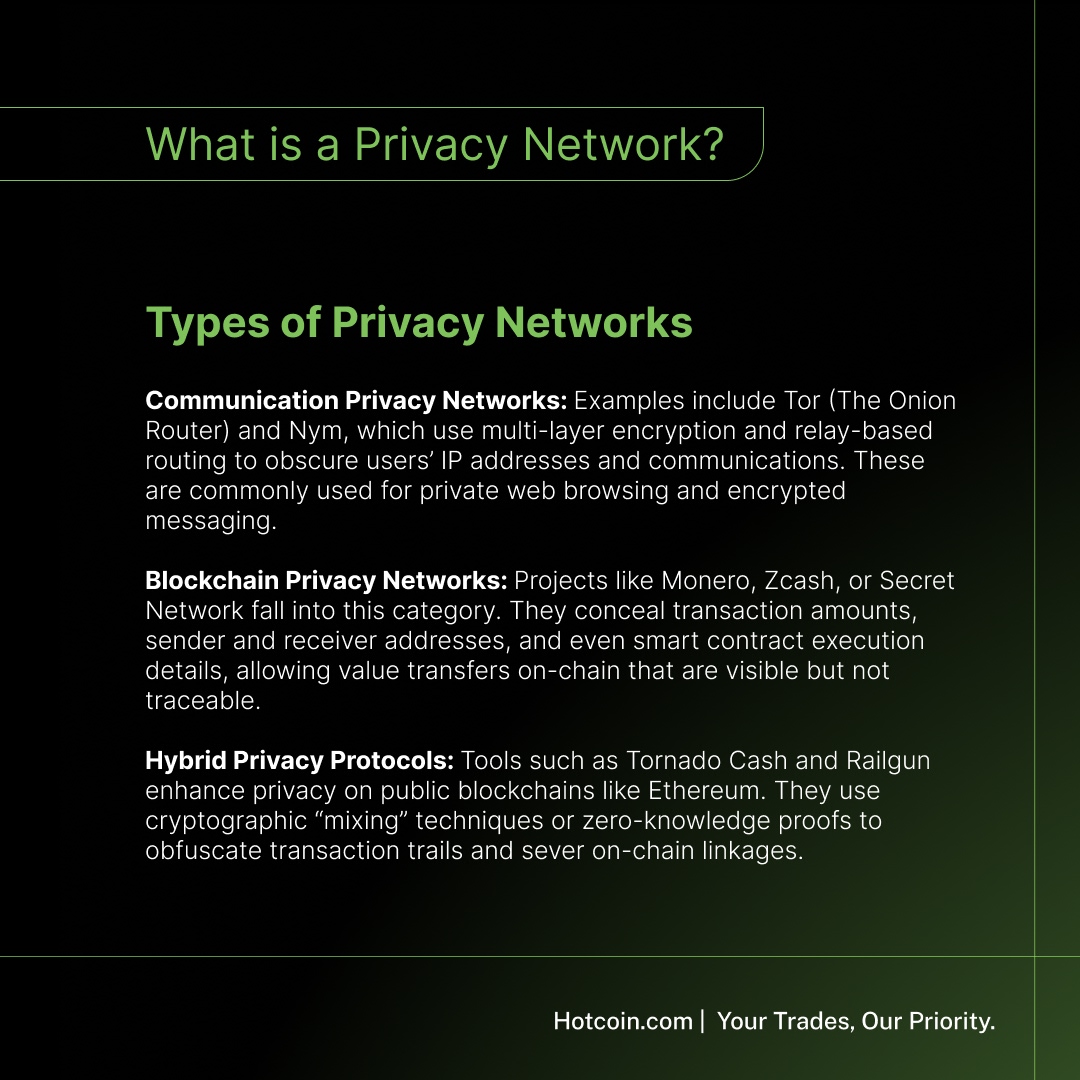
Types of Privacy Networks
-
Communication Privacy Networks:Examples include Tor (The Onion Router) and Nym, which use multi-layer encryption and relay-based routing to obscure users’ IP addresses and communication metadata. These tools are commonly used for private web browsing and encrypted messaging.
-
Blockchain Privacy Networks:Projects such as Monero, Zcash, and Secret Network belong to this category. They conceal transaction amounts, sender and receiver addresses, and even smart contract execution details, enabling on-chain value transfers that are visible but not traceable.
-
Hybrid Privacy Protocol:Solutions like Tornado Cash and Railgun enhance privacy on public blockchains such as Ethereum. They employ cryptographic mixing or zero-knowledge proofs (ZKPs) to obfuscate transaction trails and break on-chain linkages between senders and recipients.
Applications and Controversies
Privacy networks have a wide range of legitimate applications. They empower individuals to protect financial autonomy, enable confidential business accounting, support private DeFi transactions, and in some regions, act as tools for censorship resistance and freedom of expression.
However, they also attract regulatory scrutiny. Authorities in several jurisdictions argue that privacy networks could facilitate illicit activities, including money laundering or tax evasion. As a result, some exchanges have delisted privacy tokens or restricted related functions. Yet, it is crucial to recognize that technology itself is neutral—the real challenge lies in finding a balance between privacy rights and regulatory oversight.
Conclusion
Privacy networks serve as the “invisibility cloak” of the blockchain world—not to conceal wrongdoing, but to safeguard personal anonymity and freedom in the digital era. As the technology matures, the concept of controllable privacy may emerge—protecting individual data while enabling necessary audits and lawful transparency. Achieving this balance could pave the way toward a healthy coexistence between freedom and order in decentralized financial systems.
Đề xuất đọc
Xem thêm



Service@hotcoin.com
Product@hotcoin.com
Business@hotcoin.com
Casecn@hotcoin.com