
Hotcoin Research | When the Flywheel Reverses: The Truth Behind DAT and Its Structural Risks
Introduction
In the past few years, DAT companies represented by Strategy have pioneered the now-familiar "coin-stock flywheel" model: financing through capital market instruments such as equity issuance, convertible bonds, and preferred stock, and using the funds to purchase crypto assets such as BTC and ETH. With the continued increase in holdings, the market further strengthens its asset exposure and narrative premium, thereby pushing up stock prices and enhancing financing capabilities, forming a positive and reflexive cycle that makes it one of the market's key marginal buyers.
However, this model is undergoing stress testing in the current market environment. On June 25th, the trading price of Strategy's preferred stock, STRC, has fallen below $80, a drop of more than 20% from the target face value of $100. At the same time, its BTC holdings have experienced significant unrealized losses. Under the dual effects of the price decline and the contraction of the capital markets' premium, the financing capacity of the DAT model is being challenged. Not only is Strategy facing pressure on the balance sheet, but other DAT companies with BTC/ETH as their core assets are also undergoing systematic stress testing due to the "flywheel reversal".
I. The Essence of DAT: From Asset Holding to Financing-Driven Valuation System
The core of DAT lies not in the simple holding of crypto assets, but in how it is structurally priced by capital markets and transformed into an asset expansion mechanism driven by continuous financing capabilities.
1.1 The Essence of DAT: The "Listed Wrapper" for Crypto Assets
DAT (Digital Asset Treasury) refers to an asset management structure that uses listed companies or pre-IPO entities as vehicles, continuously raising capital through market instruments such as equity and debt, and centrally allocating proceeds raised to crypto assets such as BTC/ETH.
Under this structure, the company's valuation anchor is no longer traditional business cash flow, but "holding size + financing capacity + market narrative". In other words, DAT actually provides a "way to trade crypto asset beta in the stock market".
Strategy is the starting point of this model. After transforming from a software company to a BTC treasury company, the market gradually abandoned the pricing logic of its traditional business and instead regarded it as a "publicly listed proxy for BTC".
1.2 Why the Market Is Willing to Pay a Premium for DAT
The emergence of DAT was driven by the structural needs of three types of capital.
-
The first type is traditional funds that cannot be held directly, such as pension funds, mutual funds, or brokerage accounts. These funds obtain BTC/ETH exposure through the stock market, which has a lower threshold and is more compliant than on-chain or exchange paths.
-
The second type is leverage-seeking investors. DAT stocks essentially provide a combination exposure of "crypto assets + financing leverage". When the company continues to acquire crypto assets with external capital, per-share exposure to crypto assets is amplified.
-
The third category is the demand for index and institutional allocation. Stocks can enter the index, options, and margin system to obtain passive fund allocation, while holding crypto directly cannot enter this system.
Therefore, the market is willing to pay a premium for DAT, essentially paying for the "financing of crypto asset packaging structure", rather than simply paying for its current holdings of BTC or ETH.
1.3 mNAV: Core Variable for DAT Pricing
The core pricing mechanism of DAT can be abstracted as the mNAV (market net asset value) system, which refers to the multiple of a company's market value relative to its net asset value in held cryptocurrency. The mNAV essentially determines the financing capability boundary of DAT, that is, how much premium the market is willing to pay for its "every $1 cryptocurrency exposure".
When mNAV > 1, it indicates that the market is willing to pay a premium for "future financing capacity + continuous buying ability".
When mNAV ≈ 1, the market only regards it as a passive crypto asset holding tool.
When mNAV < 1, it means the market begins to question the company's capital structure and ability to continue financing.
The key to the DAT model lies here. It is not simply "companies purchasing crypto assets", but "companies purchasing crypto assets at a premium in the stock market". As long as the market gives the DAT company a premium, it can buy more crypto assets with relatively cheap capital and increase the number of coins held per share. As long as this process continues, the market will believe that stocks are more elastic than holding crypto directly.
However, this model rests on an implicit premise: the market must continue to believe the company can finance itself in the future. Once the mNAV contraction occurs, the financing capacity will decrease; if the financing capacity decreases, the pace of new coin purchases will slow; if the pace of new coin purchases slows, the market will lower its expectations for the company's future coin-holding growth. This is the starting point for the DAT model to shift from positive flywheel to reverse pressure.
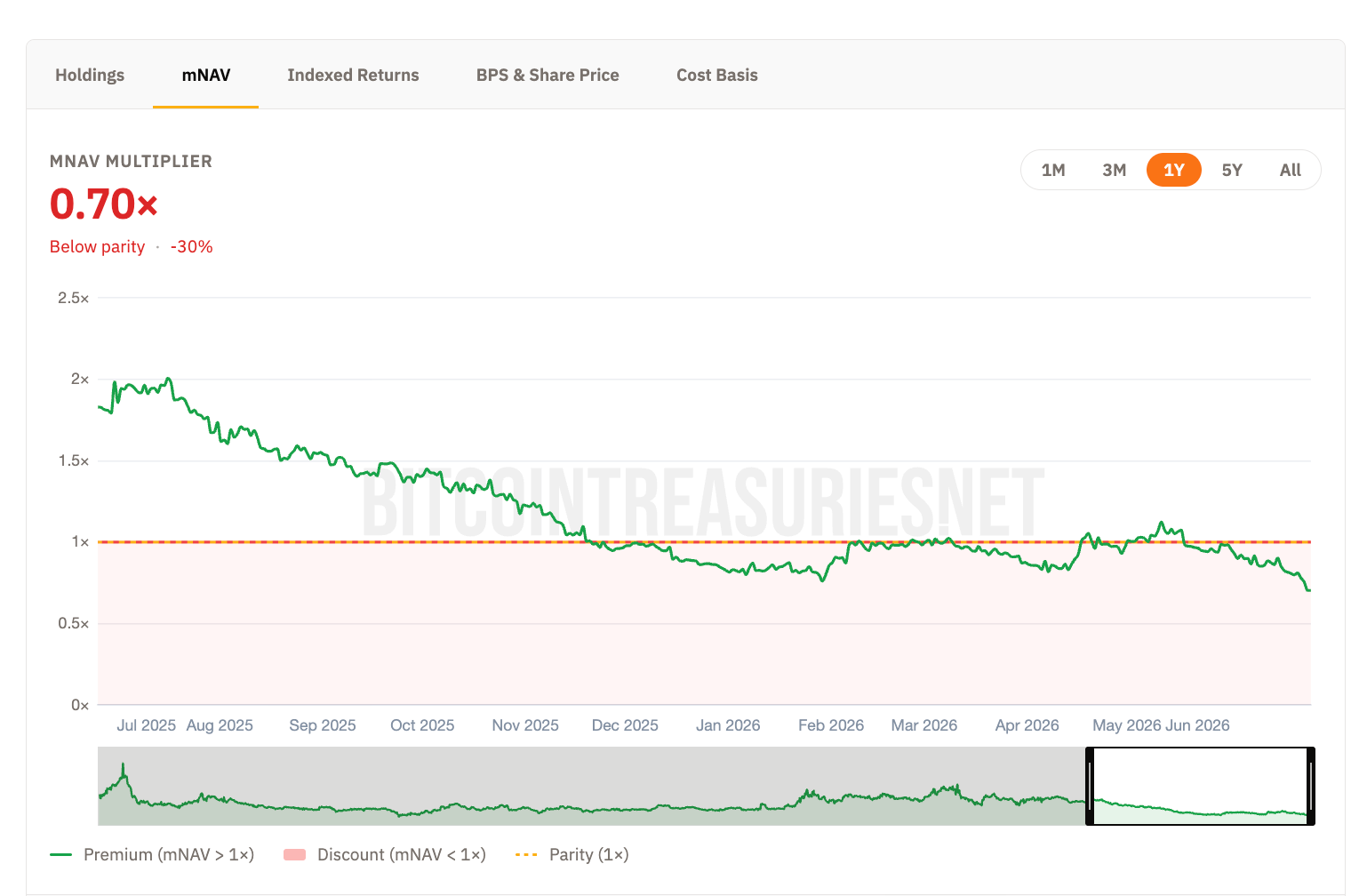
As shown in the figure below, Strategy's mNAV multiplier has continued to decline from about 2x to 0.7x in the past year, falling below the theoretical parity level of 1x. This change indicates that the market is systematically reassessing the pricing logic of its "cryptocurrency asset position premium", shifting from financing-premium-driven to discount-driven trading.
Source: https://bitcointreasuries.net/public-companies/strategy
II. The Coin-Stock Flywheel — DAT's Structural Positive Feedback Model
The flywheel of DAT is not a single-price logic but a positive feedback system driven by asset revaluation, financing capacity, and market expectations.
2.1 The Core of the DAT Flywheel: A Closed-Loop System from Assets to Financing
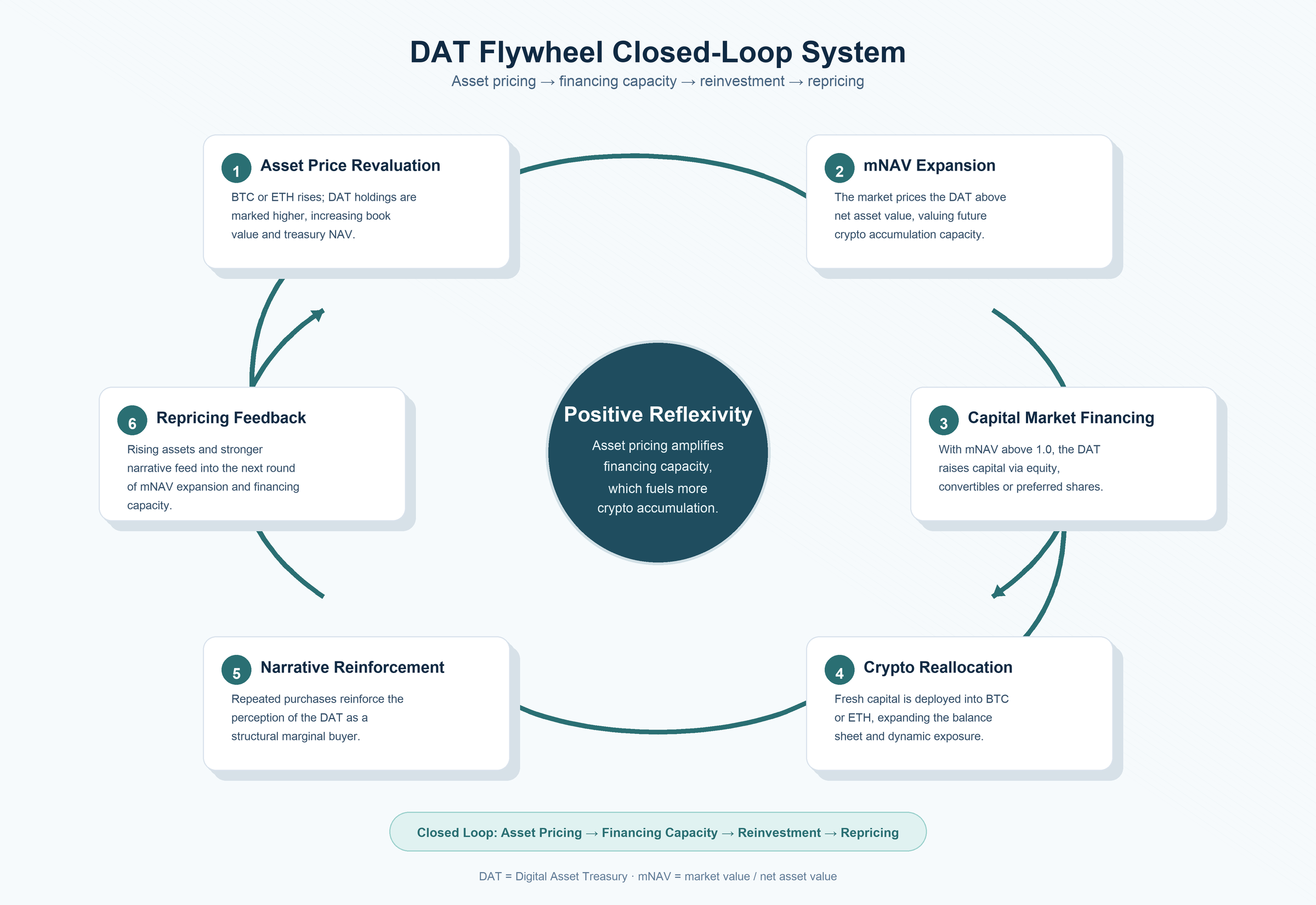
The flywheel of DAT is not a single-price logic but a six-stage flywheel jointly driven by capital markets and crypto assets. Its core lies in the continuous strengthening of "asset pricing → financing capacity → repurchase → repricing".
-
The first step is asset price revaluation. When BTC or ETH rises, the value of DAT holdings increases in tandem, directly pushing up the company's net asset level. This stage is essentially a passive reevaluation, but it determines the availability of subsequent financing.
-
The second ring is the expansion of mNAV. As the market begins to assign DAT companies a valuation multiple above their net assets, the stock price trades at a premium relative to the underlying assets. This premium essentially reflects the market's pricing of its "sustained purchasing capacity", not just its existing holdings.
-
The third stage is the release of capital markets' financing capabilities. Under the condition that mNAV > 1, DAT can conduct low-friction financing through equity issuance, convertible bonds, or preferred stock, converting market premiums into real capital inflows. This stage marks the beginning of the flywheel's self-driving force.
-
The fourth ring is the reallocation of crypto assets. DAT will continue to invest the financing proceeds in BTC or ETH, thereby expanding the scale of its balance sheet, so that its holdings are no longer static exposures but dynamic exposures that continue to expand.
-
The fifth ring is the strengthening of the market narrative. Continuous buying behavior will strengthen the market's perception of its "structural buyer", further positioning DAT as a structural marginal buyer, which in turn supports its valuation premium.
-
The sixth ring is the repricing feedback. The rise in assets and the strengthening of the narrative jointly promote the next round of mNAV expansion, forming a positive closed loop. At this point, DAT completes the transformation from "asset holder" to "capital markets crypto asset amplifier".
2.2 Interpreting the STRC Flywheel: Strategy's Multi-Layered Capital Structure
The uniqueness of Strategy lies in its ability to turn this flywheel into a multi-layered capital structure. MSTR common stock targets investors with a higher risk appetite and a willingness to bear stock price fluctuations; Convertible bonds target investors who are willing to accept bond protection and potential equity stake increases; preferred stock, such as STRC, STRD, STRF, STRK, targets investors seeking high-yield cash flow.
Among them, STRC is a perpetual preferred stock, which aims to trade around $100 face value and attract investors through an adjustable dividend yield. Theoretically, when the market price of STRC is below its target face value, Strategy can increase the dividend yield and enhance its attractiveness. When the price returns to or exceeds the face value, the company can continue issuing STRC via the ATM mechanism, and the proceeds can be used to buy BTC. This makes STRC one of the financing engines in the Strategy flywheel. Compared with common stock, preferred stock usually does not directly dilute the voting rights of common stock, nor does it need to repay the principal like bonds. For Strategy, if STRC can stabilize around $100, it can continuously raise funds by issuing preferred stock to purchase BTC.
However, the cost of STRC has not disappeared, but continues to exist in the form of dividends. Currently, Strategy has about $15 billion in preferred stock, of which STRC accounts for about $9 billion; the annual dividend payment obligation of preferred stock is about $1.70 billion. In other words, the asset side of Strategy is mainly non-interest-bearing BTC, while the liability/class liability side has ongoing cash payment obligations.
This is exactly the source of the fragility of the flywheel. The further away STRC is from the target face value of $100, the higher the risk compensation required by the market. The higher the dividend yield is, the higher the financing cost Strategy must use to maintain its capital entry. If STRC is consistently below face value, Strategy's ability to accumulate BTC through STRC issuance will decline, as discounted issuance will undermine financing efficiency and further intensify market concerns about its capital structure. This also shows that the core fuel of the DAT flywheel is not BTC itself, but the willingness of capital markets to believe that BTC will rise in the future and to finance this belief with current funds.
III. Flywheel Reversal Case: From Financing Tools to Risk Triggers
When financing capacity and asset prices are under pressure, the positive feedback structure of DAT will begin to fail and gradually turn to the reflexive contraction path.
3.1 STRC: Fracture of the Financing Flywheel and Credit Repricing
STRC, as the core preferred stock financing tool in Strategy's multi-level capital structure, supports continuous issuance and low-cost financing capabilities. During the smooth flywheel phase, this mechanism makes STRC a key channel connecting capital markets with BTC buying demand.
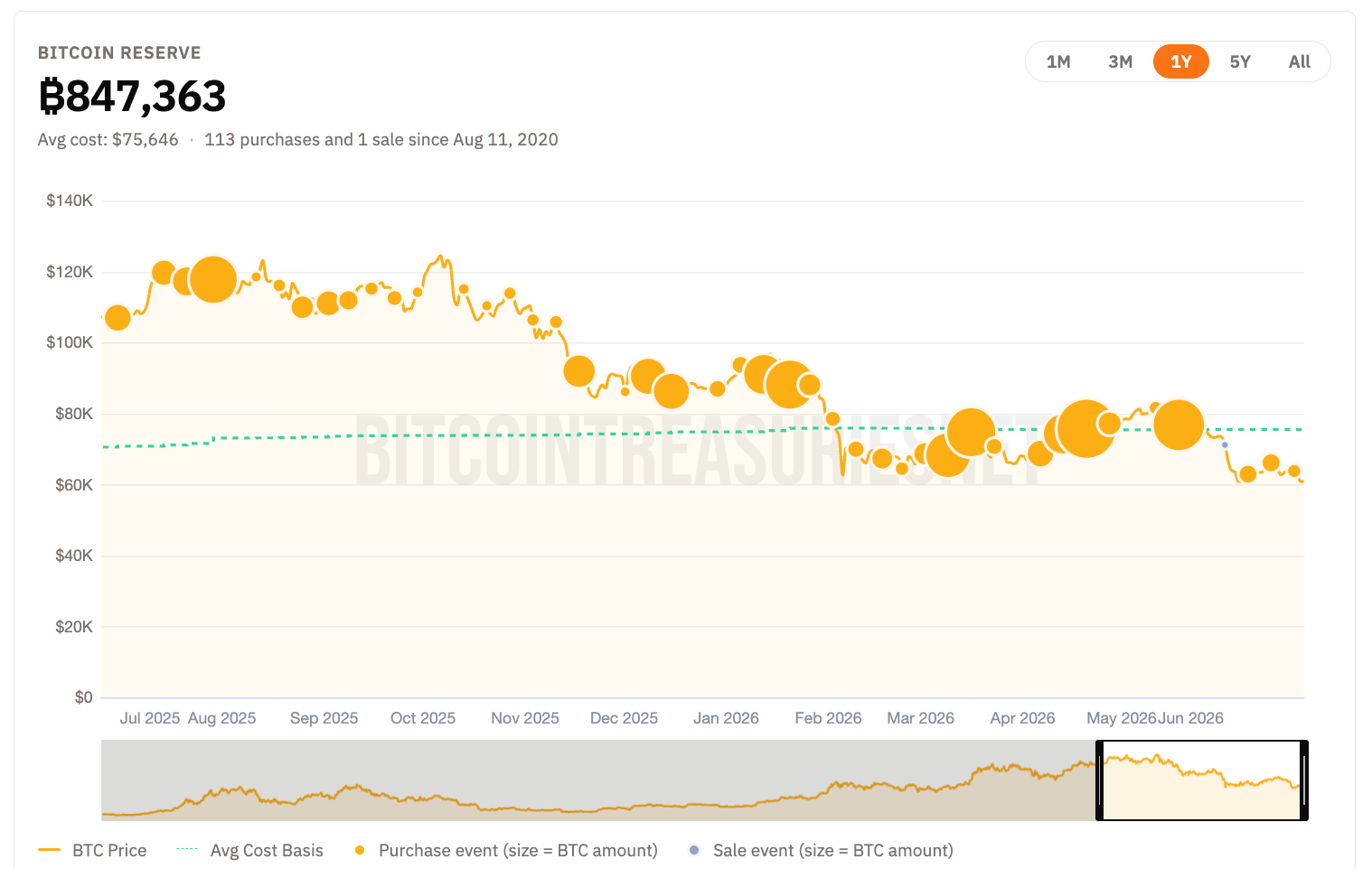
However, the recent STRC price has continued to fall below the target face value range, with the lowest point falling below about $80, a discount of more than 20% from the target face value of $100. This change essentially means the market is beginning to reprice its risk-compensation structure, rather than treating it as a "stable financing tool". Currently, Strategy's total holdings have reached 847,363 BTC, with an average cost of about $75,651. According to the BTC spot price of $61,956 on June 25, its BTC position book loss is about $11.60 billion.
Source: https://bitcointreasuries.net/public-companies/strategy
The price of preferred stock, such as STRC, has fallen. Firstly, it compresses the new financing space by raising the actual financing cost; secondly, it reduces the market's expectation of "continuous expansion ability", thereby directly compressing the premium on mNAV. When mNAV expects contraction, the financing capacity of DAT and the purchasing power of assets will decrease synchronously, forming a negative feedback chain of "financing contraction → reduced buying power → asset decline".
3.2 BitMine: Shrinkage of Profitable Assets Brings Pressure on the Asset Side
If STRC represents "financing pressure", then BitMine represents "asset pressure". BitMine's structure is similar to Strategy, but its underlying assets have shifted from BTC to ETH, making its risk structure more complex. ETH has staking yield, DeFi participation, and ecosystem expansion attributes, making it theoretically an "endogenous source of income". However, it also adds smart contract risk, liquidity risk, staking lock-up risk, and protocol-layer uncertainty. Therefore, ETH Treasury is not a simple "upgraded version of BTC Treasury", but a more complex asset structure with a more complex risk dimension. In the upcycle, this structure is priced as a "yield enhancer", but in the volatility cycle, it will be repriced as a "risk amplifier".
Currently, BitMine holds 5,672,956 ETH, accounting for about 4.7% of the total ETH supply, making it the world's largest ETH corporate treasury. Its average cost is about $3,513. Based on the ETH price of about $1,653 on June 25th, BitMine's ETH holdings have a paper loss of about $10.50 billion.
The core issue of BitMine is not whether to hold ETH, but whether it can continue to create "additional value beyond holding the currency itself". If the market believes that its profitability is limited, then BitMine's valuation will face structural compression: returning from an "actively managed asset carrier" to a "passive ETH exposure tool", and even converging to a closed-end fund at a discount. When the ETH price declines, this problem will be further magnified: the combination of paper losses and income uncertainty will prompt the market to re-evaluate the necessity of holding ETH in the form of stocks.
STRC and BitMine, respectively, reveal the same core issue from the financing and asset ends: the risk of DAT is not a single-point problem but a structural resonance risk. When this mechanism operates smoothly, it manifests as a "structural buyer who continues to acquire crypto assets"; while when the financing capacity and asset price contract at the same time, DAT will shift from a "positive feedback flywheel" to a "negative feedback loop": financing capacity decreases → buying demand declines → asset support weakens → financing premium further contracts, ultimately forming a typical reflexive contraction path, switching the entire structure from expansion logic to defense logic.
IV. DAT Risk Reassessment: From Asset Losses to Structural Constraints
The risk of DAT does not come from price fluctuations themselves, but from the systemic constraints in the relationship between its financing structure and balance sheet.
4.1 Cognitive Correction: DAT Risk Does Not Come from Price Fluctuations
The risk of the DAT model is often misunderstood by the outside world as "cryptocurrency price volatility risk", but this understanding is not accurate. Whether it is the rise and fall of BTC or ETH, it is only a triggering variable, not a decisive factor.
The core issue of DAT is not the direction of asset prices, but whether its capital structure can still sustain the cycle of "financing-buying-repricing". In other words, price fluctuations are only exogenous shocks, and what really determines the system's stability is whether the ability to finance continues to exist.
4.2 Double Constraint Model: Structural Coupling of Asset Drawdown × Financing Contraction
The risk of DAT comes from the synchronous changes of two variables, rather than a single factor: on the one hand, the price retracement of BTC and ETH will directly compress the net asset value, causing mNAV to start contraction; on the other hand, the discount of financing instruments represented by STRC will significantly increase financing costs and weaken the ability to continue expanding the balance sheet.
These two variables do not operate independently but rather exhibit a mutually reinforcing structural coupling: asset declines weaken financing expectations, and financing contraction, in turn, reduces market buying, further suppressing asset prices. Therefore, DAT is not facing linear risk, but a structural problem of "dual variable tightening simultaneously".
4.3 Pricing Mechanism Switch: Risk Narrative Shift Triggered by mNAV Contraction
The market pricing of DAT is not static, but highly dependent on changes in mNAV. When mNAV is in the expansion stage, the market trades on "future financing capabilities" and is willing to give DAT companies a premium; but when mNAV begins to contract, the market's pricing logic will undergo a fundamental shift, shifting from "growth narrative" to "risk narrative".
The core trigger variable for this switch is not the price itself but the expected change in financing capacity: when the market begins to question whether the company can continue to finance at low cost, its valuation anchor shifts from "expansion ability" to "asset safety margin".
4.4 Irreversible Transmission Mechanism: Closed-Loop Feedback from Financing Contraction to Liquidity Fallback
The reason why the risk of DAT is systemic is that its transmission path has self-reinforcing characteristics. Financing side contractions (such as STRC discount) will first weaken the ability to buy new coins, leading to a decrease in market marginal buying; the decrease in buying further suppresses asset price performance, causing further contraction of mNAV; and the contraction of mNAV will, in turn, exacerbate financing difficulties.
This process is not a simple linear conduction, but a typical reflexive closed-loop system. Once in the contraction phase, the structure will not naturally return to the expansion path but tends to continue adjusting downward until a new pricing balance point is found.
Overall, the core issue with DAT does not lie in the assets it holds or the scale of short-term floating losses, but in whether it still has the structural ability to generate liquidity continuously. When financing capacity persists, DAT is a "capital markets crypto asset amplifier"; but when financing capacity contracts, its structural attributes will reverse and gradually evolve into a "liquidity sink". Therefore, the essence of DAT is not an investment target in the traditional sense, but rather a structural liquidity system, with capital markets' financing capacity as the core variable.
V. Future Trends: Cyclical Differentiation and Structural Repricing of DAT
The future evolution of DAT will not develop in a single direction, but will be jointly determined by two core variables.
-
One is mNAV, which determines whether the market is still willing to price "expansion capability".
-
The second is the degree of openness of the financing window, which determines whether DAT can continue to expand the balance sheet at low cost.
When mNAV is in the expansion zone and the financing window is open, DAT enters the forward flywheel stage; when mNAV contracts while the financing window remains open, the system enters the oscillation stage; and when both contract simultaneously, the system enters the reverse contraction cycle. Therefore, the essence of DAT is not a linear growth or decline model, but a cyclical structural system driven by "investor willingness to assign a premium".
5.1 Scenario 1: Flywheel Repair Path (Re-Expansion Driven by Cyclical Rebound)
In the case of a phased rebound in BTC/ETH, DAT's balance sheet will be repaired in tandem, and mNAV is expected to expand again, thereby restoring financing capacity.
In this scenario, preferred stock such as STRC may return to the target face value range, financing costs will decrease, and capital markets will once again be willing to pay a premium for "sustained purchasing capacity".
The essence of this stage is not simply a price rebound, but a structural restart of "financing expectation repair → capital premium return → flywheel restart".
5.2 Scenario 2: Low-Speed Running Path (Structural Stabilization After mNAV Convergence)
If BTC/ETH enters a long-term oscillation range, DAT may not experience severe contraction, but it is also difficult to re-enter a high-premium expansion cycle.
In this state, mNAV will gradually converge towards 1; the company's financing behavior tends to be cautious; the pace of purchasing crypto assets slows; and the asset structure shifts from an "expansion model" to an "asset management mode".
DAT will gradually return from "capital markets crypto asset amplifier" to "listed crypto holding vehicle", and its valuation system will also shift from growth premium to NAV logic.
5.3 Scenario 3: Reverse Flywheel Path (Financing Contraction and Structural Repricing)
When the mNAV remains below 1 and the financing window contracts, the DAT will enter the reverse flywheel phase.
At this stage, the decline in financing capacity first weakens the ability to buy new coins, thereby reducing marginal market demand; once asset prices come under pressure, mNAV is further compressed, worsening financing conditions and thus forming a typical reflexive contraction cycle.
It should be emphasized that this process is not equivalent to "clearing risk" but rather to "capital markets exiting the logic of expansion": the market no longer rewards expansionary behavior and begins to price the stability of the capital structure.
Conclusion: The Essence of DAT Is a Cyclical Liquidity Structure
In short, the core of DAT is not a simple asset-holding structure but a financing-acquisition cycle driven by mNAV. Its essence is to convert the valuation premium of capital markets into a marginal buying source for the cryptocurrency market. In different cycles, this system may manifest as an expansion flywheel, steady-state phase, or reverse contraction, and its key variable is always the market's pricing of "continuous financing capacity".
Therefore, the so-called "end of the cryptocurrency myth" is not a black-and-white conclusion. A more accurate statement is that DAT is transitioning from a narrative-driven stage to a balance sheet stage. In the future, the market will reward not only aggressive balance sheet expansion, but also capital structure resilience, financing discipline, cash reserves, transparent disclosure, and the ability to navigate cycles.
About Us
Hotcoin Research, the core research and investment arm of Hotcoin Exchange, is dedicated to turning professional crypto analysis into actionable strategies. Our three-pillar framework—trend analysis, value discovery, and real-time tracking—combines deep research, multi-angle project evaluation, and continuous market monitoring.
Through our Weekly Insights and In-depth Research Reports, we analyze market dynamics and highlight emerging opportunities. With Hotcoin Selects—our exclusive dual-screening process powered by both AI and human expertise, we help identify high-potential assets while minimizing trial-and-error costs.
We also engage with the community through weekly livestreams, decoding market hot topics, and forecasting key trends. Our goal is to empower investors of all levels to navigate cycles with confidence and capture long-term value on Web3.
Risk Disclaimer
The cryptocurrency market is highly volatile, and all investments carry inherent risks. We strongly encourage investors to remain informed, assess risks thoroughly, and adhere to strict risk management practices to protect their assets.
Connect with Us
Website:https://www.hotcoin.com/en_US/learn/index/
X: x.com/HotcoinAcademy
Email: labs@hotcoin.com
Đề xuất đọc
Xem thêm
Hotcoin Research | AI Ignites the New Engine for DeFi: An Analysis of DeFAI Track Representative Projects and Development Potential
In-depth Research

Hotcoin Research | Awakening the “Sleeping Goldmine” of BTCFi: Babylon Protocol’s Progress and Ecosystem Overview
In-depth Research

Hotcoin Research | Play and Earn Web3: Castile - A New Era of 3A Idle RPG in the Fantasy Cthulhu Universe
In-depth Research

Liên hệ dịch vụ
Service@hotcoin.com
Phản hồi sản phẩm
Product@hotcoin.com
Hợp tác kinh doanh
Business@hotcoin.com
Liên hệ pháp lý
Casecn@hotcoin.com
Về chúng tôi
Phục vụ
hỗ trợ
©2017-2026