
A Quick Guide to the Connection and Difference Between Layer 1 and Layer 2
In blockchain technology, Layer 1 and Layer 2 are two commonly used terms that represent technical solutions at different levels. Each is responsible for distinct functions within the blockchain network, aiming to improve the scalability and efficiency of blockchain systems.
Layer 1: The Foundation Layer
Layer 1 typically refers to the main chain of a blockchain network, forming the foundational layer of a blockchain system. Blockchains like Bitcoin and Ethereum are classic examples of Layer 1 solutions. Layer 1 is responsible for executing core protocol rules, including transaction verification, consensus mechanisms, and data recording. Since Layer 1 handles all on-chain transactions and data, its decentralization and security are critical. However, due to the limited capacity of the main blockchain, Layer 1 has limited scalability; for example, high transaction volumes on Bitcoin and Ethereum networks can lead to congestion and increased fees.
Layer 2: The Expansion Layer
Layer 2 is an expansion solution built on top of Layer 1, designed to alleviate the pressure on Layer 1 by handling certain transactions and computations off-chain, thereby increasing the network’s speed and scalability. Examples of Layer 2 solutions include Bitcoin’s Lightning Network and Ethereum’s Rollups. By moving a large volume of transactions off the main chain, Layer 2 significantly reduces the load on the main chain, and the final transaction results can periodically sync back to Layer 1 to ensure data security and finality. Layer 2 achieves fast, low-cost transactions, providing a better user experience.
The Connection and Difference Between Layer 1 and Layer 2
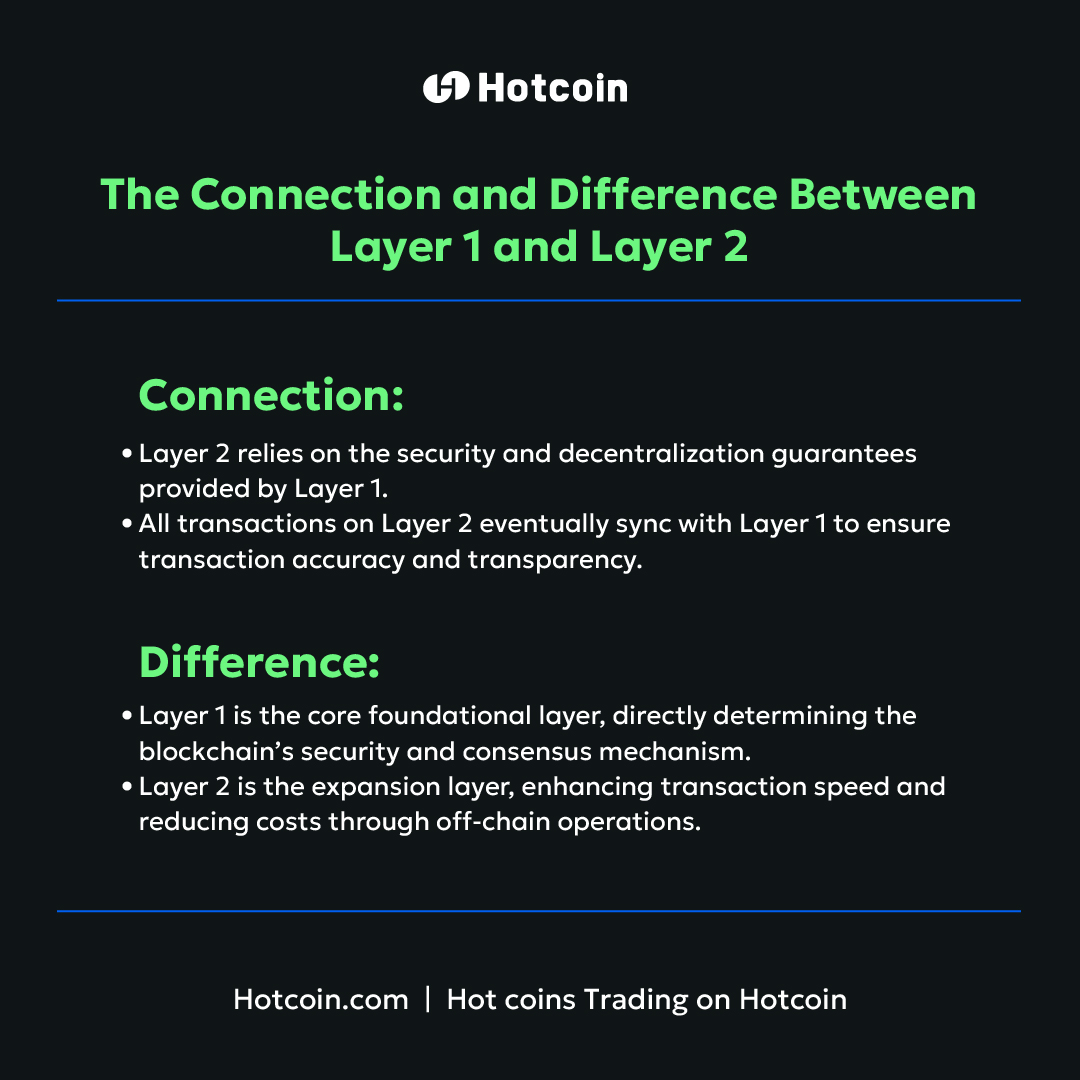
Connection: Layer 2 relies on the security and decentralization guarantees provided by Layer 1. All transactions on Layer 2 eventually sync with Layer 1 to ensure transaction accuracy and transparency. In other words, Layer 1 provides a solid foundation of trust for Layer 2.
Difference: Layer 1 is the core foundational layer, directly determining the blockchain’s security and consensus mechanism, while Layer 2 is the expansion layer, enhancing transaction speed and reducing costs through off-chain operations. Layer 1 processes on-chain transactions, while Layer 2 processes transactions off-chain to more efficiently handle large transaction volumes.
Đề xuất đọc
Xem thêm


Service@hotcoin.com
Product@hotcoin.com
Business@hotcoin.com
Casecn@hotcoin.com