What Is RWA? How Asset Tokenization Works and Key Projects
Blockchain is not only used for cryptocurrencies like Bitcoin; it is also beginning to be applied to traditional financial assets such as U.S. Treasuries, gold, and funds. Through asset tokenization, these real-world assets can be recorded and transferred on the blockchain in the form of digital tokens.
Such applications are commonly referred to as RWA. However, putting assets on-chain does not mean everyone can trade them freely, nor does it mean the risks of the underlying assets disappear.
Key Takeaways
- What RWA is: Real World Assets; in the blockchain space, it usually refers to their tokenized applications.
- Asset tokenization: Representing ownership, income rights, or other legal rights to an asset with blockchain tokens.
- Tokenized U.S. Treasuries: Often provide on-chain U.S. Treasury exposure through fund shares holding U.S. Treasuries or related debt instruments.
- Key projects: BlackRock BUIDL, Franklin Templeton BENJI, and related products from Ondo Finance.
- Main risks: Including underlying asset, issuer, liquidity, smart contract, and legal and compliance risks.
What Is RWA? What Real-World Assets Does It Include?
RWA (Real World Assets) refers to physical or financial assets with economic value that exist outside the blockchain.
In the cryptocurrency space, RWA usually refers to converting the rights corresponding to these assets into blockchain tokens, enabling them to be recorded, held, or transferred through on-chain systems.
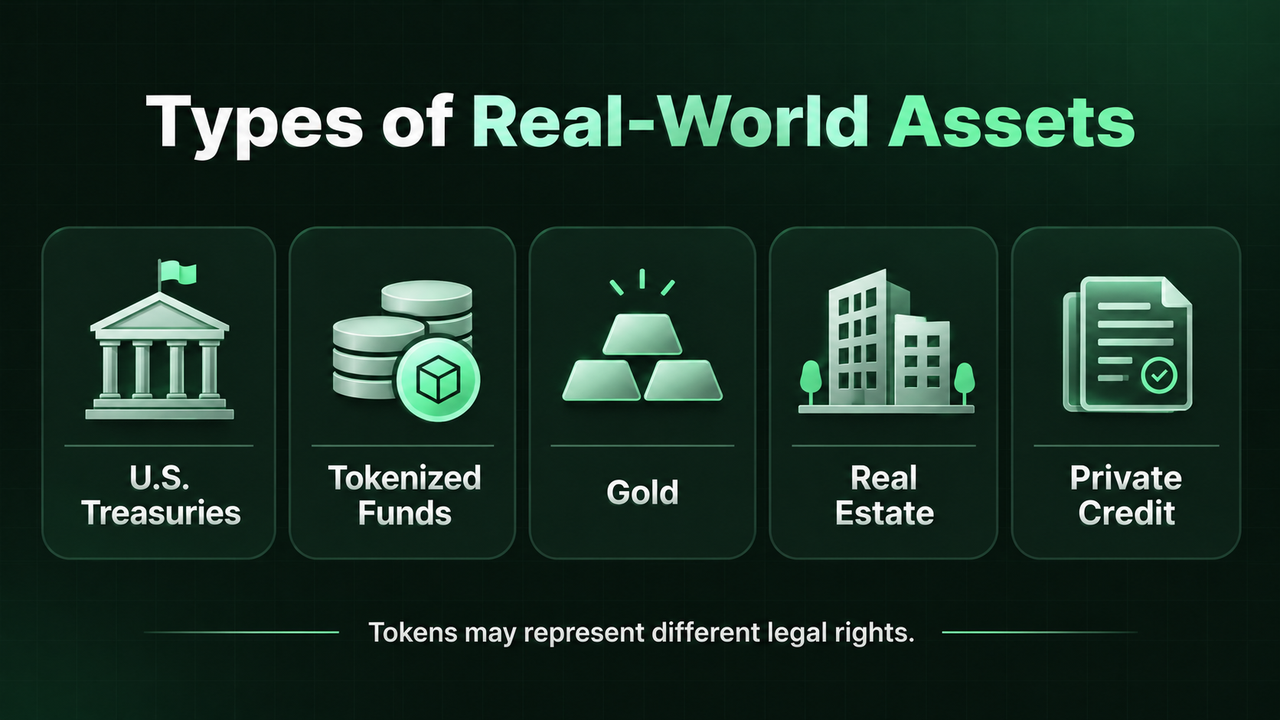
Common types of RWA include:
| Asset Type | Common Tokenization Targets |
|---|---|
| Government bonds | U.S. Treasuries, short-term Treasury bills |
| Funds | Money market funds, investment fund shares |
| Precious metals | Gold and other physical commodities |
| Real estate | Property income rights, investment shares |
| Private credit | Corporate loans, accounts receivable |
Different RWA tokens may represent different legal rights. Some represent fund shares, some represent debt claims, and others may correspond to ownership of specific assets.
Therefore, holding an RWA token does not necessarily mean directly holding its underlying physical asset.
How Does RWA Asset Tokenization Work?
Asset tokenization is the process of representing the relevant rights of real-world assets in the form of digital tokens.
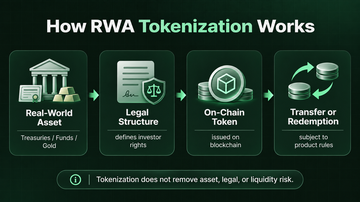
Taking a tokenized fund as an example, it can usually be divided into four steps:
- Determine the underlying asset: Select Treasuries, funds, or other suitable assets and confirm their legal and management structure.
- Establish token rights: Define the rights corresponding to the tokens through the issuer and legal documents.
- Issue on-chain tokens: Use the blockchain to record token issuance, holders, and transfer data.
- Management and redemption: Provide income distribution, transfer, or redemption services according to product rules.
The main value of traditional asset tokenization lies in improving the recording, transfer, and settlement methods of certain assets.
For example, on-chain systems may make it easier for eligible participants to transfer fund shares and may also reduce some manual reconciliation costs.
However, actual efficiency still depends on the issuer, custody arrangements, smart contracts, and legal rules. Tokenization does not mean the asset itself automatically has round-the-clock liquidity.
Further reading Real-World Assets (RWA) in Crypto: What They Are, Tokenization & Risks
What Are Tokenized U.S. Treasuries? How Do They Differ from Traditional U.S. Treasuries?
Tokenized U.S. Treasuries are one of the important applications of RWA.
They usually represent, through blockchain tokens, fund shares holding U.S. Treasuries or debt instruments backed by assets such as short-term U.S. Treasuries, allowing eligible holders to obtain related financial exposure.
Comparison of Tokenized U.S. Treasuries and Traditional U.S. Treasuries
| Comparison Item | Traditional U.S. Treasuries | Tokenized U.S. Treasury Products |
|---|---|---|
| Holding form | Bonds or traditional account records | On-chain tokens or tokenized fund shares |
| Underlying assets | U.S. government debt | U.S. Treasuries, related funds, or other supporting assets |
| Trading method | Through traditional financial institutions | According to the issuance platform and product rules |
| Income source | Bond interest or discount income | According to the underlying assets and product structure |
| Main risks | Interest rates, market prices, etc. | In addition to underlying risks, issuance and technical risks |
Note that some products called "tokenized U.S. Treasuries" actually hold shares of short-term Treasury funds rather than individual U.S. Treasury bonds.
Investors should distinguish between the legal structure of the product itself and the underlying assets, and should not judge its nature based solely on its name.
What Are the Key RWA Projects?
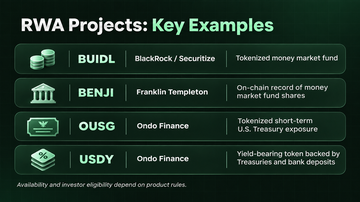
Traditional asset management companies and blockchain financial platforms are already participating in the RWA market. The following are examples of relatively representative financial products:
| Project | Related Institution | Main Features |
|---|---|---|
| BUIDL | BlackRock, Securitize | On-chain tokenized U.S. dollar liquidity fund |
| BENJI | Franklin Templeton | Records money market fund shares on the blockchain |
| OUSG | Ondo Finance | Provides investment exposure related to short-term U.S. Treasuries |
| USDY | Ondo Finance | Yield-bearing token backed by short-term U.S. Treasuries and bank deposits |
BUIDL is a tokenized fund launched by BlackRock, with Securitize providing tokenization-related services.
It allows eligible investors to obtain U.S. dollar-denominated yield exposure through on-chain fund shares and is a representative case of traditional asset management institutions participating in RWA.
Franklin Templeton BENJIx
BENJI is related to the Franklin OnChain U.S. Government Money Fund (FOBXX), with each BENJI token corresponding to one fund share.
Its feature is the use of blockchain technology for recording fund shares and processing some transfers.
Ondo Finance: OUSG and USDY
Ondo Finance provides on-chain financial products with different structures.
OUSG mainly targets qualified investors and provides exposure related to short-term U.S. Treasuries; USDY is a yield-bearing debt token backed by assets such as short-term U.S. Treasuries and bank deposits.
The two are not identical products, and their eligibility, legal structure, and redemption rules also differ.
The above projects are product examples only. They do not mean all investors can purchase them, nor do they constitute investment recommendations.
What Are the Benefits and Risks of RWA?
RWA connects traditional financial assets with the digital financial system through blockchain, but its actual value still needs to be judged from three aspects: efficiency, rights, and risk.
| Potential Benefits | Corresponding Limitations or Risks |
|---|---|
| Improve transparency of asset records | On-chain data may not verify all off-chain assets |
| Improve some transfer and settlement processes | May still be affected by trading restrictions and reviews |
| Provide fractional holding methods for some assets | May not allow free redemption or resale |
| Connect traditional assets with DeFi | Smart contract and platform risks exist |
Common Misconceptions
- "An RWA token equals direct ownership of a physical asset": The specific rights depend on the product's legal structure.
- "Tokenized U.S. Treasuries are completely risk-free": Risks such as interest rate, credit, custody, and liquidity may still exist.
- "RWA can be bought and sold at any time once on-chain": Actual transfer and redemption are still subject to product rules.
RWA FAQ
Q1: Is RWA a cryptocurrency?
RWA itself is a general term for real-world assets. Tokenized RWA uses blockchain tokens to represent related rights, but not all RWA are ordinary cryptocurrencies.
Q2: What is the relationship between RWA and DeFi?
RWA can introduce the rights of some traditional financial assets into on-chain applications, allowing them to be used in scenarios such as trading, payment, or collateral when conditions permit, but not all RWA can be integrated into DeFi.
Q3: Do tokenized U.S. Treasuries generate interest?
Some products provide distributions or value accumulation based on the income of the underlying assets, but the specific method depends on the product structure. Returns are not guaranteed.
Q4: Can RWA tokens be traded freely?
Not necessarily. Some tokens have identity verification, investor eligibility, regional restrictions, or transfer whitelists.
Q5: What are the main risks of RWA?
In addition to the price and credit risks of the underlying assets, issuer, legal rights, asset custody, liquidity, and smart contract security also need to be considered.
Conclusion
Through asset tokenization, RWA enables the relevant rights of real-world assets such as U.S. Treasuries, funds, and gold to be recorded and circulated on the blockchain.
BUIDL, BENJI, and related products from Ondo Finance demonstrate different ways of combining traditional finance with on-chain systems. However, tokenization does not eliminate asset risks. Understanding the underlying assets, legal structure, and redemption conditions remains an important foundation for understanding RWA.
Risk Warning: This article is for informational and educational purposes only and does not constitute investment advice. RWA products may involve market, legal, liquidity, and smart contract risks. Specific rules should be subject to the documents published by the issuer.
Leitura recomendada
Veja mais