Hardware Wallet vs. Cold Wallet vs. Paper Wallet: Which Is Safest?
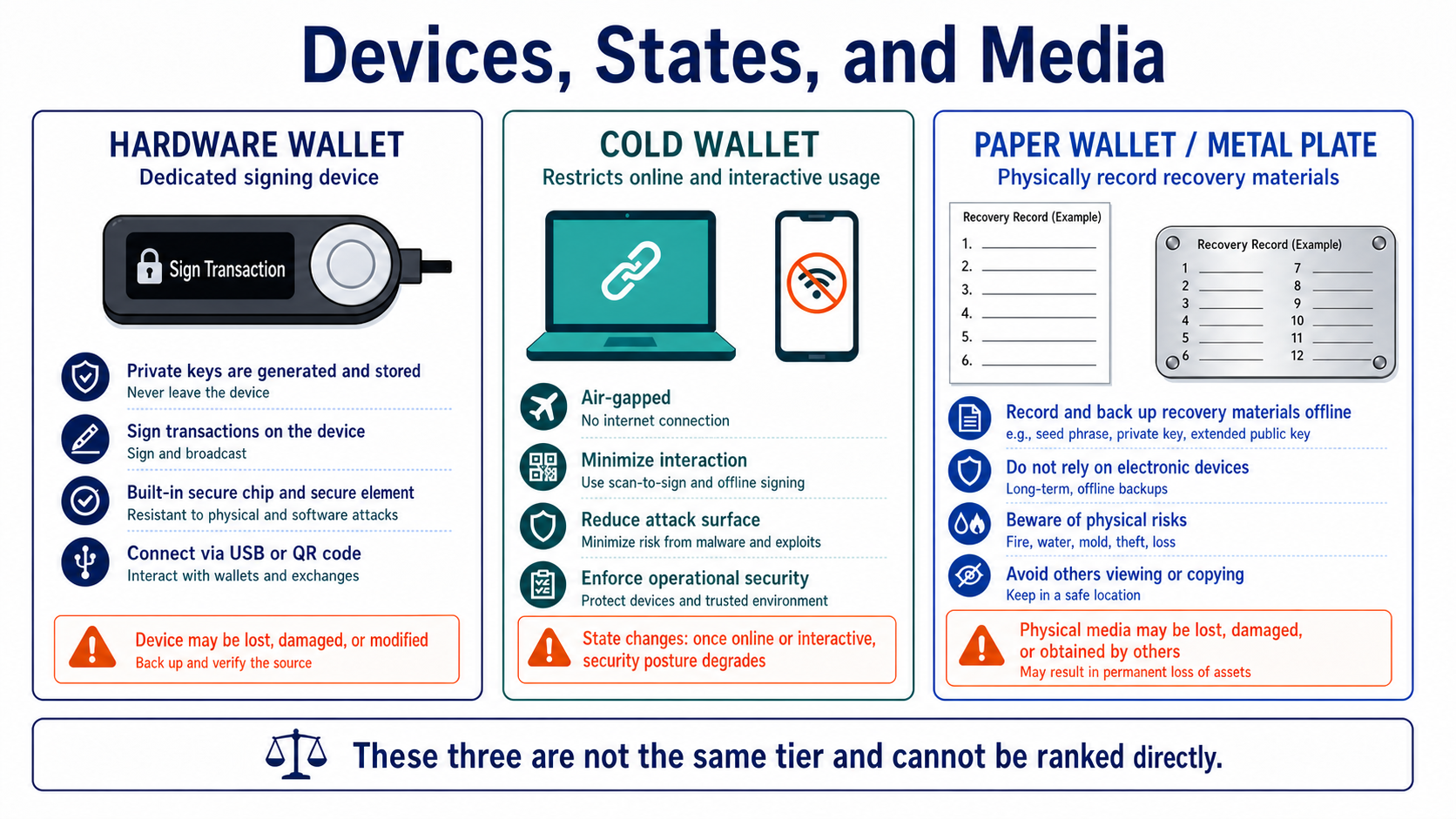
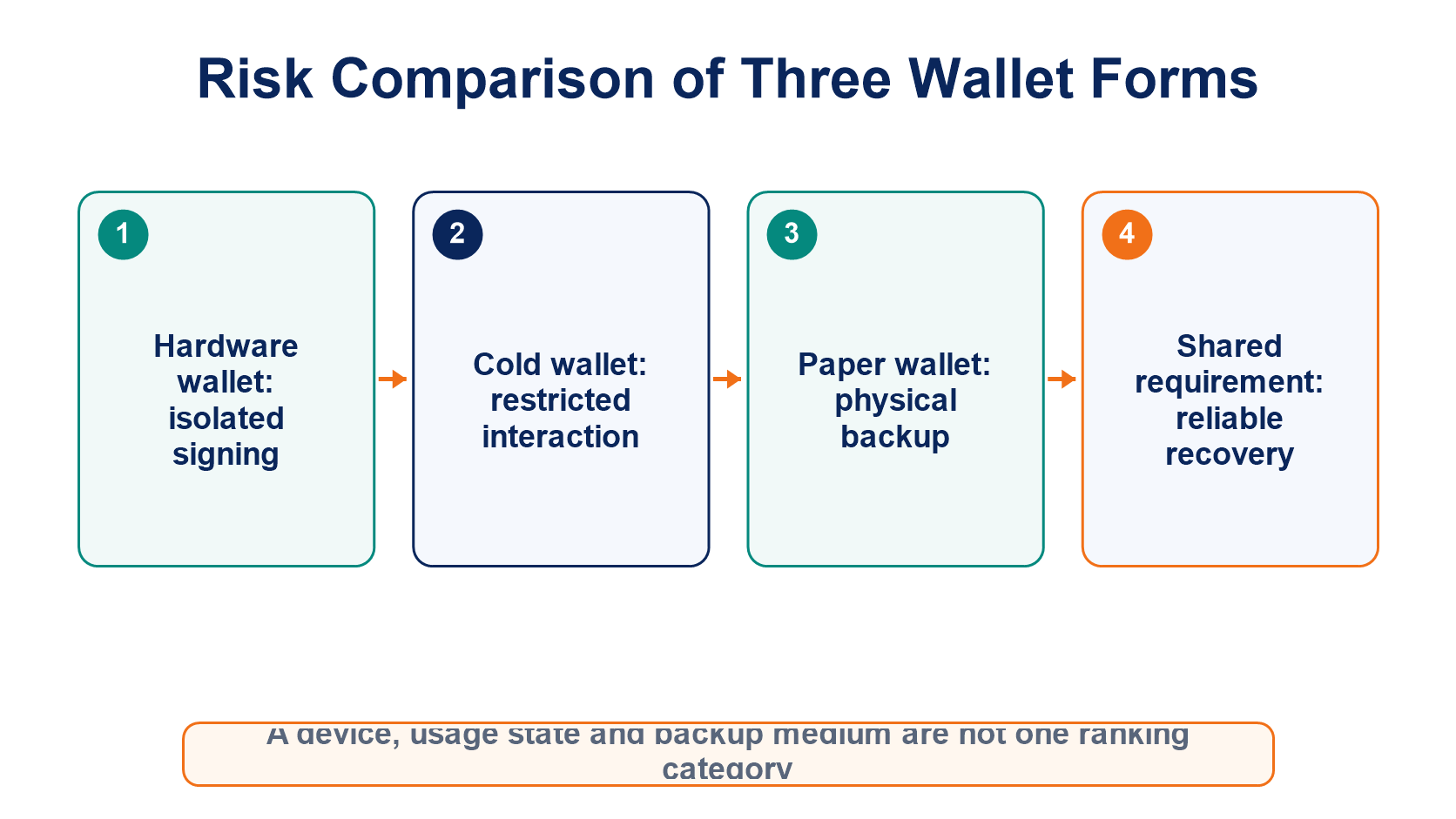
A hardware wallet is a signing device, a cold wallet describes a setup in which private keys remain offline, and a paper wallet is a physical medium used to record a key or backup. These terms refer to different layers of wallet security, so they cannot be ranked by name alone.
Why Isn't a Hardware Wallet Always a Cold Wallet?
A hardware device keeps private keys inside the device. However, if it is frequently connected to unfamiliar DApps or used to sign token approvals and complex smart-contract transactions, it functions as a hardware-protected interactive wallet rather than strict cold storage intended only for occasional transfers.
The defining feature of a cold wallet is operational isolation. Cold storage can use a hardware device, an offline computer, or another dedicated signing system. Whether a wallet is truly cold depends on how its keys and signing process are handled, not on the product label.
What Makes Paper Wallets Different?
Paper can hold a single private key, a QR code, or a seed phrase. It cannot be hacked remotely by itself, but security can still be compromised by the generation environment, printer caches, cameras, fire, water damage, fading ink, or transcription errors.
Early single-address paper wallets also created risks when users mishandled change while spending. For most modern users, paper or metal is better used as a verified backup medium for a standard wallet than as a way to generate a standalone private key from a website.
Choose Based on the Use Case
| Use case | More suitable approach | Main considerations |
|---|---|---|
| Frequent on-chain activity | A small-balance software wallet or interactive hardware wallet | Approvals, malicious contracts, and device security |
| Long-term personal storage | A dedicated hardware cold account with an offline backup | Recovery testing, passphrases, and inheritance |
| Team treasury | Multisig or policy-based institutional custody | Thresholds, signer independence, and modules |
| Disaster recovery | Standard recovery data recorded on paper or metal | Theft protection, durability, location, and access control |
The safest solution is the one that fits your threat model and operational ability. A complex system that has never been recovery-tested can be more dangerous than a simple setup operated correctly.
For selecting and initializing a device, read the hardware wallet guide. For an overview of how wallet credentials relate to one another, see private keys and seed phrases.
Frequently Asked Questions
Does Unplugging a Hardware Wallet Automatically Make It a Cold Wallet?
Not necessarily. You must also consider whether its seed phrase has ever been exposed, whether dangerous approvals remain active, and how future transactions will be signed.
Is a Metal Seed Phrase Plate a Hardware Wallet?
No. It is a durable backup medium and cannot generate keys or sign transactions by itself.
Is an Offline Paper Wallet Completely Risk-Free?
No. Risks still exist during generation and printing, as well as from physical damage, theft, and recovery mistakes.
Can a Cold Wallet Receive Tokens and NFTs?
Its address can receive them, but there is no need to interact with unsolicited assets. Whether you can view and safely spend supported assets depends on the recovery tools and network compatibility.
Leitura recomendada
Veja mais