
Ponzi and Pyramid Schemes: The Math Behind High-Return Promises
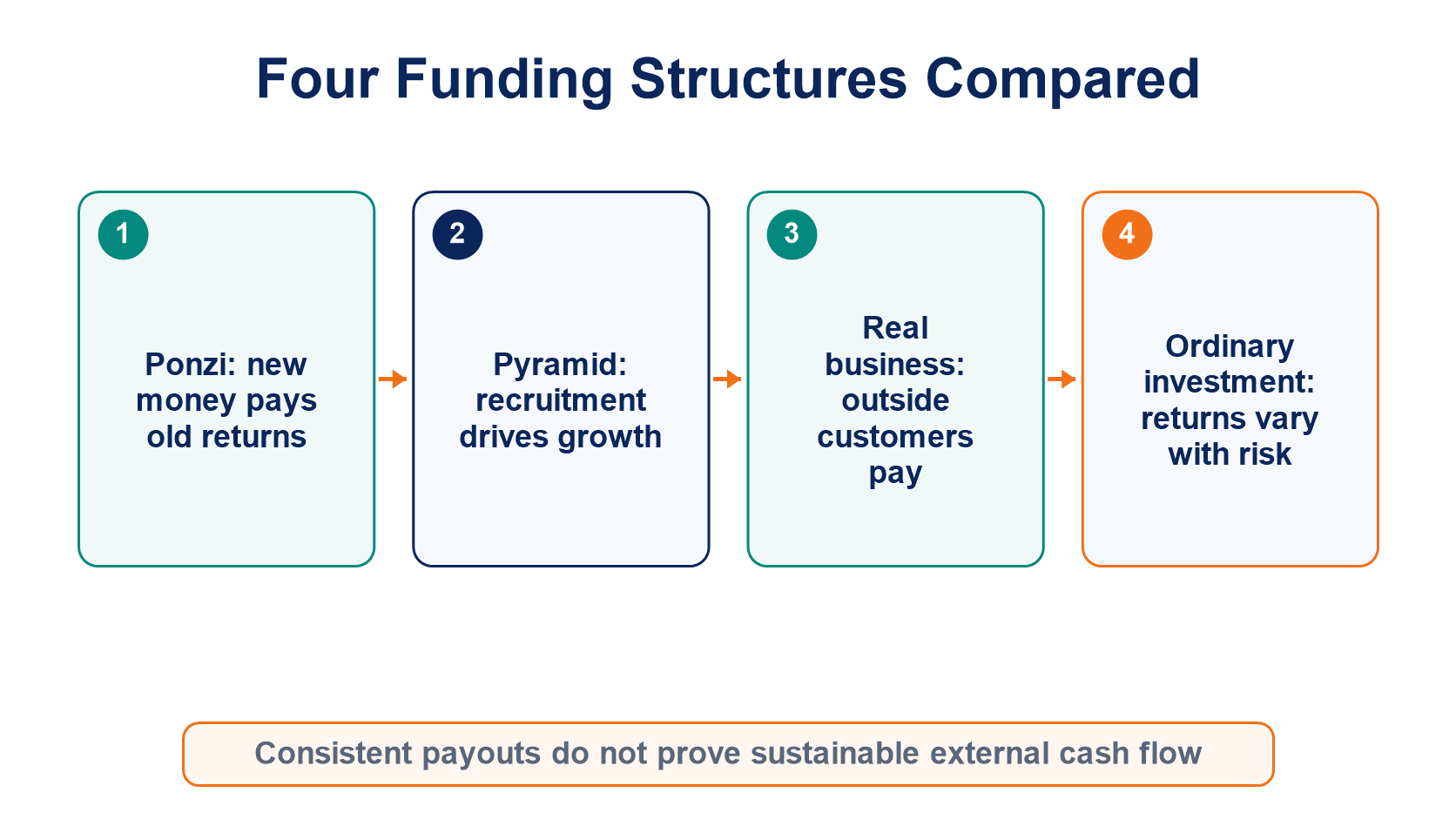
A Ponzi scheme uses money from later participants to pay earlier investors their supposed "returns," while a pyramid scheme depends on members continually recruiting people beneath them. Neither has enough external cash flow to cover its promises, so the structure fails once expansion stops.
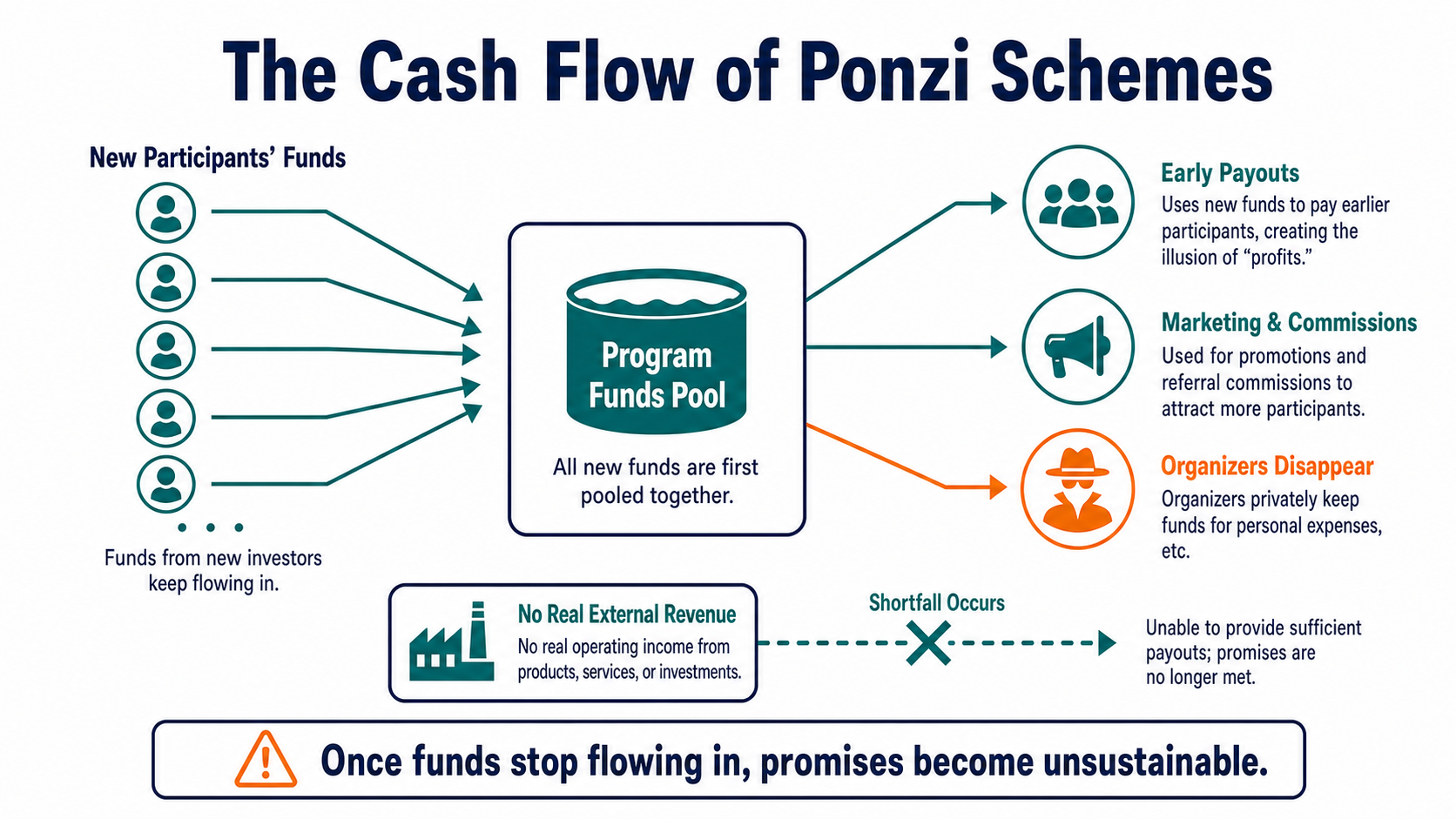
What Is the Difference Between a Ponzi Scheme and a Pyramid Scheme?
In a Ponzi scheme, an organizer generally collects money centrally and fabricates returns from investments, arbitrage, quantitative trading, mining, or another claimed strategy. Participants do not necessarily have to recruit others, but the system must keep attracting new money.
A pyramid scheme builds recruitment directly into its reward rules. Members pay to join and earn commissions by developing a downline. If every person must recruit b newcomers, level n requires b^n people. That demand grows exponentially and cannot continue indefinitely.
Real-world fraudulent programs often combine both structures: they promise fixed returns, offer referral rewards, and use rising token prices to conceal a cash shortfall.
How Can You Check Where the Returns Come From?
Start by asking who pays for the service and whether its revenue can be verified through independent information. Legitimate businesses can also lose money and experience volatility. If a platform shows only internal reports, team turnover, and on-chain deposits but no revenue from external customers, the claimed returns may simply be redistributed participant funds.
A high return alone does not prove fraud. However, promises such as "principal guaranteed," "stable returns," or "risk-free," combined with a refusal to explain the strategy, accounting only in an internal token, or constant pressure to reinvest, are warning signs that should be assessed together.
Why Do Withdrawals Become Increasingly Restricted?
When incoming funds slow down, a platform may extend review times, impose limits, encourage lockups, or demand additional fees. Organizers may launch a new package, migrate to another platform, or issue a new token, converting old liabilities into internal balances that cannot be redeemed.
One successful withdrawal does not prove long-term sustainability. What matters is the source of funds and the responsible legal entity, not whether you happened to receive a payout temporarily.
How Can Participants Avoid Increasing Their Losses?
Do not deposit more money or recruit friends and family in order to "unlock" your principal. Preserve contracts, promotional materials, chats, transfer records, wallet addresses, and failed-withdrawal evidence, and contact the appropriate law-enforcement, regulatory, or legal channels in your jurisdiction as soon as possible.
When discussing the risk with friends and family, focus on verifiable cash flow and withdrawal conditions instead of arguing only about the project's name. For a broader classification of scams, return to the complete guide to cryptocurrency scams.
Frequently Asked Questions
If a Project Pays Returns On-Chain Every Day, Does That Mean It Is Not a Ponzi Scheme?
No. Automated on-chain distributions prove only that a contract executes; they do not prove that returns come from sustainable external revenue.
Does Continued Growth in Participant Numbers Prove That a Project Is Healthy?
No. A structure that depends on newcomers looks most successful while it is growing. The real question is who will meet its earlier promises once growth stops.
Is a Platform Trustworthy If It Has a Physical Office and Celebrity Endorsements?
Neither replaces verification of the legal entity, finances, licenses, use of funds, and withdrawal obligations.
Is There No Legal Risk If I Recover Only My Principal and Take No Returns?
Rules and case handling differ by jurisdiction. The source of payments, recruitment activity, and the participant's level of knowledge may all affect liability, so consult a qualified local professional.
Leitura recomendada
Veja mais