NVIDIA (NVDA) Stock Price | Live Chart, Market Cap and FAQs
People searching for “NVDA stock price” usually want to confirm which businesses NVIDIA earns money from, how large data center revenue is, and how to read the market cap; they also need to separate reported results from guidance or newly announced management changes.
NVDA is the ticker for NVIDIA Corporation’s common stock listed on Nasdaq. The live chart and market cap on this page should come from the latest market feed and will change with trading; a single moment’s figures should not be treated as a long-term conclusion.
When reading this stock, use the segment and market-platform definitions in the company’s latest financial report, rather than the old business categories that are no longer separately reported.
Key takeaways
- NVDA is the ticker for NVIDIA’s common stock on Nasdaq; the company is headquartered in Santa Clara, California, and its fiscal year usually ends in late January.
- Under the latest definition in FY2027 Q2, the reportable segments are Compute & Networking and Graphics; the company also reports revenue by two market platforms, Data Center and Edge Computing.
- According to the company’s November 12, 2026 announcement and the Form 8-K filed the same day, the board accepted Jensen Huang’s resignation as President, CEO and director on November 11, effective immediately; CFO Colette Kress is now interim CEO.
- FY2027 Q3 ended on October 25, 2026, and the company has scheduled results for November 17; before release, Q2 guidance must not be treated as realized results.
- The live chart reflects exchange trading; regular hours are 9:30–16:00 New York time, and pre-market or after-hours prices are not official closing prices.
- Market cap is generally estimated as “share price × shares outstanding”; it is not cash on the company’s balance sheet and does not mean all shares could be sold at the displayed price.
What is NVIDIA? Where is NVDA listed?
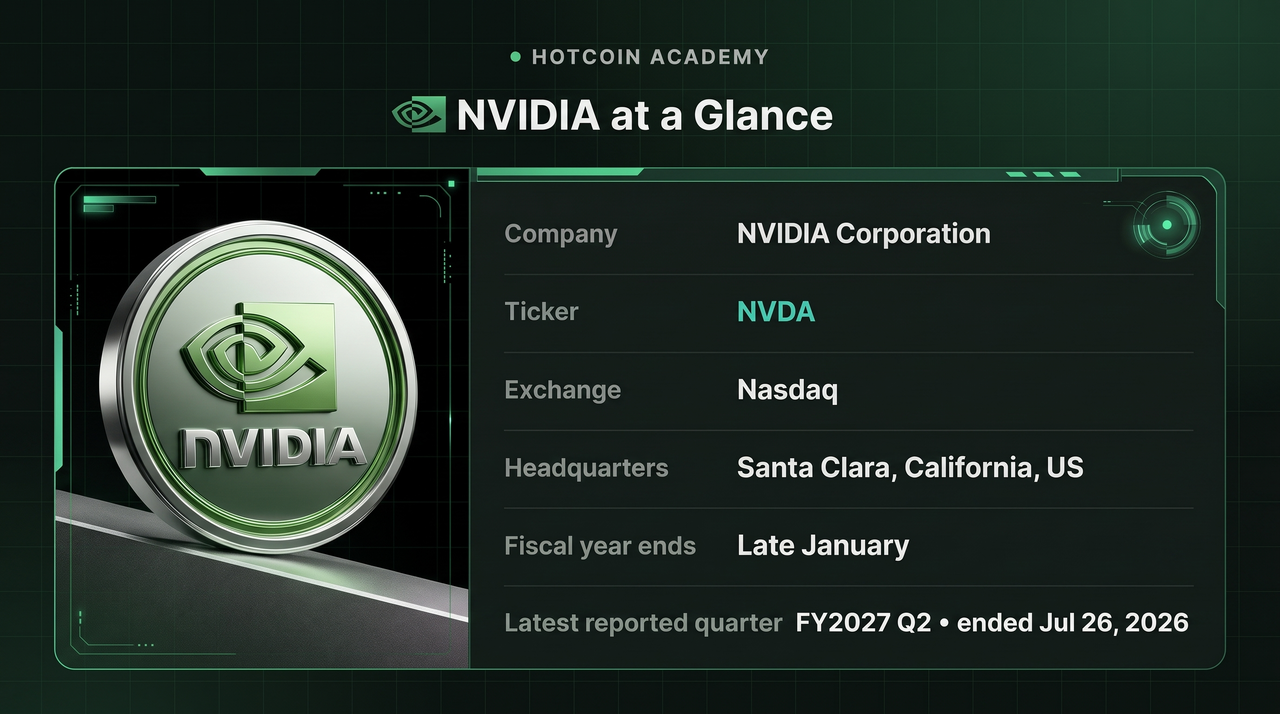
NVIDIA is a semiconductor and computing platform company headquartered in Santa Clara, California. Its products cover accelerated computing, data center systems, networking, graphics computing and related software. The stock is listed on Nasdaq under the ticker NVDA. The company’s fiscal year ends around the last Sunday of January; the exact date is subject to the current report.
| Item | Details |
|---|---|
| Company name | NVIDIA Corporation |
| Ticker | NVDA |
| Exchange | Nasdaq |
| Headquarters | Santa Clara, California, US |
| Fiscal year end | Late January |
| Latest reported quarter | FY2027 Q2, ended July 26, 2026 |
According to the FY2027 second-quarter results announcement published on NVIDIA’s investor relations website on August 26, 2026, quarterly revenue was $96.221 billion, up 106% year over year; GAAP operating income was $63.734 billion, GAAP net income was $59.688 billion, and diluted EPS was $2.46. These figures come from the company’s published announcement and will be updated in later quarters; please refer to the latest filings.
FY2027 Q3 results have not been published as realized results. Recent public management changes, the results schedule and the guidance given in the Q2 announcement are covered in the next section.
What recent public information should be read first?
As of the public documents on which this article is based, there are two matters formally disclosed by the company that are easy to mix up with reported financial figures.
First, the management change. According to NVIDIA’s management transition announcement on November 12, 2026, and the Form 8-K filed with the U.S. Securities and Exchange Commission the same day: the board accepted Jensen Huang’s (also written Jen-Hsun Huang in official documents) resignation as President, CEO and director on November 11, 2026, effective immediately; it appointed current Executive Vice President and CFO Colette Kress as interim CEO. She will continue as CFO while the company searches for a permanent successor. The board has begun a formal CEO search that will consider both internal and external candidates. On the same day, the board appointed Harvey C. Jones as Chair of the Board; the company said this is the first time it has created the role of board chair. Neither the official announcement nor the Form 8-K stated a reason for the resignation. The company also said third-quarter results would still be released on the originally scheduled date.
Second, FY2027 Q3 results have not been published as realized results. According to NVIDIA’s conference-call scheduling announcement on October 28, 2026, the quarter ended on October 25, 2026; the company plans to release results on November 17, 2026 at about 13:20 Pacific Time and hold a conference call at 14:00 Pacific Time (17:00 Eastern Time). Under U.S. winter time, this corresponds to about 5:20 and 6:00 Beijing time on November 18. Before release, Q2 guidance must not be treated as realized financial results.
In its second-quarter results announcement on August 26, 2026, the company’s guidance for the third quarter was: revenue expected to be $108.0 billion, plus or minus 2%; GAAP and non-GAAP gross margins expected to be 74.0%, plus or minus 50 basis points. The outlook explicitly excludes data center computing product revenue from China. Guidance is not realized performance; actual results are subject to company announcements on and after November 17.
Which businesses does NVIDIA earn money from now?
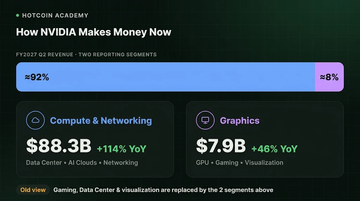
When reading NVIDIA’s revenue structure, look at two latest definitions at the same time. Both sum to quarterly revenue of $96.221 billion, but they divide the business differently.
First, reportable segments, from the same-period CFO commentary:
| Reportable segment | FY2027 Q2 revenue | Year over year |
|---|---|---|
| Compute & Networking | $88.299 billion | Up 114% |
| Graphics | $7.922 billion | Up 46% |
Second, the market-platform view. The company says its platforms primarily serve two large markets, Data Center and Edge Computing:
| Market platform | FY2027 Q2 revenue | Year over year |
|---|---|---|
| Data Center | $89.023 billion | Up 117% |
| Of which: Hyperscale | $48.710 billion | Up 102% |
| Of which: AI Clouds, Industrial, & Enterprise (ACIE) | $40.313 billion | Up 138% |
| Edge Computing | $7.198 billion | Up 27% |
The company mainly attributed data center revenue growth to Blackwell Ultra infrastructure shipments; edge computing revenue growth mainly came from Blackwell workstation sales, partly offset by slower consumer PC demand. Data Center Hopper products sold to China accounted for less than 1% of data center revenue in the quarter. The company also noted that it reclassified one customer from ACIE to Hyperscale in the quarter and restated prior-period figures under the new definition, so historical comparisons should check whether the definitions are consistent.
The old “Gaming, Professional Visualization, Automotive, OEM & Other” categories are no longer the basis on which this latest report presents segment revenue. When reading third-party quotes or company profiles, note that some pages may still describe the company by gaming, professional visualization, data center and automotive markets; that is an application-market description or an old reporting convention. When discussing the current revenue structure, use the Compute & Networking and Graphics segments and the Data Center and Edge Computing platforms. These figures help explain revenue concentration and cannot be directly converted into a “fair share price.”
How should I read NVDA’s live chart?
The live chart on a quote page comes from securities-market trading. Read it in these steps:
- Confirm the trading session first: U.S. regular trading hours are 9:30 to 16:00 New York time. The corresponding Beijing time differs by 12 or 13 hours depending on daylight saving time; use the time zone shown on the page.
- Distinguish the latest price from the closing price: the latest price is the most recent trade. Percentage moves are usually calculated against the previous trading day’s official close. Pre-market and after-hours liquidity is often thin, so those prices are not confirmed closing results.
- Consider volume and the day’s high and low: NVIDIA draws high attention and is volatile; a large single-day range alone does not prove a trend has formed.
- Compare with the latest reporting definitions, not old categories: when you see discussions such as “data center share,” go back to the current reportable segments or market-platform figures rather than treating outdated business categories as the current structure.
- Use the page’s live data: this article does not hard-code a share price, percentage move or market cap for any moment.
How should market cap be read?
Market cap is generally estimated as follows:
Market cap ≈ current share price × shares outstanding
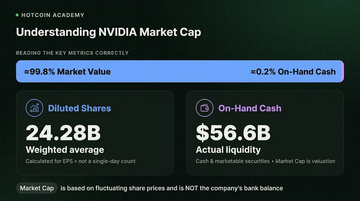
The share-count basis is subject to the quote page’s explanation. NVIDIA reported in its quarterly results that the weighted average diluted share count used to calculate diluted EPS was about 24.285 billion shares; that is the period average, not the shares outstanding at a single day’s close. The company returned about $26 billion to shareholders through buybacks and cash dividends in the quarter; buybacks reduce the share count, so use the figure the page uses at the time.
When reading market cap, remember: it is not cash on the company’s balance sheet, nor is it the amount that would be received by selling all shares at once at the displayed price. At the end of the quarter, cash, cash equivalents and marketable securities were $56.6 billion, which is not the same concept as a market cap calculated from the share price.
Common misconceptions
- “NVIDIA is still a gaming-card, professional-visualization and automotive business”: that is an outdated reporting approach. The latest report’s segments are Compute & Networking and Graphics, while market platforms are Data Center and Edge Computing.
- “High data center revenue means the stock must rise”: data center does account for most quarterly revenue, but the share price is also affected by supply, customer capex, export controls, valuation and risk appetite; revenue structure alone is not a buy or sell basis.
- “The latest price I see is today’s official close”: only the official close after the regular session is normally the benchmark for daily moves.
- “The Q3 guidance given with Q2 is already realized performance”: it was only guidance at the time, not published Q3 results; actual figures must wait for company announcements on and after November 17.
FAQs
Q1: On which exchange is NVDA listed? NVDA is the ticker for NVIDIA Corporation’s common stock on Nasdaq; the company is headquartered in Santa Clara, California.
Q2: What businesses does NVIDIA mainly have now? Under the latest definition in FY2027 Q2, the reportable segments are Compute & Networking and Graphics, with quarterly revenue of $88.299 billion and $7.922 billion, respectively. The company also reports revenue by two market platforms, Data Center and Edge Computing, at $89.023 billion and $7.198 billion, respectively; refer to the latest financial report.
Q3: How is NVDA’s market cap calculated? Generally, current share price multiplied by shares outstanding. The weighted average share count in financial reports is used for EPS and may not equal the share count used on a quote page at a given moment; use the page display.
Q4: Do pre-market or after-hours NVDA prices count as official closing prices? No. The official closing price generally corresponds to the end of regular trading; extended-hours prices are a separate session.
Q5: Can the share price alone tell whether NVIDIA is expensive? No. The share price does not include information such as share count, segment structure and margins, and cannot alone be a buy or sell basis.
Q6: Is Jensen Huang still NVIDIA’s CEO? According to the company’s November 12, 2026 announcement and the Form 8-K filed the same day, the board accepted his resignation as President, CEO and director on November 11, effective immediately; CFO Colette Kress is now interim CEO and continues as CFO while a permanent successor is sought.
Q7: Have FY2027 Q3 results been published? As of the public documents on which this article is based, they have not been published as realized results. The company has scheduled release for November 17, 2026; actual figures are subject to company announcements at and after that time. Before release, Q2 guidance must not be treated as realized performance.
Conclusion
NVDA is the ticker for NVIDIA’s stock on Nasdaq. When looking at this stock, first use the latest published report to separate the reportable-segment and market-platform definitions, note the announced management change and the not-yet-published Q3 schedule, then return to the quote page to read the live price and market cap. These figures change with the market, share count and later announcements; rely on the page’s live display and the company’s latest announcements.
If you also want to distinguish what “price” and “market cap” each explain and do not explain, you can start with What are market cap, circulating supply and fully diluted valuation (FDV)?.
Risk notice: This article is for educational and informational purposes only and does not constitute investment advice or a buy/sell recommendation. Financial figures come from the company’s published reports or results announcements and may be updated by later filings. NVIDIA’s share price is highly volatile and may cause partial or total loss of principal. Please rely on the company’s latest announcements and the live data on your page, and make decisions carefully according to your own risk tolerance.
Leitura recomendada
Veja mais